20 Sep 2018 | News
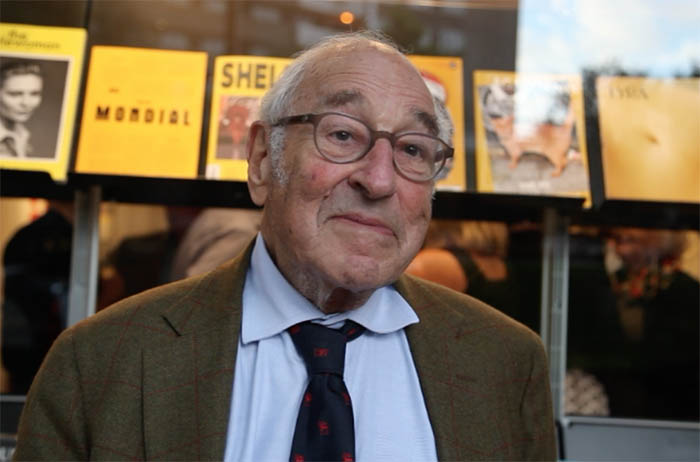
Louis Blom-Cooper at the launch of the 250th issue of Index on Censorship magazine at MagCulture, London, July 2016
Index on Censorship is deeply saddened by the news that Louis Blom-Cooper, one of the earliest supporters of our organisation, has passed away. The lawyer, human rights defender, free speech advocate and journalist died Wednesday at the age of 92.
Born in London in 1926, Blom-Cooper was called to the bar in 1952, where he championed and helped secure prisoners’ rights and campaigned against the death penalty. Doughty Street Chambers, the human rights firm that he later spent many years working at, said in a tribute to Blom-Cooper at his 90th birthday:
“It was he who first challenged the mandatory death penalty throughout the Commonwealth, raising arguments decades before they came to be accepted by the Privy Council.”
In 1961 he helped found Amnesty by supporting an appeal for amnesty for political prisoners and getting this appeal publicised in the Observer. Then, in the 1970s he became involved in the establishment of Index. For the 250 issue of Index on Censorship magazine, published in 2016, Blom-Cooper wrote about why he initially became involved with the organisation and why it is still needed today. He said:
“If one views the current scene of censorship, whether it be self-censorship or state intervention on individual speech, one is struck by its intrusion elsewhere – in universities and other paragons of human knowledge. There is much to be concerned about. The ambit of freedom of speech, which may be qualified by other public interests, needs close examination and protection from other interests that do not apply as qualifications of the proposed rights. It is a core function of Index to scrutinise the scope of Article 10 of the convention. At a time when the convention is under threat of extinction (as some ministers aver) or modification by a domestic bill of rights (as other ministers might claim) vigilance is called for. The road is clearly marked ahead, without any diversionary influence that smacks of authoritarianism.”
He also attended the London launch of the issue, where he gave an emotive speech about still being involved with Index decades later. Watch the clip here.
Unsurprisingly, Blom-Cooper was known fondly for his fierce intellect and love of debate and in this first article for Index on Censorship magazine, published in 1977, these qualities shine. Here he has a fruitful back-and-forth with the philosopher and critic Stuart Hampshire about the exact definition of the word “censorship”.
Blom-Cooper, who was former chair of the Press Council, was not just an ardent defender of free speech but an ardent defender of the freedom of the press. In 1992, he wrote in the magazine about the future of press regulation in Britain.
He was later interviewed for the Index website on the Leveson Inquiry.
Blom-Cooper was also independent commissioner for holding centres in Northern Ireland and wrote this article in the magazine in 1997.
Jodie Ginsberg, CEO of Index on Censorship, said: “I had the privilege to meet Louis Blom-Cooper when I first started at Index and was inspired by his still unstinting commitment to freedom of expression and the need to tackle censorship worldwide. We strive daily to defend the freedoms that he believed to be so important in creating a better society.”
Click here for more information on the founding of Index on Censorship.
1 Mar 2018 | Campaigns -- Featured, Statements
[vc_row][vc_column][vc_column_text]Index on Censorship welcomes the announcement by Secretary of State Matthew Hancock that the government will not implement Section 40 of the Crime and Courts Act 2013.
Implementing Section 40 would have meant that Index, which refuses to sign up to a state-backed regulator – and many other small publishers – could have faced crippling court costs in any dispute, whether they won or lost a case. This would have threatened investigative journalists publishing important public interest stories as well as those who challenge the powerful or the wealthy.
We have argued consistently that Section 40 is a direct threat to press freedom in the UK and must be scrapped. This part of the act, created as a response to the Leveson Inquiry into phone hacking, has been on the statute for several years but was not enacted because — until 2016 — there was no approved regulator of which publishers could be part. [/vc_column_text][/vc_column][/vc_row][vc_row][vc_column][vc_custom_heading text=”Don’t lose your voice. Stay informed.” use_theme_fonts=”yes”][vc_separator color=”black”][vc_row_inner][vc_column_inner width=”1/2″][vc_column_text]Index on Censorship is a nonprofit that campaigns for and defends free expression worldwide. We publish work by censored writers and artists, promote debate, and monitor threats to free speech. We believe that everyone should be free to express themselves without fear of harm or persecution – no matter what their views.
Join our mailing list (or follow us on Twitter or Facebook) and we’ll send you our weekly newsletter about our activities defending free speech. We won’t share your personal information with anyone outside Index.[/vc_column_text][/vc_column_inner][vc_column_inner width=”1/2″][gravityform id=”20″ title=”false” description=”false” ajax=”false”][/vc_column_inner][/vc_row_inner][vc_separator color=”black”][/vc_column][/vc_row][vc_row][vc_column][vc_basic_grid post_type=”post” max_items=”4″ element_width=”6″ grid_id=”vc_gid:1519906042363-4bc2dd22-cabf-7″ taxonomies=”6534″][/vc_column][/vc_row]
9 Jan 2017 | Media Freedom, News
[vc_row][vc_column][vc_column_text]
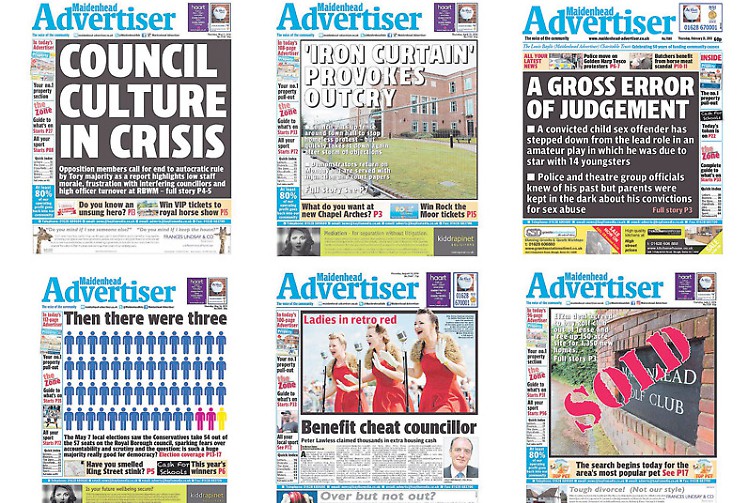
Small publishers and local newspapers like the Maidenhead Advertiser could be targeted if Section 40 is implemented.
Local newspapers have an extremely important role in shining a light on corruption, danger and crime in their communities. This is not a job likely to be picked up by anyone else should those newspapers close. They do this in an increasingly difficult financial environment.
They report on court cases, the costs of local services and interrogate local officials. Once our local press dies that these essentials will probably go unreported.
The public should be aware that today is the last day that they can make clear to the government that Section 40 of the Crime and Courts Act 2013 is not acceptable in a modern democracy that believes in a free press. This is a bizarre law that punishes truthful reporting by making newspapers and magazines of all sizes and shapes pay the legal costs of a law suit that proves that their reporting is accurate and should not be given a place in our legal system.
This could have extremely dangerous effect on our local newspapers that’s why so many local newspaper editors have spoken about their fears for the future if Section 40 is triggered.
Here’s how some local newspapers have responded to Section 40.
“Section 40 of the Crime and Courts Act is an obscure piece of legislation for the public, but its implementation could force newspapers and magazines to pay both sides’ costs in privacy and libel cases, even if they successfully defend a legal action by showing their reporting was accurate and publication was in the public interest.
“A government consultation, which closes on Tuesday, is seeking opinions on whether or not to put costs orders under Section 40 into operation.
“This flies in the face of fundamental rights of the freedom of the press, freedom of expression, the public’s right to receive information, and the first principle of justice – that it should be fair.”
Read the full Cambrian News article
“It is no secret that the regional press operates in a very challenging commercial environment as we transition from being a print focused industry (where our revenues have been in decline for a number of years) into a digitally led business.
“The huge disruption in our industry has made the job of serving regional audiences harder, and it has been getting harder for the best part of a decade.
“I urge you to join me in opposing Section 40 of the Courts and Crime Act, a piece of legislation that would empower those who seek wrongdoing from the eyes of the public and add a huge financial risk to regional newspapers.”
Read the full Cambridge News article
“Essentially, this is a piece of legislation that would mean newspapers paying the costs for anyone who wants to sue them – whether they are successful or not.
“It would lead to a raft of spurious complaints made by people unhappy with something they have seen in print, who could challenge matters all the way up to the High Court, safe in the knowledge that if they eventually lose the case . . . the newspaper will pay their costs.
“Not only is this lunacy, it is dangerous lunacy.”
Read the full Express & Star article
“Section 40 of the Crime and Courts Act 2013 will mean newspapers that refuse to join the state-approved press regulator IMPRESS will have to pay the costs of both sides in civil cases like libel – even if they win.
“The costs will be ruinous for the local press and even national newspapers will be dissuaded from running contentious stories that could result in legal action.
“The most solid defence against a libel action is that a story is true.
“Section 40 undermines this crucial pillar of British justice and with it brings the whole house crashing down on the role of newspapers to inform the public without fear or favour.”
Read the full Maidenhead Advertiser article
“The terrible revelation that murdered schoolgirl Milly Dowler had her mobile phone hacked by national newspaper journalists quite rightly caused public outrage.
“But rather than demanding to know why the long-standing criminal laws that prevent phone-hacking had not been enforced and guilty parties prosecuted, politicians instead started a process that could well diminish Britain’s freedom of the press.”
Read the full Nottingham Post article
“But if the Government decides to go ahead and put Section 40 into action, it is something that will affect every single reader of this newspaper – because it will place draconian constraints on what information we can and can’t share with you. In short, it means we could be punished for telling the truth.
“Stories such as the controversy about the Future Fit hospital proposals, the troubles of Shropshire Council’s IP & E venture, and the fall-out from the Operation Chalice investigation into child sex abuse could all become a thing of the past if the Government chooses to activate Section 40.”
Read the full Shropshire Star article[/vc_column_text][/vc_column][/vc_row][vc_row][vc_column][vc_cta h2=”TAKE ACTION” h2_font_container=”font_size:30|color:%23dd3333″ shape=”square” color=”grey” use_custom_fonts_h2=”true”]
Index on Censorship urges everyone to voice their opposition to Section 40
Write to the Secretary of State
The Rt Hon Karen Bradley MP
Department for Culture, Media and Sport
100 Parliament Street
London SW1A 2BQ
Write to your MP
Find your MP here
Respond
Add your voice to the consultation on the Leveson Inquiry and its implementation[/vc_cta][vc_basic_grid post_type=”post” max_items=”4″ element_width=”6″ grid_id=”vc_gid:1483963575538-ea4de372-7b3e-9″ taxonomies=”8996″][/vc_column][/vc_row]
6 Jan 2017 | Campaigns, Campaigns -- Featured, Media Freedom, media freedom featured, Statements
[vc_row][vc_column][vc_column_text]Section 40 is part of the Crime and Courts Act 2013, which deals with a whole range of issues but also implemented some of the recommendations contained in the Leveson Report into phone hacking by newspapers. Index on Censorship strongly opposes the introduction of section 40.
Section 40 addresses the awarding of costs in a case where someone makes a legal claim against a publisher of “news-related material”. The provision means that any publisher who is not a member of an approved regulator at the time of the claim can be forced to pay both sides’ cost in a court case — even if they win.
What is wrong with Section 40?
Section 40 does not protect “ordinary” individuals as its advocates claim. It protects the rich and powerful and is a gift to the corrupt and conniving to silence investigative journalists – particularly media outfits that don’t have very deep pockets. Special interest investigative news outlets could shy away from exposing government officials engaged in bribery, for example, because – even if the publication is right – they could end up paying both sides’ legal costs if the story is challenged by a claimant. This could bankrupt a small organisation and would make many investigative journalists think twice about publishing a story for fear of being hit with crippling costs from any claim. The role of the press is to hold the powerful to account and they need to be able to do this without the fear of being punished for doing so.
But there is a recognised regulator — Impress — why not join that?
Index — which is itself a small publisher as well as a freedom of expression campaign group – will not join any regulator that has to have the approval of a state body. The Press Recognition Panel – set up by an arcane political mechanism called a Royal Charter – is the body that approves any press regulator and we do not believe it is sufficiently separate from politicians and political interests. Keeping Section 40 on statute effectively forces publishers to join an approved regulator even if they do not believe it represents their best interests or those of the public.
The Royal Charter isn’t really state involvement, is it?
Yes it is. Its supporters claim that the Press Recognition Panel, established by something called a Royal Charter, is at arm’s length from the government. It’s true that changes to the Royal Charter require a two thirds majority from both houses but after the recent manoeuvring we have seen from the House of Lords to introduce a version of Section 40 by the back door, and given all the unprecedented political upheavals worldwide over the past year, it’s not at all beyond the bounds of possibility that it could happen. Index on Censorship has always opposed the Royal Charter and we will continue to do so. We also campaign against government control of the media across the world as a principle.[/vc_column_text][/vc_column][/vc_row][vc_row][vc_column width=”1/4″][vc_icon icon_fontawesome=”fa fa-times-circle” color=”black” background_style=”rounded” align=”right”][/vc_column][vc_column width=”3/4″][vc_column_text]
[/vc_column_text][/vc_column][/vc_row][vc_row][vc_column][vc_column_text]What’s wrong with state involvement?
It’s a fundamental principle of a free press – and a free society – that if journalists or anyone else wants to ensure politicians are held to account then they must be entirely free from political control.
But some of your patrons are supporters of Hacked Off, which supports section 40.
Yes. And on this point we disagree with them. This includes people like the highly respected journalist Harold Evans. But many people also agree with our position, including human rights expert Lord Lester who has called the Royal Charter a “steamroller to crack a nut”.
But didn’t we need new laws?
No. The elements that the Leveson Inquiry was set up to investigate — contempt of court, phone tapping, bribing the police — were already all illegal. We had all those laws.
Would you join IPSO, the regulator to which the majority of the press belong and which is not approved?
No. We think that as a free expression organisation, albeit with a publishing arm, it is important that we stand outside the various vested interests of different parts of the media.
Isn’t this all just about protecting the big commercial interests of the press and allowing big newspapers to print lies?
No. The publications most likely to be affected by Section 40 are small publications like Index on Censorship or local newspapers, like the Maidenhead Advertiser, that refuse to join a government-recognised regulator. Many local newspaper editors are very worried about the impact of this. Section 40 does not protect individuals from an unchecked, irresponsible press. That is achieved by making redress cheaper and faster by mechanisms such as early arbitration and mediation that avoid courts altogether, and by making sure any self-regulator applies a clear and robust code of conduct that holds papers clearly to account for any mistakes.
But broadcasters are regulated, why not the press?
Broadcast regulation seems largely a relic of a bygone era when viewers had a choice between one or two providers and therefore the risk of skewed information loomed large. Government regulation of any media which has the power to stop stories being broadcast or otherwise published is a principle that Index opposes.
Should there be Leveson 2 to investigate the relationships between press and police?
We see absolutely no need for Leveson 2 – Leveson 1 already exceeded quite considerably its remit and investigating the relationship between the police and press seems no longer the most important concern when considering the print media. Leveson was already outmoded when it began and the inquiry’s recommendations fail to address the largely unregulated realm of online news.
Who is doing press regulation right?
Sadly there aren’t any models that work perfectly. Finland has an excellent model of self-regulation and is ranked at the top of the world’s press freedom indices but even there this is backed by statute, which has the taint of political involvement that Index on Censorship would be wary of. We monitor threats to press freedom in detail in Europe and neighbouring countries and the picture is deteriorating rapidly. Countries such as Poland and Hungary are introducing more stringent controls on the press that threaten the media’s independence. You only have to look to what’s happening to journalists in Turkey to see how easily democracies can extinguish press freedom by arguing it’s in the interests of national security.[/vc_column_text][/vc_column][/vc_row][vc_row][vc_column][vc_basic_grid post_type=”post” max_items=”4″ element_width=”6″ grid_id=”vc_gid:1488189869194-a6a69648-dcf8-0″ taxonomies=”8993″][/vc_column][/vc_row]
