17 Feb 2014 | Digital Freedom, India, News
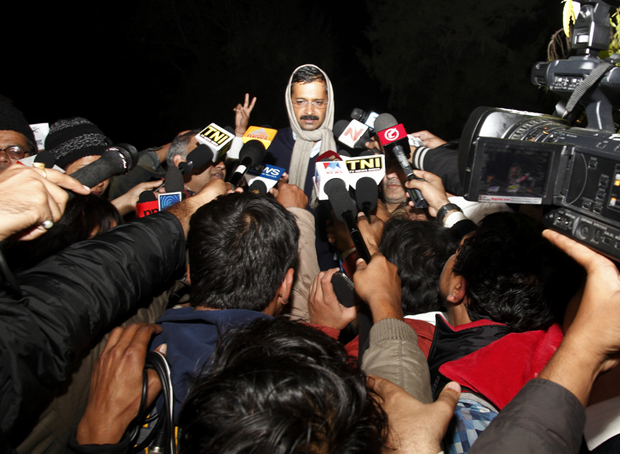
Delhi Chief Minister Arvind Kejriwal called off the 30-hour protest (Dharna) outside Rail Bhavan on January 21, 2014 after few of his demands were considered.
Arvind Kejriwal, Delhi’s erstwhile chief minister, gained popularity among the ‘aam aadmi’ – ordinary citizens – because of his tough anti-corruption stand. Many saw his newly formed party, the Aam Aadmi Party (AAP) as a breath of fresh air. His antics and strategies to grab media attention didn’t disappoint either.
During his campaign for Delhi’s highest seat, he cut off electricity wires outside peoples homes to mark his defiance of what he said are corrupt electricity meters that overcharge people. Once in office, he sat in protest against Delhi’s own police force, demanding that the Central Government that controls the Police in Delhi, the country’s capital, immediately transfer its control to his government. Kejriwal has become an urban icon. Always wrapped in his trademark muffler, with a seemingly constant cough, his image is being parodied intensely on the internet. He insisted on being sworn in as Chief Minister of Delhi, in an open –to-all public function at one of Delhi’s biggest grounds instead of at the office of the Lt. Governor of Delhi, as is practice. For a while, he was adamant about holding a special session of the Delhi Assembly, called for legislating the Jan Lokpal Bill seeking to establish an anti-corruption ombudsman, in one of the capital’s largest stadium instead of inside the Assembly itself. On 14th February, after unsuccessfully trying to introduce the Jan Lokpal Bill on the first day of Delhi’s State Assembly, he held a press conference in the pouring rain to announce that he was resigning over this issue. This capped his 49 day tenure, and just before ending his press conference, he declared that che is ready to “sacrifice his life for the country” in his fight against corruption.
In terms of theatrics that inescapably accompanies his politics, Kejriwal is caught the imagination of India’s common man. He is always on television. That any politician willingly resigned as chief minister will not be lost on Indians, used to seeing politicians hang onto power with dear life. Many are looking to Kejriwal to make a sizable dent in the national elections, projected to be held in April 2014.
While campaigning and during this term in office, Kejriwal unveiled an arsenal of ideas to battle status quo – and take on people in authority head on – including his idea of asking the common man to use the mobile phone as a “weapon” to secretly film government and police officials demanding bribes. This proof then could be turned over to his government, which had set up an exclusive hotline to deal with corruption charges. Don’t get mad, get even – seems to be his motto as he urged residents of Delhi, “setting kar lo” – or fix them.
Media reports confirm that as a result of “open season on sting operations” the sale of spycams have increased in Delhi, with some shopkeepers estimating that the sale of these hidden cameras have shot up almost 90%. Spy cameras are available in the form of pens, keyrings, buttons, watches, pen-drives and eyeglasses, and on a more expensive scale, in jewellery and other bespoke items.
This isn’t the first time AAP has recommended the use of spycameras. Days before the New Delhi vote, the media reported that AAP were fitting slums with spycams to ensure that candidates of other parties did not go there to try and buy votes – and if they did – they would be caught. Over 2,000 spycams were reportedly used for this operation.
The AAP party is not the first — and certainly won’t be the last — in suggesting the use of cameras, especially through mobile phones, for citizen empowerment. In fact, when Delhi’s traffic police first launched a page on Facebook, citizens began posting pictures of cops breaking traffic laws in hopes that they be reprimanded. Similarly when the Municipal Corporation of Delhi started its Facebook page, people took advantage of the platform to post pictures of shoddy or incomplete works in their neighbourhoods.
Community video project, India Unheard, has armed citizen journalists from small towns and villages with cameras, and they report on development and other issues, and publish these videos on the internet. In many areas, due to the spotlight on them, government officials have responded to these negative reports and taken action. The parent outfit, Video Volunteers, even ran a campaign to check the “real” progress of India’s Right to Education Act, by bringing out over 100 videos that document the real implementation of this act on the ground.
The use of technology “from below” to hold those in power accountable is also known as sousveillance, a word that comes the French word “sous” (from below) with the word “viller” coined in 1998 by Professor Steve Mann of the University of Toronto. In the West, sousveillance is being looked at by some as an foil to mass surveillance; a manner in which citizens can watch those watching them. Others, however, express some doubts at a society where citizens are pointing cameras at a state that is watching them, and perhaps ultimately leading to a situation where everyone is watching each other. Surveillance is normalized because it is so institutionalized.
However, sousveillance is not necessarily targeted towards government and law enforcement officials alone. In New York, a project called Hollaback asks women to take pictures of their harassers and upload it to their site. The movement has expanded and extends to Indian cities as well. And gadgets like Google Glass will make humans capable of recording their perspectives on a 24/7 basis, amassing huge data.
So it appears that at a time when civil society is up in arms against big brother surveillance schemes run by the government because of their privacy breaches, we are simultaneously doing the same to ourselves, with what some call little brother surveillance.
Jay Stanley, Senior Policy Analyst at ACLU writes, “Under the old expectation, the default expectation was that any given event would not be photographed… That is rapidly being replaced by a new mindset in which the default expectation is that something taking place in public will be recorded. Thus you often hear expressions of disappointment when a disputed or dramatic public event is NOT caught on video.” He also raises the point that citizen video footage might give the state a reason to scale down their mass surveillance activities, because video evidence can simply be collected from private photos and videos. However, it seems unlikely, given what we know about governments world wide, that most countries will be ready to give up their schemes to the off-chance that somebody-recorded-it.
Of course, one can argue there is a subtle difference between CCTV cameras that clearly announce their existence, people pointing mobile phones at each other on the street, and the proliferation of spycams to “fix” people. There is also legitimacy attached to this process when the chief minister of a state asks its citizens to collect proof of wrongdoing as the basis of taking action, as has been done in New Delhi. In fact, in a speech made just about three weeks after he took office, Kejriwal announced that he is quite sure that corruption must have come down at least 20-30% in Delhi, to thunderous applause. A helpline the new government has set up even offers to tutor citizens in how to conduct sting operations against corrupt officials. In an editorial by the Indian Express, the paper advises that, “Sting operations are an ethical minefield. They are based on lies and entrapment, even if in the service of a larger cause. They are easy to manipulate at several levels, including editing to convey the desired impression of a meeting. This unease about the subterfuge and distortion of using undercover cameras is the reason stings are not admissible as legal evidence. How can they be the basis of prompt government action, then?”
The truth is that India has a problem of entrenched corruption, and the AAP’s ride and subsequent anti-graft ideas address these concerns head on. Previously India’s Central Vigilance Commission in 2010, had encouraged people to conduct stings on government officials, even as a draft privacy law, yet to be passed by the Indian parliament, said such operations could violate individual privacy. Others worry that programs like these need protections such as a Whistleblowers Act and provisions to protect anonymity. However, the concept of sting operations, made popular by a vigilante media has become so popular that there is now an Indian website that collates India sting operations for anyone to see.
The government of India’s capital is installing more and more CCTVs for safety reasons, the Central Monitoring System is being deployed to track citizens online behavior, and now the Delhi government is glorifying sting operations through radio ads and billboards. Ultimately, the AAP, consciously or unconsciously, has given its vote to a society based on sousveillance.
Can the encouragement of spycams and secret mobile tapings end up in people spying on neighbours, and perhaps even blackmail them? Could Delhi’s public spaces shrink because of the “spycam moral police”? Are adequate privacy frameworks in place?
The AAP needs to think about these questions, especially if it plans to field these ideas during the national election campaign trail.
Point and shoot are never orders to be given lightly.
This article was published on 17 February 2014 at indexoncensorship.org
6 Feb 2014 | Events

Join English PEN and Open Rights Group on a day of global protest against mass surveillance, as civil liberties groups and activists around the world unite to defend privacy and freedom of expression online. With keynote speakers and tech experts to advise you on your privacy and security online.
Since Edward Snowden’s first revelations about the National Security Agency’s collection of US data last summer, the British public has witnessed a series of alarming disclosures regarding the extent of the surveillance programmes operated by US and UK intelligence services.
Guest speakers from leading privacy, freedom of expression and human rights groups in the UK will announce a new coalition, Don’t Spy On Us, calling for legal reform and judicial oversight of the intelligence service’s mass surveillance programme.
This event is FREE, with a bar, live demonstrations and keynote speakers.
When: Tuesday 11th February, 7:00pm onwards
Where: Free Word Centre, EC1R 3GA
Tickets: FREE but Reserve your tickets
Presented by

5 Feb 2014 | About Index, Campaigns, Press Releases
After two years at the helm of Index on Censorship, Chief Executive Kirsty Hughes will be leaving the leading international freedom of expression organisation in mid-April to pursue new projects and writing in the international and European politics arena.
Hughes joined Index in April 2012 taking its international editorial and advocacy strategy to new audiences and leading Index in its work on international digital freedom, including Index’s opposition to mass surveillance as revealed by the Snowden revelations, reinforcing its work in authoritarian and transition regimes around the world, and introducing a new focus on the question of access to freedom of expression. Hughes has been a key commentator and evangelist for Index, raising the organisation’s profile in the United Kingdom, India, Brazil, the EU and the United States.
Index on Censorship is currently seeking a leading free speech defender as our new CEO. Full details on the role can be found here.
10 Jan 2014 | Digital Freedom, Europe and Central Asia, European Union, News

(Illustration: Shutterstock)
This article is part of a series based on our report, Time to Step Up: The EU and freedom of expression
The EU has made a number of positive contributions to digital freedom: it plays a positive part in the global debate on internet governance; the EU’s No-Disconnect Strategy, its freedom of expression guidelines and its export controls on surveillance equipment have all be useful contributions to the digital freedom debate, offering practical measures to better protect freedom of expression. Comparatively, some of the EU’s member states are amongst the world’s best for protecting online freedom. The World Wide Web Foundation places Sweden at the top of its 2012 Index of internet growth, utility and impact, with the UK, Finland, Norway and Ireland also in the top 10. Freedom House ranks all EU member states as “free”, and an EU member state, Estonia, ranks number one globally in the organisation’s annual survey, “Freedom in the World”. But these indices merely represent a snapshot of the situation and even those states ranked as free fail to fully uphold their freedom of expression obligations, online as well as offline.
As the recent revelations by whistleblower Edward Snowden have exposed, although EU member states may in public be committed to a free and open internet, in secret, national governments have been involved in a significant amount of surveillance that breaches international human rights norms, as well as these governments’ own legal commitments. It is also the case that across the EU, other issues continue to chill freedom of expression, including the removal or takedown of legitimate content.
The EU’s position on digital freedom is analysed in more detail in Index on Censorship’s policy paper “Is the EU heading in the right direction on digital freedom?” The paper points out that the EU still lacks a coherent overarching strategy and set of principles for promoting and defending freedom of expression in the digital sphere.
Surveillance
Recent revelations by former US National Security Agency (NSA) whistleblower Edward Snowden into the NSA’s PRISM programme have also exposed that mass state surveillance by EU governments is practised within the EU, including in the UK and France.
Mass or blanket surveillance contravenes Article 8 (the right to respect for private and family life) and Article 10 (the right to freedom of expression) of the European Convention on Human Rights. In its jurisprudence, the European Court of Human Rights has repeatedly stated that surveillance, if conducted without adequate judicial oversight and with no effective safeguards against abuse, will never be compatible with the European Convention.[1]
This state surveillance also breaches pledges EU member states have made as part of the EU’s new cybersecurity strategy, which was agreed in February 2013 and addresses mass state surveillance. The Commission stated that cybersecurity is predominantly the responsibility of member states, an approach some have argued gives member states the green light for increased government surveillance. Because the strategy explicitly states that “increased global connectivity should not be accompanied by censorship or mass surveillance”, member states were called upon to address their adherence to this principle at the European Council meeting on 24th October 2013. The Council was asked to address revelations that external government surveillance efforts, such as the US National Security Agency’s Prism programme, undermining EU citizens’ rights to privacy and free expression. While the Council did discuss surveillance, as yet there has been no common EU position on these issues.
At the same time, the EU has also played a role in laying the foundations for increased surveillance of EU citizens. In 2002, the EU e-Privacy Directive introduced the possibility for member states to pass laws mandating the retention of communications data for security purposes. In 2006, the EU amended the e-Privacy Directive by enacting the Data Retention Directive (Directive 2006/24/EC), which obliges member states to require communications providers to retain communications data for a period of between six months and two years, which could result in member states collecting a pool of data without specifying the reasons for such practice. A number of individual member states, including Germany, Romania and the Czech Republic, have consulted the European Convention on Human Rights and their constitutions and have found that the mass retention of individual data through the Data Retention Directive to be illegal.
While some EU member states are accused of colluding in mass population surveillance, others have some of the strongest protections anywhere globally to protect their citizens against surveillance. Two EU member states, Luxembourg and the Czech Republic, require that individuals who are placed under secret surveillance to be notified. Other EU member states have expanded their use of state surveillance, in particular Austria, the UK and Bulgaria. Citizens of Poland are subject to more phone tapping and surveillance than any other citizens in the European Union; the European Commission has claimed the police and secret services accessed as many as 1,300,000 phone bills in 2010 without any oversight either by the courts or the public prosecutor.
Internet governance
At a global level the EU has argued for no top-down state control of internet governance. There are efforts by a number of states including Russia, China and Iran to increase state control of the internet through the International Telecommunication Union (ITU). The debate on global internet governance came to a head at the Dubai World Conference on International Telecommunications (WCIT) summit at the end of 2012 which brought together 193 member states. At the WCIT, a number of influential emerging democratic powers aligned with a top-down approach with increased state intervention in the governance of the internet. On the other side, EU member states, India and the US argued the internet should remain governed by an open and collaborative multistakeholder approach. The EU’s influence could be seen through the common position adopted by the member states. The European Commission as a non-voting WCIT observer produced a common position for member states that opposed any new treaty on internet governance under the UN’s auspices. The position ruled out any attempts to make the ITU recommendations binding and would only back technology neutral proposals – but made no mention of free expression. The absence of this right is of concern as other rights including privacy (which was mentioned) do not always align with free speech. After negotiations behind closed doors, all 27 EU member states and another 28 countries including the US abstained from signing the final treaty. That states with significant populations and rising influence in their regions did not back the EU and leant towards more top-down control of the internet should be of significant concern for the EU.
Intermediate liability, takedown and filtering
European laws on intermediate liability, takedown and filtering are overly vague in defining what constitutes valid and legitimate takedown requests, which can lead to legal uncertainty for both web operators and users. Removal of content without a court order can be problematic as it places the content host in the position of judge and jury over content and inevitably leads to censorship of free expression by private actors. EU directorate DG MARKT[2] is currently looking into the results of a public consultation into how takedown requests affect freedom of expression, among other issues. It is expected that the directorate will outline a directive or communication on the criteria takedown requests must meet and the evidence threshold required, while also clarifying how “expeditiously” intermediaries must act to avoid liability. A policy that clarifies companies’ legal responsibilities when presented with takedown requests should help better protect online content from takedown where there is no legal basis for the complaint.
The EU must take steps to protect web operators from vexatious claims from individuals over content that is not illegal. Across the EU, the governments of member states are increasingly using takedown requests. Google has seen a doubling of requests from the governments of Germany, Hungary, Poland and Portugal from 2010-2012; a 45% increase from Belgium and double-digit growth in the Netherlands, Spain and the UK. Governments are taking content down for dubious reasons that may infringe Article 10 rights of the ECHR. In 2010, a number of takedown requests were made in response to ‘”government criticism” and four in response to “religious offence”. A significant 8% of takedown requests were in response to defamation offences. With regard to defamation charges, it must be noted that the public interest is not protected equally across all EU countries (see Defamation above).
Although corporate takedown is more prevalent than state takedown, particularly in the number of individual URLs affected, the outcome of the DG MARKT consultation must be to address both vexatious state and corporate takedown requests. The new communication or directive must be clearer than the EU e-Commerce directive has been with respect to the responsibility of member states. While creating a legal framework that was intended to protect internet intermediaries, the EU e-Commerce directive has failed to be entirely effective in a number of high-profile cases. EU member states use filters to prevent the distribution of child pornography with questionable effectiveness. However, filters have not been used by states to block other content after a Court of Justice of the European Union ruling stated EU law did not allow states to require internet service providers to install filtering systems to prevent the illegal distribution of content. The Court made it clear at the time that such filtering would require ISPs to monitor internet traffic, an infringement under EU law. This has granted European citizens strong protections against systematic web filtering on behalf of states. There continue to be legal attempts to force internet intermediaries to block content that is already in the public domain. In a recent case, brought by the Spanish Data Protection authority on behalf of a complainant, the authority demanded that the search engine Google remove results that pointed to an auction note for a reposessed home due to social security debts. The claimant insisted that referring to his past debts infringed on his right to privacy and asked for the search results to be removed. In June 2013, the Advocate General of the European Court of Justice decided Google did not need to comply to the request to block “legal and legitimate information that has entered the public domain” and that it is not required to remove information posted by third parties. Google has estimated that there are 180 cases similar to this one in Spain alone. A final decision in the case is expected before the end of this year, which could have profound implications for intermediate liability.
[1] In Liberty v. UK (58243/00) the ECHR stated: “95. In its case-law on secret measures of surveillance, the Court has developed the following minimum safeguards that should be set out in statute law in order to avoid abuses of power: the nature of the offences which may give rise to an interception order; a definition of the categories of people liable to have their telephones tapped; a limit on the duration of telephone tapping; the procedure to be followed for examining, using and storing the data obtained; the precautions to be taken when communicating the data to other parties; and the circumstances in which recordings may or must be erased or the tapes destroyed”; A. v. France (application no. 14838/89), 23.11.1993: found a violation of Article 8 after a recording was carried out without following a judicial procedure and which had not been ordered by an investigating judge; Drakšas v. Lithuania, 31.07.2012, found a violation of Article 13 (right to an effective remedy) on account of the absence of a judicial review of the applicant’s surveillance after 17 September 2003.
[2] The Internal Market and Services Directorate General
