28 Mar 2017 | Belarus, Campaigns -- Featured, Statements
[vc_row][vc_column][vc_column_text]We, the undersigned members of the Civic Solidarity Platform (CSP), a coalition of human rights NGOs from Europe, the former Soviet Union region and North America, and other non-governmental organisations decry the mass detentions of peaceful demonstrators, journalists and human rights defenders, as well as the use of violence and abusive treatment targeting them in Belarus on 25-26 March 2017. These events were the culmination of a series of repressive measures taken by the authorities of the country since the beginning of March to stifle the public expression of grievances. Given the severity of this human rights crisis of unprecedented scale since December 2010, it is crucial that the international community takes resolute action to push for an end to the crackdown in Belarus and justice for those targeted by it.
We condemn the gross violations of the right to peaceful assembly, freedom of expression, freedom from arbitrary detention, and the right to fair trial in Belarus in connection with the recent peaceful protests, and call on the international community to use all available means to put pressure on the Belarusian authorities to immediately end these violations.
Such measures by the authorities should include:
- immediately releasing those currently behind bars because of their involvement in the peaceful protests or their efforts to monitor them;
- dropping charges against all those prosecuted on these grounds;
- carrying out prompt, thorough and impartial investigations into all allegations of arbitrary detention, ill-treatment and other violations of the rights of protesters, passers-by, journalists, human rights defenders and political activists in connection with the protests; and
- bringing those responsible for violations to justice.
We call in particular for the following concrete actions by international community in response to the current crackdown in Belarus:
To the OSCE:
- The OSCE participating States should initiate and support the renewal of the Moscow Mechanism in relation to Belarus and the appointment of a new rapporteur for this process, in view of the fact that the current developments mirror those on the grounds of which this mechanism was invoked in 2011;
- The OSCE Chairmanship should appoint a Special Representative on Belarus, whose mandate should include investigating the recent violations;
- The Office of Democratic Institutions and Human Rights should monitor the trials of those facing charges because of their participation in the recent peaceful protests, or their efforts to monitor and report on them;
- The OSCE Parliamentary Assembly should reconsider holding its annual session in Minsk in July 2017 and identify another host country and city for this event.
To the Council of Europe:
- The Parliamentary Assembly of the Council of Europe should replace its current rapporteur on the situation in Belarus, ensuring that the individual holding this position forcefully speaks out against human rights violations in the country.
To the UN:
- Members of the Human Rights Council should extend the mandate of the Special Rapporteur on the human rights situation in Belarus, continue urging the Belarusian authorities to allow the Special Rapporteur to visit the country, and adopt a strong resolution on the human rights situation in Belarus at the next session of the Council;
- High Commissioner on Human Rights should publicly condemn the crackdown in Belarus and engage in direct contact with the Belarusian authorities on this matter.
To international financial institutions:
- International financial institutions should apply strong human rights conditionality in the implementation of their programs in Belarus and refrain from allocating funding to government projects until the human rights situation in the country has substantially improved. Specifically, the European Bank for Reconstruction and Development should reinstate its calibrated strategy on Belarus.
To the EU:
- The EU member states and institutions should apply stronger and more consistent human rights conditionality to the development of its relations with Belarus and consider the prospects of reinstating sanctions similar to those applied in 2011-12 for widespread human rights violations.
To the USA:
- The US government should consider reinstating the sanctions against Belarus that it suspended in 2015-16.
Background information, based on reports from the ground:
In the afternoon of 25 March 2017, people took to the streets in the Belarusian capital of Minsk for planned peaceful protests on the occasion of the Day of Freedom, which commemorates the Belarusian declaration of independence in 1918. There was as a heavy police and security presence in the city, the downtown area where protests were due to be held was cordoned off, and traffic was blocked on the main Independence Avenue. Local and international human rights monitors representing the CSP member organisations documented the use of heavy-handed tactics by the law enforcement and security authorities to prevent the peaceful protests, for which authorities had not given advance permission as required by Belarusian law and in violation of international standards. At least 700 people were detained on 25 March, including elderly and passers-by. As can be seen on available photos and footage, police forcefully rounded up and beat protesters with batons, although these made no resistance. More than 30 journalists and photographers from both Belarusian and international media outlets were detained; cameras and other equipment of some of them were damaged by police. Toward the evening, police started releasing detainees from the detention facilities, in many cases without charge. However, others remain in detention, and dozens of individuals are expected to stand trial starting Monday 27 March on charges relating to their participation in the peaceful protests.
The following episode requires particular attention: At 12.45 pm local time on 25 March, about an hour before the start of the planned peaceful protest, anti-riot police raided the offices of the Human Rights Center Viasna and detained a total of 57 Belarusian and foreign human rights defenders and volunteers as well as journalists. Human rights defenders and volunteers had gathered there for a training on monitoring the protests and were planning to go to the streets of Minsk for observation of the assemblies. Among them were representatives of Viasna, the Belarusian Helsinki Committee, the Belarusian Documentation Center, Frontline Defenders, International Partnership for Human Rights and other organisations. The police shouted at all present, intimidated them, and ordered to lie down on the floor face down. 57 people were detained without any charges, packed in the buses and brought to the Pervomaisky district police station, where their belongings were searched and their personal information recorded. The detainees were held there for two and a half hours and were released afterwards without charges. One of the detained needed medical treatment because of injuries sustained when being beaten by police. The raid of the offices of Viasna and the detention of the monitors were clearly aimed at intimidating and preventing them from observing the peaceful assembly and documenting possible violations.
The crackdown continued on 26 March, with dozens of people being detained by police as they gathered at October Square in Minsk at noon to express solidarity with those detained the day before. Among the detained on 26 March were at least one human rights defender, one civil society activist and one journalist. Representatives of national and international human rights NGOs, including members of the CSP, continue to document violations perpetrated in connection with the events of the last few days.
The detentions on 25-26 March followed the earlier detention of about 300 people, including opposition members, journalists and human rights defenders in the last few weeks. These detentions have taken place against the background of a wave of peaceful demonstrations that were carried out across Belarus since mid-February 2017 to protest against so-called “social parasites” law which imposes a special tax on those who have worked for less than six months during the year without registering as unemployed. The legislation, which has affected hundreds of thousands of people in the economically struggling country, has caused widespread dismay. On 9 March, President Lukashenko suspended the implementation of the law but refused to withdraw it, resulting in further protests. Many of those detained have been fined or arrested for up to 15 days on administrative charges related to their participation in the peaceful protests. Over two dozen people are facing criminal charges on trumped-up charges of preparation to mass riots.
Signed by the following CSP members:
- Analytical Center for Inter-Ethnic Cooperation and Consultations (Georgia)
- Article 19 (United Kingdom)
- Association UMDPL (Ukraine)
- Bir Duino (Kyrgyzstan)
- Bulgarian Helsinki Committee
- Center for Civil Liberties (Ukraine)
- Centre for the Development of Democracy and Human Rights (Russia)
- Committee against Torture (Russia)
- Crude Accountability (USA)
- Freedom Files (Russia/Poland)
- German-Russian Exchange – DRA (Germany)
- Helsinki Association of Armenia
- Helsinki Citizens’ Assembly – Vanadzor (Armenia)
- Helsinki Committee of Armenia
- Helsinki Committee for Human Rights in Serbia
- Helsinki Foundation for Human Rights (Poland)
- Human Rights Center of Azerbaijan
- Human Rights First (USA)
- Human Rights House Foundation (Norway)
- Human Rights Information Center (Ukraine)
- Human Rights Monitoring Institute (Lithuania)
- The institute for Reporters’ Freedom and Safety (Azerbaijan/Georgia/Switzerland)
- Index on Censorship (United Kingdom)
- Institute Respublica (Ukraine)
- International Partnership for Human Rights (Belgium)
- Kazakhstan International Bureau for Human Rights and Rule of Law
- The Kosova Rehabilitation Center for Torture Victims
- Macedonian Helsinki Committee
- Moscow Helsinki Group (Russia)
- The Netherlands Helsinki Committee
- Norwegian Helsinki Committee
- Office of Civil Freedoms (Tajikistan)
- Promo-LEX (Moldova)
- Protection of Rights without Borders (Armenia)
- Public Association “Dignity” (Kazakhstan)
- Public Alternative Foundation (Ukraine)
- Public Foundation Golos Svobody (Kyrgyzstan)
- Public Verdict Foundation (Russia)
- Regional Center for Strategic Studies (Azerbaijan/ Georgia)
- Serbian Helsinki Committee for Human Rights
- SOLIDARUS e.V. (Germany)
- The Swiss Helsinki Committee
- Ukrainian Helsinki Human Rights Union
- Women’s International League for Peace and Freedom
- World Organisation against Torture (OMCT)
Other organisations who have joined the statement:
- Belarus Free Theatre
- Libereco – Partnership for Human Rights (Switzerland)
- PEN International
[/vc_column_text][/vc_column][/vc_row][vc_row][vc_column][vc_basic_grid post_type=”post” max_items=”4″ element_width=”6″ grid_id=”vc_gid:1490686433484-ad7cf42c-cf25-10″ taxonomies=”172″][/vc_column][/vc_row]
10 Mar 2017 | Denmark, Digital Freedom, Europe and Central Asia, News
[vc_row][vc_column][vc_column_text] Few people take religion less seriously than the Danes.
Only 19% consider religion to be an important factor in their day to day lives. While some 76% remain members of the state church, that figure is down from 83% in 2006, and more than 24,000 people left the institution last year. Church going remains popular at Christmas, weddings and baptisms, but many churches are almost empty on any given Sunday. Long gone are the days when criticising the doctrines of Lutheranism or the Lutheran state church would land you in prison (or on the scaffold). So it created quite a stir when in February a local prosecutor announced that a Danish man was being charged for violating Denmark’s blasphemy law, which has been dormant since 1971 and last resulted in a conviction in 1946. A move approved by Denmark’s chief prosecutor.
How was a dead letter such as the Danish blasphemy ban suddenly revived?
The first step was taken by the Danish Criminal Law Council, an expert body advising the Ministry of Justice. In 2015 it released a lengthy statement on the blasphemy ban arguing that the burning of holy books would still be punishable, despite the decades-long practice of emphasising the importance of free speech over religious feelings. However, suspiciously, the expert body omitted any reference to a case from 1997 in which a Danish artist burned the Bible on national television.
Back then a number of complaints from the public were dismissed by the chief prosecutor emphasising among other things the importance of freedom of expression. It is difficult to understand why this seemingly clear precedent was disregarded by the expert body. But it was this questionable interpretation that paved the way for bringing back from the dead a ban thought of as antiquated and incompatible with a secular liberal democracy by most Danes, and indeed by most Europeans, since only five EU-member states still have blasphemy bans on the books.
One of the reasons cited by the expert body for punishing the burning of holy books is the need to prevent religious extremists – at home and abroad – from instigating riots and violence as a result of having their religious feelings insulted. This is a deeply problematic argument in and of itself, but even more so in the context of Danish newspaper Jyllands-Posten having been the target of at least four foiled terrorist attacks since publishing cartoons of the prophet Muhammad in 2005, the murderous attack on Charlie Hebdo in 2015 and the killings of atheists and free thinkers in Bangladesh. A blasphemy ban indirectly legitimizes the Jihadist’s Veto, rather than confronting it. It is not punishable – nor should it be – to burn the Danish flag as has happened repeatedly in protests against the cartoons both in Denmark and abroad. No one would dream of arguing that it should be a crime to burn the Communist manifesto, Burke’s Reflection on the French Revolution, or Adam Smith’s The Wealth of Nations even though communists, conservatives and classical liberals might view these works as essential to their identities and deeply held beliefs. In all likelihood one of the most frequently burned book of the 20th century was Salman Rushdie’s Satanic Verses, which went up in flames all over the world as offended Muslims took to the streets. Offended Muslims were free to do so, while Rushdie had to spend years living underground.
While burning books is certainly a crude and primitive practice with deeply troublesome historical connotations, it is nonetheless a peaceful symbolic expression, that should be protected free speech, whether the content of the scorched paper is secular or religious. By solely protecting religious books against such desecration the Danish blasphemy ban not only violates free speech and equality before the law, it is also tantamount to victim blaming and a dereliction of duty on the part of a liberal society which in no uncertain terms should make clear to religious fundamentalists that they cannot hope to have democracies impose their religious red lines on the rest of society through threats, intimidation and violence.
This was a point made clear by both Norway and Iceland whose parliaments chose to abolish these countries’ respective blasphemy bans as a direct consequence of the attack against Charlie Hebdo.
It would be wrong however, to suggest that Denmark has succumbed to the will of Islamists in particular, rather than to a loss of faith in free speech in general. Last year Parliament adopted a bill prohibiting “religious teachings” that “expressly condone” certain punishable acts and allows the government to maintain a dynamic list of “hate preachers” barred from entering Denmark. These initiatives were the direct consequence of a documentary exposing radical imams in Danish mosques preaching that the punishment for adultery and apostasy is stoning. And the current government has also presented a bill that would criminalize the mere sharing of “terrorist propaganda” online and allow the police to block access to websites containing criminal material such as terrorist propaganda or racist content. These developments signal a marked shift in the Danish approach to free speech.
In the post-World War II era Denmark has with a few exceptions been a liberal democracy committed to the idea that freedom of expression was an essential tool in defeating extremism and totalitarian ideologies. But Denmark is turning towards a model of militant democracy where free speech is often seen as the problem rather than the solution, and as a hindrance rather than the foundation of social peace. The revival of the Danish blasphemy ban should therefore be seen in the wider context of a world where respect for freedom of expression is at its lowest level in 12 years, a development that has now affected even one of the global bastions and beacons of free speech.
Jacob Mchangama is director of Justicia, a Copenhagen think tank focusing on human rights and the rule of law[/vc_column_text][vc_basic_grid post_type=”post” max_items=”4″ element_width=”6″ grid_id=”vc_gid:1489139072253-6b7daeee-fe12-8″ taxonomies=”53″][/vc_column][/vc_row]
1 Mar 2017
[vc_row equal_height=”yes” css=”.vc_custom_1487955099221{margin-right: -15px !important;margin-left: -15px !important;}”][vc_column css=”.vc_custom_1487955108553{margin-right: 15px !important;margin-bottom: 15px !important;margin-left: 15px !important;background-color: #ffffff !important;}”][vc_custom_heading text=”DEFEND MEDIA FREEDOM” font_container=”tag:h1|text_align:center” use_theme_fonts=”yes”][vc_custom_heading text=”SUPPORT INDEX ON CENSORSHIP” font_container=”tag:h1|text_align:center” use_theme_fonts=”yes”][vc_column_text]
Reporters working to share the truth are being harassed, intimidated and prosecuted – across the globe.
Index on Censorship is a nonprofit fighting against these corrosive attacks on press freedom.
Index documents threats to media freedom in Europe via a monitoring project and campaigns against laws that stifle journalists’ work.
[/vc_column_text][/vc_column][/vc_row][vc_row][vc_column width=”1/3″][staff name=”Mapping Media Freedom” title=”Documenting threats to the press in Europe and neighbouring countries” profile_image=”85817″]Mapping Media Freedom – a major Index on Censorship project and a joint undertaking with the European Federation of Journalists, partially funded by the European Commission – covers 42 countries, including all EU member states, plus Bosnia, Iceland, Kosovo, Macedonia, Montenegro, Norway, Serbia, Turkey, Albania along with Ukraine, Belarus, Russia, and Azerbaijan. The platform was launched in May 2014 and has recorded over 3,900 incidents threatening media freedom.
“The precarious state of press freedom across the globe is underlined by the volume of verified incidents added to Mapping Media Freedom in 2017. The spectrum of threats is growing, the pressure on journalists increasing and the public right to transparent information is under assault. People who are simply trying to do their job are being targeted like never before. These trends do not bode well for 2018.” — Joy Hyvarinen, Index on Censorship head of advocacy[/staff][/vc_column][vc_column width=”1/3″][staff name=”Changes to the Official Secrets Act” title=”Proposals to update spy laws a threat to journalism” profile_image=”81191″]Proposed legislation that could see journalists and whistleblowers sentenced up to 14 years for leaking official documents has no place in a democracy. The proposals were drawn up by the Law Commission as part of a review of the Official Secrets Act and would cover any data that affects the UK’s national and international interests, including economic interests. The public’s right to know about the Brexit negotiations, for instance, could be put into jeopardy if these proposals were brought into force.
“It is unthinkable that whistle blowers and those to whom they reveal their information should face jail for leaking and receiving information that is in the public interest. It is shocking that so few organisations were consulted on these proposed changes.” — Jodie Ginsberg, CEO, Index on Censorship[/staff][/vc_column][vc_column width=”1/3″][staff name=”Section 40, Crime and Courts Act” title=”Section 40 would allow the corrupt to silence investigative journalists” profile_image=”85827″]Section 40 is part of the Crime and Courts Act 2013, which deals with a whole range of issues but also implemented some of the recommendations contained in the Leveson Report into phone hacking by newspapers. Index on Censorship strongly opposes the introduction of section 40.
Section 40 addresses the awarding of costs in a case where someone makes a legal claim against a publisher of “news-related material”. The provision means that any publisher who is not a member of an approved regulator at the time of the claim can be forced to pay both sides’ cost in a court case — even if they win.
“If such laws were introduced in another country, British politicians would be speaking out against such shocking media censorship.” — Rachael Jolley, editor, Index on Censorship magazine[/staff][/vc_column][/vc_row][vc_row equal_height=”yes” css=”.vc_custom_1474531377622{margin-right: -15px !important;margin-left: -15px !important;}”][vc_column width=”1/3″ el_class=”text_white” css=”.vc_custom_1487957370833{margin-right: 15px !important;margin-bottom: 15px !important;margin-left: 15px !important;background-color: #f21400 !important;}”][vc_column_text]
A gift of £20
ensures a verified attack is mapped publicly
[wpedon id=100537]
[/vc_column_text][/vc_column][vc_column width=”1/3″ el_class=”text_white” css=”.vc_custom_1487957380442{margin-right: 15px !important;margin-bottom: 15px !important;margin-left: 15px !important;background-color: #f21400 !important;}”][vc_column_text]
A gift of £100
enables an official report to pressure governments
[wpedon id=100538]
[/vc_column_text][/vc_column][vc_column width=”1/3″ el_class=”text_white” css=”.vc_custom_1487957389388{margin-right: 15px !important;margin-bottom: 15px !important;margin-left: 15px !important;background-color: #f21400 !important;}”][vc_column_text]
A gift of £1000
supports extensive fieldwork to identify and confirm reported violations
[wpedon id=100539]
[/vc_column_text][/vc_column][/vc_row][vc_row css=”.vc_custom_1474531692548{margin-top: 30px !important;margin-bottom: 30px !important;}” el_class=”mw700″][vc_column][vc_column_text]
UK donors can also give to Index on Censorship by making a bank transfer.
Sort Code: 16-58-10 Account number: 20110063
Outside the UK and cannot access Paypal? Please email [email protected]
[/vc_column_text][vc_column_text]
If you are a US donor and would like more information about tax deductible charitable giving to Index, please contact [email protected]. Index works with CAF American Donor Fund.
[/vc_column_text][/vc_column][/vc_row][vc_row equal_height=”yes” content_placement=”middle” css=”.vc_custom_1487172040880{margin-top: 15px !important;margin-right: 0px !important;margin-bottom: 15px !important;margin-left: 0px !important;background-color: #ee3424 !important;}” el_class=”text_white”][vc_column width=”1/2″ css=”.vc_custom_1478508145989{padding-top: 60px !important;padding-bottom: 60px !important;background: #000000 url(https://www.indexoncensorship.org/wp-content/uploads/2012/01/art-and-the-law-banner.jpg?id=80742) !important;background-position: center !important;background-repeat: no-repeat !important;background-size: cover !important;}”][vc_row_inner][vc_column_inner][/vc_column_inner][/vc_row_inner][/vc_column][vc_column width=”1/2″ css=”.vc_custom_1474534568795{padding-top: 0px !important;padding-bottom: 0px !important;}”][vc_custom_heading text=”Sponsor the Awards” font_container=”tag:h2|font_size:24|text_align:left” use_theme_fonts=”yes”][vc_column_text]If you would be interested in sponsorship – including sponsorship of our Digital and Arts Awards – please contact Helen Galliano – [email protected][/vc_column_text][/vc_column][/vc_row][vc_row equal_height=”yes” content_placement=”middle” css=”.vc_custom_1487172040880{margin-top: 15px !important;margin-right: 0px !important;margin-bottom: 15px !important;margin-left: 0px !important;background-color: #ee3424 !important;}” el_class=”text_white”][vc_column width=”1/2″ css=”.vc_custom_1487609489413{padding-top: 60px !important;padding-bottom: 60px !important;background: #ffffff url(https://www.indexoncensorship.org/wp-content/uploads/2016/11/2017-awards-logo-white.jpg?id=85472) !important;background-position: center !important;background-repeat: no-repeat !important;background-size: contain !important;}”][vc_row_inner css=”.vc_custom_1487609333823{background-position: center !important;background-repeat: no-repeat !important;background-size: contain !important;}”][vc_column_inner][/vc_column_inner][/vc_row_inner][/vc_column][vc_column width=”1/2″ css=”.vc_custom_1474534568795{padding-top: 0px !important;padding-bottom: 0px !important;}”][vc_custom_heading text=”Freedom of Expression Awards 2017″ font_container=”tag:h2|font_size:24|text_align:left” use_theme_fonts=”yes” link=”url:https%3A%2F%2Fwww.indexoncensorship.org%2F2016%2F11%2Fawards-2017%2F|||”][vc_column_text]Celebrate the courage and creativity of some of the world’s greatest journalists, artists, campaigners and digital activists[/vc_column_text][/vc_column][/vc_row]
28 Feb 2017 | Index Reports, Mapping Media Freedom, Press Releases
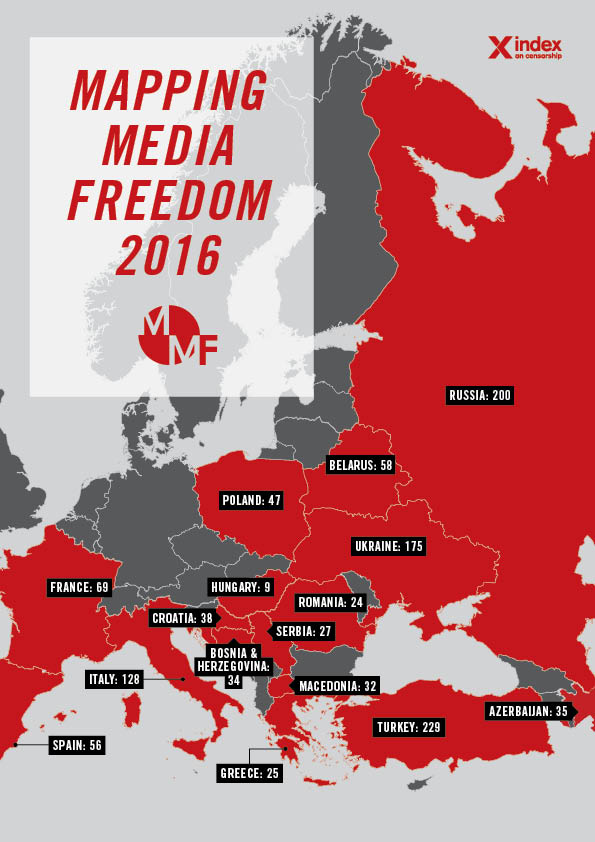 Freedom of expression campaign group Index on Censorship launches Media Freedom Month in March with the release of its annual report into media freedom in Europe. The report shows journalists face regular harassment, legal sanctions and even jail for doing their job – even in supposed democracies. Index’s Media Freedom Month aims to raise awareness of and funding for its work campaigning on press freedom.
“Right now, journalists and journalism are threatened from all directions: UK journalists who travel to the US are being told they need to hand over their mobile phone contacts and Facebook passwords. US journalists are being labelled as peddlers of ‘fake news’ over any articles the President dislikes and reporters across Europe face a host of laws that hamper their ability to work,” said Index chief executive Jodie Ginsberg.
Media Freedom Month will begin with the launch on Tuesday of the latest Mapping Media Freedom report on Europe and will end with an exclusive study of media freedom in the United States that goes well beyond the current focus on Donald Trump and his relationship with the press.
“A country without a free media is not a free country: Journalism provides a vital check on corruption and abuse of power and we must fight to protect it,” said Ginsberg.
Between 1 January and 31 December 2016, Mapping Media Freedom’s network of correspondents, partners and other journalists submitted a total of 1,387 verified threats to press freedom in 42 European countries.
“The precarious state of press freedom across the globe is underlined by the volume of verified incidents added to Mapping Media Freedom in 2016. The spectrum of threats is growing, the pressure on journalists increasing and the public right to transparent information is under assault. People who are simply trying to do their job are being targeted like never before. These trends do not bode well for 2017,” Hannah Machlin, Mapping Media Freedom project officer, said.
Some of the major themes in the data – and which journalists should be wary of in 2017 – include:
- Violence from right-wing groups
- Dangers faced when reporting on protests and demonstrations organised across the political spectrum
- Impunity: Physical attacks on journalists not properly investigated; government officials intimidating reporters without fear of punishment
- Difficulties reporting on refugees, including being denied access and violence
- Silencing journalists by arresting them on ties to terrorist or extremist groups
- Criminalised libel laws subjecting media outlets to high fines
- Economic difficulties leading to the closure or restructuring media outlets and buyouts by wealthy businesspeople, often leading to job cuts and dismissals
- State of emergency laws being used to detain journalists without charge
- Death threats and smear campaigns disseminated online
The 2016 report is available in web and pdf format at https://mappingmediafreedom.org/plus/
For more information, please contact Hannah Machlin, Mapping Media Freedom project officer at [email protected]
About Mapping Media Freedom
Mapping Media Freedom – a major Index on Censorship project and a joint undertaking with the European Federation of Journalists and Reporters Without Borders, partially funded by the European Commission – covers 42 countries, including all EU member states, plus Bosnia, Iceland, Kosovo, Macedonia, Montenegro, Norway, Serbia, Turkey, Albania along with Ukraine, Belarus and Russia in (added in April 2015), and Azerbaijan (added in February 2016). The platform was launched in May 2014 and has recorded over 2,700 incidents threatening media freedom.
About Index on Censorship
Index on Censorship is a freedom of expression charity that campaigns against censorship and promotes free expression worldwide. Founded in 1972, Index has published some of the world’s leading writers and artists in its award-winning quarterly magazine, including Nadine Gordimer, Mario Vargas Llosa, Samuel Beckett and Kurt Vonnegut. It also has published some of the greatest campaigning writers from Vaclav Havel to Elif Shafak.
