Do taboos play an essential role in culture and society or must we simply get rid of them? Index on Censorship magazine editor Rachael Jolley spoke on the topic at Fritt Ord headquarters in Oslo, Norway, on 21 June at a discussion co-organised by Index, Fritt Ord the Free Word Centre.
Other speakers included Maria Stepanova, poet and editor of the webzine Colta.ru, Moscow, and Pål Johan Karlsen, author and editor-in-chief of the website Psykologisk.no.
Index magazine’s winter 2015/16 issue was on the theme of taboos and why breaking down social barriers matters. In her talk, Jolley presented a global survey of taboos, discussed their history in certain countries and explored why certain taboos lead to censorship.
“Who decided these are the rules and how do they change?” she asked. “Sometimes it takes a generational shift such as we’ve seen in Ireland with the vote to change the law on gay marriage.”
“There’s a tipping point theory where a body of resistance builds up to such a point that the dam breaks and the public suddenly demands another way is found and an older way is discarded,” Jolley added.
Stepanova focused on taboos in Russia, paying special attention to “government-inspired” taboos that were virtually non-existent until a few years ago, but which are now shaped and encouraged by propaganda. Johan Karlsen spoke in defence of the elephant in the room: Why are taboos useful? If we are to co-exist and find inner peace in a dangerous world, we must make space for taboos in our lives, he argued.
Knut Olav Åmås, executive director of the Fritt Ord Foundation, moderated the discussion.
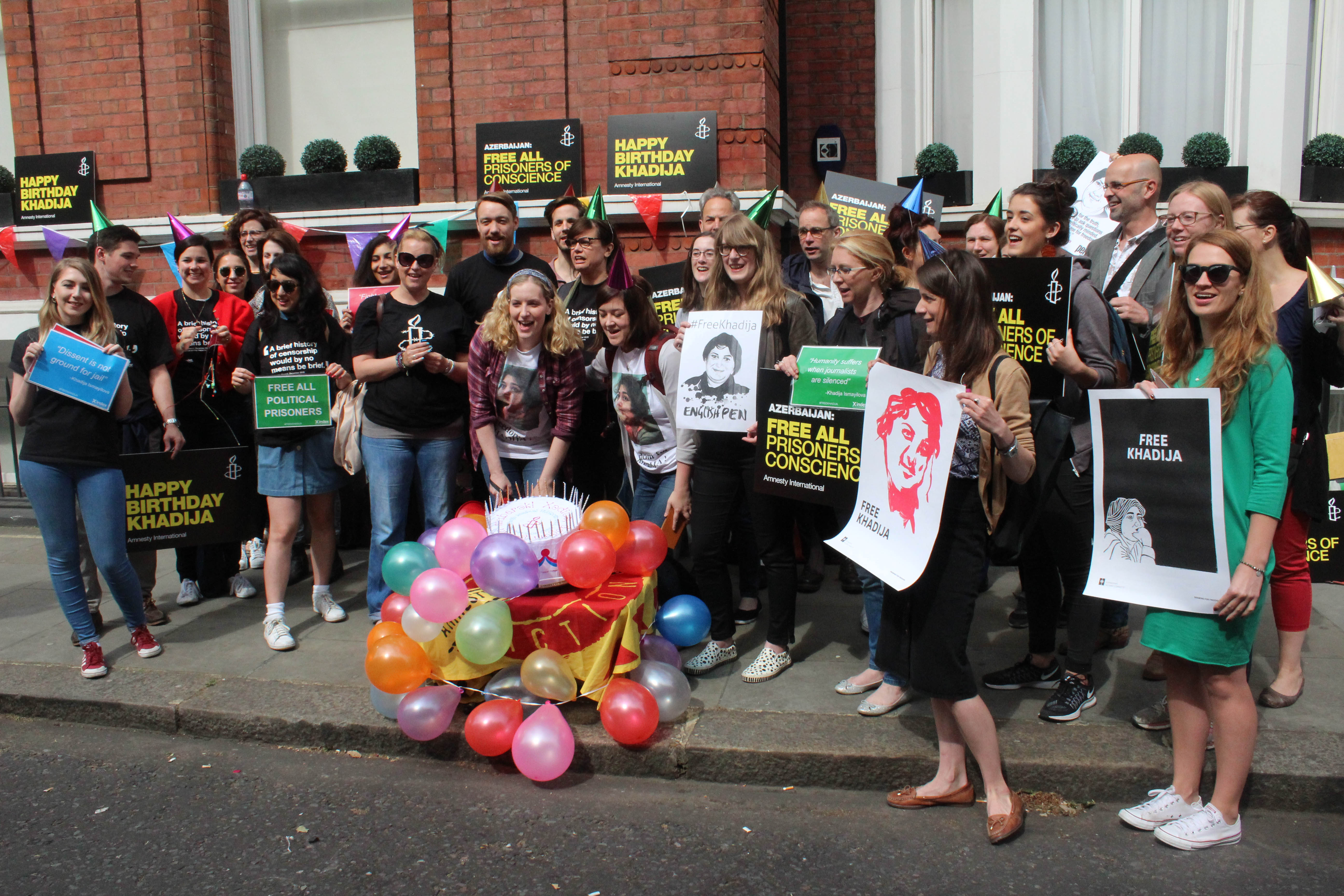
Protest for Khadija Ismayilova, Azerbaijan embassy, London. Credit: Cat Lucas, English Pen
Azerbaijani investigative journalist Khadija Ismayilova may have been released from prison on Wednesday, but two trumped-up charges against her — illegal entrepreneurship and tax evasion –remain. Her seven-and-a-half-year jail sentence has only been reduced to a three-and-a-half-year suspended term and she isn’t free to leave the country.
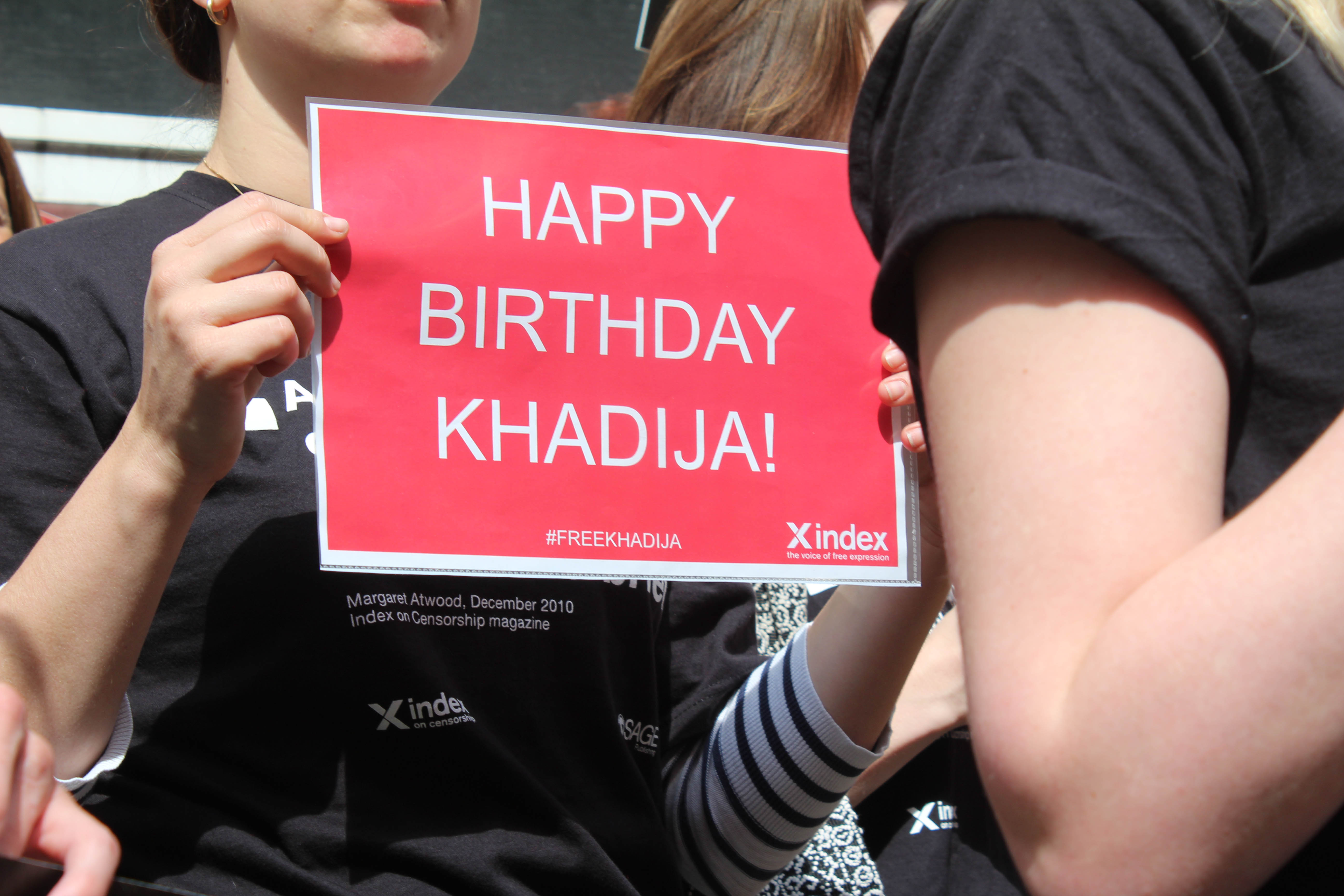
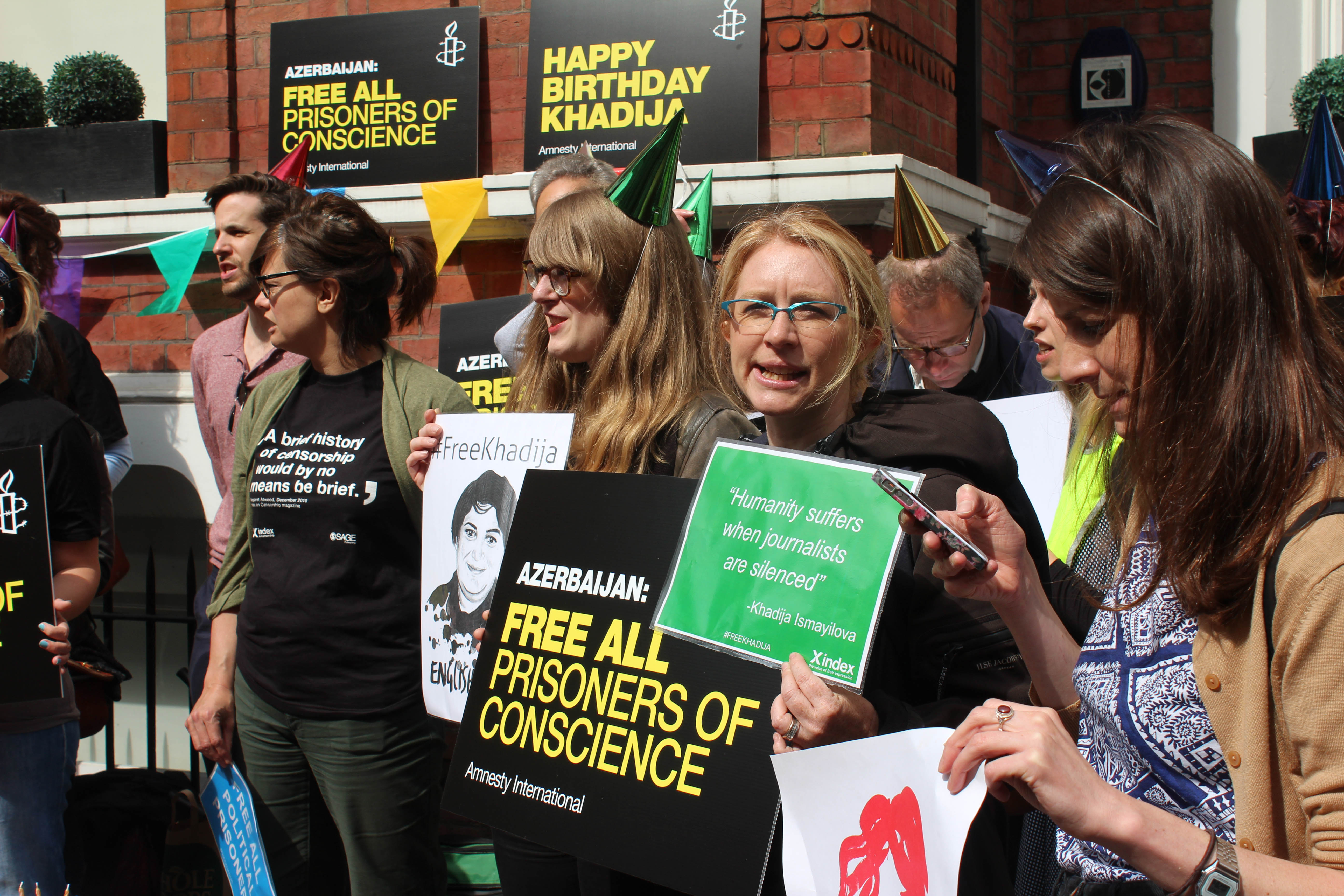
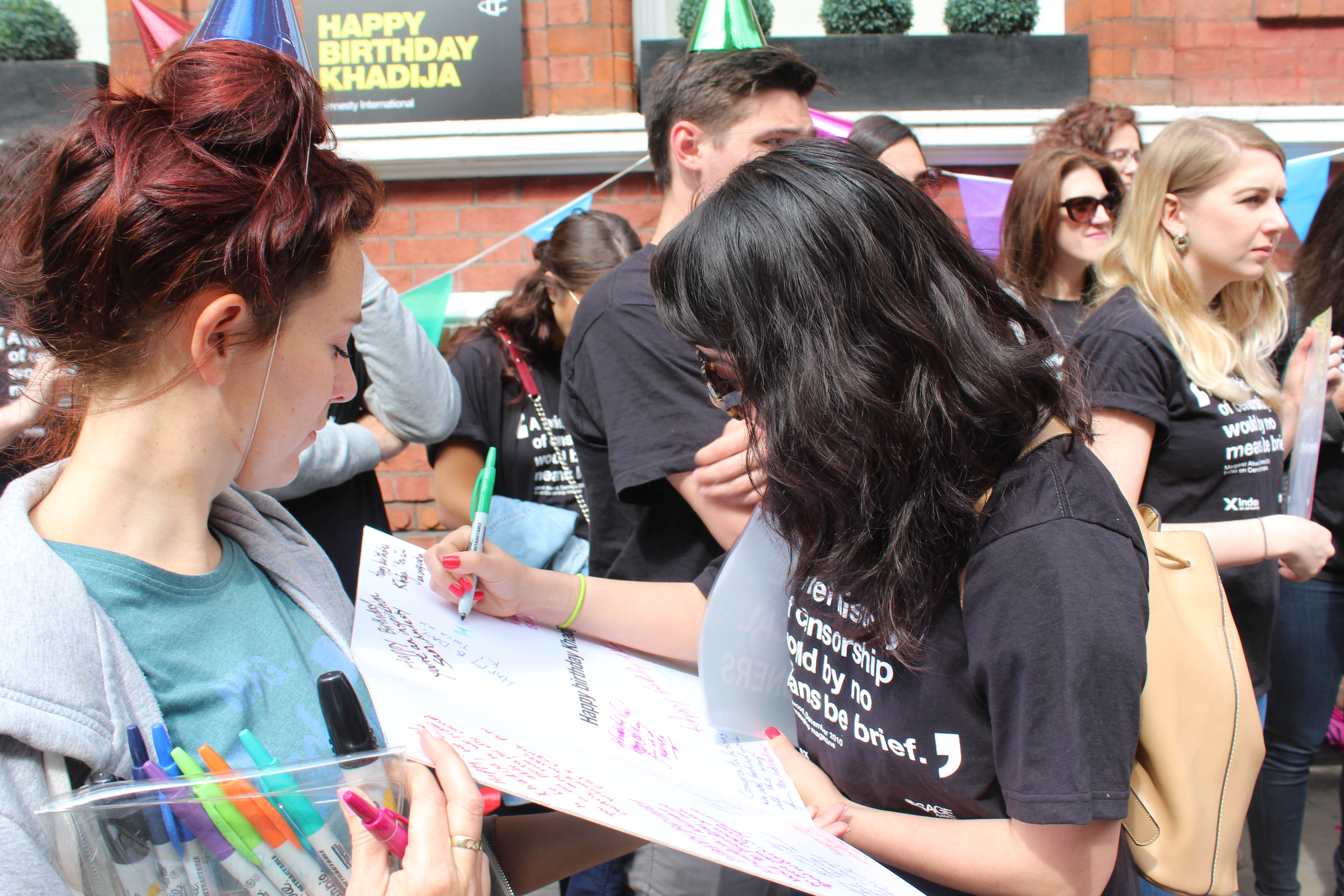
Today is Ismayilova’s 40th birthday and to mark the occasion, protesters gathered at 40 different demonstrations from around the world, not just to celebrate, but to call for all charges against her to be quashed. Index joined other members of the Sports for Rights coalition at the Azerbaijani embassy in London (see above).
— Index on Censorship (@IndexCensorship) May 27, 2016
“Let’s take a moment to celebrate the work that’s been done by this remarkable woman,” Rebecca Vincent, the co-ordinator of the Sport for Rights campaign, told demonstrators.
Currently, around 70 political prisoners — including journalists, bloggers, activists and religious followers — sit in Azerbaijani jails, and Vincent called on protesters to sustain their focus on all of them. “That’s what Khadija has asked for for her birthday,” she said.
Seymur Hezi is an Azerbaijani journalist serving a five-year prison sentence on charges of “aggravated hooliganism”. Hezi, who contributed to the Index on Censorship Freedom of Expression Award-winning newspaper Azadliq, was sentenced on 29 January 2015. He was arrested on 29 August 2014 following an altercation in which the journalist was defending himself from a physical assault and harassment, according to his lawyers. “His case doesn’t get enough international attention, possibly because he is not an English speaker and not well networked,” Vincent said.
Other political prisoners include Ilgar Mammadov, the opposition politician who leads Azerbaijan Republican Alternative Movement, who has been in jail for over three years, and Ilkin Rustemzade, the activistt originally jailed following his Harlem Shake video filmed in Baku.
On the same day Ismayilova was released, two more political prisoners, a youth activist and a journalist, were arrested.
Protest for Khadija Ismayilova, Azerbaijan embassy, London. Credit: Cat Lucas, English Pen
Protest for Khadija Ismayilova, Azerbaijan embassy, London. Credit: Cat Lucas, English Pen
Protest for Khadija Ismayilova, Azerbaijan embassy, London. Credit: Cat Lucas, English Pen
Journalists have been murdered and burned in effigy. Reporters have been publicly discredited by government officials, prosecuted for under anti-terrorism laws and excluded from public meetings on the refugee crisis. We’ve even recorded journalists being menaced with mechanical diggers.
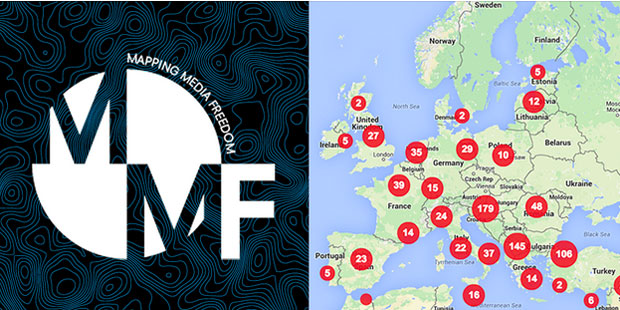
Mapping Media Freedom launched to the public on 24 May 2014 to monitor media censorship and press freedom violations throughout Europe. Two years on, the platform has verified over 1,800 incidents, ranging from insults and cyberbullying to physical assaults and assassination.
“The original impetus behind the project was to uncover everyday attacks on press freedom in Europe. The database has given Index, its partners and policy makers a highly unnerving look at the ways journalists are barred, attacked or even murdered simply for doing their jobs,” Hannah Machlin, project officer for Mapping Media Freedom, said.
The project has been granted renewed funding by the European Commission.
“The strength of Mapping Media Freedom is that it provides an ongoing narrative about the state of press freedom in the European region. It is gratifying that the European Commission values its contribution to the project by renewing its funding for a third year,” Melody Patry, senior advocacy officer, Index on Censorship said.
Over the period of coverage, Mapping Media Freedom has released periodic reports on the verified incidents. In the first quarter of 2016, the project received a total of 301 violations of press freedom to the database, a 30% rise over the fourth quarter of 2015. Earlier reports documented similar trends: February 2016, October 2015, May 2015 and December 2014.
The platform — a joint undertaking with the European Federation of Journalists and Reporters Without Borders and partially funded by the European Commission — covers 40 countries, including all EU member states, plus Albania, Belarus, Bosnia, Iceland, Kosovo, Macedonia, Montenegro, Norway, Russia, Serbia, Turkey, Ukraine and Azerbaijan. In September 2015 the platform expanded to monitor Russia, Ukraine and Belarus and in February 2016 into Azerbaijan. Since launching in May 2014, the map has recorded over 1,800 violations of media freedom, as 17 May 2016. Each report is fact checked with local sources before becoming publicly available on the interactive map.
Mapping Media Freedom works in conjunction with the Council of Europe’s platform about the safety and protection of journalists, provides resources for researchers and information for journalists. It is also affiliated with European Youth Press, Media Legal Defence Initiative, Human Rights House Kiev, Ossigeno per L’Informazione, Osservatorio Balconi e Caucaso and the European Centre for Press and Media Freedom.
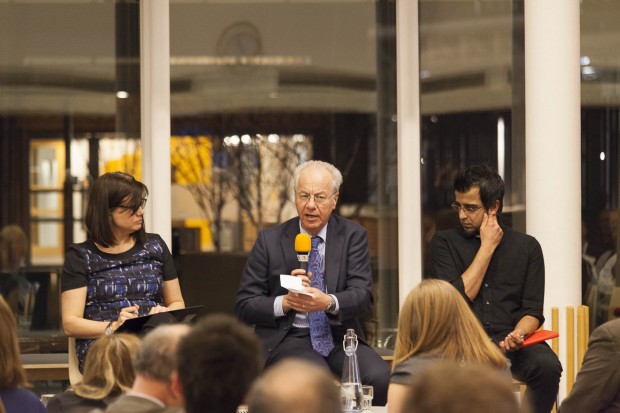
Peter Kellner speaks at the Winter 2015 Index on Censorship magazine launch event at the British Library in February 2015. The panel discussion coincided with the publication of Drafting freedom to last: The Magna Carta’s past and present influences to mark the 800th anniversary of the document’s drafting.
Peter Kellner is president of YouGov and a contributor to Index on Censorship magazine. Kellner discusses the results of a YouGov survey about rights across seven European democracies and the United States. Full results are available here.
As far as I know, North Korea is the only significant country whose citizens have never been polled. Everywhere else, it is possible to discover what people think on at least some issues; and in the world’s democracies we can ask about the most sensitive social and political topics and obtain candid answers. In less than a century, and in many countries less than half a century, opinion polls have given people a voice of a kind they never had before.
It is against this backdrop that I chose the topic for my final blog for YouGov, before stepping down as president. The rise of polling in different countries has accompanied the spreading of democracy and human rights. We can do something that our grandparents never could: find out which human rights matter most to people – and to do it, simultaneously, in a number of countries. In this case we have surveyed attitudes in seven European democracies and the United States.
This is what we did. We identified thirty rights that appear in United Nations and European Council declarations, in the British and American Bills of Rights and, in some cases, are the subject of more recent debate in one or more countries. To prevent the list being even longer, we have been selective. For example, we have omitted “the right of subjects to petition the king”, and the right of people not to be punished prior to conviction, which were promised by Britain’s Bill of Rights. Matters requiring urgent attention in one era are taken for granted in another.
Even so, thirty is a large number. So we divided the list into two, and asked people to look at each list in turn, selecting up to five of the 15 rights from each list that “you think are the most important”. This means that respondents could select, in all, up to ten rights from the thirty. This does not mean that people necessarily oppose the remaining rights, simply that they consider them less important than the ones they do select.
This is what we found:
The right to vote comes top in five of the eight countries (Britain, France, Sweden, Finland and Norway), and second in two (Denmark and the United States – in both cases behind free speech). Only in Germany does it come lower, behind free speech, privacy, free school education, low-cost health care and the right to a fair trial.
In all eight countries more than 50% select free speech as one of the most important rights. It is the only right to which this applies.
Views vary about the importance of habeas corpus – the right to remain free unless charged with a criminal offence and brought swiftly towards the courts. It is valued most in Denmark (by 49%) and the United States (40%). In Britain, where habeas corpus originated in the seventeenth century, the figure is just 27%.
Rights to free school education and low-cost health care are selected by majorities in six of the eight countries. The exceptions are France and the United States. In the US, this reflects a different history and culture of public service provision. In France, unlike the other six European countries we surveyed, financial rights (to a minimum wage and a basic pension) come higher than the rights to health and education.
France is out of line in three other respects. It has by some margin the lowest figure for the right to live free from discrimination – and the highest figures for the right to a job and the “right to take part with others in anti-government demonstrations”
Few will be surprised that far more Americans than Europeans value the right to own a gun (selected by 46% of Americans, but by no more than 6% in any European country) and “the right of an unborn child to life” (30%, compared with 13% in Germany and no more than 8% in any of the other six countries).
The French and Americans are also keener than anyone else on “the right to keep as much of one’s own income as possible with the lowest possible taxes”. In the case of the United States, this is consistent with limited expectations of public-sector provision of health, education and pensions. With France it’s more complex: public services do not rank as high as in the six other European countries, but jobs, pay and pensions matter a lot. In their quest for security, income AND low taxes, many French voters appear to make demands on the state that seem likely to lead to disappointment. Perhaps this, as well as the lingering memory of France’s revolutionary past, explains the enthusiasm of so many French voters on both Left and Right to mount anti-government demonstrations.
In Europe, property rights matter less than social rights. In Germany only 6% regard ‘the right to own property, either alone or in association with others’ as one of their most valued human rights. The figures are slightly higher for France (14%) and Britain (16%) and higher still in the four Scandinavian countries (20-29%). Only in the United States (37%) is it on a par with the rights to free school and low-cost health care.
There are striking differences in views to rights that are matters of more recent controversy. In most of the eight countries, significant numbers of people value “the right to communicate freely with others” (e.g. by letter, phone or email) without government agencies being able to access what is being said). Four in ten Germans and Scandinavians regard this as one of their most important rights, as do 35% of Americans. But it is valued by rather fewer French (29%) and British (21%) adults.
Much lower numbers choose the right of gay couples to a same-sex marriage: the numbers range from 10% (Finland) to 19% (US). This is a clear example of a reform that, separate YouGov research has found, is now popular, or at least widely accepted – but not considered by most people to be as vital a human right as the others in our list.
In six of the eight countries, many more people value “the right of women to have an abortion” than “the right of an unborn child to life”. The exceptions are France, where both rights score just 13%, and the United States, where as many as 30% choose the right of an unborn child to life as a key human right, compared with 21% who value a woman’s right to an abortion. The countries with the strongest support for abortion rights are Denmark and Sweden.
Those are the main facts. Each of them deserves a blog, even a book, to themselves. It’s not just the similarities and differences between countries that are significant, but the variations between different demographic groups within each country. (For example, British men value free speech more than women, while women place a higher priority on the rights to free schooling and low-cost health care. Discuss…)
Nor does this analysis tell us about direct trade-offs. How far are people willing to defend free speech in the face of social media trolls – and habeas corpus when the police and security services seek greater powers to fight terrorism? (Past YouGov surveys have generally found that, when push comes to shove, most people give security a higher priority than human rights.)
The results reported here, then, do not provide a complete map of how human rights are regarded in the eight countries we surveyed. But they do give us a baseline. They tell us what matters most when people are invited to consider a wide range of rights that have been promoted over recent decades and, in some cases, centuries. It is, I believe, the first survey of its kind that has been conducted.
It won’t be the last. Understanding public attitudes to human rights, like promoting and defending those rights, is a never-ending task. It is also a vital one, just like giving voters, customers, workers, patients, passengers, parents – indeed all of us in our different guises – a voice in the institutions that affect our lives. Which has been the purpose of YouGov for the past fifteen years and will continue to be so.