31 Jan 2017 | Azerbaijan, Belarus, Europe and Central Asia, France, Mapping Media Freedom, News, Russia, Ukraine, United Kingdom
[vc_row][vc_column][vc_column_text]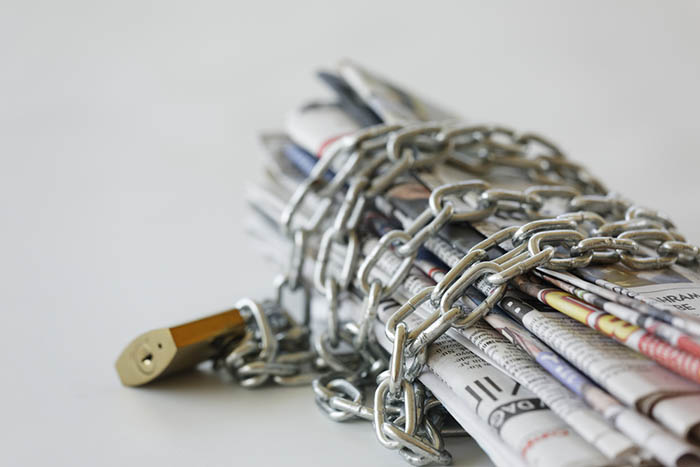
Each week, Index on Censorship’s Mapping Media Freedom project verifies threats, violations and limitations faced by the media throughout the European Union and neighbouring countries. Here are five recent reports that give us cause for concern.
Police detained Aleksandra Ageyeva, a correspondent for the media outlet Sota Vision, at a mass demonstration near the Russian Constitutional Court building on 24 January.
According to Ageyeva, she was detained while filming the detainment of a demonstrator who was protesting against the imprisonment of opposition human rights activist Ildar Dadin.
Dadin is the first Russian citizen to be convicted for a “repeated violation” under a new law on mass rallies and meetings by peacefully protesters. He is currently serving a two-and-a-half year prison sentence and claims that his captors repeatedly abuses him.
A total of four protesters were detained along with Ageyeva at the scene. The police explained that the demonstrators were detained because they were supposedly jaywalking. Ageyeva spent around 11 hours in police custody.
The General Prosecutor’s Office of Belarus ruled to extradite Alexander Lapshin, a Russian-Israeli travel blogger to Azerbaijan, on 20 January.
On 15 December 2016 he was detained in Minsk on an extradition request from Azerbaijan, where he is wanted for visiting the disputed region of Nagorno-Karabakh and for criticising Azerbaijani policies.
A criminal case under two articles of the criminal code was filed in Azerbaijan which, if convicted, can lead to a prison sentence from five to eight years.
Lisa Giachino, editor-in-chief of the environmental magazine L’âge de faire, was arrested on 20 January at the border with Italy in the Roya valley, as she was following migrants for a story, news website Basta reported.
She is believed to have been kept in custody since 5am for “assisting migrants at the border,” and because she does not have a press card the police have refused to believe she is a journalist.
According to Nice Matin newspaper, Giachino was following six migrants for the story.
Giachino was later freed. She told Libération: “[Police officers] told me: ‘If we see you again with migrants, careful!’ It’s not normal to tell this to a journalist.”
Oleksiy Bobrovnikov, an investigative journalist and special correspondent for TSN programme on 1+1 TV channel, publicly wrote on his Facebook on 10 January that he left Ukraine after receiving numerous threats.
Since 2015 Bobrovnikov has been investigating the fatal shooting of officers and volunteers who oppose smuggling along what is known as the “grey zone,” the dividing line between western Ukraine and the self-proclaimed Donetsk and Luhansk People’s Republics.
Bobrovnikov confirmed to Mapping Media Freedom that he left the country in mid-December because he feared his life was in danger. He said he had received five warnings connected with his investigation telling him his life was in danger.
“The threats ranged from a pat on the shoulder to threats coming from people with weapons in their hands. Other people investigating trade with occupied territories also received similar threats,” Bobrovnikov wrote.
According to Ukrayinska Pravda, two individuals working to fight against the smuggling were killed on 2 September 2015, near Schastye, a town in the Luhansk region.
St Helens Council passed a motion on 18 January calling on retailers in the borough to stop selling daily newspaper The Sun, The St Helens Star reported.
The motion is not enforceable by law, but recommends retailers do not distribute the publication.
At the council meeting on Wednesday evening, Parr councillor Terry Shields asked the authority to support the Total Eclipse of The Sun campaign, which the paper’s controversial coverage of the Hillsborough disaster as a reason to boycott.
The campaign describes itself as a peaceful campaign group with more than 50,000 members.
Councillors approved the motion at the town hall. The three Conservative councillors abstained from the vote.
A spokeswoman says: “We have enjoyed great success now having over 240 establishments not selling the paper. This includes small newsagents, major supermarkets and petrol stations. Cafes, pubs, hotels and local hospitals, have also joined in, showing their support to the campaign.”[/vc_column_text][vc_column_text]
Click on the bubbles to view reports or double-click to zoom in on specific regions. The full site can be accessed at https://mappingmediafreedom.org/
[/vc_column_text][/vc_column][/vc_row][vc_row][vc_column][vc_basic_grid post_type=”post” max_items=”4″ element_width=”6″ grid_id=”vc_gid:1485518684846-d4098701-7bc7-6″ taxonomies=”6564″][/vc_column][/vc_row]
27 Jan 2017 | News, Turkey, Turkey Uncensored
[vc_row][vc_column][vc_column_text]
Turkey Uncensored is an Index on Censorship project to publish a series of articles from censored Turkish writers, artists and translators.
[/vc_column_text][vc_video link=”https://youtu.be/LzWBgzJrQdo”][vc_column_text]As tens of thousands of women took to the streets around the world on 21 January, another woman, the Turkish MP Şafak Pavey was being treated in hospital for injuries sustained during a physical assault on the floor of the Grand National Assembly during debates on constitutional amendments.
Pavey had just delivered a moving speech in which she warned that the presidential system being considered would bring about unchallenged one-man rule. The “bandits”, as she called them, a group of women MPs belonging to the ruling AKP, attacked her and two other MPs, Aylin Nazlıaka, an independent, and Pervin Buldan from the Kurdish HDP. The AKP MPs were said to be acting under a male colleague’s orders.
The attack contrasted sharply with the pictures of enthusiastic women from around the United States and the world committed to sisterhood and equality. The distance between the two extremes might seem to be yawning but isn’t. In Turkey, the gap opened up in just four short years.
The empowered mood created by women marching for equal rights and uniting their voices in opposition reminded me of the heady days of 2013 when the anti-government Gezi Park protests rocked Turkey. Like the demonstrators in DC and London, people all over Turkey took to the streets to raise a chant against our own Trump: President Recep Tayyip Erdogan. In Gezi, the seeds of dissent spread through social media and bloomed across the country just as the women’s march did across the globe. It was just the beginning, or so we thought.
After a brutal suppression that left at least 10 dead and over 8,000 injured, the Gezi spirit, that united voice, faded away. The most significant political heritage was the “Vote and Beyond” organisation, which launched an incredibly effective election monitoring network during the June 2015 elections. Thanks to that group and the popular young Kurdish leader Selahattin Demirtaş’s energy, the outcome of the polls reflected the full and complete picture of Turkey’s population in parliament. The combined opposition parties were the majority in the assembly and to continue governing, the AKP would be forced to form a coalition. Then things happened.[/vc_column_text][vc_single_image image=”85130″ img_size=”full” add_caption=”yes”][vc_column_text]As the ceasefire with the Kurdistan Workers’ Party (PKK) collapsed and armed conflict resumed, coalition negotiations ground into political deadlock as the summer wore on. Erdogan called a snap election for that November that lined up with his political ambitions. Less than a month before the election, a staggering terror attack rocked Ankara and ongoing deaths of security personnel in the country’s south-east added to a grim mood. At the polls, the AKP regained its majority in parliament. Though the governing party was nominally back in full control, it lacked political legitimacy and popular support, both of which would be delivered by the rogue military units that staged the failed July 15 coup and paved the way for Erdogan’s emergency rule.
Witch hunts are a strange thing. Even if you spot one when it’s getting underway, it’s always too late to stop it.
After the election, the political opposition was locked out of enacting change through parliament. It was further paralysed by Erdogan’s “shock and awe” tactics, which saw the leaders of the parties assaulted on the floor of the assembly or imprisoned on fabricated terror charges. Opposition voters are too depressed now to remember the confident and exhilarating days of the Gezi protests.
It would be a mistake to dismiss Turkey’s experience as a unique case. There are parallels with the unfolding situations in Russia, Poland, Hungary and now the USA. The bullies of our interesting times are singing from the same hymn sheet, using identical language and narratives — power to the right people, experts and intellectuals are overrated, overturn the establishment. The forces of resistance must now share strategies as well. Opposition to the growing threat of illiberal democracy needs to network and be vocal or else our initial responses to the horrors and human rights violations — including the purge of Turkey’s press under emergency rule — would be a waste of time.
Here’s a small taste of where we failed in Turkey — a warning to Europeans and Americans of what not to do.
“No” is an intoxicating word that gives emotional fuel to the masses. After swimming in the slack waters of identity politics or concerning yourself with whether or not your avocados are fair trade, taking to the streets en masse for a proper cause is like a fresh breeze. But as we learned in Turkey, “No” can also be a dead end. It exists in a dangerous dependency on the what those in power are up to. It shouldn’t be mistaken for action as it is only a reaction.
“No” is unable to create a new political choice. It is an anger game that sooner or later will exhaust all opposition by splitting itself into innumerable causes intent on becoming an individual obstacle to the ruling power.
Make no mistake: the bullies of the world are united in a truly global movement. It is sweeping all before it. And it’s not just Putin, Trump, Erdogan or even Orban, it’s their minions, millions of fabricated apparatchiks that invade the political, social and digital spheres like multiplying gremlins.
What the opposition must do — what Turkey’s protesters failed to do — is strengthen the infrastructure, harden networks and open strong lines of communication between disparate groups whether at home or abroad. All those lefty student movements, marginalised progressive newspapers or resisting communities that are labelled as naïve or passé until now must coalesce around core campaigns and goals.
Failure to move beyond “No”, in Turkey’s case, has made alternative and potential political movements all but invisible. There are just three leftist newspapers in Turkey, three ghosts to break news about women MPs being beaten up. And that’s because we can’t move past “No” when others were shut down or silenced.[/vc_column_text][/vc_column][/vc_row][vc_row][vc_column][vc_basic_grid post_type=”post” max_items=”4″ element_width=”6″ grid_id=”vc_gid:1485771885900-d32a2643-5934-8″ taxonomies=”8607″][/vc_column][/vc_row][vc_row][vc_column][/vc_column][/vc_row]
19 Jan 2017 | Event Reports, News, Volume 45.04 Winter 2016 Extras
[vc_row][vc_column][vc_custom_heading text=”It may be easy to dismiss fashion as a trivial issue, but an expert panel argued otherwise at the launch of the winter 2016 Index on Censorship magazine’s new issue.” font_container=”tag:p|font_size:24|text_align:left” google_fonts=”font_family:Libre%20Baskerville%3Aregular%2Citalic%2C700|font_style:400%20italic%3A400%3Aitalic”][vc_video link=”https://www.youtube.com/playlist?list=PLlUhPA3TuB56uIAdpLWxk_kqBzjVOV9_J” title=”#FashionRules at Google”][/vc_column][/vc_row][vc_row][vc_column][vc_column_text]
“I wasn’t trying to rebel,” former Elle magazine editor Maggie Alderson told the room at the launch of Index on Censorship’s winter 2016 issue Fashion Rules: Dressing to Oppress, which was hosted by Google at its central London offices. “I was just expressing myself.”
Maggie Alderson was speaking about how she was arrested in London as a teenager for wearing a t-shirt featuring two naked cowboys, and she lamented what she sees as a lack of creativity in modern western fashion, longing for the days when she would be frequently shocked and even appalled by designers such as Alexander McQueen.
Alderson was joined by fellow panelists — fashion historian Amber Butchart, New African Woman magazine editor Regina Jane Jere-Malanda, and award-winning journalist Laura Silvia Battaglia — for a wide-ranging discussion chaired by Index magazine editor Rachael Jolley to explore the nexus between fashion and freedom of expression.
Battaglia explained the literal interpretation of the Koran that requires women to cover their faces with “a towel”, and told of a teenage girl in Saudi Arabia who received death threats after posting a selfie without her compulsory abaya, but pointed out that those same sects of Islam also require men to dress a certain way.
Regina Jane Jere-Malanda did not hesitate to call out the misogyny of attitudes to women’s clothing in African countries, telling of how an MP in her home country of Zambia was thrown of Parliament for wearing a skirt that was too short, while Amber Butchart said that people have never liked being ordered to conform, explaining how American sailors used to sew intricate patterns into the inside of their uniforms to express themselves while on shore leave, and mentioning that Tartan became a symbol of Scottish rebellion simply because it was banned by the English.
Audience questions raised new topics such as the politics surrounding black women wearing natural hairstyles, and the taboo on men wearing women’s clothing.
Listen to the #FashionRules playlist.
Thank you to Google for hosting #FashionRules, as well as our publishers SAGE for helping to make the event happen.[/vc_column_text][vc_column_text]You can order your copy of the latest issue here, or take out a digital subscription via Exact Editions. Copies are also available at the BFI, the Serpentine Gallery, MagCulture, (London), News from Nowhere (Liverpool), Home (Manchester), Calton Books (Glasgow) and on Amazon. Each magazine sale helps Index on Censorship continue its fight for free expression worldwide.[/vc_column_text][vc_single_image image=”84974″ img_size=”full” add_caption=”yes” alignment=”center”][vc_media_grid element_width=”3″ grid_id=”vc_gid:1484923141783-3032303e-c962-0″ include=”84955,84957,84958,84959,84960,84961,84962,84963,84965,84966,84967,84968,84969,84970,84971,84972,84973,84974,84975″][/vc_column][/vc_row][vc_row content_placement=”top”][vc_column width=”1/3″][vc_custom_heading text=”Fashion Rules” font_container=”tag:p|font_size:24|text_align:left” link=”url:https%3A%2F%2Fwww.indexoncensorship.org%2F2016%2F12%2Ffashion-rules%2F|||”][vc_column_text]The winter 2016 issue of Index on Censorship magazine looks at fashion and how people both express freedom through what they wear.
In the issue: interviews with Lily Cole, Paulo Scott and Daphne Selfe, articles by novelists Linda Grant and Maggie Alderson plus Eliza Vitri Handayani on why punks are persecuted in Indonesia. Special report on clothes and freedom, how Shakespeare challenges the censors, and assessing Correa’s free speech heritage.[/vc_column_text][/vc_column][vc_column width=”1/3″][vc_single_image image=”82377″ img_size=”medium” alignment=”center” onclick=”custom_link” link=”https://www.indexoncensorship.org/2016/12/fashion-rules/”][/vc_column][vc_column width=”1/3″ css=”.vc_custom_1481888488328{padding-bottom: 50px !important;}”][vc_custom_heading text=”Subscribe” font_container=”tag:p|font_size:24|text_align:left” link=”url:https%3A%2F%2Fwww.indexoncensorship.org%2Fsubscribe%2F|||”][vc_column_text]In print, online. In your mailbox, on your iPad.
Subscription options from £18.
Every subscriber helps support Index on Censorship’s projects around the world.
 SUBSCRIBE NOW[/vc_column_text][/vc_column][/vc_row]
21 Dec 2016 | Magazine, News, Turkey, Turkey Uncensored, Volume 45.04 Winter 2016
[vc_row full_width=”stretch_row” full_height=”yes” equal_height=”yes” css_animation=”none” css=”.vc_custom_1481548134696{background-image: url(https://www.indexoncensorship.org/wp-content/uploads/2016/12/Sevan-Nişanyan-1460×490.jpg?id=82526) !important;background-position: center !important;background-repeat: no-repeat !important;background-size: cover !important;}”][vc_column][/vc_column][/vc_row][vc_row][vc_column][vc_column_text]
Turkey Uncensored is an Index on Censorship project to publish a series of articles from censored Turkish writers, artists and translators.
[/vc_column_text][vc_custom_heading text=”Linguist and newspaper columnist SEVAN NIŞANYAN has found himself locked up for 16 years after being subjected to a torrent of lawsuits. Researcher JOHN BUTLER managed to interview him for the winter 2016 issue of Index on Censorship magazine” font_container=”tag:p|font_size:24|text_align:left” google_fonts=”font_family:Libre%20Baskerville%3Aregular%2Citalic%2C700|font_style:400%20italic%3A400%3Aitalic”][vc_column_text]
Well-known linguist Sevan Nişanyan will not be eligible for parole in Turkey until 2024. Locked up in the overcrowded Turkish prison system, he has found his initial relatively short jail sentence for blasphemy getting ever longer as he has been subjected to a torrent of “spurious” lawsuits on minor building infringements related to a mathematics village he founded.
Nişanyan, who is 60, spoke exclusively to Index on Censorship. He said he was being kept in appalling conditions. Moved from prison to prison since being jailed in January 2014, he is now being held in Menemen Prison, a “massively overcrowded and brain- dead institution”.
He added: “About two thirds of our inmates were recently moved elsewhere and the remainder pushed ever more tightly into overpopulated wards to make room for the thousands arrested in the aftermath of the coup attempt.”
[/vc_column_text][/vc_column][/vc_row][vc_row css=”.vc_custom_1481550218789{padding-bottom: 40px !important;}”][vc_column width=”1/4″][vc_icon icon_fontawesome=”fa fa-quote-left” color=”custom” size=”xl” align=”right” custom_color=”#dd3333″][/vc_column][vc_column width=”3/4″][vc_custom_heading text=”Nişanyan is adamant that his time has not been wasted. He has been working on the third edition of his Etymological Dictionary of the Turkish Language, which presently stands at over 1500 pages“” font_container=”tag:h2|font_size:24|text_align:justify|color:%23dd3333″ google_fonts=”font_family:Libre%20Baskerville%3Aregular%2Citalic%2C700|font_style:400%20italic%3A400%3Aitalic” css_animation=”fadeIn”][/vc_column][/vc_row][vc_row][vc_column][vc_column_text el_class=”magazine-article”]
Nişanyan’s ordeal started in 2012 when he wrote a blog post about free speech arguing for the right to criticise the Prophet Mohammed. Through notes passed out of his high security prison via his lawyer, Nişanyan told Index what he believes happened next:
“Mr Erdoğan, the then-prime minister, believes in micromanaging the country. He was evidently incensed.
“I received a call from his office inquiring whether I stood by my, erm, ‘bold views’ and letting me know that there was much commotion ‘up here’ about the essay. The director of religious affairs, the top Islamic official of the land, emerged from a meeting with Erdoğan to denounce me as a ‘madman’ and ‘mentally deranged’ for insulting ‘our dearly beloved prophet’.
“A top dog of the governing party, who later became justice minister, went on air to assure us that throughout history, no ‘filthy attempt to besmirch the name of our holy prophet’ has ever been left unpunished. Groups of so- called ‘concerned citizens’ brought complaints of blasphemy against me in almost every one of our 81 provinces. Several indictments were made, and eventually I was convicted for a year and three months for ‘injuring the religious sensibilities of the public’.”
But what happened afterwards was even more sinister. He found himself, while in prison, facing eleven lawsuits relating to a village he was building with the mathematician and philanthropist Ali Nesin. Nişanyan has been involved for many years in a project to reconstruct in traditional style the village of Şirince, near Ephesus, on Turkey’s Western seaboard. It is now a heritage site and popular tourist destination. And nearby, he and Nesin have built a mathematics village which offers courses to mathematicians from all over Turkey and operates as a retreat for maths departments in other countries. They hope it will be the beginnings of a “free” university.
[/vc_column_text][/vc_column][/vc_row][vc_row css=”.vc_custom_1481549931165{padding-bottom: 40px !important;}”][vc_column width=”1/4″][vc_icon icon_fontawesome=”fa fa-quote-left” color=”custom” size=”xl” align=”right” custom_color=”#dd3333″][/vc_column][vc_column width=”3/4″][vc_custom_heading text=”Jailing a non-Muslim, an Armenian at that, for speaking rather mildly against Islamic sensibilities… would be a first in the history of the Republic“” font_container=”tag:h2|font_size:24|text_align:justify|color:%23dd3333″ google_fonts=”font_family:Libre%20Baskerville%3Aregular%2Citalic%2C700|font_style:400%20italic%3A400%3Aitalic” css_animation=”fadeIn”][/vc_column][/vc_row][vc_row][vc_column][vc_column_text]
It was this project the Turkish authorities decided to focus on. Nişanyan was given two years for building a one-room cottage in his garden without the correct licence, then two additional years for the same cottage. Nine more convictions for infringements of the building code followed, taking his total term up to 16 years and 7 months.
He, and many others, are convinced that this is a political case, because jail time for building code infringements is almost unheard of in Turkey. He believes the authorities have prosecuted him for these crimes because they do not want his case to cause an international stir.
“Jailing a non-Muslim, an Armenian at that, for speaking rather mildly against Islamic sensibilities… would be a first in the history of the Republic,” he told Index. “It might raise eye- brows both here and abroad.”
Despite everything, Nişanyan is adamant that his time has not been wasted. He has been working on the third edition of his Etymological Dictionary of the Turkish Language, which presently stands at over 1500 pages.
On entering prison, he signed away most of his property, including the copyright to his books, to the Nesin Foundation which runs the mathematics village he is so passionate about. Today the village has added a school of theatre. A philosophy village is the next project in the works.
“The idea is, of course, to develop all this into a sort of free and independent university,” he said. “I am sure the young people who have come together in Şirince for this quirky little utopia will have the energy and determination to go on in my absence.”
[/vc_column_text][vc_column_text]
John Butler is a pseudonym
[/vc_column_text][vc_column_text]
[/vc_column_text][/vc_column][/vc_row][vc_row][vc_column][vc_custom_heading text=”From the Archives”][vc_row_inner][vc_column_inner width=”1/3″][vc_single_image image=”90772″ img_size=”213×289″ alignment=”center” onclick=”custom_link” link=”http://journals.sagepub.com/doi/pdf/10.1080/03064229908536530″][vc_custom_heading text=”Slapps and chills” font_container=”tag:p|font_size:24|text_align:left” link=”url:http%3A%2F%2Fjournals.sagepub.com%2Fdoi%2Fpdf%2F10.1080%2F03064229908536530|||”][vc_column_text]January 1999
Julian Petley’s roundup looks at the bullying of broadcasters and asks: are they being SLAPPed around?[/vc_column_text][/vc_column_inner][vc_column_inner width=”1/3″][vc_single_image image=”89167″ img_size=”213×289″ alignment=”center” onclick=”custom_link” link=”http://journals.sagepub.com/doi/pdf/10.1177/0306422010388687″][vc_custom_heading text=”Survival in prison” font_container=”tag:p|font_size:24|text_align:left” link=”url:http%3A%2F%2Fjournals.sagepub.com%2Fdoi%2Fpdf%2F10.1177%2F0306422010388687|||”][vc_column_text]December 2010
Detained writers suffer from violence, humiliation and loneliness – writing is their only solace.[/vc_column_text][/vc_column_inner][vc_column_inner width=”1/3″][vc_single_image image=”93991″ img_size=”213×289″ alignment=”center” onclick=”custom_link” link=”http://journals.sagepub.com/doi/pdf/10.1080/03064228408533768″][vc_custom_heading text=”Writers on trial” font_container=”tag:p|font_size:24|text_align:left” link=”url:http%3A%2F%2Fjournals.sagepub.com%2Fdoi%2Fpdf%2F10.1080%2F03064228408533768|||”][vc_column_text]October 1984
The trial outcome is uncertain, but it could mean putting Turkey’s leading intellectuals behind bars for 15 years.[/vc_column_text][/vc_column_inner][/vc_row_inner][vc_separator][/vc_column][/vc_row][vc_row][vc_column width=”1/3″][vc_custom_heading text=”Fashion Rules” font_container=”tag:p|font_size:24|text_align:left” link=”url:https%3A%2F%2Fwww.indexoncensorship.org%2F2016%2F12%2Ffashion-rules%2F|||”][vc_column_text]The winter 2016 issue of Index on Censorship magazine looks at fashion and how people both express freedom through what they wear.
In the issue: interviews with Lily Cole, Paulo Scott and Daphne Selfe, articles by novelists Linda Grant and Maggie Alderson plus Eliza Vitri Handayani on why punks are persecuted in Indonesia.[/vc_column_text][/vc_column][vc_column width=”1/3″][vc_single_image image=”82377″ img_size=”medium” alignment=”center” onclick=”custom_link” link=”http://www.indexoncensorship.org/2016/12/fashion-rules/”][/vc_column][vc_column width=”1/3″][vc_custom_heading text=”Subscribe” font_container=”tag:p|font_size:24|text_align:left” link=”url:https%3A%2F%2Fwww.indexoncensorship.org%2Fsubscribe%2F|||”][vc_column_text]In print, online. In your mailbox, on your iPad.
Subscription options from £18 or just £1.49 in the App Store for a digital issue.
Every subscriber helps support Index on Censorship’s projects around the world.
SUBSCRIBE NOW[/vc_column_text][/vc_column][/vc_row]
