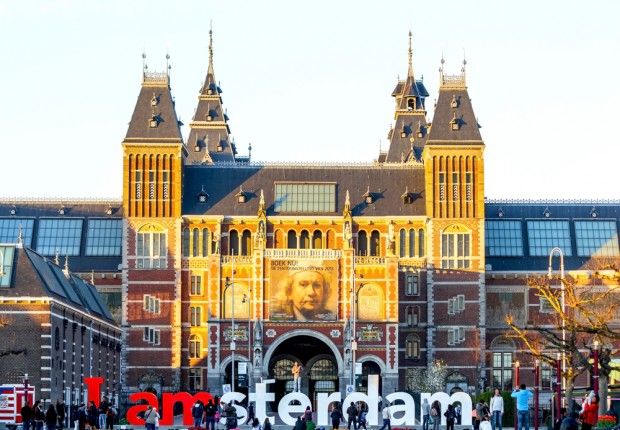
Amsterdam’s Rijksmuseum is in the process of removing terms visitors may find offensive, including “negro”, “dwarf” and “Indian”, from digitised titles and descriptions of around 220,000 pieces of artwork, replacing them with less racially-charged terminology.
The titles of 8,000 pieces of art on display were updated in time for the museum’s reopening in 2013 after a decade-long renovation, and the museum has now begun work to remove “offensive” language from the museum’s digitised collections.
This includes a 1900 painting by Dutch artist Simon Maris originally called “Young Negro-Girl” which will now be called “Young Girl Holding a Fan”.
“We Dutch are called kaas kops, or cheeseheads, sometimes, and we wouldn’t like it if we went to a museum in another country and saw descriptions of images of us as ‘kaas kop woman with kaas kop child’,” she added: “And that’s exactly the same as what’s happening here.”
Other words to be removed from the collections include Mohammedan, an old word for Muslim; and Hottentot, a name given to Dutch people by the Khoi people of South Africa, meaning stutterer.
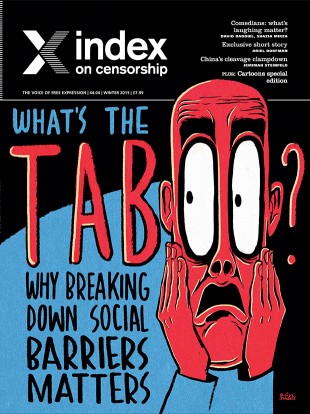
In the latest issue of Index on Censorship magazine, which tackles taboos and the breaking down of social barriers, Kunle Olulode discusses the problems with editing out racist language from books and films. “Should we not accept that films and TV programmes set in the past will include some stereotypical images of minorities?”, he writes. However uncomfortable these words may seem, they should not be censored as they provide vital insights into history.
The winter 2015 issue of Index on Censorship magazine, focusing on taboos. Cover image by Ben Jennings
Join Index on Censorship for a taboo-busting evening at London’s best alternative venue – the Royal Vauxhall Tavern – to celebrate the launch of What’s the Taboo? – Index’s latest magazine featuring stories of the most controversial subjects from around the world.
With a panel that includes comedians Shazia Mirza and Grainne Maguire – we’ll be tackling tricky subjects – nudity, atheism, porn in China, mental health and racism could all be on the cards. If you want to explore and question who makes the rules when it comes to taboos – join us for what will be a dynamic evening exploring the unthinkable, the unmentionable and the unacceptable.
Following the panel event stick around for a special DJ set – Taboo Disco!
When: Wednesday 27 January 6:00pm – 11:00pm (6:00pm: Doors open & drinks; 6:30-8:00pm: What’s the Taboo?; 8:00-11pm: Taboo Disco DJ set) Where: The Royal Vauxhall Tavern, 372 Kennington Lane, London SE11 5HY (map) Tickets: Free but limited. Tickets must be booked in advance by emailing: [email protected]
More on the speakers:
Shazia Mirza is an award-winning comedian and columnist. TV Appearances include: Have I Got News For You, F*** Off, I’m a Hairy Woman, NBC’s Last Comic Standing and Richard and Judy. In 2008, she was listed in The Observer as one of the 50 funniest acts in British comedy and won the GG2 Young Achiever of the Year Award. Her current show The Kardashians Made Me Do It is on tour at the moment.
Grainne Maguire is a stand up comedian and comedy writer. She has appeared on Stewart Lee’s Alternative Comedy Experience, Radio 4’s Now Show, Stephen K Amos’ An Idiots Guide, Front Row and Women’s Hour. Last year her campaign to tweet Taoiseach Enda Kenny her menstrual cycle to protest against Ireland’s abortion laws went viral.
Kunle Olulode is director of black campaigning infrastructure charity Voice4Change England. He is also a film historian and exhibitor and part of the BFI’s African Odyssey programming team.
Max Wind-Cowie is a writer and political consultant. He previously ran the Progressive Conservatism project at the thinktank Demos and has written for newspapers including The Guardian, and the London Evening Standard.
Before 24 November, Turkey was described in Russian news reports as a reliable partner in ambitious projects (TurkStream pipeline, construction of Sochi’s Olympic venues), a source of fruits and vegetables in a period of European food embargoes and Crimea blockade, and one of the main tourist destinations, visited annually by over three million Russians.
But after the downing of the Russian fighter jet, Turkey became the target of a new information war. Reports on estimated growth of turnover and perksat Turkish resorts in Russian state-run media were replaced by a long list of accusations.
Dmitry Kiselev, the head of a state international news agency Rossiya Segodnya and the anchorperson of a weekly programme Vesti Nedeli accused Turkey of buying oil from the Islamic State, exporting carcinogenic vegetables to Russia and trying to revive the Ottoman Empire. Vladimir Soloviev, a popular anchorperson on television channel Rossiya 1, labeled Turkey a sponsor of terrorism.
All media platforms, directly or indirectly controlled by the state, were used in the construction of an image of a new enemy. The past was revised by articles, recalling a long history of Russian-Turkish wars and crimes of the Ottoman Empire. The future was programmed by analysing chances in a possible third world war. Coverage of current affairs has become far from unbiased. News selection has been focused on demonstration of Russia’s sanctions effects and Turkey’s internal problems — oppression of journalists, a growth of child marriage and crime.
After weeks under information attack, on 3 December, Turkish Prime Minister Ahmet Davutoglu dismissed the allegations by Russian media as “lies of this Soviet-style propaganda machine”.
“In the Cold War period, there was a Soviet propaganda machine. Every day it created different lies. Firstly, they would believe them and then expect the world to believe them. These were remembered as Pravda lies and nonsense,” he said.
Days later the Russian state news agency RIA Novosti proved his point by using a classic Soviet propaganda trick. In an op-ed that called Davutoglu “Reich Minister”, RIA Novosti compared the new enemy to the old by appealing to one of the most loathed images for all Russian people since the WWII – Nazi Germany.
This method, as with many others used against Turkey, has been tested and mastered during the Ukrainian crisis. Maidan activists, who later became a new elite of the country, were also labeled by Russian television channels as “fascist nationalists” and “extremists”. The technology of information war, the main propaganda mouthpieces and the image of the enemy remain the same.
On 7 December, Russian Public Opinion Research Center (VTsIOM) published the results of its survey, saying that 73% of Russian population have changed their attitude to Turkey to the worse since the downing of Su-24.
VTsiom, whose director admitted that the main clients of the center are the Kremlin and the ruling party United Russia, has been criticised for manipulation. The results of the survey are symptomatic. If the data is correct, it demonstrates that anti-Turkey propaganda works very well. If the results were rigged in favour of the Kremlin’s agenda, it shows the desirable goal of the information attack.
The day after, on 8 December, a film crew from Russia’s state television channel Rossiya 1 was detained in the Turkish province of Hatay, close to the Syrian border, and deported from the country because of “violations of regulations of work of foreign journalists in the Turkish Republic”. The Ministry of Foreign Affairs of the Russian Federation responded with harsh critiques, accusing Turkey of “a series of infringements of the rights of local and foreign journalists”.
However, in a communique by OSCE Representative on Freedom of the Media on propaganda in times of conflicts, published last year in reference to a similar case related to the Ukrainian crisis, Dunja Mijatović made it clear that censoring propaganda is not the way to counter it. The best way to neutralise propaganda is balance and accuracy in broadcasting, independence of media regulators, prominence of public service broadcasting with a special mission to include all viewpoints, a clear distinction between fact and opinion in journalism and transparency of media ownership.
A similar view was expressed in a speech by Agnès Callamard, the former executive director of ARTICLE 19, delivered at UN Headquarters in December 2014.
“Hatred needs and is fed by censorship, which, in turn, is needed to nurture incitement to the actual commission of atrocity crimes. The lesson is clear: In our efforts to prevent mass atrocities, the free flow of information and freedom of expression are ultimately are our key allies – not our enemies.”
Documentary It Is Forbidden to Talk in Angola tells the story of the 15 young adults who were accused of planning a rebellion against the government of José Eduardo Dos Santos for taking part in a book club. It is released for the first time with English subtitles by Index in conjunction with Brazil’s award-winning investigative journalists Agencia Publica.
Filmed over 25 days by award-winning journalists Natalia Viana and Eliza Capai from Agencia Publica, It Is Forbidden to Talk in Angola tells the story of the young rappers and activists who are being tried for reading a book by US Nobel Prize nominee Gene Sharp, called From Dictatorship to Democracy, A Conceptual Framework for Liberation.
The activists are facing trial on charges of “preparing acts of rebellion and plotting against the president and state institutions”, which are considered crimes against the security of the Angolan state. If found guilty they could face heavy prison sentences of up to 12 years. Some of the 15 jailed activists were kept in pre-trial detention for 177 days, exceeding the 90 days allowed by Angolan law.
The activists were told on 15 December that they would be sent home and placed under house arrest, according to MakaAngola.org.
Some of the jailed activists went on hunger strike to protest their arrest and detention. Rapper Henrique Luaty Beirão ended his hunger strike on October 27, after 36 days, following requests by his family and friends. He remains in serious condition.
Viana and Capai met several members of Central Angola, a community journalist and activist website whose members have received threats, have been beaten and are constantly surveilled by the security services of the Angolan government. Laurinda Gouveia, a 26-year old philosophy student, told the interviewers how she was beaten with metal bars for two hours in November 2014 for filming a small protest against the government.
“I felt their anger when the police beat me up. They kept saying: ‘You shouldn’t get involved in this, you are a woman, you should think about having a husband and a family… By the way we are beating you up, you will not be able to have babies’,” Gouveia told the journalists.
Following the interview, Gouveia was included in the state prosecutor’s investigation and is now on trial with her colleagues.
Viana and Capai also interviewed rapper Beirão’s family, after which the two journalists were targeted by Angolan authorities. Five days later, while in a public square during an event to mark the president’s birthday, the journalists said they were attacked by two members of the security forces. Disguised as “thieves”, the individuals stole the journalists’ equipment. Shaken, the two sought protection from the Brazilian embassy.
It Is Forbidden to Talk in Angola is a first-hand account of how Dos Santos’ regime works to intimidate anyone who questions his power, and it is released here for the first time with English subtitles.
Agencia Publica is a non-profit investigative journalism organisation that seeks to provide non-partisan reporting in the public interest on Brazilian and Latin American issues.

 Shazia Mirza is an award-winning comedian and columnist. TV Appearances include: Have I Got News For You, F*** Off, I’m a Hairy Woman, NBC’s Last Comic Standing and Richard and Judy. In 2008, she was listed in The Observer as one of the 50 funniest acts in British comedy and won the GG2 Young Achiever of the Year Award. Her current show The Kardashians Made Me Do It is on tour at the moment.
 Grainne Maguire is a stand up comedian and comedy writer. She has appeared on Stewart Lee’s Alternative Comedy Experience, Radio 4’s Now Show, Stephen K Amos’ An Idiots Guide, Front Row and Women’s Hour. Last year her campaign to tweet Taoiseach Enda Kenny her menstrual cycle to protest against Ireland’s abortion laws went viral.