19 Sep 2014 | Events
Wednesday, September 24, 9am PT/12pm ET/5pm BST
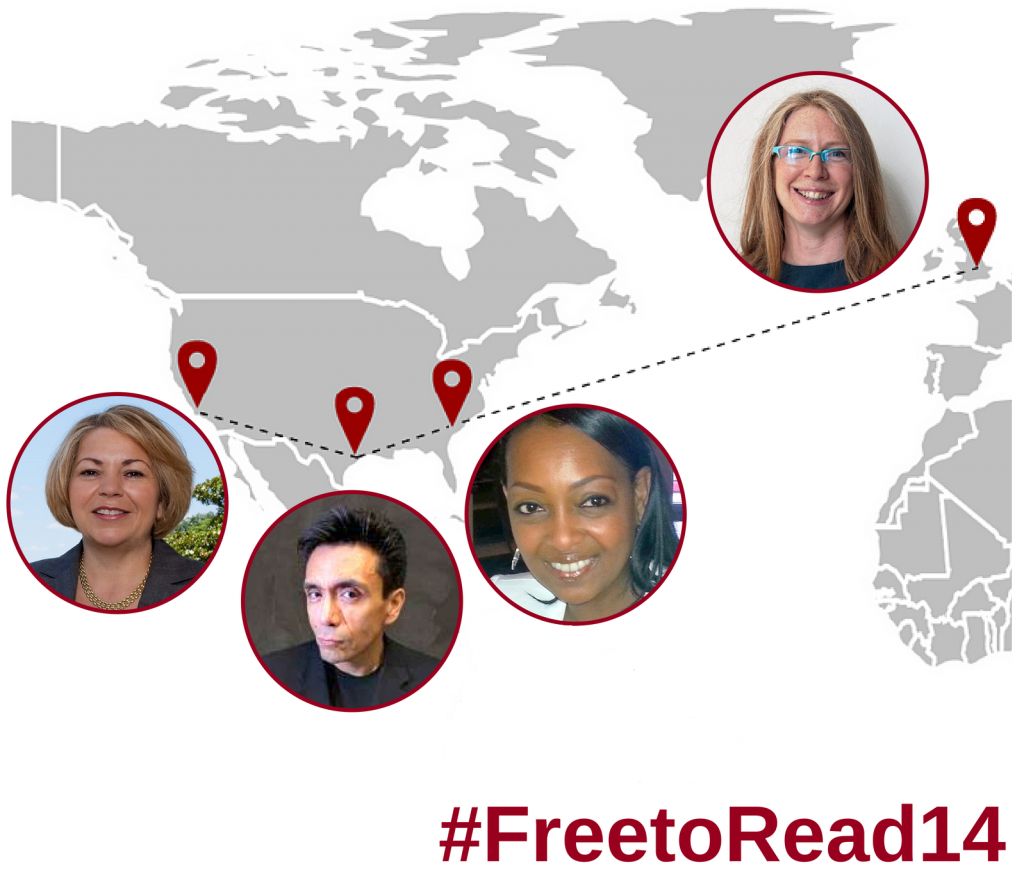
In 2013, there were 307 reported requests for books to be removed from America’s libraries, potentially putting those volumes out of reach of students, readers, and learners of all types. While every corner of the map faces unique issues related to library censorship, these issues also catalyze passionate freedom-to-read advocates dedicated to getting the books back on library shelves. In this one-hour webinar, we will “travel” from London, to South Carolina, to Texas, to California, to talk with three activists about the problems they face and their efforts to un-ban books as well as Congresswoman Linda Sanchez about why their efforts are so important.
London, UK: Jodie Ginsberg, CEO of Index on Censorship, will start us off by discussing issues faced outside of the U.S. and how Index chooses to respond.
Charleston, South Carolina: We will then travel to Charleston — where the graphic novel Fun Home: A Family Tragicomic by Alison Bechdel has been a flashpoint in a university funding controversy — to hear from Shelia Harrell-Roye, a committee member from Charleston Friends of the Library. With the 2014 Banned Books Week focus on graphic novels, Harrell-Roye will discuss what her group has been doing to support this critically acclaimed book.
Houston, Texas: Moving westward, we will travel to Houston to hear from Tony Diaz, author, radio host, and leader of El Librotraficante. Diaz is a champion for banned books and for ethnic studies textbooks in both Arizona and Texas.
This banned books journey will end in California where Congresswoman Linda Sánchez of the CA 38th District, will offer some closing remarks about why the freedom to read is so important for our nation’s future. Afterward, our very own Ed McBride will wrap up the conversation from Thousand Oaks, CA.
Wednesday, September 24, 9am PT/12pm ET/5pm BST
Registration is free, but spaces are limited. (Note: On the following screens you will be asked to set your timezone preferences, then click register on the third screen to reserve your spot.)
Planning to attend? Let your social space know about this important event using #FreetoRead14.
18 Sep 2014 | Armenia, Azerbaijan, Azerbaijan News, News, Turkey
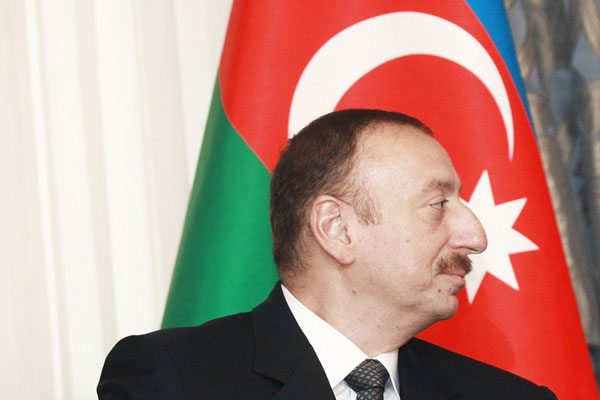
On 5 September, Azerbaijaini president Ilham Aliyev addressed the Nato summit at the Celtic Manor golf resort in Newport, Wales.
It was an unspectacular speech from an unspectacular autocrat. As he often does, he talked about the amount of money Azerbaijan was spending abroad, Azerbaijan’s rapid economic development, Azerbaijan’s role as a bridge between east and west, and Azerbaijan’s continuing dispute with Armenia.
The dispute between the two countries over the territory of Nagorno-Karabakh, which has gone on pretty much since the break-up of the Soviet Union, flared as recently as this summer, when fourteen Azerbaijani troops were killed in clashes with their Armenian counterparts. It was easy to miss this, considering events in other parts of the former Soviet Union. As seems usual in international conflict now, neither side made any gain and both sides claimed victory.
A few weeks after that skirmish, and just before his Nato address, Aliyev met recently-elected president (formerly prime minister) Recep Tayyip Erdogan of Turkey. Aliyev is keen to build an alliance with Turkey, and clearly sees common cause in a shared dislike of Armenia. After the meeting, the Azerbaijani leader tweeted that “Turkey has always pursued an open policy on the issue of the Armenian-Azerbaijani conflict over Nagorno-Karabakh, has always stood by Azerbaijan, stood by truth, justice and international law.” He went on:
This was interesting, in that Erdogan did not seem to mention any discussion of the Armenian genocide in his press briefing after the meeting. In fact, the Turkish president has been perceived as attempting to soften the Turkish state’s hardline denial of the incidents of 1915, when one million Armenians suffered deportation and death at the hands of the Ottoman Empire, the predecessor of modern Turkey.
In April, on the 99th anniversary of the beginning of the ethnic cleansing of Armenians, Erdogan released a statement saying: “Millions of people of all religions and ethnicities lost their lives in the first world war. Having experienced events which had inhumane consequences – such as relocation – during the first world war should not prevent Turks and Armenians from establishing compassion and mutually humane attitudes towards one another.”
The Justice and Development (AK) party leader went on to express condolences to the descendants of people who had died “in the context of the early 20th century”.
Now, this isn’t quite an apology; it’s barely even an apology at upset caused. It’s closer to the “mistakes were made” formulation, which is designed not so much to pass the buck as fire the buck into the heart of the sun in the hope that no one will ever have to deal with it again, particularly not the person whose buck it is in the first place.
But in the context of Turkey, where not long ago talking about the Armenian genocide could get you killed, it’s as good as you’re going to get for now.
So why would Aliyev raise the genocide issue this month? Perhaps he is nervous that Turkey, a major ally in the Nagorno-Karabakh dispute, is going soft on Armenia. This year’s detente between Turkey and Armenia continued when Armenia’s foreign minister Eduard Nalbandian attended Erdogan’s presidential inauguration at the end of August.
Nalbandian, in return, formally offered Erdogan an invitation to Armenia’s genocide commemorations next year, repeating an invitation first extended a few months ago by the country’s president Serzh Sargsyan. Any newfound good relations between Armenia and Turkey would severely weaken Azerbaijan’s territorial argument, or more accurately, weaken its ability to make the argument forcefully in the international arena. Turkey’s dispute with Armenia, after all, is mainly historic, and Erdogan, having seemingly consolidated his own power base outside of both the secular “deep state” and the Islamic Gülen movement to which many assumed he owed his success, now has a free hand on shaping foreign policy. Azerbaijan’s dispute with Armenia is current and, Aliyev hopes, immediate.
And so Azerbaijan has chosen to try to reignite the issue for its own ends. Meanwhile, in his own country, human rights abuses continue, with reports last week that Leyla Yunus, Director of the Institute for Peace and Democracy, was in ill health after prison beatings.
In spite of all this, Azerbaijan will continue to attempt to buy respectability. Next June, Baku will hold the first “European Games”, backed by the European Olympic Committee, featuring such irrelevancies as three-a-side basketball and beach soccer. It is not exactly the real thing, but then, post-Soviet Azerbaijan is a country built of facades; facades of modernity and wealth and progress and “democracy”. Facades that hide an underlying ugliness.
This article was posted on Thursday 18 Sept 2014 at indexoncensorship.org
17 Sep 2014 | Artistic Freedom, Index Arts, News, Religion and Culture, Turkey
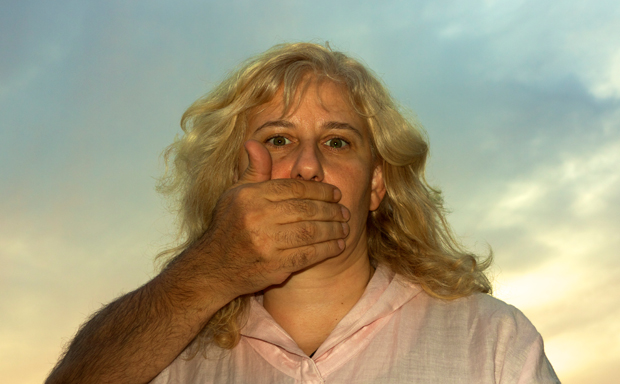
Meltem Arikan is a Turkish playwright living in the United Kingdom.
“Oh, but of course,
you women have the right to speak!
Oh, but of course,
you have the right to laugh!
Oh, but of course,
you have a say over your bodies…
Oh, but of course,
freedom of expression!”
So they say, but in Turkey,
silence grows daily ever heavier
as the culture of fear expands.
If I shout ‘enough’,
will anyone hear my voice?
My voice…
a woman’s voice…
Aren’t women’s voices equivalent to muteness in Turkey?
As women begin to step outside the frames of their lives,
as modern tools for communication enlighten them about the world beyond,
the more curious they become
the more they inquire
the more they change
the more they demand more from their lives.
They dare to say no,
And they become those dangerous women
who are attempting to break the order…
Women, forced into passivity
scared to be counted as trouble makers,
they must be content to accept
the scraps thrown from men’s tables.
The traditional culture engenders fear
the fear of failure:
failing to satisfy the expanding demands of women
men lose self confidence,
when their constructed masculinity is perceived to be at risk,
they will stoop to violence and kill women and children.
So there are men
who feel that their manhood is under threat,
who take issue with their wives’ increasing demands,
who applaud this authoritarian system of government
as an example of how to deal with these problems.
Authority approves violence towards women,
the young and lesbian,
gay, bisexual and transgender people
by extending clemency to perpetrators of violence
instead of punishing them with the severity they deserve.
So there are men
Who are afraid facing up to their fear and pain.
Recoiling from pain and embarrassment of what has happened to them, rebound towards leaders
who apportion them so called high ideals.
So these men have become as dishonorable as the ones
who govern the country through fear and oppression.
Leaving aside, for the moment,
their antagonism towards organized resistance and protest,
just think: they can’t bear you,
the individual woman,
expressing your feelings
beyond the limitations they’ve decreed.
They can’t control their desire to destroy those
who raise their voices
who show resistance to their flawed dominance.
They’re always on the look-out for
the ‘other’,
an individual
or a group:
a race,
a sect
or a religion
on whom to project their hatred
and take revenge.
To mitigate their pain,
they target women,
the young:
anyone
or anything
that reminds them of their own inadequacies
and limitations.
Oppression first manifests in discourse…
Women are should have three children…
Women unveiled are like houses without curtains,
for rent or sale…
Women confirm that women who are raped
are at fault for wearing low cut dress.
It must be true: it’s reported in the press.
Women should not laugh in public.
Girls and boys must be educated separate.
No matter how much they want,
women can no longer shout out loud.
Enough is enough?
They cannot do it.
Shouting? Forget it!
Any female expression results in accusations,
exclusion and irreversible judgments.
If despite this
a woman insists on speaking her thoughts,
she will get a violent response
or at its extreme,
homicidal.
Perpetrate a greater violence
by politicking over women bodies
A genuine course of action against violence
would entail taking
their hands,
their politics
their ideas off women.
If I shout ‘enough’,
will anyone hear my voice?
My voice…
a woman’s voice…
Aren’t women’s voices equivalent to muteness in Turkey?
This poem was published on Wednesday Sept 17 at indexoncensorship.org
8 Sep 2014 | Iran, Middle East and North Africa, News, Religion and Culture
I’m a hand that has become a fist…
I’m a Shia in Bahrain, I’m an Armenian in WWI
I’m the one who is starving, with ribs obvious from starvation
They are raping someone and I am the sound of the agonised screaming
When they tell him or her “relax, so that we can enjoy it, whore”, I’m that tense muscle
I’m an Afghan homosexual woman that lives in Iran
Iranian rapper Soroush Lashkari, aka Hichkas, is sharing extracts from an unfinished song for his new album Mojaz, translating the lyrics into English on the spot. Hichkas (Nobody) has been called the godfather of Iranian hip-hop, which seems fitting for a man who turned the local calling code for Tehran — 021 — into song and a sign language that became the symbol of the Iranian hip-hop movement and its followers. But being a hip-hop artist in a country where the genre is banned comes with many challenges.
“When we made physical copies of our first album Jangale Asphalt in 2006, we were arrested whilst selling it on the streets of Tehran,” Hichkas, now in his late twenties, tells Index on Censorship. “You can’t just sell records in Iran, you need to seek approval from the authorities before you release anything or perform concerts. There is no structure or support system for musicians to perform freely, and in particular for hip hop artists.”
Anyone who wishes to publish, distribute or perform music in Iran is required to submit their work for review by the Ministry of Culture and Islamic Guidance (MCIG), which is guided by Islamic law in force since the country’s 1979 revolution. The MCIG operates under the influence of the minister of culture, who is chosen by the president and the parliament. Even if the amount of freedom artists may experience varies under each presidency, all recordings submitted are archived to ensure the authenticity of Iranian musical culture is maintained. Exposure to Western music is also heavily scrutinised with genres such as hip-hop banned altogether. The implication is that musicians adopting traditional Iranian standards are favoured over artists incorporating external sounds tainted with “decadence”. The name of Hichkas’ upcoming album Mojaz -– meaning an album or artwork within the mojavez, the seal of approval required from the MCIG to sell records in the country.
The advent of the internet has provided an opportunity for musicians to challenge official censorship. The MCIG measures, designed with the intention to control the relationship between musician and audience within Iran’s geographical borders, often lead to long waits for recordings to be released. Digital technologies allow artists to distribute music produced in home-based studios or in secret locations, bypassing official channels. The web had a particular effect on Iranian hip-hop, helping rappers facilitate their own version of concerts through mobile phone video uploads and live streaming.
A figurehead in developing these alternative systems of dissemination, Hichkas argues the intention was not to go against the revolutionary regime as part of a political act. “Even if the laws allowed rappers to release music freely, consumers of music around the world were already shifting towards buying internet downloads,” he says. “In other words, the crisis of selling music was not unique to Iran; the real problem back home is that there is no way of making money from shows with rappers not being allowed to perform.”
But having been arrested numerous times for his work, it’s clear that even if you claim to shun politics, everything becomes political under a paranoid regime. “I’m actually a quiet person,” he said.
Hichkas doesn’t replicate American accents and maintains his typically Iranian appearance, blending in with those on the street. Most importantly, he embraces literary devices rooted in traditional Iranian poetry and turns it into conversational street talk that engages the disillusioned.
“I don’t like the blinging culture of hip-hop made in America that celebrates money and fakeness,” he said. “Me and my friends were teenagers making music that described our own culture, the society we grew up in, and challenging the clichés associated with it.”
He argues that the absence of hip-hop from the Iranian music scene is due to the lack of artists adopting the genre, rather than the association of hip-hop as a Western import. “No one had adopted rap to make music about our culture before us, so it was inevitable to be the first in finding that path for hip-hop to be heard,” he says. “We set standards through being driven by the love of what we were doing, which forced authorities to catch up and think about how investments can be made into a growing movement.”
Being a pioneer in developing a distribution network meant Hichkas’ many supporters outside of Iran began facilitating performances for him abroad in 2011, helping him get visas and opportunities to lecture at leading universities. Now based in London and juggling studio time alongside college work, he hopes his work on Mojaz “will add more substance to the poetry” and “set new benchmarks musically within the global standards of hip-hop by making it experimental but at the same time catchy”.
While he admits that rapping in Farsi is “a big barrier” to international audiences, he hopes the inclusion of English subtitles will help listeners find common ground across cultures. “Although previous songs were written in Iran and made in Iran, my lyrics were against evil deeds all around the world,” he explains. “They were against human discrimination in general. I want to continue writing something that engages my audience back home by addressing issues I have always talked about. I will use different lyrics, matching together social problems worldwide to scenes and characters that they can relate to.”
He says being in London, and having the opportunity to meet people from all over the world “helps me think about humanity through discovering common viewpoints.” The relocation also means working out new processes of distribution, from the logistics of sharing music from outside Iran, to the adoption of technological developments such as the bitcoin.
Navigating the external restrictions in his work has in itself become an art in the development of hip-hop. Working alongside long-time producer Maghdyar Aghajani, Hichkas preserves Iranian roots in his work whilst ensuring he can make his mark on the world wide hip-hop scene by making “a more complex music rather than the typical hip-hop” in his upcoming album.
“Self-censorship actually helps you to have more impact,” Hichkas argues. “Regardless of what the authorities say, if you come out in an extremely raw way in a closed society, people are not going to understand you. Also, if someone can’t go back to his or her society, how is he or she able to see what’s going on internally in his or her country? Why say something if you end up in jail for three years?”
He has tried writing about who he would be if he didn’t live under these rules, but gave up. “It just didn’t work,” he explains, “the lyrics wouldn’t flow, simply because I felt I would still be the same person, pushing boundaries through talking about whatever is going on around me from the culture I come from.” He says he wants to study psychology, “to understand how these cultures shape people, including those who choose to go into government.”
“Therefore, my music is not aimed at changing politics, but changing something at a grassroots level.”
This article was posted on 8 Sept 2014 at indexoncensorship.org