22 Aug 2014 | Egypt, Middle East and North Africa, News
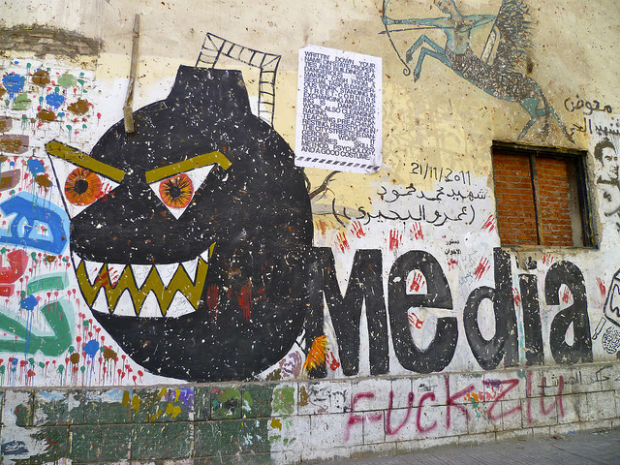
Street art from Mohamed Mahmoud Street, Cairo. (Photo: Melody Patry/Index on Censorship)
Before the January 2011 uprising, street art was little known in Egypt. Then came the revolution and with it, an outburst of creativity.
With the fall of the authoritarian regime of Hosni Mubarak, Egyptian artists who had routinely faced censorship restrictions under his autocratic rule, felt a strong urge to break out of the confines of their studios and reclaim public spaces. Young artists in particular, decided they needed bigger canvases for the grand ideas they wanted to convey through their paintings. To celebrate their newfound liberation, many of them took their art directly to the people and onto the streets, expressing their views and opinions on public walls and on the sides of buildings.
Bonded by their shared aspirations for a better Egypt, the young graffiti artists spent long hours working together, creating vivid group murals that told the stories of the revolution in which they had actively participated. The images they produced in the months following the 2011 uprising documented the dramatic changes that were unfolding in the country, the continued unrest ensuring a steady supply of material for them to work with. The artists also spread powerful messages of “equality” and “freedom” that helped shape public opinion, attitudes and values.
“Our murals added colour to the otherwise dull streets and boosted the morale of the people. But as graffiti artists and activists, we also played the role of the ‘alternative critical media,’ telling the untold stories and spreading messages that helped the public better understand what was really happening on the ground,” said graffiti artist Salma Sami, a graduate of fine arts who has also worked as a broadcaster.
An image of Pinnochio on TV, spray-painted on a wall on Mohamed Mahmoud Street, off Tahrir Square, shortly after the fall of Mubarak, was intended to poke fun at state media — for long, a propaganda tool of the ousted Mubarak regime. According to Sami, the mural also “serves as a warning to Egyptians not to believe everything the media tells them”.
Besides being a critical voice, raising awareness and informing the public of the events unfolding in the country, Cairo’s nascent street art movement also helped keep the spirit of the January 25 revolution alive.
“As a woman, I wasn’t accustomed to working in the street and was afraid at first especially after hearing stories of sexual assault incidents in the very neighbourhood where we worked. But once I started working, I felt safe. Working in a group helped us revive the spirit of the revolution, letting go of our fears and uniting behind a common goal,” Sami said.
The street artists successfully managed to break down social barriers of class, religion and gender. They created a close-knit community among themselves but were also accessible to the public.
“Crowds would often gather to watch as we worked and then, someone would volunteer to help. Soon, we would find others joining in. The fact that a lot of our work was painted with roller brushes made it easy for anyone to participate,” Sami told Index.
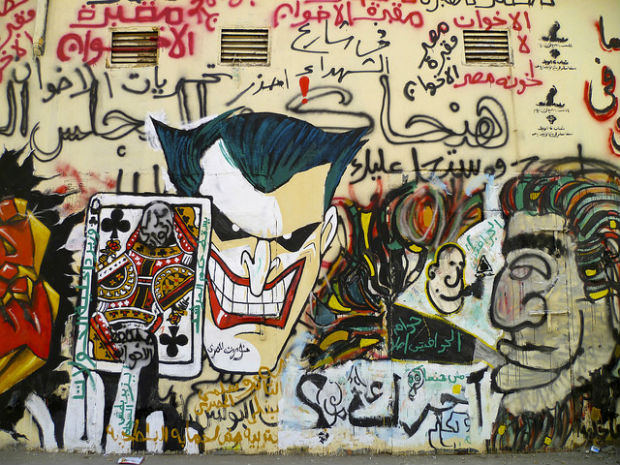
(Photo: Melody Patry/Index on Censorship)
Like Sami, Bahia Shehab — an art historian and graphic designer — was also very much a part of the street art movement that emerged and developed after the 2011 revolution. Her trademark “no” stencils, spray painted on the walls of Mohamed Mahmoud Street have helped draw public attention to social problems, exhorting Egyptians to take a stand against violence, oppression, and other forms of injustice.
Shehab joined the street art movement nine months after the revolution when she saw an image of a protester’s corpse dumped in a pile of rubbish in her Facebook newsfeed. The gruesome picture, which had gone viral on social media networks, so infuriated her that she rushed to Tahrir Square to express her rage. Her stencilled message “no to military rule” marked the beginning of her “thousand times no” campaign — a series of images decrying torture, sexual violence and other issues she felt strongly about.
Carrying on the idea from her 2010 book — a compilation of “one thousand no-s” in a multitude of Arabic calligraphy styles — she added a range of fiery messages denouncing rights abuses that were committed during the country’s transitional period. ”No to violence and thuggery”, “no to stripping girls” and “no to sectarian divisions” are just a few in her long list of stencilled images.
More than three years after the uprising that toppled autocrat Hosni Mubarak, Shehab says her “old” list is “still relevant” and her concerns “still valid”. She continues to consistently add more “no” messages, saying she is “deeply disappointed” with the turn of events in her country. Among the new additions is a stencil calling for an end to the brutal security crackdown on dissent.
A nationalist fervour sweeping the country has however made it dangerous for graffiti artists to express themselves freely. Those who dare criticise government policies are often accused of being “traitors” and “terrorists” by self-proclaimed “patriots”. Today, while many of the young street artists view former army chief and current president Abdel Fattah el-Sisi as merely the new face of the old military regime, few dare depict him in their artworks. Sisi came to power following the 2013 coup that overthrew Egypt’s first democratically elected president, the Muslim Brotherhood’s Mohamed Morsi. Several established street artists have chosen to remain anonymous, signing their artworks using nicknames for the sake of their security.
“Working in the street has always been dangerous,” noted Shehab, adding that “the only difference is that the danger now comes from violent ‘patriotic’ mobs supporting the military where before it was from the police.”
But mob violence is not the only danger threatening Egypt’s street art movement. A proposed draft law banning so-called “abusive graffiti art” — if passed — may likely restrict artistic expression and may spell the end of the graffiti tradition, even before it fully emerges. Under the draft law, violators could face a prison sentence of up to four years or a fine of up to 100,000 Egyptian pounds.
The recent alleged murder of one of Shehab’s comrades — 19 year-old graffiti artist and member of the April 6 youth movement Hisham Rizk — has compounded her fears, sending shivers down many spines in Egypt’s artistic circles. Rizk’s body was found in a Cairo morgue last month, a week after his family reported his “mysterious disappearance”. A forensic report concluded that the young artist had died of “asphyxiation by drowning in the Nile River”. Sceptical fellow artists however, believe Rizk’s critical views of the government expressed in his drawings and on Facebook may have instigated a confrontation with security officials that led to his death.
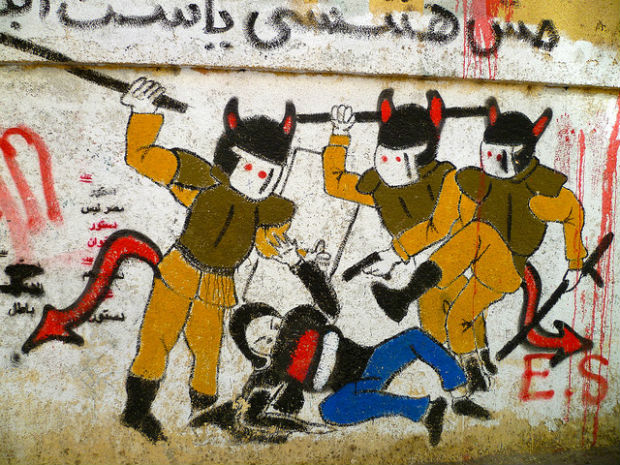
(Photo: Melody Patry/Index on Censorship)
“People don’t always agree with our views and different people interpret our artworks in different ways but at least our murals provide food for thought,” noted Sami who, in early 2012, designed a controversial mural depicting a skull with a military cap, holding a flower between clenched teeth. The image was a fitting portrayal of the brutal military regime that replaced Mubarak after the revolution. The 18-month rule of the Supreme Council of the Armed Forces (SCAF) was marred by political turmoil and violence including forced virginity tests performed by the military on female protesters
You can still see Sami’s mural on Mohamed Mahmoud Street, along with many others that are critical of both SCAF and the Muslim Brotherhood. The latter are depicted as sheep, while military men are portrayed as butchers in some of the murals. The colourful artworks are reminiscent of a happier time of free artistic expression and hope — a phase that, some of the artists fear, may well be over.
Yet, both Sami and Shehab remain defiant, saying that neither laws nor intimidation will deter them from the journey they have started. They draw similarities between their art and the 2011 revolution, saying both are constantly shifting and come in waves. Their murals in downtown Cairo have been whitewashed several times with other artists painting over them or adding new images as new events unfold, sparking new ideas. “Sometimes, residents in the area paint over the images if they oppose our views,” said Sami.
“I no longer mind when my work disappears. When that happens, I just tell myself it’s time to design a new stencil and I head straight back to Mohamed Mahmoud Street.”
The Index on Censorship interactive documentary Shout Art Loud explores how Egyptians use graffiti and other art forms to tackle the issue of sexual harassment and violence against women. Watch it here.
This article was posted on August 22, 2014 at indexoncensorship.org
19 Aug 2014 | Malaysia, News, Religion and Culture
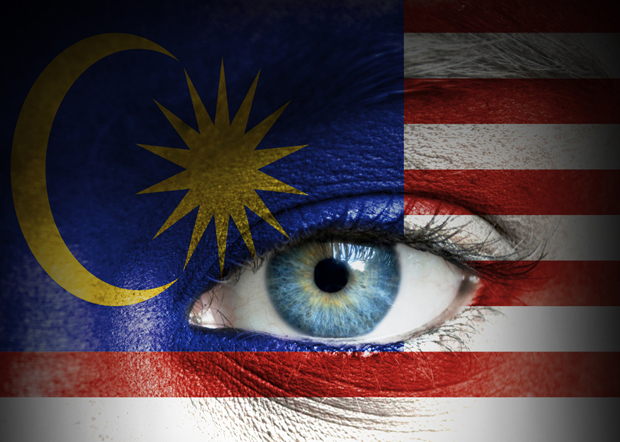
(Image: Aleksandar Mijatovic/Shutterstock)
It is said that the Muslim jurist al-Shafi’i so revered the name Allah that he wore a ring inscribed with a message to himself from God. One might think, then, that the name would be universally celebrated in those countries where the doctrine of al-Shafi’i is the predominant school of Islamic jurisprudence. But this is not the case in Malaysia. In June, the federal court turned down an appeal by a Catholic bishop against a decision of the ministry of home affairs to impose limits on certain uses of the word Allah.
The story dates back to 2009, and a letter from Che Din bin Yusoh, a civil servant working for the ministry, to the Roman Catholic Archbishop of Kuala Lumpur, Murphy Nicholas Xavier Pakiam. It approved a permit to publish The Herald, a weekly Catholic newspaper available in English, Chinese, Tamil and Bahasa Melayu, the official language of Malaysia. On the face of it, the letter contained good news: renewed permission to publish The Herald, in print since 1994. But it also stipulated two conditions: that Pakiam and the Bishops of Peninsular Malaysia confine their distribution of The Herald to the church and its adherents; and that they refrain from printing the word Allah in the Bahasa Melayu version.
The first condition was inconsequential as far as the bishops were concerned: The Herald had only ever been distributed amongst the congregants of the country’s three archdioceses. Furthermore, since the 1970s and 80s, the church had adopted a largely ecumenical posture towards the other religious establishments in Muslim-majority Malaysia, partly in response to the rise of the Islamic dakwah, or missionary, movement. (Proselytising Muslims is also an offence under Malaysian Federal law.)
The second condition, however, was intolerable to the bishops. Allah, from Arabic, is the Bahasa word for God irrespective of the religious context in which it is used — just as it is for Bahasa-speaking Sikhs, Indonesian and Arabic-speaking Christians, Mizrahi Jews, Maltese Catholics, and many other non-Muslim groups — and it appears in Al-Kitab, the Bahasa translation of the Bible. The second condition effectively forbade the use of the word Allah in the Bahasa version of The Herald in reference to any God but the Islamic deity.
And so Pakiam went to court, seeking judicial review of the government’s decision to impose the second condition. He asked for an order of certiorari, quashing the decision. He also asked for a series of judicial declarations: that imposing such a condition violated certain fundamental freedoms enshrined in the constitution — the rights to freedom of speech and to practice non-Islamic religions in peace and harmony — and, in a bold move that invited the Malaysian judiciary to pronounce dispositively on a matter of considerable religious sensitivity, that the word Allah is not exclusive to the Islamic faith. The bishops also asked the Court to find that the decision was irrational and unreasonable, contravened the laws of natural justice, and had been made in bad faith.
The ministry’s decision to impose the Allah condition can only be understood in the light of a series of laws passed by ten of Malaysia’s thirteen state legislatures. These enactments — each called some variation on the Control and Restriction of the Propagation of Non-Islamic Religions — proscribe the use of any of 25 words or 10 phrases in reference to a religion other than Islam. (The Johor state enactment doesn’t include a list of words or phrases but imposes a blanket ban on the use of words of “Islamic origin”.) The list of words could double as a glossary of key terms for any student of Islamic theology: Allah, Fatwa, Hadith, etc.; and the list of phrases contains such Islamic maxims as Alhamdulilah and Allahu Akbar. The laws vary in their severity — what might in Terengganu lead to a fine of 1000 ringgits could in Kelantan result in a five-year jail term and/or whipping — but so sacrosanct are they in the eyes of many that five states, as well as the prefecture of Kuala Lumpur and the Chinese Muslim Association of Malaysia, attempted (unsuccessfully) to join the government as defendants in Pakiam’s action.
But on the final day of 2009, the high court found in favour of Pakiam and the Bishops of Peninsular Malaysia, marking either a victory for freedom of speech or a lamentable triumph of secular values over democratic choice in a majority Muslim country, depending on one’s view. The issue, however, was far from resolved. For one thing, the government appealed against the decision of the high court, as did the five states. For another, the high court had not been asked to review the legality of the various non-Islamic religions enactments — merely the decision to impose the condition contained in bin Yusoh’s letter — and so, they remained good law.
This would prove troublesome for Malaysia’s Christians. In early 2011, it was reported that the Islamic affairs departments of certain states had raided the premises of various Christian organisations, including a Bible-import business called Gideon, and impounded tens of thousands of Bahasa and Iban-language Bibles, citing the Non-Islamic religions enactments as justification. This prompted the prime minister of Malaysia, Mohammad Najib Abdul Razak, to write to the chairman of the Christian Federation of the country, proposing a ten-point solution to defuse the welling inter-religious tension. The letter affirmed that Bibles in any language could be imported into the country, but stipulated that Bahasa-language Bibles, whether imported or locally-produced, must have a crucifix and the words Christian publication printed on their front.
The inclusion of this proviso made clear the strength of the government’s fear of non-Islamic and secular proselytising encouraged by the ready availability of Bahasa-language Bibles — fear of the “naked public square”, increasingly devoid of Islamic speech and thus increasingly hostile towards Islam in general, to paraphrase the American Catholic writer John Neuhaus. Given this anxiety on the part of the Government one might think that all the parties would have embraced the ten-point proposal as a much-needed compromise. But for various reasons — the peculiarities of Malaysian domestic politics and the procedural limitations of the justice system, to name two — the proposal was never enshrined in law and the various state enactments remained untouched. Preserving the status quo, however, meant that incidents of Bible-seizing continued; the most recent widely reported case occurred earlier this year, in Selangor province.
And then, as if to rub salt in the Bible-seizing wound, the court of appeal ruled unanimously in favour of the ministry and set aside the decision of the high court. The bishops were given leave to appeal but, on 23 June of this year, the Federal Court of Malaysia turned down their application and upheld the decision of the court of appeal, thus drawing the case to an unsatisfactory close.
The decision of the federal court — decided by a narrow four-to-three margin — is disappointing not only in the result but in the reasons given, too. Like many administrative law cases, the judgment is preoccupied with questions of procedural, rather than substantive, unfairness. This would be tolerable if the decision taken by the ministry had not impacted on fundamental rights enshrined in the federal constitution: Article 3 asserts that while Islam is the official religion of the federation, this should not impinge on the rights of non-Muslims to practice other religions in peace and harmony.
But, in banning the use of the world Allah in a weekly newspaper, the decision clearly affected the rights of individuals to freedom of speech and religion. The questions put before the court were held by the three dissenting judges to be of such constitutional importance that all three chose to write opinions setting out their reasons, an incredibly rare occurrence in judicial review proceedings of this kind: “too weighty to suffer indifference,” wrote Justice Zainun Ali.
The majority opinion of Justice Arifin Zakaria, by comparison, is preoccupied by the far more incidental question of whether the appropriate standard in evaluating the reasonableness of a decision taken by the ministry should be objective or subjective. And Justice Zakaria also concludes that the decision of the Court of Appeal must be correct because Pakiam had not sought to challenge the various state enactments before the high court. As the enactments were not the object of judicial review, Zakaria can only conclude that the decision to impose a condition on the propagation of non-Islamic religion was in keeping with the letter and spirit of those laws and not, therefore, an abuse of power. If put forward in a contextual void this argument might be persuasive. However, Zakaria also upholds the decision of the court of appeal on the basis that Pakiam would have erred if he had sought to challenge the various state laws before the high court, as the only appropriate forum in which to bring such a challenge would have been the federal court. Pakiam and the bishops were predestined to lose, it would seem.
If there were a southeast Asian regional court of human rights, we might think that the Bishops of Peninsular Malaysia would have good grounds to get on its cause list. Presuming the existence of some regional charter of fundamental rights, similar in content, say, to the European and American Conventions on Human Rights, the bishops would surely be able to rely either on a breach of the fundamental rights or on the denial of an effective remedy at law. And given the relative willingness of supra-national courts to scrutinise governmental arguments premised on public order and/or national security with greater force, we might even imagine such a regional court to declare the various non-Islamic religions enactments in breach of such a charter.
Then again, such a court might equally take into consideration the fact of Malaysia’s Muslim-majority population and conclude that the government had acted to protect the religious rights of the majority from the tyranny of a minority. In the now-famous European case of Lautsi v. Italy, the European Court of Human Rights held that the display of crucifixes in Italian state schools was not in breach of Article 9 ECHR (the right to freedom of conscience and/or religion). But whereas in Lautsi it was held that the “negative” right to freedom of religion did not endow individuals with the right to be always and ever free from encountering religious imagery, in Malaysia the various state laws actively impinge on the exercise of a minority religion. The result of Titular Roman Catholic Archbishop of Kuala Lumpur vs. The Government of Malaysia has led many to conclude that questions of religious coexistence and the true ownership of the word Allah cannot be resolved through the courts. That is undoubtedly true. But in the meantime, if Archbishop Pakiam and the Bishops of Peninsular Malaysia feel that they have been the victims of a miscarriage of justice, then that would be true, too.
This article was posted on August 19, 2014 at indexoncensorship.org
18 Aug 2014 | News, Poland, Religion and Culture
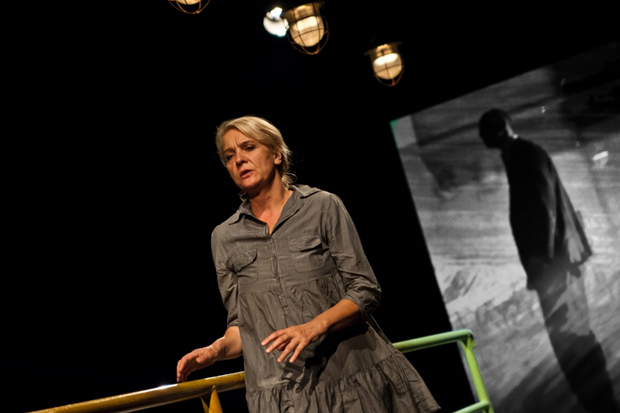
Ewa Wojciak has been working in the in theatre since the 1970s when she was a dissident artist under the communist regime. (Photo: Maciej Zakrzewski)
Ewa Wojciak, director of Poland’s Theatre of the Eighth Day, was fired by Poznan mayor Ryszard Grobelny on 28 July. His administration oversees culture and arts in the city, including Wojciak’s subversive and anti-establishment theatre group.
The official reason given was that she did not ask for permission to leave the city between 18 and 28 February, when she visited Yale and Princeton universities, performing her touring duties as director and actress with the theatre. However, these trips were not sponsored by the local government, so it is hard to see why she would need permission from authorities.
Wojciak’s career with the theatre began in 1970 when she was a dissident artist under the communist regime. After the end of communism, she turned the theatre into a welcoming space for refugees, minorities, anti-facists, feminists, lesbian, gay, bisexual, and transgender people and emerging theatre-makers. She has become a “new dissident”, confronting the realities of life after communism. During her tenure, the theatre, known for its artistic experimentation and politically subversive productions, has drawn the fire of Grobelny, known for his ultraconservative views.
The Theatre of the Eighth Day has played at the Edinburgh Festival, London’s LIFT, at the universities of Yale and Princeton, as well as innumerable major and small venues in Poland. The New York Times has written on their production under the heading “When Courageous Artists Ripped Holes in the Iron Curtain“.
During last month’s Index on Censorship debate with Timothy Garton Ash, Kate Maltby and David Edgar, about freedom 25 years after the fall of the Berlin Wall, I tried to emphasise how important such new dissidents are in Eastern Europe. Commenting on this debate, Index CEO Jodie Ginsberg reminded us how authorities are taking an increasingly hard line on civil society groups.
The Theatre of the Eighth Day, which helped build an alternative civil society under communism, continues its non-conformity — and faces threats from Poznan’s political establishment. Wojciak is being unfairly dismissed for defying the far right, clericalism, the “moral majority” and censorship.
Grobelny’s record as mayor of Poznan, a job he has held since 1998, leaves much to be desired in an open, democratic society. He has repeatedly stifled independent voices in the city, and Wojciak has been a long-standing adversary. In 2005, Grobelny banned the Equality March, a feminist-queer pride event. Wojciak and other members of the Theatre of the Eighth Day took part in this forbidden event, which was suppressed by the police — one of the actors was arrested. More recently, Grobelny also supported the Poznan ban of the play Golgota Picnic, on which Index has reported.
In 2013 Wojciak was reprimanded by the mayor for a comment on her Facebook wall immediately after the conclave of Pope Francis: “[T]hey’ve elected a prick who denounced left-wing priests under the military dictatorship in Argentina.” Her Facebook account was shut down and Wojciak — mistaken about the Pope’s involvement with the Argentinian junta — was vilified by Poland’s far right. Her Facebook account was later restored and the Poznan prosecutor declined to pursue the matter. At the time, intellectuals and artists defended her on grounds of free expression.
Adam Michnik, editor-in-chief of Poland’s leading broadsheet Gazeta Wyborcza and a legendary dissident, wrote that he supports Wojciak. Michnik is a member of the committee of the fiftieth anniversary of the Theatre of the Eighth Day. A petition protesting the dismissal of Wojciak has been issued by civic-educational initiative Otwarta Akademia (“Open Academy”), spearheaded by Piotr Piotrowski, an art historian and former director of Warsaw’s National Museum (who initiated the groundbreaking exhibition Ars Homo Erotica there), feminist Izabela Kowalczyk, artist Marek Wasilewski and ethicist Roman Kubicki, among others.
This petition has so far been signed by 317 people, including Irena Grudzinska-Gross of Princeton University and Alina Cala of the Jewish Historical Institute in Warsaw, who both write on anti-semitism in Poland; Elzbieta Matynia of the New School for Social Research and author of Performative Democracy; Jeffrey C. Goldfarb, author of The Persistence of Freedom: The Sociological Implications of Polish Student Theatre; and Pawel Leszkowicz of Poznan University, curator of Ars Homo Erotica.
The Theatre of the Eighth Day epitomises liberty: Wojciak and her company speak out against injustices and experiment aesthetically. It’s deplorable that they should be repressed by the authorities of their city.
If you would like to protest the dismissal of Ewa Wojciak, please email [email protected] with the subject “Ewa”.
This article was posted on August 18, 2014 at indexoncensorship.org
15 Aug 2014 | Europe and Central Asia, News, Turkey
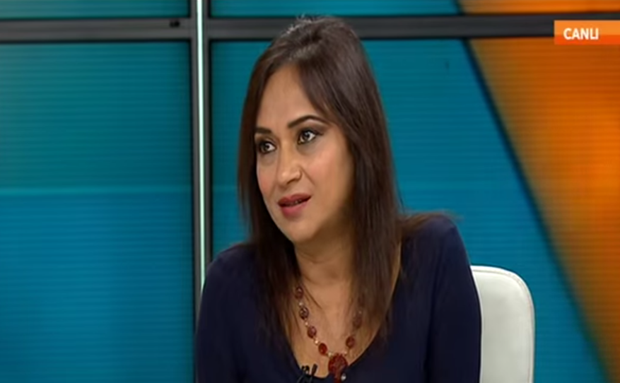
Amberin Zaman during a TV appearance (Image: serm canker/YouTube)
“A militant in the guise of a journalist, a shameless woman.” “Know your place.” “[Y]ou insult at a society of 99 percent Muslims.”
The comments from Recep Tayyip Erdogan — Turkey’s newly elected president and outgoing prime minister — were heard across the world. While he did not mention a name, it was the clear the woman in question was Amberin Zaman, a journalist for The Economist and Taraf. Erdogan’s tirade came during a campaign rally last Thursday in the city of Malatya, ahead of Sunday’s presidential vote. Zaman had expressed opinions critical of Erdogan during a TV discussion the night before.
Erdogan continued during a rally in Ankara on Saturday, calling her a “despicable woman” and saying she had insulted Islam. She has also been targeted online by Erdogan supporters, in what the Organisation for Security and Cooperation in Europe (OSCE) has labelled a “widespread smear campaign“.
“The pro-Erdogan camp emboldened by his very public insults against me continue to mob lynch me via the social media,” Zaman told Index on Censorship. “My Twitter feed is flooded with threats and profanities. Being called an enemy of Islam in a Muslim country, when radical groups like IS have Turkish members who are active Twitter users, puts me at physical risk and hobbles my work.”
She says she was unable conduct interviews on the streets on election day, “for fear of being recognised and attacked”.
This is not the first time Zaman has been targeted for speaking out against Turkish authorities. She was fired last year from Haberturk over articles critical of the government, and she was also one of the journalists reportedly wiretapped with the approval of Erdogan. As she said at a recent Index event on digital freedom, she is attacked online daily by pro-government trolls.
But Zaman is not the only member of the Turkish media under threat. According to recent figures there are 40 journalists behind bars in the country, making it one of the world’s worst jailers of press. Since 1992, 14 journalists have been murdered with impunity. Turkey stands at 154th out of 180 countries in the latest Reporters Without Borders Press Freedom Index, and its ranking has deteriorating over the past years.
In addition to Zaman’s case, there have been a number of other attacks on press freedom just over the past few days, as reported by the Index media mapping tool among others. Enis Berberoglu, editor-in-chief of Hurriyet, resigned on 8 August. The paper has denied that it was as a result of political pressure. However, in his attacks on Zaman during the Malatya rally, Erdogan specifically mentioned the owners of the TV channel she was on, Dogan Holding. Hurriyet is also owned by Dogan.
“The consensus is that he was pushed out but his departure coincided with the elections so it didn’t get the attention it deserved. But it is a further sign that media bosses will continue to cave in to power. It’s a tragic comment on the state of the Turkish media,” says Zaman.
The same day as Berberoglu’s resignation, investigative journalist Mehmet Baransu was beaten by police. The day after he was detained for tweeting about the incident, and about the Istanbul public prosecutor. There have also been reports that the Cihan news agency was restricted from covering the presidential election, with police ordered to keep journalists out of polling sites across the country.
The election also put the spotlight on issues surrounding biased media coverage in favour of Erdogan; something that was highlighted by observers after the vote. Zaman says it is difficult to measure the impact of the poor state of media freedom on the election and its outcome — Erdogan won comfortably after one round. But it was not, she says, “a level playing field”.
“Erdogan has indirect control over a broad swathe of media outlets, most crucially of television. So the opposition candidates received scant coverage, and the little they got in pro-government was more of a smear campaign to which they were unable to effectively respond. Intimidation of the media and of media bosses has created an environment of self-censorship where journalists fear losing their jobs,” she explains.
“Even the mildest criticism is no longer tolerated. It’s stifling.”
Despite the attacks from Erdogan and his supporters, Zaman says she is “very heartened by the thousands of messages of support I have received, including from pious Muslims”.
The Women’s Equality Monitoring Group, whose membership includes female journalists, academics and writers has called on Erdogan to apologise.
“Making a female journalist a target by calling her shameless for simply performing her job was the last link in a chain of sexist stances,” they said. “This attack was also an attempt to silence the few remaining critical voices in the media, which has been silenced with bribery, censorship and self-censorship.” The Economist have stated that they “stand firmly” by Zaman.
“I am not alone,” she said.
But as Erdogan has indicated intention to expand the powers of the presidency, Zaman is not optimistic about the future.
“Should he continue to run the government as he announced he would it is horrible news for journalists. Things can only get worse not better.”
This article was posted on August 15, 2014 at indexoncensorship.org
