12 Jun 2014 | Americas, Brazil, News
(Image: Ksenia Ragozina/Shutterstock)
World Cup time! Hurray! An entire month of football! Rejoice as the pubs stay open late for weirdly timed matches! Gasp at your workmates’ expertise on Iran’s deployment of a false 9! Repeatedly smash yourself in the face with your iPad as you read yet another article by a broadsheet columnist complaining that people don’t pay as much attention to literary fiction as they do to sport!
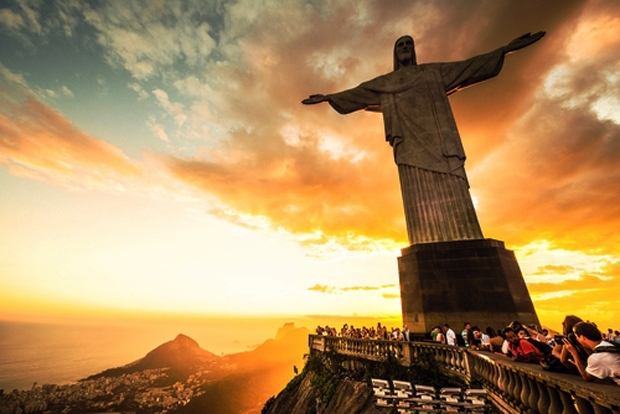
While the competition officially kicks off tonight, the Brazilians, or, specifically, the archdiocese of Rio have dived in with an early tackle, reportedly threatening to sue Italian broadcaster RAI for an advert showing Rio’s famous Christ The Redeemer statue wearing the Jersey of Italy’s Azzurri.
Suing for what, exactly, is not clear. The church’s lawyer, Rodrigo Grazioli, has been quoted as saying “The Archdiocese is deeply offended. It’s as if Brazilian TV were to make a commercial in which mulatto girls engaged in lewd behaviour with the gladiators of the Colosseum.”
Leaving aside the bizarrely specific and racist mention of “mulatto girls”, and the fact that people involved with churches have to make absolutely everything, ever, about “lewd behaviour”, it’s still not clear what the exact complaint is. Is it the suggestion that the colossal statue might support Italy? That Jesus himself might support Italy? Is this about putting any jersey at all on Jesus, or specifically an Italian one? Is there something specifically blasphemous about suggesting that the Son of God is a catenaccio man?
Or is it something rather more prosaic, such as, say, the church claiming to hold copyright over the image of the statue?
If it is that, as the original O Globo newspaper report suggests, then Grazioli and his clients are being more than a little disingenuous in their outrage. If the issue is simply an objection to commercial usage of the image, than that’s what the complaint should be about.
So why the offended line? Why the suggestion of an insult to religion? Because, put simply, it works. Who wants to be offensive?
In Ireland this week, national broadcaster RTE refused to show a sketch as part of the Savage Eye sketch show. The sketch, now leaked on the web features a group of “wild nuns” ogling a muscular Jesus, in a spoof of Diet Coke ads of old. Comic David McSavage, the man responsible for the skit, has said the broadcaster is afraid of Ireland’s blasphemy laws; RTE says its own guidelines will not allow for “undue offence”.
I’m not even sure that, even if one was a supporter of laws against blasphemy, images of hunky Jesus, or Azzurri Jesus would necessarily count as blasphemous, at least not for Catholics.
On a panel on religious art a few years ago, I found myself simultaneously playing the role of token secularist and token Roman Catholic. The other panelists – art critics and Anglicans – were quite keen on abstraction in religious art. I found myself defending the more visceral, more Roman depictions of Jesus and God on the basis that the entire point of Jesus was his manifestation as human.
To ascribe certain human possibilities to him, such as lust, or even supporting a particular sports team, should not be considered transgressive; indeed I recall, in my youth, our parish priest would often offer up prayers for the local Gaelic football club, suggesting at least the possibility of partisanship. And the very fact that nuns are “brides of Christ” is suggestive of, well…
Catholicism doesn’t really have a problem with idolatry either. Catholics complaining about depictions of Christ do not have the same theological basis as Orthodox Sunni Muslims, who at least can point to some rules on portrayals (which is not to suggest that everyone should follow those rules). Catholics, with our brightly painted statues, sacred medals and all the rest, don’t really have a leg to stand on this one.
These squeals of “offence” are really demands for “respect”, in the Corleone sense. And since the Danish Muhammad cartoons, religions have been in a respect-based arms war. Every time you hear a conservative Christian moan that this or that comic or writer “wouldn’t say that about the Muslims”, remember, they are not praising their own faith’s humility, but condemning its timidity. The archdiocese of Rio is playing a version of this game with its claim to be offended by a Photoshopped football jersey. There’s no reason we should play along.
This article was published on June 12, 2014 at indexoncensorship.org
29 May 2014 | News, Religion and Culture, United Kingdom
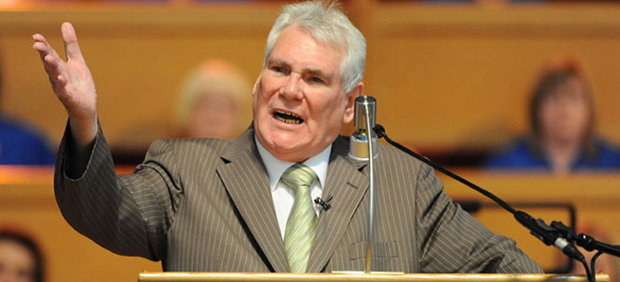
Pastor James McConnell
Belfast’s Whitewell Metropolitan Tabernacle is one of those things that makes a soft Southern Irish atheist Catholic like me think I’ll never truly understand Northern Ireland.
Every week, Ulster Christians flock from across the province to the 3,000-seater auditorium, there to hear Pastor James McConnell preach his Christian message. Not the Christian message of the BBC’s Thought For The Day, however; you may hear Beatitudes at Whitewell, but it’s not a place for platitudes. This is the real deal, fire and brimstone; damnation and salvation. If you’re not going to Whitewell, you’re going to Hell.
It is a comforting message, and actually, a very modern one. Think of how many politicians these days talk about how they work for hard-working-families-that-play-by-the-rules. Hardline evangelical Christianity is the epitome of that idea. We don’t refer to the “Protestant Work Ethic” for nothing.
But what we tend to forget when discussing hardliners from the outside is that there is a strong apocalyptic element in orthodox monotheistic religion. This is particularly true of Christianity. The closer to the core you get, the more you find Jesus’s teachings are essentially about the end of the world, not some vague being-nice-to-one-another schtick.
For some time, Christians have fretted over Matthew 24, in which Jesus apparently tells of the signs of his second coming, that is, to, say, the end of the world. What worries them particularly is Matthew 24:34: “Verily I say unto you, This generation shall not pass, till all these things be fulfilled.”
Does this mean Jesus was telling his apostles that the world would end in their lifetime? CS Lewis, in his work The World’s Last Night, seemed to believe so, and went so far as to call the Messiah’s assertion “embarrassing”. Lewis wrote:
“‘Say what you like,’ we shall be told, ‘the apocalyptic beliefs of the first Christians have been proved to be false. It is clear from the New Testament that they all expected the Second Coming in their own lifetime. And, worse still, they had a reason, and one which you will find very embarrassing. Their Master had told them so. He shared, and indeed created, their delusion. He said in so many words, ‘This generation shall not pass till all these things be done.’ And he was wrong. He clearly knew no more about the end of the world than anyone else.”
“It is certainly the most embarrassing verse in the Bible. Yet how teasing, also, that within fourteen words of it should come the statement ‘But of that day and that hour knoweth no man, no, not the angels which are in heaven, neither the Son, but the Father.’ The one exhibition of error and the one confession of ignorance grow side by side.”
Lewis, though himself a Northern Irish Protestant, was clearly not of the same cloth as Pastor McConnnell, Ian Paisley, and the other preachers of their ilk. Orwell disdained Lewis for his efforts to “persuade the suspicious reader, or listener, that one can be a Christian and a ‘jolly good chap’ at the same time.” The booming pastors of Northern Ireland, and other Christian strongholds such as the US’s Bible Belt, are very firmly convinced that the end is imminent. And thus, they do not have time to be “jolly nice chaps”. There are souls to be saved, right now.
It’s this attitude that has got Pastor McConnell into trouble in the past week. Recently, at Whitewell, inspired by the story of Meriam Yehya Ibrahim, a Sudanese woman reportedly sentenced to death for converting to Christianity, McConnell told the thousands assembled at his temple that “”Islam is heathen, Islam is Satanic, Islam is a doctrine spawned in Hell.”
In an interview with the BBC’s Stephen Nolan, McConnell refused to back down, claiming that all Muslims had a duty to impose Sharia law on the world, and suggesting they were all merely waiting for a signal to go to Holy War. A subtle examination of modern Islamist and jihadist politics this was not.
The PSNI is now investigating McConnell for hate speech. Northern Ireland’s politcians have been quick to comment. First Minister Peter Robinson backed McConnell, first saying that the preacher did not have an ounce of hate in his body, and then managing to make the situation worse by saying he would not trust Muslims on spiritual issues, but would trust a Muslim to “go down the shops for him”.
Insensitive and patronising that may be, but Robinson also touched on something more relevant to this publication when he said that Christian preachers had a responsibility to speak out on “false doctrines”.
The issue raised is this: if we genuinely believe something to be untrue, no matter how misguided we may be, do we not have a right to challenge it in robust terms? In politics we often bemoan the fact that leaders will not call things as they, or we, see them: indeed, Tony Blair, the bete noire of pretty much every political faction in Britain (a bete noire who oddly managed to win three election) has found grudging praise from across the spectrum this week for suggesting that rather than “listening to” or “understanding” the xenophobic United Kingdom Independence Party, politicians should tackle their arguments head on.
But in religion, we tend to hope that no one will upset anyone too much, in spite of the fact that, for true believers, theological issues are far more important than taxation or anything else.
When Blair’s government proposed (and eventually passed) a law against incitement to religious hatred in Britain, the opposition came from a coalition of secularists and some evangelical Christians, both groups realising, for different reasons, that being able to call an ideology false or untrue – and in the process criticise and question its adherents – was a fundamental right. The trade off in that is acknowledging others’ right to question your truths, something I suspect, judging by the recent controversy in Northern Ireland over a satirical revue based on the Bible, Pastor McConnell and his supporters may not quite excel at.
This article was originally posted on May 29, 2014 at indexoncensorship.org
28 May 2014 | News, Religion and Culture, Spain, Turkey
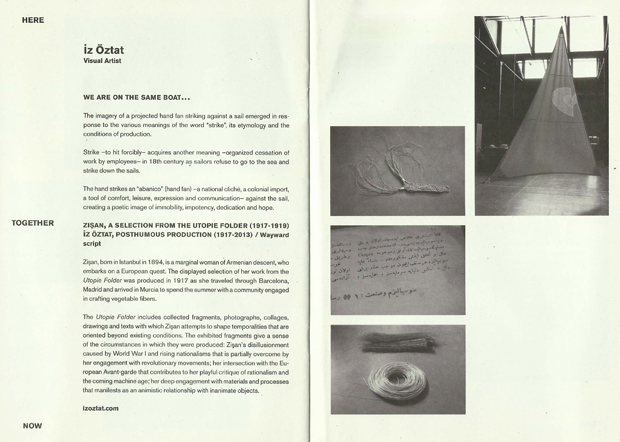
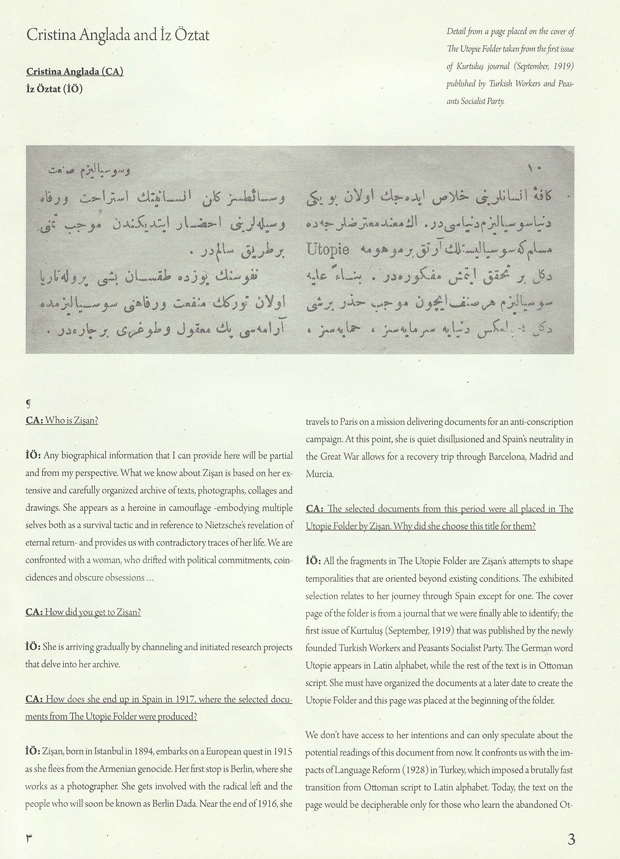
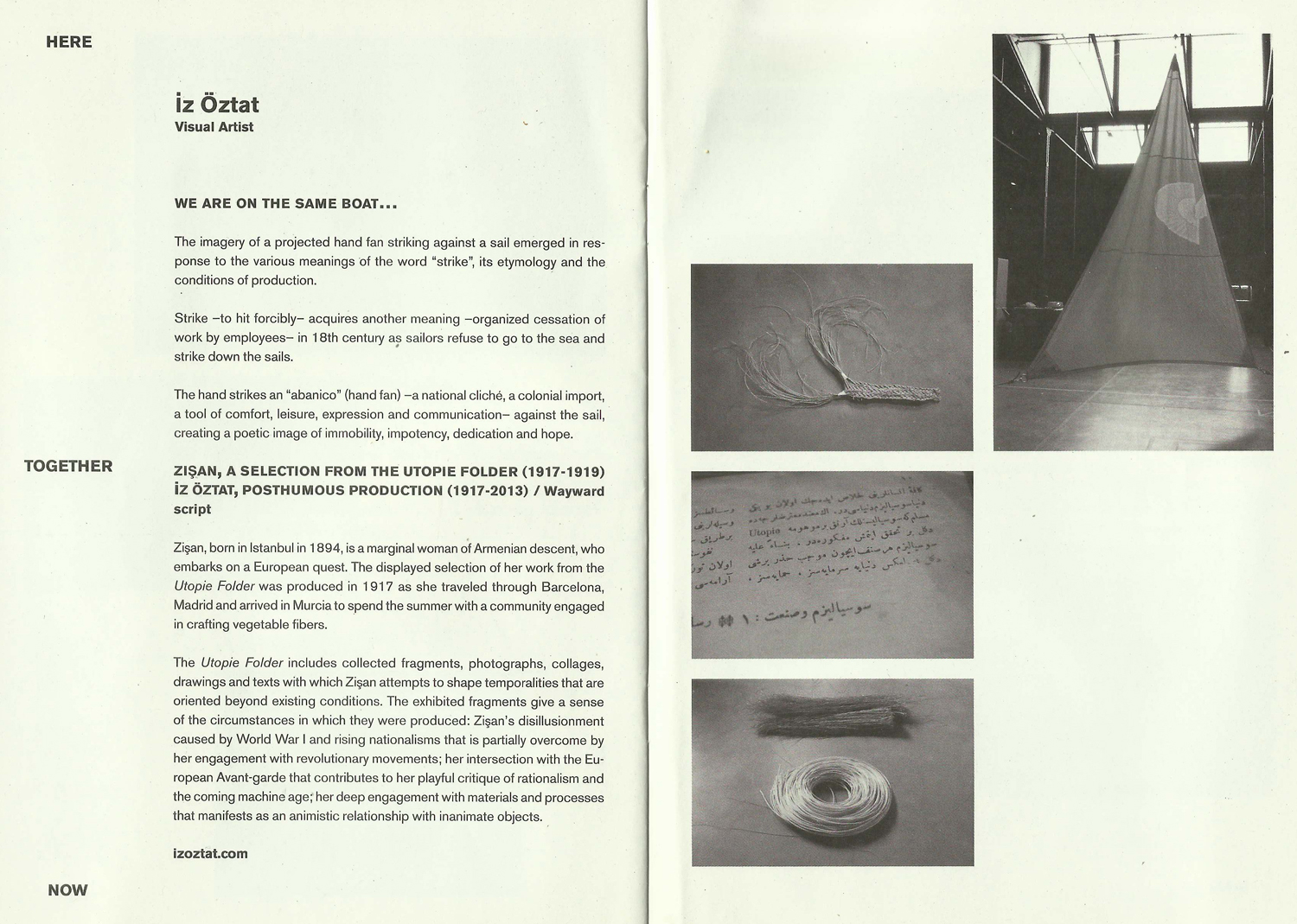
Last year, the exhibition Here Together Now was held at Matadero Madrid, Spain. Curated by Manuela Villa, it was realised with the support of the Turkish Embassy in Madrid, Turkish Airlines and ARCOmadrid. But in the exhibition booklet, the explanatory notes to artist İz Öztat’s work “A Selection from the Utopie Folder (Zişan, 1917-1919)” was censored upon the request of the Turkish Embassy in Madrid, and the expressions “Armenian genocide” and the date “1915” were taken out.The case shows how the Turkish state delimits artistic expression in the projects it supports, and how it silences the institutions it cooperates with.
After Turkey was chosen as the country of focus for the 2013 edition of the ARCOmadrid International Contemporary Art Fair, the designated curator Vasıf Kortun and assistant curator Lara Fresko started to work with the galleries that would join the fair. They helped in fostering connections between the Madrid arts institutions and artists in Turkey; as well as with the embassy officers in charge of the financial support of events such as Here Together Now, which would run as a parallel event to the main fair. The embassy indicated that it would support this exhibition with the generous sum of €250,000. However, it did not provide any written documentation guaranteeing this support, and outlining the mutual duties and responsibilities of the parties involved. Likewise, during the realisation of the project, there was no written communication between the embassy and Matadero Madrid, and all negotiations took place verbally, over the phone. It was in this manner that, from the very beginning, the state kept the exact conditions of its support ambiguous and created a tense situation for the organisers. Ultimately, this working practice gave the Embassy the possibility of denying the promised support, in the event that their request was not carried out.
This is not the first case of the Turkish state censoring an arts event it sponsors abroad. We frequently hear about such cases off the record, and at times through the media. One of the best-known cases of state intervention took place in Switzerland, during the 2007 Culturespaces Festival. Director Hüseyin Karabey’s film Gitmek – My Marlon and Brando, which had received support from the Turkish Ministry of Culture and Tourism, was taken out of the festival program at the very last minute, at the request of an officer from the General Directorate of Promotion Fund, on the pretext that “a Turkish girl cannot fall in love with a Kurdish boy” as was the case in the film. The officer threatened the festival organisers with withdrawal of sponsorship totaling €400,000 — much like the case of the Madrid exhibition. The festival director decided that they could not go ahead with the event without this support, ceded to the censorship request, and accepted to take the film out of the program. However, independent movie theaters in Switzerland criticised this decision and ended up screening the film independently of the festival.
Both examples show that the state controls the content of the projects it sponsors abroad, interferes with the organisations on arbitrary grounds, and violates artists’ rights by threatening the very institutions it collaborates with.
The administrative channel for the state’s support to events outside of Turkey is the Ministry of Culture and Tourism’s Promotion Fund Committee, established under law 3230 (10 June, 1985) with the aim of supporting activities that “promote Turkey’s history, language, culture and arts, touristic values and natural riches”. The Committee reports directly to the Prime Minister’s office, and is presided over either by the Prime Minister himself, the Vice Prime Minister or a minister designated by the PM. It has five more members: Deputy Undersecretaries from the Prime Minister’s Office, the Ministry of Foreign Affairs, and the Ministry of Culture and Tourism, as well as the general managers of the Directorate General of Press and Information, and the Turkish Radio and Television Corporation (TRT). The objective of the fund is “to provide financial support to agencies set up to promote various aspects of Turkey domestically and overseas, to disseminate Turkish cultural heritage, to influence the international public opinion in the direction of our national interests, to support efforts of public diplomacy, and to render the state archive service more effective”.
The Committee convenes at least four times a year upon the invitation of its president to evaluate project applications. The only criterion in accepting a project is whether it complies with the objectives mentioned above. After the Committee carries out its evaluation, the projects are put into practice upon the approval of the PM. Representative offices of the Promotion Fund Committee monitor whether the projects are implemented in compliance with the principles of the fund. In the case of the Madrid exhibition, the Turkish Embassy assumed the role of representative office. In this respect, as per the relevant regulation, the embassy was in charge of controlling the project, signing protocols with project managers to outline mutual duties and responsibilities, making the necessary payments, and delivering the project report to the Committee. As such, the embassy’s avoidance of all written documentation is in breach of the principles and modus operandi established by its own regulations.
Overall, it can be said that the Promotion Fund Committee does not meet the criteria of transparency and accountability generally expected from a public agency. The dates when the committee convenes to evaluate the projects are not announced, and the committee members, annual budget, sponsorship priorities and selection criteria are not made public. The sums paid to projects sponsored and the content of the projects are not disclosed officially. In other words, there is no transparency about the distribution of the funds, or about the auditing procedures. Such structural problems make it even harder to reveal and question the state’s violation of the right to artistic expression.
Another important aspect of this case is that the state constantly tries to reproduce its dominant discourse based on the denial of past and ongoing human rights violations such as forced displacement, genocide, political murders, burning of villages, enforced disappearances, rape, and torture through security forces; and does its utmost to silence any expression which contests this discourse. The centenary of the Armenian genocide, 2015, is drawing near. As such, it becomes even more important to demand that the Turkish state be held accountable for this human rights violation.
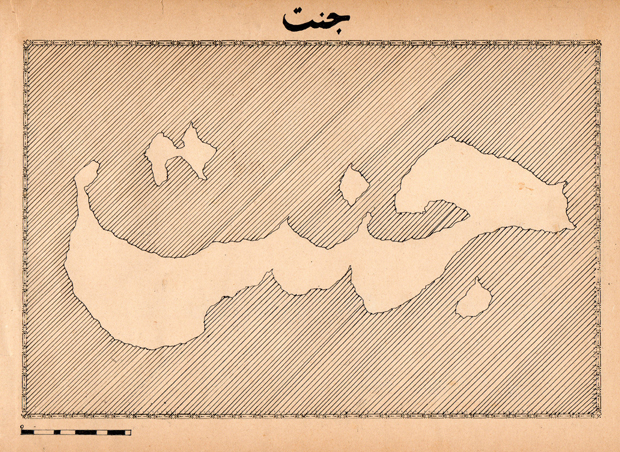
Map of Cennet/Cinnet (Paradise/Possessed Island). Zişan, 1915-1917. Ink on paper, 20×27 cm. Dedicated to the Public Domain
Siyah Bant is a research platform that documents and reports on cases of censorship in arts across Turkey, and shares these with the local and international public. In the context of this work, we wanted to investigate the censorship that occurred at Here Together Now. In accordance with the Right to Information Act, we asked the Turkish Embassy in Madrid and the Ministry of Culture and Tourism, to explain the legal basis of the censorship they imposed on the booklet. In response, the Ministry of Culture and Tourism indicated that Matadero Madrid and curator Manuela Villa were the only authorities in charge of selecting the artists who would participate in the workshops of ARCOmadrid, designating the content of the works to be produced during the workshops, and preparing all printed matter in connection to the event. We were unable to obtain an official statement from curator Manuela Villa, despite several inquiries. Finally, we conducted an interview the artist İz Öztat to understand how the censorship took place, and how she experienced the process.
How did you come to be involved in the exhibition?
I was invited by Manuela Villa, curator of Matadero Madrid, after meeting her in Istanbul. Matadero planned for a residency program and an exhibition project titled Here Together Now to take place concurrently with the 2013 edition of the ARCOmadrid Art Fair that had a section consisting of invited galleries from Turkey. By the time I signed the contract with Matadero Madrid, I knew that the project was partially supported by the Turkish Embassy in Madrid and Turkish Airlines.
Here Together Now was a process that allocated the resources with an emphasis on living and working together. Cristina Anglada (writer), Theo Firmo, Sibel Horada, HUSOS (a collective of architects), Pedagogias Invisibles (art mediation collective), Diego del Pozo Barrius, Dilek Winchester and I had six weeks together, during which we figured out common concerns, negotiated our relationship to the institution’s public, designed the working and exhibition space, collaborated and produced our works.
Can you tell us about the nature of contract with the institution and if there were any limitations indicated as to the nature of your work?
We signed a very detailed contract with Matadero Madrid that laid out the responsibilities of the institution and the artist in relation to the production and authorship of new work but there were no limitations outlined in the contract. I took it for granted that the artist has freedom of expression and institutions do not interfere in the produced content.
The institution was extremely supportive of the project. They were engaged in our discussions and ready to help once we started producing the work.
Could you talk a bit about the work that you prepared for Matadero Madrid?
The work shown in the Here Together Now exhibition was part of an ongoing process, in which I imagine ways to conjure a suppressed past. Since 2010, I have been engaged in an untimely collaboration with Zişan (1894-1970), who is a recently discovered historical figure, a channeled spirit and an alter ego. By inventing an anarchic lineage with a marginalized Ottoman woman, I try to recognize a haunting past and rework it to be able to imagine otherwise. For the exhibition at Matadero Madrid, I produced and exhibited “A Selection from Zişan’s Utopie Folder (1917-1919)” accompanied by works from the “Posthumous Production Series”, in which I depart from Zişan’s work to open a path towards the future in our collaboration. The exhibited work was complemented by a publication with three interviews, which situates the work and builds a discourse around it.
Which aspect of the work was censored? How did the process of censorship occur, and what kind of dilemmas did you face in this process?
Manuela Villa, the curator, met with me in the exhibition space one evening a few days prior to the opening. Officials from the Turkish Embassy had threatened to withdraw their financial support, if the demanded changes were not made. I had to make a decision on the spot and accepted the censorship in the booklet, but not in the publication complementing the work. The exhibition booklet was reprinted and the sentence was changed to “Zişan, born in Istanbul in 1894, is a marginal woman of Armenian descent, who embarks on a European quest.”
As I said before, there was an emphasis on the community we built together during the residency at Matadero and I didn’t want to make a decision alone that would put the whole project at risk. Because of the time constraints, we were only able to meet with the other artists after the opening to discuss the precarious condition that we were all in. The institution didn’t have any signed documents from the Embassy committing to the sponsorship. Everything was communicated verbally and there was no written documentation. I was not able to reach out for a support network to resist the situation, not least due to the immediacy the decision required.
The exhibition booklet that was presented to the embassy was altered but the publication accompanying your work remained unchanged. How did the curator and other artists react to your refusal to change the publication?
I could not stand my ground with regard the exhibition booklet because it concerned everybody in the project. Yet, I was able to take full responsibility of my own work. We were informed that officials from the embassy will visit the show prior to the opening and I was ready to withdraw the work, if there was any interference. Everybody was supportive of my decision.
What happened on the day of the opening? Did you feel the need to prepare yourself?
In the end, none of the officials from the embassy came to the opening or the exhibition. There was no confrontation regarding the work. There might be a few reasons for this that I can think of. Maybe, they felt entitled to interfere with the content of the exhibition booklet because it had the logo of the embassy and could dismiss my publication since it only had the logo of Matadero Madrid. It was not of benefit for the embassy to confront me in a situation that would have made the case public.
As Siyah Bant we inquired both with the curator and the Ministry of Culture and Tourism in order to understand how this censoring motion played out. Given that the ministry rejects any responsibility and instead assigns all responsibility to the curator, and that the curator was acting under the duress of loosing all funding last minute, where does this leave you as the artist? How do you make sense of what happened to your work?
Since I accepted the censorship, my only option was making the situation public after the fact. I have been working in cooperation with Siyah Bant since I got back from Madrid. It took a few months to receive an official response from the embassy, which denied all responsibility. We wanted to make the case public after receiving a statement from the curator or the institution. I was unable to receive such a statement, and Siyah Bant is working on that now.
I see it as an experience, in which I was able to test and see the boundaries of government support that is allocated to arts and culture for promoting the country. If you decide to accept this support and challenge official policies, a system of censorship starts to operate.
Next year marks the centenary of the Armenian genocide which will inevitably bring about numerous artistic and cultural reflections on the subject. Given the current climate in Turkey, how confident are you that artistic freedom of expression will be respected?
We are going through a period, in which it is impossible to make predictions about what can happen even the next day. I can only hope that genocide denial at state level comes to an end. I am sure that artists will articulate their own ways of recognising the Armenian Genocide and confronting its denial. You are probably more prepared than I am to predict and know what kinds of mechanisms are at work to limit the production and dissemination of such work.
What would be your recommendations to other artists taking part in cultural events that are supported by the Turkish government?
Based on my experience, I think that artists and art institutions need to act in solidarity in these situations. If there is funding from the Turkish state, the institutions and artists involved need to be aware that the state monitors the content. The various institutions that distribute state funding do not provide written documents about their commitments and communicate their demands mostly in person or by phone. Demanding written documentation at every step is necessary. Artists who are considering to take parts in projects that receive state funding, can demand from the art institutions to be more transparent about the budget and its workings so that they can be prepared to make alternative plans if the state funding does not come through as promised.
If I encountered the same case of censorship now, I would not feel obliged to make a decision immediately and in isolation. I would consult the rest of the group and demand the involvement of the institution.
This article was posted on May 28 2014 at indexoncensorship.org
27 May 2014 | About Index, Campaigns, European Union, Press Releases
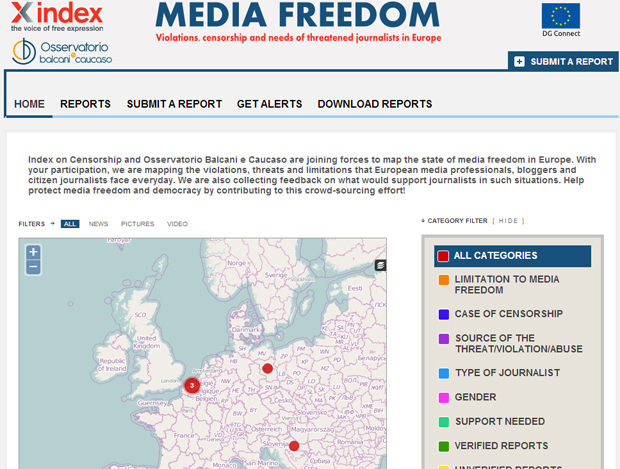
Index on Censorship and Osservatorio Balcani e Caucaso are launching mediafreedom.ushahidi.com to track media violations in Europe.
Index on Censorship, (London, United Kingdom) and Osservatorio Balcani e Caucaso, (Rovereto, Italy) have launched mediafreedom.ushahidi.com, a website that will enable the reporting and mapping of media freedom violations across the 28 EU countries plus candidate countries. The platform will collect and map out crowd-sourced information from media professionals and citizen journalists across Europe over the course of a year.
Based in London, Index on Censorship is an international organisation that promotes and defends the right to freedom of expression. Since its founding in 1972, Index has used a unique combination of journalism, campaigning and advocacy to defend freedom of expression for those facing censorship and repression, including journalists, writers, social media users, bloggers, artists, politicians, scientists, academics, activists and citizens.
“Index believes that free expression is the foundation of a free society and this website will enable journalists to report incidences of violations as soon as they happen. By mapping these reports online, the entire system will act as an advocacy, research and response tool, highlighting that violations on media freedom still occur in Europe.” explained Melody Patry, Index on Censorship senior advocacy officer.
Osservatorio Balcani e Caucaso (OBC) has been reporting on the socio-political and cultural developments of South-East Europe since 2000. Through the online platform, OBC will monitor and document media freedom violations in 11 countries, among which Bulgaria, Croatia, Greece, Romania, Serbia and others, and collect the needs of journalists under threat.
“We aim at improving the working conditions of media professionals and citizen journalists in Italy, South-East Europe and Turkey and ultimately at enhancing the quality of European democracy,” said Luisa Chiodi, scientific director of OBC.
This new website is part of a European Commission grant project under the EU’s Digital Agenda (DG Connect). In light of remaining violations to media freedom and plurality in Europe, and longer-term challenges in the digital age, the DG Connect launched a call for proposals to address the issue.
The successful candidates- the International Press Institute, Index on Censorship, Osservatorio Balcani e Caucaso together with SEEMO, Ossigeno per l’Informazione and Dr Siapera, as well as the European University Institute in cooperation with the Central European University– will spend the next year working on four projects, under the title European Centre for Press and Media Freedom.
For more information on the projects and the website, please read EU project to explore media freedom and pluralism or contact Melody Patry, [email protected], +44 (0) 207 260 2671 or OBC, [email protected].