27 May 2014 | About Index, European Union, News, Politics and Society
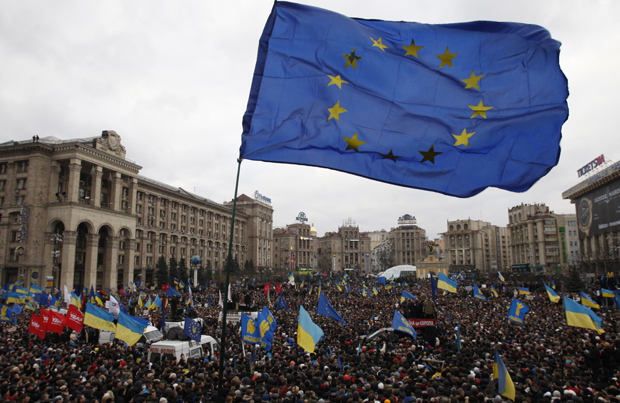
(Photo: Anatolii Stepanov / Demotix)
Free speech has always been a concern to the EU, with flaws in the world of press freedom and pluralism in Europe still apparent today. In an attempt to raise awareness to these problems, both on an institutional scale and publicly, DG Connect, tasked with undertaking the EU’s Digital Agenda, launched a call for proposal for funding for a new project to allow NGOs and civil society platforms to research and develop tools to tackle this problem.
The successful candidates- the International Press Institute, Index on Censorship, Osservatorio Balcani e Caucaso and the European University Institute in cooperation with the Central European University– will spend the next year working on the project, under the title European Centre for Press and Media Freedom.
“It is true that we regularly receive concerns about media freedom and pluralism that come from citizens, NGOs and the European Parliament,” Lorena Boix Alonso, Head of Unit for converging media and content at DG Connect told Index.
The Vice President of the European Commission, Neelie Kroes, began implementing action on this topic in 2011 with the creation of a high level group on media freedom and pluralism, but there are still violations in the world of European media freedom that need to be dealt with. These projects will be useful to raise awareness, according to Boix Alonso, to something which many people have little knowledge on.
Index on Censorship
In 2013, an Index on Censorship report showed that, despite all EU member states’ commitment to free expression, the way these common values were put into practice varied from country to country, with violations regularly occurring.
Building on this report, the DG Connect-funded project will enable Index to implement real-time mapping of violations to media freedom on a website that covers 28 EU countries and five candidate countries. Working with regional correspondents, specialist digital tools will be used to capture reports via web and mobile applications, for which workshop training will be provided. Index led events across Europe will discuss the contemporary challenges currently facing media professionals, allowing them to share good practices, while learning how to use the tools.
“Index believes that free expression is the foundation of a free society. Enabling journalists to report on matters without the threat of censorship or violations against them means promoting the right to freedom of expression and information, which is a fundamental and necessary condition for the promotion and protection of all human rights in a democratic society,” explained Melody Patry, Index on Censorship Senior Advocacy Officer.
The DG Connect grant demonstrates the current focus of the EU on the needs of journalists and citizens who face these violations to media freedom and plurality, according to Patry, as well as longer term challenges in the digital age.
Click here to visit the mediafreedom.ushahidi.com website
The Centre for Media Pluralism and Media Freedom
For some, the need to safeguard media freedom is at the forefront of the work they do. The Centre for Media Pluralism and Media Freedom (CMPF) is one such organisation and, in collaboration with the Centre for Media and Communication Studies (CMCS) at the Central European University, will continue to do so with funding from DG Connect for their project Strengthening Journalism in Europe: Tools, Networking, Training.
“The role of journalists is to both serve as guardians of government power and to enable the public to make informed decisions about key social and political issues that affect their daily lives,” the CMPF and CMCS told Index.
“The ability of journalists to freely report on issues without censorship is therefore critical- it’s the cornerstone of the checks and balances that make democracies work.”
The collaborative project will develop legal support, resources and tools for reporters, editors and media outlets to help them defend themselves in cases of legal threat, as well as raising awareness to ongoing violations to free expression and how these “impact the foundation on which democratic systems are based.” NGOs and policy makers will also benefit from this EU-funded scheme.
The International Press Institute
For over 60 years the International Press Institute (IPI) has been defending press freedom around the world, working to improve press legislation, influencing the release of imprisoned journalists and ensuring the media can carry out its work without restrictions.
London may have earned the title over recent years of libel capital of the world but what restrictions are placed on European journalists through defamation laws? This question forms the base of the IPI project, analysing existing laws and practices relating to defamation on both a civil and criminal nature; comparing this to international and European standards; and looking to the extent of which these affect the profession of journalism in all 28 EU countries and five candidate states.
After initial research, workshops will be hosted in four countries where the IPI believes they will have the greatest impact on the ground in countries where press freedom is limited by defamation to teach journalists which defamation laws affect their work, what the legitimate limits to press freedom are and what goes beyond what is internationally accepted.
According to the IPI the EU currently has no strong standards with regards to defamation and the threat to press freedom, a fact the led to their project proposal. “We hope that at one point the work we are doing will lead to a discussion within the EU about the need to develop these standards,” Barbara Trionfi, IPI Press Freedom Manager, explained to Index. “The defence of press freedom is a fight anywhere and it does not stop even in western Europe. It is still a major problem.”
Osservatorio Balcani e Caucaso
“We aim at improving the working conditions of media professionals and citizen journalists in Italy, South-East Europe and Turkey and ultimately at enhancing the quality of democracy,” Francesca Vanoni, Project Manager at Osservatorio Balcani e Caucaso (OBC) told Index.
OBC has been reporting on the socio-political and cultural developments of south-east Europe since 2000 and through their DG Connect funded project will monitor and document media freedom violations in nine countries, including Bulgaria, Croatia, Macedonia, Romania and Serbia.
Offering practical support to threatened journalists, the project will raise public awareness of the European dimension on media freedom and pluralism, stimulating an active role of the EU with regard to media pluralism in both member states and candidate countries. This will be implemented, among other means, through social media campaigns, a crowd-sourcing platform, an international conference for the exchange of best practices and transnational public debates.
The idea behind the project was to help build a European transnational public sphere in order to strengthen the EU itself. The ethics and professionalism of media workers is crucial, according to Vanoni. A democratic environment is built upon the contribution of all parts involved: “The protection of media freedom is fundamental for the European democracy and it cannot be left aside of the main political priorities.
“Being part of a wider political community that tackles shared problems with shared solutions offers stronger protection in case pluralism is threatened,” explained Vanoni.
To make a report, please visit http://mediafreedom.ushahidi.com
This article was published on May 20, 2014 at indexoncensorship.org
22 May 2014 | Academic Freedom, News, Religion and Culture, United Kingdom
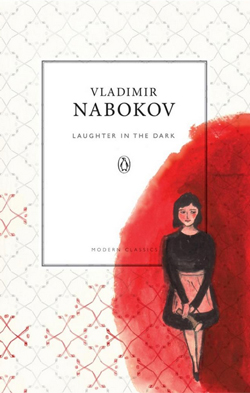
“Once upon a time there lived in Berlin, Germany, a man called Albinus. He was rich, respectable, happy; one day he abandoned his wife for the sake of a youthful mistress; he loved; was not loved; and his life ended in disaster.”
So begins Vladimir Nabokov’s Laughter In The Dark, a terse, tragic little book. There’s really not much more I can tell you about it, apart from the fact that the “youthful” mistress is uncomfortably so, Albinus says and thinks some quite sexist things about women, and he ends up disabled (and worse).
Perhaps then, in light of recent requests from English Lit students on American campuses that teachers should provide “trigger warnings” for novels that could contain traumatising themes and scenes, this already revealing opening could be rewritten:
“Once upon a time there lived in Berlin, Germany, a man called Albinus. He was rich, respectable, happy; one day he abandoned his wife for the sake of a youthful mistress; he loved; was not loved; and his life ended in disaster. TRIGGER WARNING: sexism, cis-sexism, borderline paedophilia, violence, ableism.”
Would that be so bad? Clumsy, no doubt, but does it really affect the reader’s experience, or, specifically, the academic learner’s ability to analyse the book? Well, yes, in that it skews one’s expectations, forces one immediately to think “this is a book about misogyny, violence, and disability,” rather than a book about say, the upheaval of interwar Europe, the clash of old and new, or just good old hubris: things Laughter In The Dark are actually about, rather than things that happen in Laughter in the Dark.
The trigger warning has its origins in online forums dedicated to specific topics, and in the backlash against the idea that has happened this week, some commentators have pointed out that this is an imposition by one small community on general society: Jonah Goldberg in the LA Times, for example, unfavourably compared those calling for trigger warnings on campus to Amish people, pointing out that the Amish would prefer not to have to deal with a lot of the modern world, but at least they don’t inflict their desires on other people.
It’s a tempting “who do these people think they are” argument, made all the more so enticing by the intergenerational aspect – pretty much every person I know over the age of 30 finds the “social justice” movement, from which ideas such as trigger warning have sprung from, equal parts infuriating and baffling. It feels like a world of endless taboos and astonishing sincerity, far removed from the heavy irony that, for better or worse, characterised the generation that preceded it.
And they don’t like us much either: writing for Vice last week, Theis Duelund denounced Generation Xers, born between 1965 and 1980, as “slackers [who] nihilistically accept the machine of which they are a part, and can dissect its fundamental facile and evil nature with all the clarity and urgency of a nineteenth-century Romantic poet.”
(If Theis wants to play that game, I’m creeped out by a generation of people for whom dressing up as something out of My Little Pony seems an acceptable subculture for an adult to be involved in).
But changes rarely come from spontaneous mass movements; more often than not, they come from persistent nagging from a minority (or “campaigning” as it’s more kindly called), who eventually convince the rest of us. So to complain that things such as trigger warnings are being foisted upon us by a small group of millennial social justice activists is to avoid the argument about generalised trigger warnings for literature themselves.
The argument being this. Art is an expression of the human condition; our urge to create art, and to consume art, is in large part driven by our need, as social animals, to communicate, to empathise and sympathise.
What that does not mean, however, is that a work of art should, or will, provoke a specific response. Alain De Botton, the writer of philosophically styled self-help books, has recently suggested, through an exhibition he has curated at the Rijksmuseum, that we can use art for self-improvement, implying that specific works inspire specific emotions. It’s a silly, reductive, anti-human argument, implying that there is a correct way to view art, and a correct single message to be taken from it.
Much of the discussion around trigger warnings, and indeed broader discussion of the modern “social justice” movement, is similarly anti-nuance. In the eyes of the online social justice activist, questioning is tantamount to discrimination. This, I believe, is partly generational – asking someone to explain something seems strange to generation just-fucking-Google-it, but as I’ve said, we shouldn’t make age the issue here.
The worry is that in an effort to protect individuals, we risk destroying empathy. The social justice term “allies” has replaced the old fashioned idea of “comrades”. You can support people’s struggle from a distance, “ally” suggests, but you cannot stand with them, because you do not understand the entirety of their experience. It implies a lack of faith in human imagination, in our ability to think outside of ourselves, and in the complexity of the human condition.
So it goes with the trigger warning: there seems little belief here in the idea that a work of fiction could tell us something bigger about the world, could help us understand our fellow beings; or even that reading about experiences that mirror your own may actually help, may make you realise that you are part of something universal. Blood-and-guts fantasy fiction such as Game of Thrones seems to escape opprobrium, perhaps exactly because it’s not seen as being anything to do with the bad things that happen in the real world.
The message and tone of the “trigger warning” suggests a sad lack of faith in the power of art, and, by extension, humanity. We’re capable of better.
This article was posted on May 22, 2014 at indexoncensorship.org
16 May 2014 | News, Religion and Culture, Russia
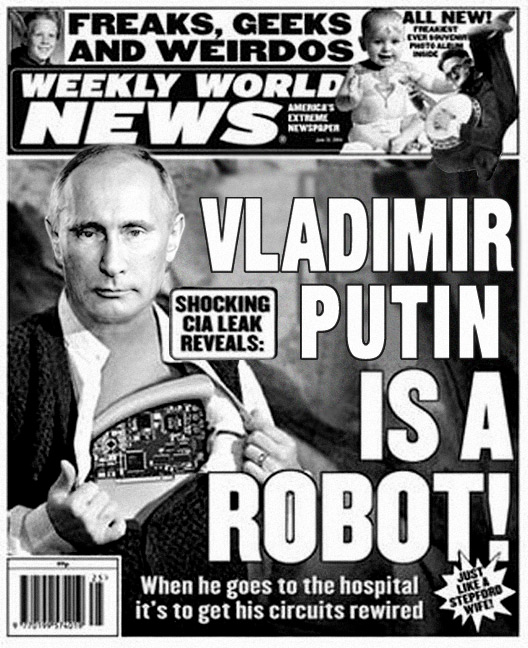
In September last year Vladimir Putin spoke at the Valdai Conference, an autumnal landmark in the Russian political calendar. The theme was values and identity and Putin proposed a “return” to morality and spirituality, praising the Russian Orthodox Church, religious tradition and resistance to political correctness.
Fast forward to Spring 2014 – and Putin’s appeal to nostalgic morality has collided with the internet age. “Swearbots” are the latest deployment – an attempt to curtail Russian’s propensity for foul language online and save the bruised fingers of online censors, who have until recently been tasked with checking over five thousand websites “manually” for profanities each day.
But how does this square off with Russian “identity,” which Putin was so keen to discuss? Russians love swearing, as much as they love vodka or not smiling at strangers. Browsing this eyebrow raising online dictionary (optimised for non-Cyrillic readers), demonstrates quite how large the Russian profanity compendium is. As one commentator cheekily told the BBC “If they ban swearing in Russia, all technical progress will grind to a halt …Warehouses will close and the army will lose its combat readiness. For our Motherland, it will be the end.”
In an attempt to police this ocean of foul language, enter the swearbot. It’s a computer programme forecast to go live this autumn, enforcing laws passed last spring. It should automate the rooting out of blasphemous Russians, and take the pressure off the media watchdog Roskomandzor, who were wilting under the pressure of censoring so much filth.
According to a statement from Moscow’s Academy of Science the law applies to “obscene references to the male and female reproductive organs, copulation and women of loose morals, and all words derived from them.”
Although that seems fairly vague, it’s a step up from when the legislation was originally passed last April. At that point, there wasn’t a specific list of forbidden words. It took until December for the the Institute of Russian Language at the Russian Academy of Sciences to confirm four words they believed should be censored – roughly translated as “c*ck” “f*ck” “wh*re” and “c**t”.
Although it’s still not exactly clear which swear words the swearbot will be primed with, those four seem a good start.
The fines for those cussing too strongly come in at 3000 rubles ($85) for an individual, and over $500 for an organisation. The bill, having passed through the parliament’s Lower House, is expected to be fully ratified by July – at which point it will come into law.
The Kremlin also announced that public performances, including cinema, theatre and stand-up comedy, would be subject to the swearing restrictions. Again, fines are in places as well as a three month suspension of business activities for repeat offences.
A trade magazine for comics, Chortle, lamented the news – worrying that comics would feel limited.
Irish stand-up comedian Rory O’Hanlon told Chortle the new rules would “make it difficult, near impossible to perform,” adding that “on the other hand it may push comedy underground and make it more exciting.’
The private TVC TV channel found itself in controversial waters when it decided to beep out the word “hrenovina” (“bullshit”). Eldar Ryazanov called the decision “an act of idiocy”.
The Ministry of Culture is defending its new legislation. “The law is not aggressive; its only aim is to regulate this sphere, so that swearing will have its purpose,” a ministry spokesperson told the Moscow Times. “It will be up to the artistic director to decide what to do with swearing, whether to break the new law or not, we will not interfere in the process.”
With the arrival of the “swearbot” program some analysts say bloggers might be at risk, especially as a law that defines major blogs as mass media is speeding towards approval.
Bloggers are now required to register as publishing entities, in a process similar to registration for TV stations and newspapers. Commentators have warned this will have a chilling effect as bloggers will be licensed to publish, as well as having their addresses logged with the government.
This article was published on May 16, 2014 at indexoncensorship.org
14 May 2014 | Middle East and North Africa, News, Yemen
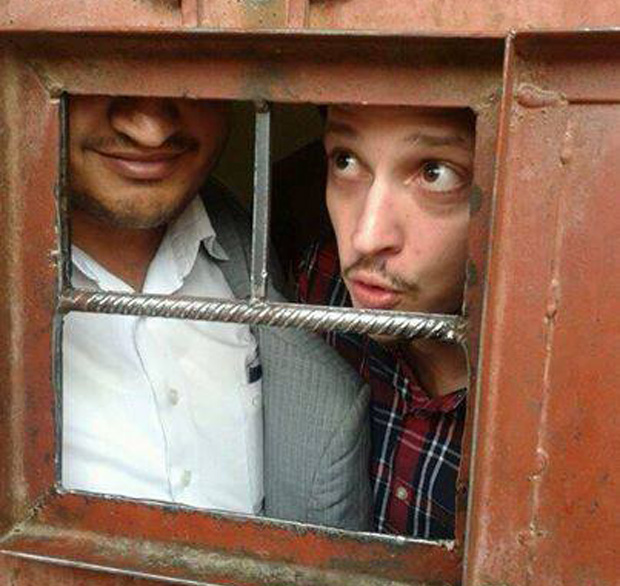
American journalist Adam Baron in jail. He was deported from Yemen last week. (Image: @almuslimi/Twitter)
Working in Yemen as a journalist can often feel like being an involuntary character in a clichéd Hollywood drama — a hybrid of a John le Carré novel and a Johnny English-style parody.
In over three and half years living in Yemen I’ve gone on the run from government agencies on four occasions. Looking back months later you either laugh or shake your head in despair at the surreal madness of it all.
One occasion involved a more than six-hour drive across part of rural Yemen popular for US drone strikes, with a local journalist alongside me. Exhausted and relieved, our successful getaway ended just before dawn.
Another was, in hindsight, rather more comical. As Yemen’s uprising intensified in April 2011, district security chief came knocking on the door in the middle of the night. He was looking for journalists and demanded copies of foreigners’ passports. It was a few weeks after soldiers had stormed the house of three foreign journalists who were then deported. The young, clandestine-revolutionary who guarded the apartment block where American journalist Jeb Boone and I were temporarily staying, managed to put the official off until the next day.
Under the cover of darkness we each packed a small rucksack of essentials: cameras, notebooks, and a change of clothes, while planning our escape to a friend’s house which had been left empty following the evacuation of the majority of the ex-pat community due to deteriorating security in Sana’a. As we made our furtive escape, creeping out of the gate in the early hours of the morning we walked straight into a truck full of soldiers parked outside the next-door neighbour’s gate. George Smiley wept.
The third almost ended in disaster. After writing a piece in January last year for The Times on Saudi Arabia’s involvement in America’s covert war in Yemen, on advice, I once again temporarily relocated in Sana’a amid fear of reprisals for my reporting. A couple of weeks after returning to my Old City home the taxi I was travelling in was ambushed outside the Ministry of Defence. A bullet smashed through the window next to my head, hissed through the hair of my driver but miraculously left both of us unharmed. Since then I have probably become the only woman in the world to convert their United Nude shoe bag into a gunshot trauma kit which I’ve since carried with me at all times.
But, as foreign journalists we have little if anything to fear. The worst that’s likely to happen to us, as American journalist Adam Baron found out during his deportation last week, is a 10-hour spell in jail wondering if we’re going to be given a few minutes to pack before being kicked out of the country we call home, without the possibility to return.
While we — the handful of foreign journalists based in Yemen — might have anxious moments once or twice a year, our Yemeni colleagues are constantly under threat. Yemen remains amongst the bottom 15 countries out of 180 in the world for press freedom. A Human Rights Watch report last September concluded that freedom of expression since President Abd-Rabbu Mansour Hadi took power in February 2012 has increased, but along with it, intimidation and violence against journalists has also risen. Yemen’s Freedom Foundation recorded 282 attacks and threats against journalists and media workers in 2013.
While Adam waited anxiously in jail last Tuesday, passport and phone confiscated, unease spread. Officials indicated that “other foreign journalists were next” my name was also mentioned. Not knowing if they’re coming to get you today, tomorrow, or at all, means that despite the relatively benign consequences, you are gripped with an almost unbearable sense of apprehension. Preparing for the worst I informed my editor at The Times in London and started to pack.
Three days later, still waiting, the madness felt like it was closing in. As the sunset over Sana’a on Friday evening one friend called to tell of gunfire and explosions next to his house. Meanwhile I sat in the protective darkness of my stairwell whispering into my phone as I heard the distant voices of two men banging on my front gate. Was this it? Was this the moment I would be forced to leave? My phone — on silent in case it was heard by those outside — lit up. Another friend had just narrowly avoided driving straight into a running gun battle in the south of the city. I tiptoed down the stairs in the dark and silently slid the two deadbolts across the large wooden door of the ancient Yemeni tower-house that is my home.
The irony is that while the ex-pat community goes into week two of lockdown in Sana’a and Western embassies close to the public due the increasing threat from al-Qaeda attacks, the most persistent threat to journalists on a daily basis is from the government and its intelligence agencies, not so-called militants.
After Adam was deported last week, for the first time, I decided not to run as I have too many times in the past. Without stopping and challenging what the government has done means the persecution of journalists will continue unabated.
There are just a small handful of foreign reporters based full-time in Yemen. Adam and I were the only ones accredited in a country where the government makes it almost impossible to live permanently as a foreign journalist with the correct paper work. Deporting unregistered journalists means no complaints can be made when individuals are thrown out.
As a legally operating reporter I had firm ground to stand on to support Adam and raise questions about why the government has chosen this moment to target him, and possibly me. Was this a personal vendetta against him? Or, was this a concerted effort by the state to remove witnesses? Those who may witness the consequences of a US-backed war currently being waged in the most significant military crackdown against al-Qaeda every carried out in Yemen.
The answers to those questions were partly answered by the manager of immigration who pulled me aside at Sana’a airport on Monday morning when I chose to leave Yemen of my own accord. I realised I’d had enough of the constant cycle of farcical drama, instigated by the state, that comes with living as a journalist in Yemen over three and a half years. I wanted it to stop. To take back control.
Despite the fact that my journalist visa is valid until February 2015, the immigration official began with “you can’t come back…” and ended with “it’s OK, you are allowed to leave now”. For the latter at least I was grateful.
The foreign media may not be welcome in Yemen, but if they are quietly trying to remove us then the greatest threat to be faced will be to domestic reporters. Over a snack of traditional sweet kataif pancakes and chilled apricot juice on my last day in Sana’a on Sunday, I sat with a Yemeni friend and fellow journalist. He acknowledge the need to step back from the madness. “The national security, they get to you,” he said tapping a finger against the side of his head. “You need to go home for some quiet time,” he added. “I got my quiet time…in prison.”
This article was posted on May 14, 2014 at indexoncensorship.org
