30 Jan 2014 | Ireland, News, Religion and Culture
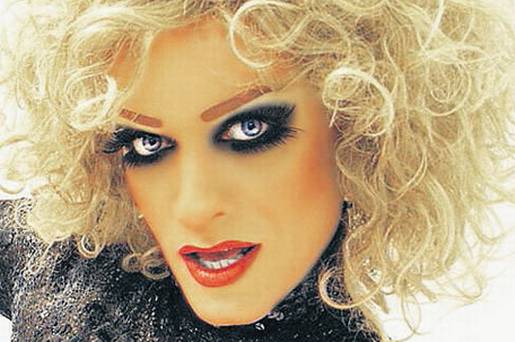
Rory O’Neill’s alter ego Panti
Irish state-run television broadcaster RTE has come under heavy criticism after offering a full apology and possible financial compensation to the Iona Institute, a conservative Catholic lobby groups declared “homophobic” by a talk show guest.
The decision appears to have been reached under pressure from Irish Broadcasting Authority board member John Waters, who was also declared homophobic during the same segment. The allegations follow RTE’s decision to remove the remarks, made by Rory O’Neill who performs as one of Ireland’s most acclaimed drag queens under the name Miss Panti, and extensive popular debate about the treatment of Ireland’s conservative lobby groups in mainstream media.
On RTE’s The Saturday Night Show, O’Neill declared a number of prominent Conservative advocates, specifically Breda O’Brien, John Waters, and “The Iona Institute crowd” homophobic. RTE removed the segment from its online player the following day, citing legal concerns as well as the recent murder of Iona Institute researcher Tom O’Gorman as a matter of “sensitivity”‘ although later admitting O’Gorman was not relevant to the program content. On January 25th, the show’s host Brendan O’Connor formally apologised for the distress caused to John Waters and other columnists. The Iona Institute has thanked RTE for the apology, which it called “an extremely valuable contribution to a calm and reasonable debate” and explained that RTE had also agreed to pay damages to the injured parties. When asked about the claim that damages would be paid over O’Neill’s comments, an RTE television spokesperson declined to comment. Neither side would confirm the identity of the claimants.
RTE’s sudden condemnation of the remarks has been linked to legal action pursued by John Waters, a conservative Catholic commentator and journalist, and board member of the Broadcasting Authority of Ireland . The Irish Independent cite anonymous sources confirming that legal representatives of Waters sent a legal letter to the broadcaster seeking the removal of the interview on the popular Saturday Night Show. It has since been restored to the website, though the offending portions of O’Neill’s interview have been edited out. Waters resigned from his position with the Irish Broadcasting Authority on January 23rd, after the letters had been drafted and sent. His decision to legally challenge RTE has been broadly criticized as an abuse of office. As solicitor Simon McGarr explains, this “was not merely a letter from an aggrieved citizen to a broadcaster. It was also a letter from one of that Broadcaster’s regulators seeking to have that broadcaster censor a citizen, who was both contributing to a matter of public debate and engaging in a defence of a minority of which he is a member, bona fide and without malice”. Waters has declined all requests for media comment.
Since his appearance on The Saturday Night Show, O’Neill has confirmed receiving personal legal correspondence from Breda O’Brien, David Quinn, Patricia Casey, and John Murray, all patrons of the Iona Institute. In a statement released on its blog, the Iona Institute defended the measure, explaining: “The problem is that merely believing that marriage is the sexual union of a man and a woman, and that children deserve the love of both a mother and a father whenever possible is automatically deemed to be ‘homophobic’ by those wishing to close down this debate.” This defamation, they claim, is harmful to political discussion.
Any private claims of defamation, explains barrister Brian Barrington, are unlikely to hold up in court, explaining: “Mr O’Neill’s comments arise in a context where the Iona Institute is well known in Ireland for its opposition to affording equal marriage rights to gays and lesbians and also for its opposition to same-sex parenting. It seeks to maintain the current discrimination whereby same-sex couples are prohibited from marrying whereas opposite sex couples are free to do so. In these circumstances, it is clear that Mr O’Neill was entirely entitled to express his honestly held opinion, which was based on facts that were reasonably known to the public.” Criticism of RTE for reacting to such a baseless legal case is well founded. “‘It is astonishing that RTE, a national broadcaster, should apologise for what Mr O’Neill has stated, censor his interview on the internet and award public money to those in the Iona Institute who have sought to prevent a free debate on equal marriage by preventing gay rights campaigners from uttering in future that opposition to same sex marriage is homophobic,” he explains.
Irish media have come under fire for a number of complaints of homophobia in recent weeks, including a discussion on RTE radio program The God Slot that discussed “curing” homosexuality and a Midwest Radio presenter’s decision to read a text on air that suggested children of gay couples could develop Aids. Ireland will legislate on a number of key gay rights issues in the coming years, including full legal recognition of gay adoptive parents, and a constitutional referendum on the legalisation of gay marriage is scheduled for 2015. The imminent debate has many calling for a “homophobia watchdog” to monitor public statements.
Una Mullally, a columnist for the Irish Times, explains: “‘Free speech’ is not a free pass to inflict psychological trauma just because you don’t want lesbians or gay people to get married. Opponents of marriage equality are not the victims in this debate.”
This article was posted on 30 January 2014 at indexoncensorship.org
30 Jan 2014 | India, News, Politics and Society, Religion and Culture
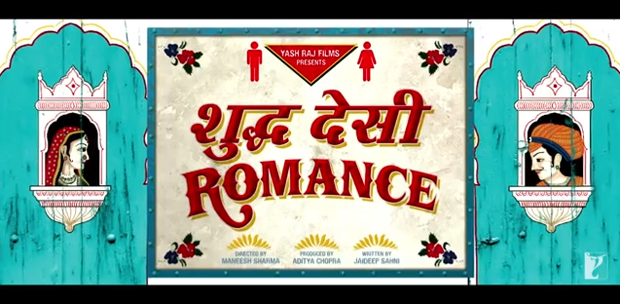
(Image: YRF/YouTube)
It an interesting introduction to his modus operandi, the new CEO of India’s censor board has described his objection to some of India’s recent blockbusters is based on the reactions of his wife and five year old daughter.
In an interview to the Mumbai Mirror, Rakesh Kumar, was quoted as saying: “After watching Shudh Desi Romance, my five-year-old daughter asked me, ‘Dad, isn’t there too much love in this movie?’ More recently, I went to see Yaariyan with her and came out visibly embarrassed. Now, I have decided not to see even a UA film with my kid.”
Predictably, reactions were fierce. Movies with a UA rating in India are tagged for parental guidance, as they might be inappropriate for young children. These movies have mild sex scenes, gory images of violence and crude language. Kumar, a former employee of the Indian Railways, might feel “inappropriate content” is making it to the big screens, however, it only serves to highlight that the censorship of movies cannot be viewed from the perspective of a five year old girl.
Aside from the many jokes being made at Kumar’s expense, a deeper issue has been brought to the surface yet again. A constitutionally mandated body under the Ministry of Information and Broadcasting, the Central Board of Film Certification (CBFC) regulates any films that are to be publicly exhibited. In India, there are a number of certificates a film could be given: A for Adult, UA, unrestricted public exhibition with parental guidance, S, restricted to a special class of persons, and the coveted U, which is unrestricted public exhibition, and is also the class of movies that can be shown on Indian television at prime time.
The first question many might ask is, does India need a censor board? With all kinds of content available on television and the internet, is censoring film for “inappropriate” content still valid? However, given that India does have a censor board, the next question is who it is made up of. There are about 500 members of CBFC, who preview around 13,500 films a year. The current chair is a famous dancer, Leela Samson, who controversially commented that almost 90% of her fellow board members were “uneducated political workers who did not understand their responsibility,” for which she later had to apologise. The current, and past, CEO of the board have been serving bureaucrats, on loan for this role. The final and biggest questions of the censor board faces, is how and why films are given the certifications they are.
In a very telling essay after his stint on the CBFC, journalist Mayank Shekhar wrote about the kinds of arguments that would take place at the meetings he attended: “Over the years, the focus of the Censor Board appears to have shifted from sex and violence to people’s “hurt sentiments” – some of it possibly real, but much of it imagined.”
The truth is that there are three broad problems in the certification of Indian films. First, the film board censors movies based on their moral outrage to sex or violence (as exhibited by the new CEO’s reaction), fear of minority groups getting upset (as witnessed by Shekhar), and the attempt to keep films with controversial subjects like the politics of Kashmir away from the mainstream audience, often by giving them A certification (as experienced by filmmaker Ashvin Kumar and reported by Index).
The second is the approach of filmmakers. Some, in order to get their films on TV by getting a U certificate, are only too happy to oblige any cuts the board might suggest, betraying any artist integrity. The other extreme is filmmakers who put in scenes with the intention of crossing swords with the board, thereby garnering some press attention for the movie. Shekhar writes in his essay of producer who was very disappointed that the board was not cutting any of his violent scenes, pleading: “Come on, how will people know this film exists? I’ve made a very violent film. How will I publicise it?”
The third is the allegation that board members take bribes in exchange for lenient certifications, as reported by Mint. Some feel the board goes easy on big production houses. This is because there are great financial implications involved with the certification process. Filmmakers want to make their investments back, both from the box office and lucrative satellite rights should their films be picked up for prime time viewing on television channels — as they can be with a U rating. Five Indian filmmakers have expressed their frustration with the lack of transparency in the decision making process of the CBFC, as well as perceived political interference. “I got an SMS from a senior member of a national political party, who told me that he was now with the Censor Board so to let him know if I needed any help,” revealed filmmaker Tigmanshu Dhulia.
However, ultimately, the entire argument boils down to the moral order, real or contrived, that Indian films must subscribe to should they want to be seen by the general public — both in movie halls and at a reasonable hour on television. In 1994, the censor board asked the makers of the movie Khuddar to replace the word “sexy” in a song with the word “baby”. So lyrics went like this (translated) – “baby, baby, baby, is what people call me.” In a repeat performance of a kind, in 2009, the world “sexy” was yet again replaced, but this time with “crazy” for the television version of the film. Over the years, kissing and even some sex scenes have slipped into Hindi cinema, as has a lot of cussing and plenty of violence. Nudity is only permitted in certain movies, which is either pixelated or viewed by a long-shot. Freedom of expression certainly seems in line behind the perceived notions of vulgarity of a few.
Thankfully, satire is alive and well in India, and enough websites are taking the CBFC and its new CEO to task. Others, like filmmaker Hansal Mehta, are determined to file an RTI – Right to Information – application to question every decision the board takes. As he says: “It only takes Rs 10 (under 1GBP) to file an RTI application. We live in a democracy, no one can stop me.”
This article was published on 29 January 2014 at indexoncensorship.org
27 Jan 2014 | Egypt, News, Politics and Society
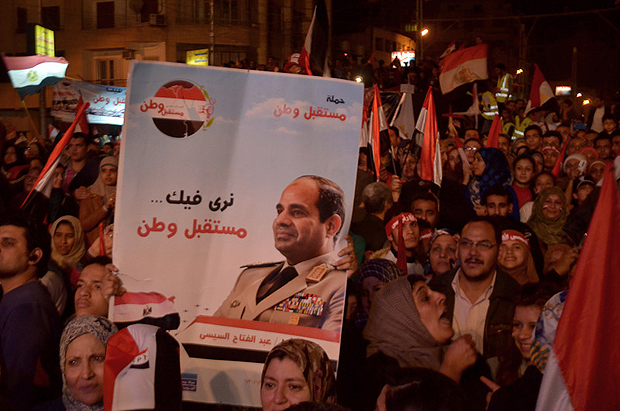
Thousands of Egyptians celebrated the 25th of January 2011 revolution anniversary at Al Etihadia Palace Square. Demonstrators chanted for the army and police and raised flags and banners bearing images of Gen. Abdel Fattah al-Sisi. (Photo: Adham Khorshed / Demotix)
As thousands of Egyptians demonstrated in support of the country’s military, journalists were attacked, 49 people were killed and 247 others were injured in anti-government marches across Egypt on Saturday on the third anniversary of the uprising that led to the overthrow of autocrat Hosni Mubarak.
The figures were announced by Egypt’s Health Ministry but Al Nadeem Center, a Cairo-based rights organization, gave an even higher death toll, adding that more than 1,000 people had been arrested in a day of violent clashes between protesters and security forces.
Still, a significant number of Egyptians refused to let the violence dampen their celebratory mood. Thousands of flag-bearing revellers flocked to Cairo’s iconic Tahrir Square on Saturday to rally in support of the army. Raising pictures of Defense Minister General Abdel Fattah El Sisi , they called on him to run for the presidency, chanting “El Sisi is our president” and “the people, the army and the police are one hand”.
Three years after the mass protests demanding an end to Mubarak’s police state system, the revelry and nationalistic fervour demonstrated a reversal in public sentiment towards the military and the police, which were perceived in a negative light during the transitional period that followed the ouster of Mubarak. It also underlined the bitter polarisation in the country.
“The people want the execution of the Muslim Brotherhood!”, the Tahrir crowd chanted over and over.
Security was intensified after a series of bombings rocked Cairo the previous day — the largest of them a remote-controlled car bombing targeting the security directorate near the centre of the city. At least six people were killed in the bomb attacks and scores of others were injured. Ansar Beit al Maqdis — an al Qaeda-affiliated jihadi group — claimed responsibility for the bombings. The group threatened more violence and warned people to stay off the streets. Many Egyptians dismiss the persistent denials by the Muslim Brotherhood — recently designated by Egypt’s military-backed authorities as a terrorist organization — that the Brotherhood was behind the violence. The Brotherhood insists its struggle is peaceful and has issued a statement on its official website condemning the terrorist attacks. Tens of thousands of riot police and armoured personnel carriers were deployed to try to maintain order and Tahrir Square was ringed by barbed wire to prevent pro-Muslim Brotherhood marchers entering the square.
Supporters of toppled Islamist President Mohamed Morsi staged marches in 34 Cairo neighbourhoods , protesting his overthrow. In a statement published on their website Ikhwanweb the previous day, they vowed to continue their protests until they topple “the fascist coup regime”. Security forces fired volleys of tear gas and gunshots in the air to disperse the protesters. Scores were killed or injured in ensuing clashes with riot police and pro-military residents who hurled stones and bottles at the protesters. Hundreds of demonstrators were arrested.
Pro-democracy activists meanwhile, staged a protest rally outside the Journalists Syndicate in downtown Cairo to express their opposition to authoritarian rule. “Down with military rule and down with the Muslim Brotherhood,” they chanted before being violently attacked by security forces and pro-military residents. The protesters ran for cover amid thick clouds of choking tear gas.
In the mayhem that followed, leftist activist Tarek Shalaby who was among the opposition protesters, sent a message on Twitter advising his comrades to “grab posters of El Sisi to avoid being targeted by riot police.” He also warned others to steer clear of the downtown area, describing it as “extremely dangerous.” For Sayed Elwez, a young member of the April Six group that played a key role in mobilising protesters ahead of the January 2011 uprising, the warnings were too little, too late. He was shot in the neck and chest by security forces while trying to escape. Ironically, Elwez had been among the thousands of secular volunteers in the Tamarod campaign, collecting signatures for a petition calling for Islamist President Mohamed Morsi’s resignation.
In recent weeks, the military-backed government’s brutal crackdown on Muslim Brotherhood supporters has widened, targeting dissenters of all stripes including liberal activists, journalists and prominent academics. Paradoxically, many of those targeted had previously opposed the Muslim Brotherhood president, aligning themselves with the country’s notorious security apparatus to remove him from office.
Two prominent Egyptian political scientists are the latest targets of the crackdown which rights activists say, is aimed at silencing all critics of the military-led authorities. Emad Shahin, an internationally-acclaimed and widely respected academic who has taught at Harvard and Notre Dame has been charged with “espionage and conspiring with foreign organizations to undermine Egypt’s national security”. His name has been added to a list of majority-Brotherhood defendants (which also includes the former President Mohamed Morsi) facing trial on similar charges that some rights activists believe are “politically motivated”. Shahin has denied the charges , insisting that his true offence “was criticism of the political events in Egypt since Morsi’s ouster”.
Amr Hamzawy, another political scientist and former lawmaker has meanwhile, been accused of “insulting the judiciary”. The legal complaint against him stems from a message he posted on his Twitter account in June, in which he criticized a court verdict sentencing 43 NGO workers to one to five year jail terms. The NGO staffers were accused of “working for unlicensed institutions and receiving illegal foreign funding”. Hamzawy described the verdict as “shocking and lacking in evidence and transparency”. The highly-publicised NGO case, also widely criticised by international rights activists, was seen by many as symbolising “a severe crackdown on civil society in Egypt”.
Amnesty International has criticized the widening crackdown on rights activists in Egypt, expressing concern that the Egyptian authorities were “tightening the noose on freedom of expression and assembly”. In a statement released soon after the charges were levelled against Shahin and Hamzawy, Hassiba Hadj Sahraoui, Middle East and North Africa Deputy Director at Amnesty International said “repressive legislation” was “making it easier for the government to silence its critics”. She warned that “with such measures in place” Egypt was “headed firmly down the path toward further repression and confrontation”.
Several prominent pro-democracy activists languish in jail for taking part in ”illegal protests”. Rights advocates say their imprisonment signals the return of Mubarak’s police state and that counter- revolutionary forces are back with a vengeance. In letters of despair leaked from their solitary prison cells, Ahmed Maher and Alaa Abdel Fattah (two symbols of the uprising against Mubarak) speak of a “failed revolution” that has been hijacked first by a religious group, then by the military.
In a letter to his two sisters written earlier this month, activist Alaa Abdel Fattah also wrote: “What adds to my feeling of oppression is that I feel this particular lock up has no value. This is not struggle, and there is no revolution.”
Journalists too have not been spared; in recent months they have continued to face physical assaults, intimidation and detentions. At least five journalists are currently behind bars for reporting on the ongoing political crisis. Three members of an Al Jazeera English TV crew have been in custody for nearly a month pending investigations on charges of “spreading lies harmful to Egypt’s national security and and joining a terrorist group”. In a letter recently smuggled out of his Torah prison cell, Al Jazeera correspondent Peter Greste recounts the ordeal of his two Egyptian colleagues who are being accused of belonging to a terrorist organisation and are held in a high security prison.
“Fahmy has been denied the hospital treatment he badly needs for a shoulder injury he sustained shortly before our arrest. Both he and Baher spend 24 hours a day in their mosquito-infested cells, sleeping on the floor with no books or writing materials to break the soul- destroying tedium,” Greste lamented in his note published on the Al Jazeera English website.
Several journalists covering Saturday’s pro-military Tahrir rallies meanwhile, reported coming under attack from mobs who suspected them of working for Al Jazeera. The Qatari-based network is highly unpopular in Egypt because of what many Egyptians perceive as a pro- Muslim Brotherhood bias in its coverage of the political crisis in Egypt. Meanwhile , the state-run and state-influenced media alike are awash with conspiracy theories and talk of foreign plots to divide and destroy Egypt. This has fuelled the xenophobia in Egypt, posing a serious security challenge for foreign journalists covering the protest rallies. Journalist Nadine Maroushi who was attacked in Tahrir Square on Saturday has shared her traumatic experience on her blog:
“In Tahrir Square yesterday a man suggested we worked for Al Jazeera. An angry crowd quickly formed around us. ‘You traitor, you pig,’ a veiled woman shouted at me. She pulled my hair and grabbed at my scarf, choking me. The police intervened; I showed my press pass. They took us away to a building just off the square and told us to hide there for an hour until the crowd calmed down.”
A message posted by freelance journalist Bel Trew on Twitter on Saturday also warned that Tahrir was not safe for journalists. Trew’s tweet was retweeted more than a hundred times within minutes, triggering a frenzied exchange of telephone numbers to report assault and harassment of journalists. Egyptian photojournalist Mosa’ab El Shamy, meanwhile described it as “horrible day for journalists in Cairo. At least 5 (including a foreigner) were arrested, 2 are in hospital and 7 cameras have been seized by the police and confiscated,” he tweeted.
Three years on, the revolutionary activists’ hopes for dramatic change have all but faded. With the demands for freedom of speech, equality , dignity and an end to police brutality and corruption unfulfilled, the political turmoil and instability of the past three years have forced many Egyptians to drastically lower their expectations. Forsaking their ambitions for freedom and democracy — at least for now — many in Egypt have settled instead for the lesser hope of restoring stability in the country gripped by violence. Stability can only be guaranteed with a return to military rule , they say. But not all Egyptians have given up their revolutionary dream of a free and democratic society. A small but resilient group of young activists that refuses to bow under repression is keeping the dream alive. They are the country’s hope for change. “Today was a harsh defeat on a long and bumpy road,” Tarek Shalaby wrote on Twitter, but there is no going back.
This article was posted on 27 January 2014 at indexoncensorship.org
24 Jan 2014 | Digital Freedom, News, United Kingdom
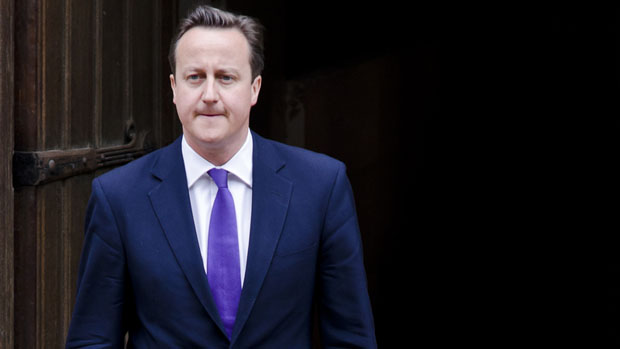
(Image: Velvet/Demotix)
It wasn’t meant to be like this.
Connoisseurs of a good political bust-up may have noticed a subtle change in tempo to the online filtering debate over the Christmas period. For the argument, so long owned — in public at least — by the pro-blocking “think of the children” lobby took a sudden and unexpected twist. For a moment, the villains were not selfish libertarians, determined to place personal freedom of expression above child protection — but the incompetents in government, who had demanded a solution that was untested without first ensuring they weren’t doing more harm than good.
What went wrong?
As German military strategist Helmuth von Moltke, in the news during this World War anniversary year, once put it: “no plan of operations extends with any certainty beyond the first contact with the main hostile force”.
It was always going to be an easy win, banging on about the need to protect children and threatening internet service providers with legislation if they didn’t comply with prime ministerial demands over filtering: easy, too, to dismiss the assorted nerds and geeks who warned it wouldn’t work. As a prime ministerial adviser on this topic, Claire Perry, MP put it: “We should not allow the perfect to drive out the good”.
But since November, filters have arrived with a vengeance and even the technologically naive can see that they don’t exactly work as claimed. A BBC expose in December revealed what was always expected: They over blocked some quite useful sites, including sites dealing with LGBTI issues, sex education and even domestic violence and rape, while simultaneously under blocking a lot of porn.
Ooops!
“Not us, guv,” explained a spokesperson for Number 10. Back in July 2013, David Cameron had very presciently blocked all possible blame by requesting the UK Council for Child Internet Safety (UKCCIS) make sure this sort of thing didn’t happen. UKCCIS, a body composed approximately 50% from those with a commercial interest in this area, set up a sub-committee which met in December 2013, some weeks after the first of the new filter solutions hit parental laptops. No minutes, though: open government has been filtered!
Meanwhile, much wordage was being unleashed in the minority and progressive press. Rather like stories about government losing databases a few years back: No sooner had the press happened on one instance of ridiculous blocking, then another even more ridiculous case joined the queue.
In the circumstances, to list the legion legitimate sites that were in one way or another blocked would be tedious. So let’s stick with some of the most serious. BT, it transpired, was offering parents the opportunity to bar access to LGBT material — almost certainly direct discrimination — as well as access to social support.
In other words, if you are a child abuser or perpetrator of domestic violence, just go BT — and you can shut off one avenue to support for your victims. The filter is still available — though BT have tactfully amended the marketing description.
Two firms — Trend Micro and Dell — were also found to be selling a tool that permitted explicit blocking of LGBTI content: both, following exposure by GayStarNews, have subsequently amended their product.
It is unlikely that opinion swung irretrievably against blocking and filtering, but it is clear that the public, now aware of what those techniques mean in practice are suddenly a lot less impressed by political demands for UK providers to censor their net habits.
Along the way came something of an own goal. The latest initiative relates only to filtering and blocking of internet access through pc portals. Mobile phones have been subject to a filtering regime — largely unnoticed — since 2004, while filtering of wifi in public spaces is up for debate in 2014. The bad news, for the former, was that suddenly their activities were up for the same level of criticism as internet service providers, while discussion of the latter may no longer be quite the slam dunk that government had hoped.
So much for the panic: What about solutions? At a parliamentary meeting last week, sponsored by Julian Huppert, MP and organised by the author of this article, Jane Fae, a wide range of groups came together to discuss the issues raised. That included the usual suspects — the minorities on the sharp end of blocking — as well as representatives from industry and members from other parliamentary parties.
The problems raised here were rehashed, but the real focus was on the future, and there was little comfort for advocates of filtering. Speakers talked about taking legal action against filter companies, both in respect to discrimination and, for compensation when, as happened to one businesswoman, they find their business website blocked for no other reason than that she is transgender.
The difficulty is that government ministers have continually harped on about the Internet Watch Foundation as model solution, while blithely ignoring the fact that they also happen to be a Rolls Royce solution: Sites are individually evaluated by individual moderators. This costs serious money.
However, while this is an issue so important that government has threatened legislation if service providers don’t play ball, government — and the public — seem remarkably unwilling to stump up the many millions that would be required to come close to even a partial fix. So service providers have done what they can, reaching out to solution providers such as Nominum, Symantec and Huawei — all non-UK companies — operating a range of different filtering systems behind the veil of “commercial confidentiality” and not subject to UK law.
There is no single central service to check if a website has been wrongly filtered — even by the government’s own criteria — no central process for removing a potentially ruinous misblock. It’s the cheap option: A bit like the government deciding child protection in the UK was so important, it should be sub-contracted to a bunch of unregulated freelance social work providers.
Is regulation the answer? That was suggested, along with licensing of filter solutions and an independent audit of same. That, however, attracted little support in the meeting, being rejected both by those opposed to all filtering, and by those who felt it would create a costly and bureaucratic quango.
At the same time there was somewhat more appetite for central reporting facilities and a central appeals process. Because, how is any legitimate business supposed to conduct itself if it needs to keep a constant eye on upwards of 80 different filtering companies?
What of future debate? Ironically, the day of the meeting, Ofcom was also publishing a report that suggested parents were mostly happy with matters as they were. Government, on the other hand, intends forcing all net users to decide whether to opt out of filtering later this year. Ofcom also pointed out — as experts already did — that children, the objects of all this protection, were becoming increasingly net savvy, with significant numbers knowing how to evade filtering and cover their browsing tracks.
That is a serious issue. It is likely that children in war zones such as Syria or central Africa will have significantly more knowledge of how to use guns than the average British child. Its all about exposure. Whereas Britain, by imposing all these controls, is growing a generation that knows how to evade internet control. From there, it is but a short step to the darknet, where lurks precisely the sort of criminality that government — again — says it wants to eradicate.
We are likely to hear more about the commercial interests involved in all this. For there is a growing realisation that many of the more startling statistics and internet horror stories are produced and disseminated by companies offering filtering solutions and American evangelist organisations: Sometimes one and the same.
It is to be hoped, too, that the media and politicians will be more critical of some of the wilder statistics being tossed around in debate. Take for instance, the incidence of children viewing porn on the internet. “The average child sees their first porn by the age of just 11. Between 60 and 90 per cent of under-16s have viewed hardcore online pornography” — according to a survey carried out in 2010 by Psychologies magazine, based on the views (no numbers cited) of 14 to 16-year-olds at a north London secondary school.
As opposed to the EU Kids Online survey of over 25,000 children in 25 countries that found just 11% of UK children had viewed any form of porn online in the previous 12 months.
Which would you believe? Which do you expect to be cited approvingly — and frequently — in the tabloid press?
So where are we now? Battle has at last been joined, and finally the public can see that there are major practical problems associated with online filtering. That hasn’t, yet, diminished the appetite of the Conservative party for more of the same. Nor has it dissuaded the Labour party from jumping aboard the same bandwagon.
Meanwhile, in an act that smacks of the politics of masochism, Labour appears to have pledged that if voluntary filtering fails, then, if elected in 2015, it will legislate to introduce mandatory filters
This one, it seems, will run and run.
This article was published on 24 January 2014 at indexoncensorship.org
