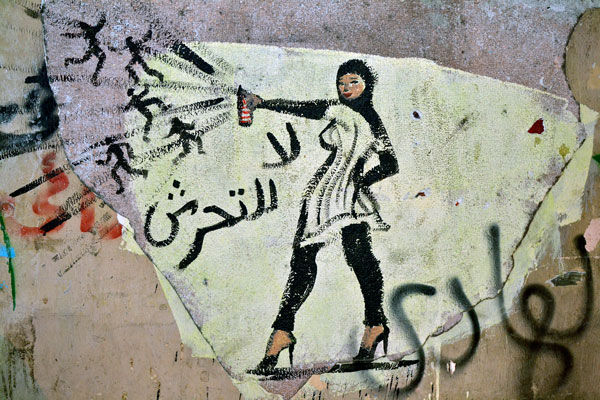
Sexual harassment has been widespread in Egypt for decades but since the January 2011 uprising that toppled former President Hosni Mubarak, the problem has taken on epic proportions becoming what rights activists now describe as “an epidemic”. Not only has there been a dramatic increase in the number of harassment cases reported , but the level of violence too, is unprecedented with mob sexual assaults becoming rampant during street protests.
No fewer than 91 girls and women were reportedly gang raped and sexually assaulted in just four days during mass protests demanding the ouster of Islamist president Mohamed Morsi last July. Rights activists say the number of assault cases could be even higher as there is the possibility that some cases had gone unreported. Most of the attacks occurred in or near Tahrir Square in downtown Cairo where hundreds of thousands of opposition protesters had gathered to demonstrate against the Muslim Brotherhood president and later, to celebrate his downfall. Vicious mobs used metal chains, sticks , blades and knives to attack female protesters despite the presence of volunteer vigilante groups keeping an eye out for harassers.
In response to the surge in harassment, several civil society organisations have sprung up in recent months with the aim of curbing sexual assaults and protecting victims of harassment. One such organisation is the Anti-Sexual Harassment Campaign , an outreach movement set up in November 2012 to keep track of harassment cases and send teams of volunteers to protest sites to intervene in mob assaults. The organisation is just one of several movements monitoring protest sites and offering ‘safety advice’ to women. The emergence of such movements is evidence of the growing unwillingness to tolerate street harassment as public awareness about the problem increases .
Police in Egypt have meanwhile, formed a special unit of female police officers to combat street harassment in particular, and violence against women in general. While the unit is still small in size –consisting only of ten women—rights campaigners believe it is “a step in the right direction.”
“Often women victims of harassment are too ashamed to report incidents of harassment and sexual assault. In some cases , they are afraid of getting blamed”, Azza Kamel , founder and director of women’s rights organisation Appropriate Communication Techniques (ACT), said in an interview. “They may feel more at ease talking to another woman about the issue,” she added. Her organisation has run a hotline for eyewitnesses and women victims to report sexual harassment or assault cases which are known to increase and get more violent during public holidays and religious festivals.
Fatma Khafagy, chairperson of the National Women’s Council ‘s Ombudsman Office meanwhile, lamented that male security officers do not take sexual harassment seriously enough and at times, themselves harass women who come forward to report such incidents.
With a background in psychology, the women police officers have undergone training in communicating, listening and helping to rehabilitate victims of harassment and assault. “We encourage women to speak up and report harassment. They should not blame themselves for causing the harassment and must not hesitate in seeking justice”, said Colonel Manar Mokhtar, one of the officers at the new police unit for combating violence against women. “We also urge them to seek professional counselling that can help them recover from their traumatic experience.”
Victims of harassment often complain of a “culture of impunity” at the state level, saying that perpetrators often go unpunished for their crime. “But that is slowly changing with the growing awareness about the problem,” Khafagy noted.
She acknowledged the pressing and urgent need for legislation to counter the problem, given the surge in violence against women in Egypt, post revolution. A study conducted in April by the Egyptian Center for Women’s Rights revealed that 99.3 percent of Egyptian women have experienced some form of sexual harassment.
“In the absence of laws against sexual violence, we can only expect street harassment and sexual assaults to continue unchecked”, argued Khafagy.
A bill on violence against women that was recently drafted by the National Council for Women and was under discussion in the now-disbanded Shura Council, the upper house of parliament has been shelved due to the political instability.
Khafagy and other rights activists however, believe that legislation won’t be enough to tackle what they described as “a social scourge.”
“The answer lies in changing people’s attitudes. Educating women about their rights and getting men to realize the extent of the harm they inflict on the women is the only way that we can change existing behavioural patterns,” insisted Kamel. “But change cannot happen overnight; it takes time.”
For Egypt’s women victims of harassment, it cannot happen fast enough.
A UK court has today ruled that a Muslim woman may not wear niqab (the face covering veil) while giving evidence in a trial. The judgment does, however, suggest that the woman may be allowed to give evidence behind screens, or on a video livelink.
The case had sparked calls for a “national debate” on niqab in the UK, led by Home Office minister Jeremy Browne.
We’ve been here before, of course. As far back as 2006, I took part in a discussion on the issue on the BBC radio’s philosophical bear pit, the Moral Maze.
I pointed out then my personal objection to niqab, and indeed other strictly interpreted religious dress codes: in my view they are the product of an obsession with female sexuality that is just creepy.
This is not a new idea, but I still think it’s true. There are, however, other parts of this argument.
Pointing out the “male gaze” argument carries a danger of simplifying the issue of niqab in the UK to a straightforward view of the face veil as a patriarchal imposition. This makes the debate easier, as it becomes simply about liberating women from portable prisons.
While male pressure may certainly be a factor, it’s far from the whole story.
Veiling (as opposed to hijab) among older Muslim women in the UK is really quite rare. The majority of those taking up niqab are teenage girls and young women choosing to do so whether due to devoutness, fashion or peer pressure. I have heard the argument put forward that the more attractive a girl is, the more it is religiously sanctioned that she should wear a veil. Thus covering your face is in fact sending a signal that you are very beautiful indeed. One can see why some teenage girls would sign up for that.
There is a debate to be had over parts of social interaction where identification is more than merely desirable: courts being the most often cited example. But too often the discussion about niqab is about what “we” are comfortable or uncomfortable with, rather than what is necessary for a functioning society.
And consistently, the voices of niqabis are not sought out. In the Independent, Yasmin Alibhai Brown blithely dismisses niqabis as “unquestioning women” following “manmade injunctions”.
On Newsnight in 2010, when asked whether women in, say, the legal profession should be allowed wear niqab, Tariq Ramadan shrugged off the notion saying the type of woman who wears niqab would never enter that profession in the first place. Niqabis are not just veiled, they are silenced.
It’s worth watching this clip below (from the same Newsnight segment as the one where Tariq Ramadan dismissed the future of niqabis), one of the rare instances where girls and women are actually asked about niqab.
Speaking to veiled young women in Whitechapel, Conservative MP Philip Hollobone encounters some interesting views, but the emphasis is on personal choice. One Niqabi implies that veiling, like goth or punk, is a subculture rather than necessarily an imposition of piety. A liberal society should not be comfortable with discussions about proscribing modes of dress, for whatever reason they are adopted.
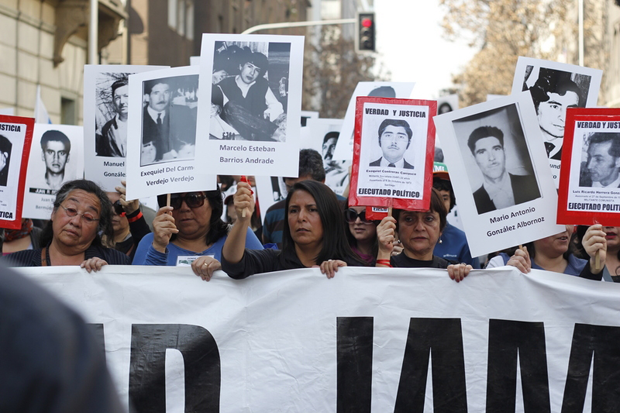
A march organized by the National Assembly of Human Rights in Santiago to mark the 40th anniversary of a military coup that ousted President Salvador Allende ended in violence and clashes with police. (Photo: Mario Tellez / Demotix)
The date September 11 has a lot of meanings. For Chile, today marks 40 years since the coup that ushered in 17 years of military dictatorship. This powerful excerpt from Exorcising Terror: the Incredible Unending Trial of General Augusto Pinochet is taken from the winter 2005 edition of Index on Censorship magazine archives.
By Ariel Dorfman
—
It must have been some time in 1974 when I think I first laid eyes on Maria Josefa Ruiz Tagle. She was a baby girl, and if I’m not mistaken she played on the floor of our kitchen in Paris with our son Rodrigo, who was then seven years old, while we chatted with her mother, Monica Espinoza. Angelica says that I am mistaken, that I could not have seen Maria Josefa then because Monica had not come to Europe at that point without her child – and yet that memory burns within me still. I had known Monica’s husband, Eugenio Ruiz Tagle Orrego, only vaguely, just a hello and good-bye a couple of times in the halls of our party’s headquarters (we both belonged to the same revolutionary organisation). Mutual friends keep on telling me that we must have met and talked any number of times, but I can’t for the life of me recall much else, other than trying to squeeze from the memory bag in my head one or two occasions in which we exchanged a joke or two; that’s all I remember of his life. His death, however, was another matter. A civil engineer who came from one of Chile’s most aristocratic families and a dedicated revolutionary since his student days at the Catholic University, the coup had found him in Antofogasta, in the north of the country, acting as general manager of the National Cement Works. He had voluntarily given himself up on 12 September, like so many who had trusted that the military would not defile or denigrate them – and had been killed a month or so later, reportedly in the most savage fashion.
A disturbing rumour had sprung up after his death: that his right-wing father in Santiago had taken his time in pressuring the military to release the wayward offspring, apparently because he thought that nothing much could happen to the young man, given the traditional civility of Chile’s armed forces, or maybe trusting that his son’s blue-blooded heritage would protect him. Which made it even more heartbreaking when his mother demanded that Eugenio’s tightly sealed coffin be opened and discovered his body and face mutilated almost beyond recognition. But I always wondered if these reports of his father’s guilty detachment and subsequent intolerable loss did not constitute a fabrication of the sort that often circulate in uncertain and violent times, an attempt by a repressed community to forge a story of how the murder of a rebellious son awakens a conservative progenitor to the true evil of a regime he helped to bring into being.
What was no fabrication, however, was how that death had devastated the family, and you could see it in the deep well of sorrow that Monica seemed to be floating in when we met her in Paris almost a year after the execution of her husband. And yet, at the same time, there was an unexpected purity in her gaze as I recall it, as if she had decided not to give fate the satisfaction of seeing her cry, as if all the tears had dried up inside her instead of coming out. Or was it a quiet resilience? – a decision she seemed to have made that she was going to get on with life, no matter how hard that might be, for the sake of the baby, but also in the name of her dead love, who would not have wanted the murder of his body to have murdered her future. So I was not entirely surprised when I heard, some months later, that she had settled into a stable relationship with Jose Joaquin Brunner, a friend of hers and Eugenio’s from way back. Brunner, whom I was also close to, was at the time working on his doctorate at Oxford and would become, upon his return to Chile a few years later with Monica and Maria Josefa, one of the country’s most prominent intellectuals. But perhaps more essential to Monica, Jose Joaquin grew into the role of Maria Josefa’s daddy, bringing her up as if she were his own child.
The little girl was told from her early age that her biological father, Eugenio, had died in front of a firing squad, but no other details were forthcoming. She conjured up, Maria Josefa wrote many years later, a sort of romantic scene – a death occasioned by a diffuse group of men, none of whom was identifiably responsible, perhaps a way of keeping that violence done to her father from overwhelming and poisoning her life, by not making her wonder about who was personally responsible for that homicide. She always sensed, nevertheless, that underneath the silence surrounding and covering that remote death, there lurked something more dreadful, some secret terror that was all the more fearful because nobody dared to name it. And then, one day, when she was twelve, a strange hunch led her to probe and explore what might lie behind a photograph in her grandmother’s house, a picture which showed Maria Josefa herself at around two years of age taking a bath in a small tub. Was it the clean water in which she was bathing in the picture that provoked her to undo the frame that held it and go beyond the false innocence of that child she had once been? Perhaps, because what she found were three pages hidden by her grandmother and written by two of her father’s friends who had witnessed the way he had been treated before he died, witnesses who had been tortured themselves but who had, by a miracle, survived instead of being killed by the Caravan of Death. Reading those words from the past, Maria Josefa found out that Eugenio had not been shot by a firing squad, but – to use her own words – ‘he was missing an eye. They had carved out his nose. His face was deeply burnt in many places. His neck had been broken. Stabs and bullet wounds. The bones broken in a thousand parts. They had torn the nails from his hands and from his feet. And they had told him that they were going to kill me and my mother’.
But she said nothing. She kept those words, those images, inside. Like the country inside. Like the country itself.
Many years later, in 1999, when she had Lucas, her first baby – at the age of 26, the age her father had reached upon his death – when she held the baby in her arms and realised that her father had also been able to hold her and get to know her, she burst into tears one morning and felt the irresistible need to write to her father, to tell her story, what it meant to be the child not only of a murdered man but of a country that did not want to confront and name that death. She denounced how everything around her had been built so she and everyone else would not have to look the past in the face. Built, she said, so that people would never have to go to sleep every night feeling afraid.
Still, however, she kept those intimate words to herself. Until, a year and a half later, in November 2000, when Eugenio’s body was exhumed from the Antofagasta cemetery and taken to the Wall of Memory in Santiago for a second burial. Then she allowed an actor publicly to read out, on that occasion, the words she had written to her father. For the tears that have been kept hidden all these years to come out, the tears that I had not been able to see when we sat with her mother Monica in that kitchen in Paris and I watched the fatherless child playing, for that to happen, first Pinochet had to be stripped of his immunity and Eugenio’s name had to be cleared – he was not a terrorist but a victim, he was not a criminal but a hero, and his death was terrible but had not been entirely in vain as it had come back to haunt the man who had ordered it. First Eugenio had to come back from the dead. Then his daughter could come out into the light of day.
But that is not the end of the story. When you drag something out from its hiding place, other things emerge, one thing leading to another. Eugenio Ruiz Tagle still had one more service to perform for his family and his friends and his country.
When Judge Guzman placed General Pinochet under house arrest at the end of January 2001, his lawyers immediately appealed – insisting that their client was innocent, that there was no proof that he had known about any of the deaths of the Caravan of Death. One week later, on February 7, the online newspaper El Mostrador (these sorts of journals are the only really free sites in Chilean print media) published the most damning document yet in the whole case. Back in 1973, Pinochet’s justice minister – probably because of Ruiz Tagle’s family connections – had informed the Commander in Chief of the Army of the young man’s torture and extrajudicial execution by the officers from the Caravan of Death. In his own handwriting, Pinochet answered the minister that he was to deny the facts and conceal them, instructing him to say: ‘Mr. Ruiz Tagle was executed due to the grave charges that existed against him. [Say that] there was no torture according to our information.’ Needless to say, any possible investigation into that death had been quashed.
This piece of news occasioned yet another revelation the next day in the same online newspaper. Carlos Bau, an accountant at the Cement Works where Eugenio had been general manager and who had given himself up to the authorities that same 12 September, told the story of Ruiz Tagle’s daily torture at the Air Force Base of Cerro Moreno in Antofagasta during the month that preceded his execution: the soldiers had wanted the prisoners to confess that they had weapons and explosives (Pinochet’s subordinates were trying to assemble a justification for the repression their commander in chief had unleashed, proof that there was a war and that the enemy was armed and dangerous). It turned out that, far from protecting him, Ruiz Tagle’s surnames had made his tormentors pick him out for special treatment – maybe to teach him a lesson, maybe because they had class resentments of their own, maybe because a Ruiz Tagle should have known better than to associate with the Allendista riffraff. Whatever the reasons, he was always the first to be beaten every time there was a session, constantly mocked and kicked and cut – and, like his wife a year later in Paris, like his daughter throughout most of her life, Eugenio had not let a cry out, had kept what was he was feeling inside. But Bau added one more detail that had not up until that moment been public knowledge in Chile: the identity of the officer who had started the beating, who had begun it all by landing Eugenio a kick in the genitals as an introduction to what was to await him in the days ahead. It was Lieutenant Herna´n Gabrielli Rojas. Who happened to be the present acting commander in chief of the Chilean air force. The same man.
‘Are you sure?’ the journalist asked Bau.
‘Absolutely sure.’
And in the next days, Bau’s identification was confirmed by several other witnesses. Herna´n Vera and Juan Ruiz and another victim, an officer called Navarro, who added that he had also seen Gabrielli torturing a 14-year-old boy.
General Gabriielli’s response on 12 February was not only to proclaim his innocence but also to announce that he was suing Bau and the others for libel – invoking a clause in the Law of National Security that shields a commander in chief from slander. The charges were subsequently dismissed (‘We weren’t slandering him,’ Bau said, ‘we were just telling the truth about him’) and, later in the year, in spite of ferocious resistance from the air force, Gabrielli was forced to step down from his post.
Another side effect of the trial of General Pinochet. And another lesson to be learned.
Because terror is not conquered in one revelatory flash. It is a slow, zigzag process, just like memory itself. Let me make myself clearer: I had read the name Gabrielli as the tormentor of Ruiz Tagle back in 1976 or 1977, when Carlos Bau arrived in Holland (where our family had just moved from Paris). He had already served three years of a 40-year prison sentence which had been commuted into 20 years of banishment. Carlos had no qualms in recounting his terrifying story – though what I recalled above all of that conversation afterward was an image that surged into my head and stayed with me through the years, my realisation that when somebody has been tortured it is as if for the rest of their life they will be wearing sunglasses behind their eyes.
Brightening brightness, alone on the road, she appears,
Crystalline crystal and sparkle of blue in green eyes,
Sweetness of sweetness in her unembittered young voice
And a high colour dawning behind the pearl of her face.
Ringlets and ringlets, a curl in every tress
Of her fair hair trailing and brushing the dew on the grass;
And a gem from her birthplace far in the high universe
Outglittering glass and gracing the groove of her breasts.
News that was secret she whispered to soothe her aloneness,
News of one due to return and reclaim his true place,
News of the ruin of those who had cast him in darkness,
News that was awesome, too awesome to utter in verse.
My head got lighter and lighter but still I approached her,
Enthralled by her thraldom, helplessly held and bewildered,
Choking and calling Christ’s name: then she fled in a shimmer
To Luachra Fort where only the glamoured can enter.
I hurtled and hurled myself madly following after
Over keshes and marshes and mosses and treacherous moors
And arrived at that stronghold unsure about how I had got there,
That earthwork of earth the orders of magic once reared.
A gang of thick louts were shouting loud insults and jeering
And a curly-haired coven in fits of sniggers and sneers:
Next thing I was taken and cruelly shackled in fetters
As the breasts of the maiden were groped by a thick-witted boor.
I tried then as hard as I could to make her hear truth,
How wrong she was to be linked to that lazarous swine
When the pride of the pure Scottish stock, a prince of the blood,
Was ardent and eager to wed her and make her his bride.
When she heard me, she started to weep, but pride was the cause
Of those tears that came wetting her cheeks and shone in her eyes;
Then she sent me a guard to guide me out of the fortress,
Who’d appeared to me, lone on the road, a brightening brightness.
Calamity, shock, collapse, heartbreak and grief
To think of her sweetnes, her beauty, her mildness, her life
Defiled at the hands of a hornmaster sprung from riff-raff,
And no hope of redress till the lions ride back on the wave.
Aodhgan O’Rathaille, translated by Seamus Heaney
The Glamoured is my translation of Gile na Gile (literally Brightness of Brightness), one of the most famous Irish poems of the early eighteenth century. It is a classic example of a genre know as the aisling (pronounced ashling) which was as characteristic of Irish language poetry in the late seventeenth and eighteenth centuries as rhymed satire was in England at the same time.
The aisling was in effect a mixture of samizdat and allegory, a form which mixed political message with passionate vision. After the devastations and repressions brought about by the armies of Oliver Cromwell and King William, the native Irish population became subject to the Penal Laws, a system of legislation as deliberately conceived as apartheid, enacted against them specifically as Catholics by the Irish parliament (representing the ‘Protestant interest’ which took control after William of Orange’s victory over the forces of the Catholic Stuart king, James II, at the Battle of the Boyne). The native Irish aristocracy fled – and were ever afterwards know as The Wild Geese – and dreams of redress got transferred into poetry.
Politically, the aisling kept alive the hope of a Stuart restoration which would renew the fortunes of the native Irish. Symbolically, this was expressed in the ancient form of a dream encounter in which the poet meets a beautiful woman in some lonely place. This woman is at one and the same time an apparition of the spirit of Ireland and a muse figure who entrances him completely. She inevitably displays signs of grief and tells a story of how she is in thrall to some heretical foreign brute, but the poem usually ends with a promise — which history will not fulfil — of liberation in the form of a Stuart prince coming to her relief from beyond the seas.
Aodhgan O’Rathaille (1675-1729) is one of the last great voices of the native Irish tradition, Dantesque in his anger and hauteur, a voice crying in the more or less literal wilderness of the Gaelic outback, at once the master of outrage and the witness of desolation.
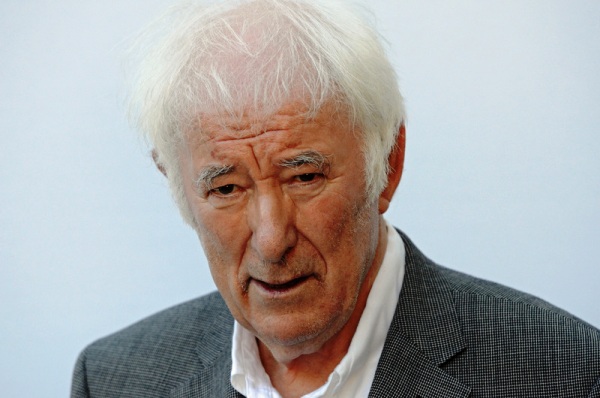
Seamus Heaney, Index on Censorship, September 1998