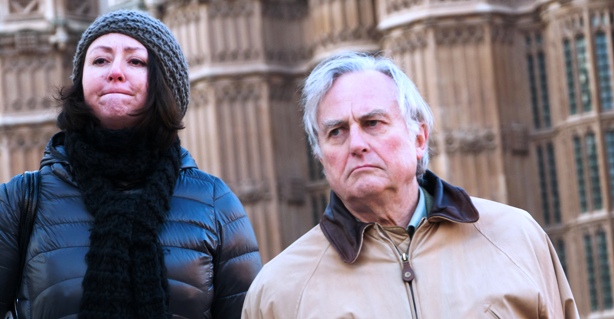
Richard Dawkins and ex-Muslim campaigner Maryam Namazie at a rally in support of free expression, London, February 2012. Image Demotix/Peter Marshall
This week has seen an outbreak of atheist infighting, as Observer and Spectator writer Nick Cohen launched an attack at writers such as the Independent’s Owen Jones and the Telegraph’s Tom Chivers. Their crime, apparently was to focus criticism on atheist superstar Richard Dawkins for his tweets, particularly those about Islam and Muslims, while not criticising religious fundamentalists.
Jones and Chivers have both replied, quite reasonably, to Cohen’s article.
Dawkins’s controversial tweets display a political naivety that can often be found in organised atheism and scepticism. Anyone who’s witnessed the ongoing row within that community over feminism will recognise a certain tendency to believe that science and facts alone are virtuous, and “ideologies” based on something other than empirical data just get in the way.
Hence the professor can tweet the statement “All the world’s Muslims have fewer Nobel Prizes than Trinity College, Cambridge” as if this in itself proves something, without further thinking about the political, historical, social and, indeed, geographical factors behind this apparent fact, and then be surprised when people object.
I’m not going to suggest that Dawkins be silenced. He can and will tweet what he wants. And it’s worth pointing out that those on the liberal left who have raised concerns about Dawkins’s pigeonholing of Muslims can be equally guilty of treating all adherents to a religion as a monolithic bloc: this happens mostly with Muslims, but often, at least in the UK with Roman Catholics as well, as if declaring the shahada or accepting the sacraments is akin to being assimilated into Star Trek’s Borg. Any amount of non-Muslim commentators who opposed the Iraq war, for example will tell you that “Muslims” care deeply about the Iraq war, neatly soliciting support for their arguments while also casting themselves as friends of a minority group. And for a great example of treating “Catholics” as a single entity, Johann Hari’s address ahead of the visit by former pope Benedict XVI to Britain in 2010, takes some beating:
I want to appeal to Britain’s Roman Catholics now, in the final days before Joseph Ratzinger’s state visit begins. I know that you are overwhelmingly decent people. You are opposed to covering up the rape of children. You are opposed to telling Africans that condoms “increase the problem” of HIV/Aids. You are opposed to labelling gay people “evil”. The vast majority of you, if you witnessed any of these acts, would be disgusted, and speak out. Yet over the next fortnight, many of you will nonetheless turn out to cheer for a Pope who has unrepentantly done all these things.
I believe you are much better people than this man. It is my conviction that if you impartially review the evidence of the suffering he has inflicted on your fellow Catholics, you will stand in solidarity with them – and join the [anti-Pope] protesters.”
Hari is literally telling people what they think. A bit like the Vatican tries to do.
Communalist rhetoric, whether used to attack or support certain groups, is the enemy of free speech, as it automatically discredits dissenting voices: “If you do not believe X, as I say members of group Y do, then you cannot be a true member of the group; ergo you can be ignored, or censored.”
Nowhere is this more evident than in India, where communalism, thanks to the British Empire, is enshrined in law. The 1860 penal code of India makes it illegal to “outrage religious feelings or any class by insulting its religion or religious beliefs”. This establishes, in an odd inversion of the United States’s model of secularism, a state where all religions are privileged, while those who criticise them are unprotected. And in India, that can be dangerous.
Sixty-seven-year-old Narendra Dabholkar was killed this week, shot dead on his morning walk.
Dabholkar was a rationalist activist, in a country where that means a little bit more than agreeing or disagreeing with Richard Dawkins. Dabholkar and his comrades such as Sanal Edamaruku have for years been engaged in a war against the superstition that leaves poor Indians open to exploitation from “holy men”. A large part of their work involves revealing the workings of the tricks of the magic men, like a deadly serious Penn and Teller. Edamaruku famously appeared on television in 2008, trying not to laugh as a guru attempted to prove that he can kill the rationalist with his mind. Dabholkar was agitating for a bill in that would curtail “magic” practitioners in Maharashtra state.
Edamaraku is now in exile, fleeing blasphemy charges and death threats that resulted after he debunked the “miracle” of a weeping statue at a Mumbai Catholic church. His friend is dead. Both victims of those who have most to gain from communalism: the con men and fundamentalists for whom the individual dissenting voice is a threat. Atheists, sceptics and everyone else have a duty to protect these people, and to avoid easy generalisations, whether malicious or well meant.
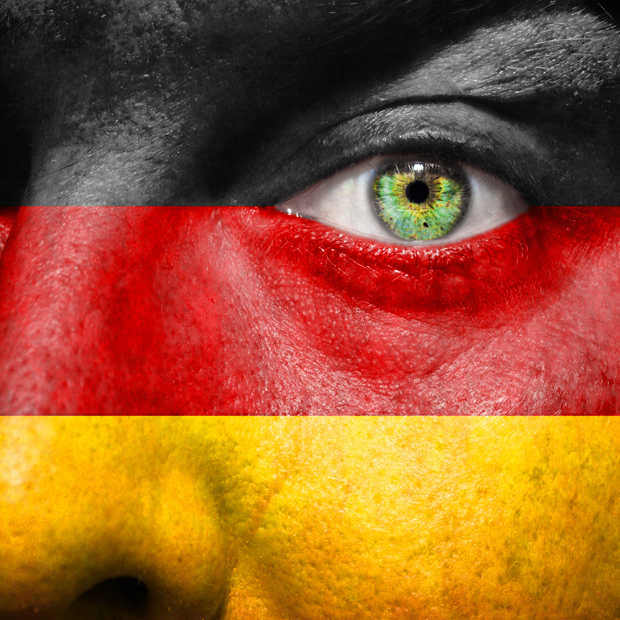
The situation with regards to freedom of expression in Germany is largely positive. Freedom of expression is protected by the German Constitution and basic laws. There is room for improvement, with Germany’s hate speech and libel laws being particularly severe.
Germany’s biggest limits on freedom of expression are due to its strict hate speech legislation which criminalises incitement to violence or hatred. Germany has particularly strict laws on the promotion or glorification of Nazism, or Holocaust denial with paragraph 130(3) of the German Criminal Code stipulating that those who ‘publicly or in an assembly approve, deny, or trivialise’ the Holocaust are liable to up to five years in prison or a monetary fine. Hate speech also extends to insulting segments of the population or a national, racial or religious group, or one characterised by its ethnic customs.
Germany still has strict provisions in the criminal code providing penalties for defamation of the President, insulting the Federal Republic, its states, the flag, and the national anthem. However, in 2000, the Federal Constitutional Court stated that even harsh political criticism, however unjust, does not constitute insulting the Republic. The criminal code however remains in place.
Freedom of religious expression is compromised through anti-blasphemy laws criminalising ‘offences related to religion and ideology’. Paragraph 166 of the Criminal Code prohibits defamation against ‘a church or other religious or ideological association within Germany, or their institutions or customs’. While very few people (just 10) have been convicted under the blasphemy legislation since 1969, the impact of hate speech legislation is seen more frequently, in particular in the prosecution of religious offences. In 2006, a pensioner in the state of North Rhine-Westphalia was given a 1-year suspended sentence for printing ‘The Koran, the Holy Koran’ on toilet paper, and sending it to 22 Mosques and Muslim community centres. In 2011, nine of the 18 operators of the far right online radio programme ‘Resistance Radio’ were given between 21 months and three years in prison for inciting hatred.
Germany has also seen heated debate over a widespread ban on religious symbols in public workplaces, especially affecting Muslim women who wear headscarves, which limits, as a result, freedom of religious expression. Half of Germany’s 16 states have, to various extents, banned teachers and civil servants from wearing religious symbols at work. Yet this is not applied equally to all religions, five states have made exceptions for Christian religious symbols.
Media freedom
Government and political interference in the media sector continues to raise concerns for media independence, with several incidents of interventions by politicians attempting to influence editorial policy. In 2009, chief editor of public service broadcaster ZDF, Nikolaus Brender saw his contract terminated by a board featuring several politicians from the ruling Christian Democratic Union. Reporters Without Borders labelled it a ‘blatant violation of the principle of independence of public broadcasters.’ In 2011, the editor of Bild, the country’s biggest newspaper, received a voicemail message from President Christian Wulff, who threatened ‘war’ on the tabloid which reported on unusual personal loan he received.
Media plurality is strong among regional newspapers though due to financial pressure, media plurality declined in 2009 and 2010. Germany has one of the most concentrated TV markets in Europe, with 82% of total TV advertising spend shared among just 2 main TV stations in Germany. This gives a significant amount of influence to just 2 broadcasters and the majority of Germans still receive their daily news from the television.
The legal framework for the media is generally positive with accessible public interest defences for journalists in the law of privacy and defamation. However, Germany still has criminal provisions in its defamation law, which although unused, remain in the penal code. Germany’s civil defamation law is medium to low cost in comparison with other European jurisdictions, places the burden of proof on the claimant (a protection to freedom of expression) and contains a responsible journalism defence, although not a broader public interest defence.
Digital
The digital sphere in Germany has remained relatively free with judicial oversight over content takedown, protections for online privacy and a high level of internet penetration (83% of Germans are online). Germany’s Federal Court of Justice has ruled that access to the internet is a basic right in modern society. Section 184b of the German Penal Code ‘states that it is a criminal offense to disseminate, publicly display, present or otherwise make accessible any pornographic material showing sexual activities performed by, on or in the presence of a child.’ Germany has also ratified and put into the law the Council of Europe’s Convention on Cyber Crimes from 2001. Mobile operators also signed up to a Code of Conduct in 2005, which includes a commitment to a dual system of identification and authentication to protect children from harmful content. This was reaffirmed and made binding in 2007.
There are concerns over the increased use of surveillance of online communications, especially since a new antiterrorism law took effect in 2009.
In 2011, German authorities acquired the license for a type of spyware called FinSpy, produced by the British Gamma Group. This spyware can bypass anti-virus software and can extract data from the device it is targeting. Two reports by the German Parliamentary Control Panel, from 2009 and 2010, stated that several German intelligence units had monitored emails with the amount of surveillance increasing from 7 million pieces items in 2009 to 37 million in 2010. However, Germany’s Constitutional Court ruled in February that intelligence agencies are only allowed to collect data secretly from suspects’ computers if there is evidence that human lives or state property are in danger and the authorities must get a court order before they secretly upload spyware to a suspect’s computer.
Germany’s tough hate speech legislation also chills free speech online. In January 2012, Twitter adopted a new global policy allowing the company to delete tweets if countries request it, meaning that tweets become subject to Germany’s hate speech laws. The latest Twitter transparency report states that German government agencies asked for just 2 items to be removed. In October 2012, Twitter also blocked the account of a far-right German group, Better Hannover, after a police investigation.
Artistic freedom
Artists can work relatively freely in Germany. Freedom of expression in arts is protected under the Constitution, and is largely respected, especially for satire or comedy. Yet, the freedom of expression of artists is chilled through strict hate speech and blasphemy laws.
The German authorities very rarely use blasphemy laws against artists[xiv]. However, there have been several examples of art being subjected to censorship due to religious offence. In 2012, at the exhibition ‘Caricatura VI – The Comic Art – analog, digital, international’ in Kassel, a cartoon created by cartoonist Mario Lars was removed after protests that it offended religious sensibilities.
There is persistent sensitivity around artistic works depicting the Nazi period. In April 2013, the German version of an Icelandic author’s book was ‘censored’ by its publisher, who cut 30 chapters from Hallgrímur Helga’s novel, ‘The woman at 1000°’. Key passages about Hitler, concentration camps and SS were censored to fit the German market.
#DONTSPYONME Tell Europe’s leaders to stop mass surveillance #dontspyonme
Index on Censorship launches a petition calling on European Union Heads of Government to stop the US, UK and other governments from carrying out mass surveillance. We want to use public pressure to ensure Europe’s leaders put on the record their opposition to mass surveillance. They must place this issue firmly on the agenda for the next European Council Summit in October so action can be taken to stop this attack on the basic human right of free speech and privacy.
(Index on Censorship)
GLOBAL Google revamps search to feature in-depth articles
Want to know more about censorship, love, or legos? The Web giant reworks its search feature to display more comprehensive articles, papers, and blog posts alongside its quick answer listings.
(CNET)
Bitcoin is crucial for the future of free speech, say experts
When US servicemen Bradley Manning was found guilty on 20 counts in connection with leaking classified military information, experts mused that bitcoin was instrumental in the continuing operation of WikiLeaks, the whistleblowing website that he helped.
(Coin Desk)
Russia opens probe into flag desecration by US band
Russia’s interior ministry on Monday launched a criminal probe into flag desecration after a US rock musician stuffed a Russian flag down his trousers at a concert.
(Dawn)
SOUTH AFRICA Free speech for all, save the chief justice?
CHIEF Justice Mogoeng Mogoeng may face an impeachment hearing before the Judicial Service Commission (JSC) for comments he made last month at the annual general meeting of Advocates for Transformation.
(Business Day Live)
Dear Mr. Cameron: U.K.’s Love for Porn and Censorship Don’t Mix
There’s an insatiable demand for Internet porn in the U.K. Whether it be straight, gay, tranny or BDSM, modern Brits have put their arms around the idea of devouring sexually explicit material in the privacy of their own homes.
(XBIZ)
The Judd Apatow Test of Free Speech
The issue was whether a school district in Pennsylvania violated the rights of two middle-school girls who were suspended for wearing “I ♥ boobies!” bracelets.
(Wall Street Journal)
‘CENSORSHIP’: ANTI-ABORTION ACTIVISTS PREPARE TO BATTLE THE MAINSTREAM MEDIA
Pro-life groups have had enough of what they call a “media blackout” when it comes to the abortion issue. So, they’re coming together to hold a “March on the Media” this Thursday. The protest rally is being organized by Lila Rose, president of Live Action, an anti-abortion group. The event’s targets are mainstream media outlets that some critics, including Rose, believe have been too silent about issues pertaining to life and the protection of the unborn.
(The Blaze)
Sen. Rockefeller Continues His Quest To Regulate Free Speech With His ‘Violent Content Research Act’
Sen. Jay Rockefeller’s pet project — fighting violent media — just got a shot in the arm from the Senate Commerce, Science and Transportation Committee (because those three seem like perfect complements…), which “advanced” his legislation directing the National Academy of Sciences to study the effects of violent media on children.
(Tech Dirt)
It’s Dangerous For Free Speech When We Confuse Leakers With Spies
We’ve tried to make similar points a few times in the past about our concern with the Obama administration going after whistleblowers and the journalists who publish their leaks by using the Espionage Act more than all other Presidents in history, combined (more than twice as much, actually).
(Tech Dirt)
We all like to think of ourselves as free – free to think, free to feel, free to speak our mind. But are we? Can we say what we want on social media? Do we have a right to offend each other?
TRIPWIRES brings a thought provoking workshop to Bradford; an opportunity to engage with these incendiary issues in an enjoyable and accessible way.
Practically exploring what free speech means, three young facilitators will open the floor with a workshop before delivering an interactive show developed in collaboration with award-winning, censored Lebanese director Lucien Bourjeily.
Emma is an actress and workshop facilitator, writer and director.
Theatre work includes Clean (The Traverse Theatre), Upper Cut (TARA Theatre) Crash (North Wall Arts Centre/ Arcola Theatre), Talent (Soho Theatre), Millennium (The Vineyard Theatre, New York), A New World Order (Barbican/Hydrocracker Theatre) . Television and Film includes Trap for Cinderella (Forthcoming Productions) BBC Ident Over the Rainbow (Red Bee Media), The Naked Poet (Triple Threat Media).
As a workshop facilitator Emma has worked for The National Youth Theatre, Apples and Snakes and Hoxton Hall.
Emma was selected for the Oval House Theatre and English Pen writers group and her debut plays Spice and Dreams of a Scholar were produced by Oval House Theatre’s 33% Festival earlier this year.
What does freedom of expression mean to you?
Freedom of Expression is a right and not a privilege, however I believe that this right comes with great responsibility and it is important to me that I use my voice to aid the freedom of expression of others and also use my skills as an artist to tell stories of those individuals and communities who do not have the freedom to have their voices head.
Lance Kirby
After completing a Performing Arts: Acting course at Westminster Kingsway College in 2008, Lance has pursued a career as a performer, project coordinator and workshop facilitator in the UK and abroad. In 2010 Lance embarked on a 6 months leadership-training course ‘Tripwires’ combining theatre, acting, writing and movement to create an open space for young people to explore freedom of expression, censorship and offence. Since then Lance has supported and led workshops for arts organisations including: Project Phakama UK, Index on Censorship, English PEN, Apples and Snakes, Urban Development, Immediate Theatre and Al Kasaba, Yes Theatre and Karama Children’s centre (In Palestine).
What does freedom of expression mean to you?
Freedom of expression is to protect the human race from the human race.
Hussina Raja
I studied Criminology and Law while always having a keen interest in Performing Arts. I work as an actress and founded the organisation FREE2B and henceforth, decided to live the life of a struggling creative in hope of gaining invaluable life experience. I came into contact with Index on Censorship via the TRIPWIRES Arts training and leadership programme, a joint collaboration between Index and Project Phakama UK. It is an innovative programme which engaged me into the Social Arts scene through exploration and gave me a sense of direction, a platform for expression and inspiration.
What does freedom of expression mean to you?
Freedom of Expression is a concept I still find very difficult to pin down. I find it vast and inconsistent, varying according to the context. For me it’s an opportunity to freely speak and do as I please, experiment and investigate boundaries without being censored by others. Freedom to express in theory is an individual right for everyone and a responsibility, one that must be reinforced among the human race. However, practically I find it can be exhausting. As a young British woman I still find it hard to express myself without the back lash from communities and conflict with my culture and traditions, leaving me confused and living in a society that promotes Human Rights and protects your Civil Liberties and yet still leaves me struggling to find a voice and stance that won’t cause offence.

 Emma is an actress and workshop facilitator, writer and director.