From Anna Politkovskaya to Marie Colvin

Syrian writer Razan Zaitouneh won the Anna Politkovskaya Raw in War Award in 2011. She addresses the Russian journalist, who’s assassination remains unsolved, about Marie Colvin, 2012 recipient, who was killed in Syria earlier this year
(more…)

For Egypt’s women, the revolution has only begun

The women of Egypt played a huge role in the uprising that toppled former President Hosni Mubarak. They were on the frontlines, standing shoulder to shoulder with men in Cairo’s Tahrir Square, demanding “Bread, Freedom and Social Justice.” Their participation in the eighteen-day mass protests raised hopes for greater inclusion of women in the decision-making process and an end to the gender discriminatory policies of the past.

However since the January 25 2011 revolution Egyptian women’s voices have been drowned out, and the “new Egypt” continues to marginalise women.

Today, as the country’s new constitution is being written, hopes are fading that Egypt’s new governing code will guarantee full and equal participation of women, and there are growing concerns that women may even lose rights gained in recent years.
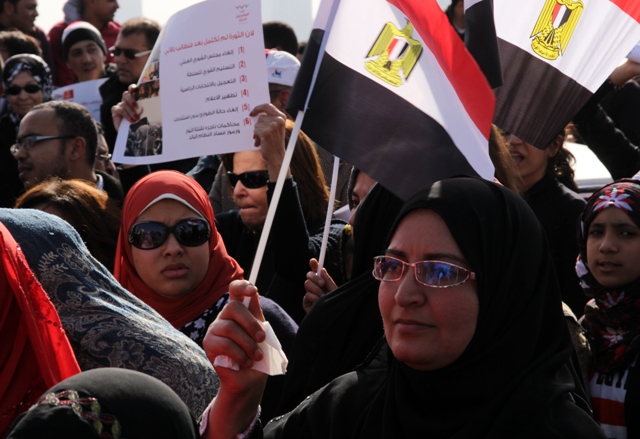
Egyptians celebrate revolution's first anniversary, Cairo. Amr Abdel-Hadi | Demotix

Egyptian women celebrate the one year anniversary of the country’s revolution in Cairo. Amr Abdel-Hadi | Demotix

(more…)

Blasphemy furore masking Morsi’s failure

Alber Saber, a young Egyptian blogger and computer science graduate has been arrested and detained for allegedly posting a trailer for an anti-Islam film on Facebook. The trailer for the film “Innocence of Muslims” deemed insulting to Islam and the Prophet Muhammad, had earlier been lifted from YouTube in Egypt after it sparked anti-US protests. (more…)

Do film protests really mean a failed Arab Spring?

Sniperphoto Agency | Demotix

 A Libyan woman shows her ink-stained finger after voting during the National Assembly election this year. (Demotix)

As protests against the anti-Islam film, The Innocence of Muslims, rage on across the globe, some began to ask if this means that the so-called Arab Spring was a failure, as news from the Arab world is once more dominated by chanting, burning American flags and beards. This conclusion is not only problematic, it is also wrong.

The number of protests only seems to grow, but we aren’t really saying much about the amount of people that are actually participating in them. Take Egypt — protests against the film drew about 2,000 protesters in Cairo Friday. A paltry number compared to the reported 1,000,000 that took to the streets of Cairo to call for the fall of Mubarak’s regime last year. Even now, labour protests have spread across schools, universities, and government bodies in Egypt, with thousands demanding improved pay and rights. The Muslim Brotherhood claimed that it organised 350 protests nationwide, no doubt distracting from some of the growing discontent with Morsi’s presidency.

There is no doubt that religious extremism is very present in the Arab world, but these groups are more interested in power, rather than protecting the integrity of Islam or the Prophet. I think it is no surprise that calls for protests have come from political religious groups like the Hezbollah and the Muslim Brotherhood. Religion is a pretty quick and easy tool to gain support and divide populations.

Hassan Nasrallah, Hezbollah’s leader, made a rare public appearance to address tens of thousands of protesters in Beirut, but made it clear that protests were about the age-old enemy: the US and Israel. No doubt an important message for Nasrallah, as his ally, Syrian president Bashar al-Assad continues to wage a brutal war to stay in power. Focusing on an external threat is a convenient way to distract from an internal struggle.

Sectarianism has been the choice tool of many repressive regimes and political groups. One of the major victories of the so-called Arab Spring was a start of a conversation to push back on those lines — hurting political groups and regimes that draw their loyalty along religious lines. Still, political leaders have clamoured to use the revolutions to their advantage, strategically condemning human rights abuses, and turning a blind eye when similar abuses are inconvenient. In a translation of a speech by Egyptian President Mohammad Morsi, where he condemned Syria’s regime, Iranian state TV replaced “Syria” with “Bahrain”.

Bahrain’s government has painted the country’s ongoing unrest as a Shia uprising, even though the protesters’ demands have been secular, and largely focused on calling for democracy. In addition to a brutal crackdown on protests, state-owned media has depicted the protesters as Shia troublemakers and agents of Iran — a transparent attempt to use religion to crush dissent. While Bahrain has voiced concern over Syria, it has yet to address its own ongoing human rights abuses.

Last year’s uprisings were the start of a long road of change, and religious extremism is another part of those struggles. The Arab world, much like many other parts of the world, is a region that has been rife with corruption, despotism and inequality, as well as groups struggling to gain power with whatever tools they can get, including religious, ethnic or racial identities. Boiling unrest in the region down to Muslim anger or an inherent hatred of the West is short-sighted: it only encourages the flattened image that benefits the groups who wish to exploit it.

Sara Yasin is an Editorial Assistant at Index on Censorship. She tweets from @MissYasin

Also read:

Padraig Reidy: A new argument for censorship?

Jamie Kirchick: Islam blasphemy riots now self-fulfilling prophecy

Myriam Francois-Cerrah: Film protests about much more than religion


SUPPORT INDEX'S WORK