12 Feb 2021 | Opinion, Ruth's blog, Saudi Arabia
[vc_row][vc_column][vc_column_text]One thousand and one days.
Twenty-four thousand and twenty-four hours.
One million, four hundred and forty-one thousand, four hundred and forty minutes.
It’s almost impossible to imagine. Sitting in a cell, in horrendous conditions, knowing that as a woman you are especially vulnerable in a Saudi jail – a target for abuse and harassment. Whippings and electric shocks are a regular part of your day-to-day life. Your family are barred from visiting for months at a time and every move you make is being monitored and reported on. You’re battered and bruised.
Every time you show dissent another charge added to your ‘crimes’. And that’s before accounting for the fear of contracting Covid, of knowing that your health and wellbeing is the last thing in the world your captors care about.
But that’s been the life that Loujain al-Hathloul has had for nearly three years, detained in a high security prison in Saudi Arabia. Her ‘crime’ was to be a women’s rights advocate. Campaigning for a woman’s right to drive a car. Her bravery in these cruelest of environments is nothing more than inspirational. Which is why so many of you sent her a message at the end of 2020 – to give her strength.
She and her family refused to back down. She has led a hunger strike. She has refused to plead guilty. She has remained resolute. She is a heroine. And she is finally at home.
But this won’t be the end of story. She faces huge restrictions on her civil liberties including a five-year travel ban. Less than 48 hours after her release we don’t know how she is going to be treated by the Saudi Government but we do know that she will refuse to be silenced.
There are too many activists still imprisoned in Saudi for demanding their basic human rights. Too many women being held as political prisoners. Too many activists who just want to build a fairer society. Loujain’s release gives everyone hope, just a little. Hope that the future may be different, hope that you really can make a difference.
Loujain – we’re so pleased you are home with your family. Now we need to guarantee your freedom and that of the other women still sitting in cells across Saudi Arabia.[/vc_column_text][/vc_column][/vc_row][vc_row][vc_column][three_column_post title=”You may also want to read” category_id=”41669″][/vc_column][/vc_row]
19 Jan 2021 | News
[vc_row][vc_column][vc_single_image image=”116064″ img_size=”full” add_caption=”yes”][vc_column_text]When prompted to accept the privacy terms on a website do you just accept, or do you take time to manage your settings?
“If you’re like me, you end up rage-quitting the settings halfway through and you end up just clicking ‘accept’ because you’re frustrated, and you just wanted the chocolate brownie recipe,” confessed Rebecca Rumbul, a privacy rights campaigner with the Privacy Collective.
It’s a split-second decision but it can determine whether or not third-party cookies will sit on your browser indefinitely, tracking you as you browse from page to page. Third-party cookies don’t offer you or your device any functional assistance. They are there to collect information about you, primarily for marketing purposes.
“They create this horrifically complex massive profile that has a scary number of data points on you,” explained Rumbul. “And that’s a concern because I don’t know how that information is going to be used against me, used to put things in front of me, or used to decide things for me.”
Not only are many of these cookies unnecessary and invasive, but Rumbul and the Privacy Collective say that they are in breach of European data protection law (GDPR). That’s why they are now taking legal action against two of the largest players in the ad-tech space: Oracle and Salesforce.
“It’s absolutely the case that we believe these companies have been misusing personal data and misusing the way they collect information and process it,” Rumbul said. “We’re not saying they are necessarily the absolute worst offenders. The reason for going for them is because they are so huge, and their cookies are so widely placed that it affects a lot a lot of people and these organisations are the highest value players so they can afford to fight this and to pay compensation if we win.”
The legal action is being taken in the UK (England and Wales) and in the Netherlands. “The cases are fundamentally the same – they hinge on the same legal points,” explained Rumbul, who is the representative claimant for the London lawsuit. “I’m able to be the representative claimant because I’m careless enough to have these cookies on my system. I still click on the ‘accept all’ automatically before thinking about it.”
As a representative action, the lawsuit is being taken on behalf of everyone in England and Wales who has been affected by Salesforce’s and Oracle’s tracking cookies. If the lawsuit is successful, the Privacy Collective will divide the compensation among those affected. “What we’re roughly calculating is that every single person that was affected should get around €500,” Rumbul said, who will get her €500 the same as everyone else. “It’s not going to be very much money on an individual basis, but hopefully the hit to the wallets of these organisations will send ripples through the ad-tech industry.”
Raising awareness for the lawsuit is therefore crucially important, not only so people might eventually be able to apply for their share of the compensation, but so that they have an opportunity to show their support for the case. “We would love more people to engage with the issue, but in terms of a quick win, getting people to click the ‘like to support’ button on our website would be great,” Rumbul said
The Privacy Collective will need to demonstrate that, by and large, people are unaware that they are losing control of their data by accepting these tracking cookies. “Under GDPR you’re supposed to be able to consent and that consent is supposed to be informed,” explained Rumbul. “You cannot exercise your legal rights if you’ve lost control of your own information.”
“Loss of control is a real harm in itself and in violation of the GDPR, and loss of control of your personal data essentially leaves you vulnerable to a multitude of other harms,” Rumbul explained, giving the example of the harm that a barrage of adverts for baby products might cause to a woman who has just suffered a miscarriage. “Or the loss of control of my data, for instance, may result in me paying higher premiums for car insurance,” she said.
These cookies also have the potential to curtail other rights, given that privacy is a gateway for other civil liberties, especially freedom of expression. “The more people become aware of how much of their own data is being hoovered up, the more careful they feel like they have to be about what they do online and how restrictive the online environment becomes. Freedom of expression is very, very difficult when you have literally no idea what people are doing with your data.”
That’s why Index on Censorship is among the organisations supporting The Privacy Collective’s legal actions. Online privacy must be guaranteed in order for freedom of expression to thrive.
Individual internet users are also invited to support simply by clicking the ‘like to support’ button on The Privacy Collective’s website or by contacting The Privacy Collective: [email protected].[/vc_column_text][/vc_column][/vc_row]
15 Jan 2021 | Opinion, Ruth's blog
[vc_row][vc_column][vc_single_image image=”116027″ img_size=”full”][vc_column_text]Irony – a situation in which something which was intended to have a particular result has the opposite or a very different one
Censored – suppressed, altered or deleted as objectionable
Words are important and while language is ever evolving some words have had the same meaning for decades, even centuries, and there are simply no excuses for misrepresenting them to try and fit your political worldview. Words have status, they have legal bearing and they are also a thing of beauty enabling us to communicate with each other.
This week we saw the ultimate unintentionally ironic political statement during the debate in the House of Representatives concerning Donald Trump’s second impeachment. Rep Marjorie Taylor Greene, a freshman Republican congresswoman from Georgia, stood up to defend the rhetoric of the president, speaking from the US Capitol, from the chamber of Congress, the home of US democracy, on live television and while being live streamed around the world, with a face mask which read “CENSORED”.
Perhaps it was a veiled reference to Trump’s removal from Twitter? But at that very moment, the congresswoman herself, with her words and her world view being heard by literally millions of people and recorded for posterity in both the media and the Congressional Record, was not being censored. Her voice wasn’t being limited, she wasn’t being forced to restrict her language or caveat her political position. She is fortunate to live in a country where free speech is still both protected and valued. And to suggest otherwise undermines the global fight for the right to free speech in repressive regimes.
Senator Josh Hawley has had his book contract cancelled by Simon & Schuster. They said “[a]fter witnessing the disturbing, deadly insurrection that took place on Wednesday in Washington, D.C. We did not come to this decision lightly. As a publisher it will always be our mission to amplify a variety of voices and viewpoints; at the same time we take seriously our larger public responsibility as citizens, and cannot support Senator Hawley after his role in what became a dangerous threat to our democracy and freedom.”
Hawley is claiming that he is being cancelled, that his constitutional right to free speech is being attacked and that he is suing. We know that because Hawley was featured in nearly every news outlet which covers the USA, both foreign and domestic. Hawley remains a senator, he has the right to speak to his nation in every sitting outlining his priorities and world view. His words were published this week in an op-ed in his local media. He hasn’t been silenced or cancelled, his lucrative book deal has. And even if that sets a bad precedent – a debate we will explore further at Index over the coming months – it is not the same thing.
Our right to free speech is precious. It is something that we need to cherish. Not abuse. And we need to be honest about when it is and is not being threatened. It is being threatened in Belarus, where our own correspondent Andrei Aliaksandrau has just been arrested by the regime. It is under threat in Egypt where according to the Egyptian Initiative for Personal Rights 60,000 political prisoners are incarcerated. It is nonexistent in Xinjiang province, China, where millions of Uighurs have been sent to re-education camps. It is not being threatened in the USA – it may be being challenged but these words mean different things.
I believe passionately about our right to free speech. I think everybody has the right to speak, to argue their position, to tell their stories. But there is a difference from having the right to speak and the right to be heard. Simply put you don’t have the latter, it is not a universal right, which can be unjust and for some incredibly damaging but it’s the reality we live in.
This brings me to the other controversy of the week, which warrants a great deal of debate and conversation. Something Index is going to launch in the coming weeks – the suspension of Trump from his social media accounts. Most online platforms are corporate entities, who balance responsibilities to defend free speech and to protect their users. They have a duty of care to their customers as well as to their corporate reputations. They also facilitate a great deal of our national and personal conversations. And they have made the remarkable decision to remove the President of the United States from their sites. They had the right to do this, but the question is should they have removed him and more importantly who decided he shouldn’t be there?
It was not a decision that was taken lightly. “I do not celebrate or feel pride in our having to ban @realDonaldTrump from Twitter, or how we got here. After a clear warning we’d take this action, we made a decision with the best information we had based on threats to physical safety both on and off Twitter. Was this correct?” wrote CEO of Twitter Jack Dorsey.
In his thoughtful thread on the action he wrote: “Having to take these actions fragment the public conversation. They divide us. They limit the potential for clarification, redemption, and learning. And sets a precedent I feel is dangerous: the power an individual or corporation has over a part of the global public conversation.”
As Dorsey himself acknowledges we need to explore what role these companies really play in our society. Are they merely platforms enabling us to engage within a framework they determine? Are they publishers responsible for every word on their sites? Do they govern the public space or merely facilitate it? And do we know what they are doing? Their actions can determine who speaks and who is heard. We need a really robust conversation about where the red lines should be on online content and what is or isn’t acceptable. These questions have been circulating for a while but have never felt more crucial to be addressed than this week. These are the questions that will define our online presence in the years ahead, so we need answers now.[/vc_column_text][/vc_column][/vc_row][vc_row][vc_column][/vc_column][/vc_row]
23 Nov 2020 | Artistic Freedom, News
[vc_row][vc_column][vc_column_text]
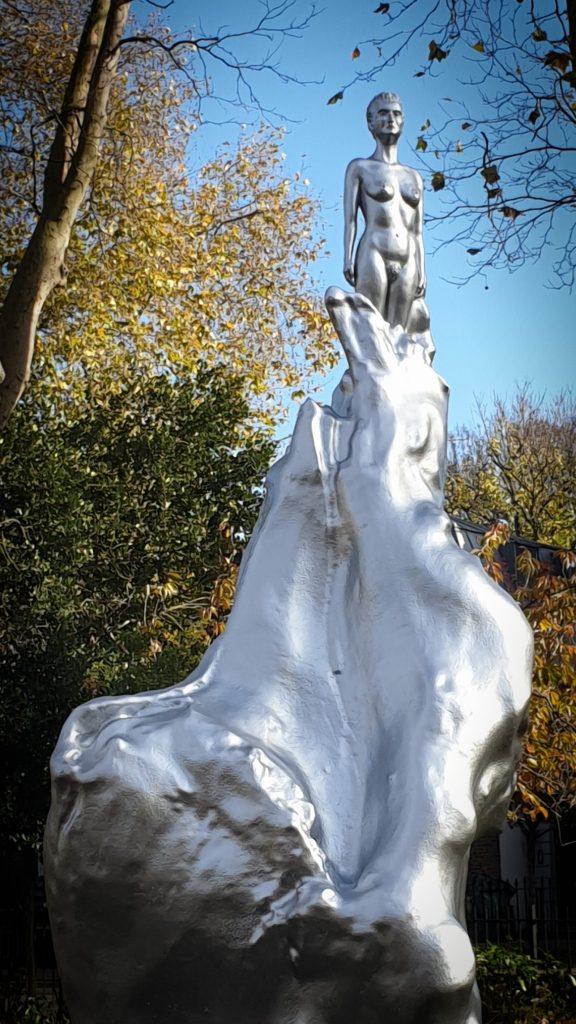
Maggi Hambling’s Statue for Mary Wollstonecraft, photo: Grim23, CC BY-SA 4.0
What would Mary Wollstonecraft have thought? The 18th century feminist, author of A Vindication of the Rights of Woman, has been commemorated with a new sculpture that includes the figure of a small, naked woman. The woman is not, according to artist Maggi Hambling, Wollstonecraft herself, but a timeless everywoman. Indeed, the work is A Sculpture for Mary Wollstonecraft rather than of her.
The reaction has been swift and almost unilaterally negative. Feminist authors who stand on Wollstonecraft’s shoulders have taken to Twitter to express their views to defend the oft- labelled “mother of feminism”. Imogen Hermes Gower said a chance to break with convention has been missed and Tracy King called the piece a “shocking waste of an opportunity”. Caitlin Moran sarcastically tweeted that she expects the streets to be full of statues depicting “John Locke’s shiny testicles, Nelson Mandela’s proud penis, and Descartes’ adorable arse”.
Meanwhile, Dianne Abbot MP tweeted: “Pleased to see the great feminist #MaryWollstonecraft honoured after 200 years. And it is in a lovely garden square in Stoke Newington. But what a disappointing statue. Tiny, shiny and completely inappropriate”.
Valid opinions, all. Debate around art is arguably what abstract artistic endeavour is all about. It is a form of expression as valid as the works themselves.
Where a line must be drawn is censorship.
Just a day after the sculpture appeared in North London, clothing, tape and facemasks had been used to cover up the female figure, who sits atop a large, amorphous silver mass like a star at the top of a Christmas tree. These efforts at censorship have since been removed, but they pose an interesting question: why does female nakedness, especially in conjunction with honouring feminist ideals, inspire a desire to censor?
My own thoughts on the reason the statue is controverial came quickly: female nakedness is linked with sexual objectification, and the idea that women do not exist in the world purely as sexual objects for male pleasure is a key tenet of feminism. The two are not happy bedfellows and their collision in this sculpture is at the root of the displeasure of its critics.
But this thought process seemed a little too easy. The truth is that the link between sexual objectification and nakedness, in art as in life, is not a truth universally acknowledged. It is not unbreakable; it is not unchallengeable. It is a construct of the patriarchy, and to censor the naked female form in art is to play into the hands of those who want to preserve the idea of women exclusively as sexual beings.
Caroline Banks, an artist who has written a blog about the sculpture, says that women should own their own nakedness: “There is an argument for reappropriation of that [sexual objectification]. Why should we be ashamed of our bodies because every time we have no clothes on we think we’re going to be looked at as a sexual creature, or not [if you’re not fertile]?”
She also explored how loaded the term “nudity” is. Several news outlets have referred to the sculpture as “nude”.
“That woman is naked,” Banks says, “she’s not nude”.
She explains: “That’s where the male gaze comes in a lot of the time. The idea of the nude in art is different from being naked. If you’re naked you just haven’t got any clothes on. Babies are not nude. People on the mortuary slab are not nude. They’re naked, they’re not nude.”
This idea of being naked as opposed to being nude, and the censorship of nakedness when it is loaded with the implications attached to nudity, is something that has also been explored in relation to the public exposure of female nipples.
Head of content at Index, Jemimah Steinfeld, wrote about this form of censorship in 2017. This was the year a case was taken the US Supreme Court by a woman named Sonoko Tagami, who was suing the city of Chicago over a fine she received for exposing her nipples in public, arguing that it is sex-based discrimination; men are not fined for the same action.
Censorship of female nipples on social media is also the source of debate and feelings of discrimination; Instagram continues to enforce a ban on female nipples, a topic covered in depth by The New York Times. The implication seems clear that female anatomy is sexual and therefore needs to be censored. The idea of parts of a woman’s body being exposed for reasons other than to sate the male gaze seems to have escaped the censors.
And back, then, to A Sculpture for Mary Wollstonecraft.
It is a work of art, the majority of which is a roiling silver mass from which the naked figure emerges. The figure’s nakedness appears at odds with feminist values.
But the sculpture’s would-be censors have it wrong. Covering its nakedness merely upholds and strengthens its sexual objectification.[/vc_column_text][/vc_column][/vc_row][vc_row][vc_column][three_column_post title=”You may also want to read” category_id=”15469″][/vc_column][/vc_row]
