4 Jan 2019 | Magazine, News, Volume 47.04 Winter 2018 Extras
[vc_row][vc_column][vc_column_text]

Credit: iStock / LemonTreeImages
Sex and pregnancy continue to be taboo subjects around the world as a special report in Index on Censorship magazine shows. From using toothpaste as emergency contraception to not receiving proper treatment during childbirth, fictional beliefs around sex education and reproductive health, combined with a lack of resources, are leading to sexually transmitted diseases, unwanted pregnancies and problems or death during pregnancy.
Toothpaste isn’t just for cleaning teeth, it can also prevent pregnancy
In Ecuador’s Amazonian region, health workers have reported instances of women using toothpaste after sex to prevent pregnancy. A woman in Mexico, who believed contraception was immoral, thought she’d successfully avoided pregnancies when she had green vaginal discharge — a sign of infection. Latin America and the Caribbean are the only regions in the world where pregnancies are rising among girls ages 15 and under due to ineffective use of contraception and lack of education.
Just touching a man’s hand can lead to pregnancy
In North Korea, a country where information is restricted by the government, topics such sex and reproduction are off-limits in schools, and myths such as touching a man’s hand can lead to pregnancy so prevalent, that STIs and unwanted pregnancies are major problems. Condoms and other forms of contraception are unknown, even among adults. Because the signs of pregnancy aren’t talked about, many women won’t know they’re pregnant until they start to show, leading to a rise in illegal and unsafe abortions. But, as Jieun Baek writes in the latest Index on Censorship magazine, the situation may be improving.
Only “weak” and “lazy” women have Caesarean sections
Nigeria has the highest rate of maternal deaths in sub-Saharan Africa, and sentiments like this contribute to societal pressure for women not to have C-sections. Even yelling or shouting during delivery may be viewed as a sign of personal failure. Many women who have C-sections still tell people they had a vaginal delivery, and the stigma against is so strong that some may attempt or be pressured into a vaginal delivery at the cost of their or their babies’ lives. According to Unicef, Nigeria has the second highest global maternal mortality rate, behind only India, a country with more than five times Nigeria’s population.
If someone experiences pain during childbirth, it’s their fault
Obstetric abuse in Russia has become almost commonplace, with often only three to four midwives and four doctors to care for 30 to 40 women. Doctors and obstetricians carry out procedures like inducing labour without asking for permission or informing the mother. And if the patient is in pain? The response may be: “How are you planning on delivering the baby if you’re already in pain?” The systemic issue of a lack of resources in hospitals has become a health endemic for women in Russia.
If you don’t have a condom, chicken skin or cling film will work just fine
According to a 2009 survey in the UK questioning 1,000 women aged 18-50, one in five said they had heard of these items being used. Misinformation such as this may be the cause behind Britain’s high rate of teenage pregnancy. Based on 2016 data, this number is at an all-time low for the country, with a rate of 18.9 conceptions per thousand women aged 15 to 17, but Britain still has the highest teenage pregnancy rate in western Europe.
[/vc_column_text][/vc_column][/vc_row][vc_row][vc_column width=”1/3″][vc_custom_heading text=”Birth, Marriage and Death” font_container=”tag:h3|text_align:left” link=”url:https%3A%2F%2Fwww.indexoncensorship.org%2F2018%2F12%2Fbirth-marriage-death%2F|||”][vc_column_text]
The winter 2018 issue of Index on Censorship magazine explores taboos surrounding birth, marriage and death. What are we afraid to talk about?
With: Liwaa Yazji, Karoline Kan, Jieun Baek
[/vc_column_text][/vc_column][vc_column width=”1/3″][vc_single_image image=”104225″ img_size=”full” onclick=”custom_link” link=”https://www.indexoncensorship.org/2018/12/birth-marriage-death/”][/vc_column][vc_column width=”1/3″][vc_custom_heading text=”Subscribe” font_container=”tag:h3|text_align:left” link=”url:https%3A%2F%2Fshop.exacteditions.com%2Findex-on-censorship|||”][vc_column_text]In print, online. In your mailbox, on your iPad.
Subscription options from £18 or just £1.49 in the App Store for a digital issue.
Every subscriber helps support Index on Censorship’s projects around the world.
 SUBSCRIBE NOW[/vc_column_text][/vc_column][/vc_row]
21 Dec 2018 | Croatia, Hungary, Macedonia, Media Freedom, media freedom featured, Montenegro, News, Poland, Serbia
[vc_row][vc_column][vc_single_image image=”104453″ img_size=”full” add_caption=”yes”][vc_column_text]Additional reporting by Ada Borowicz, Ilcho Cvetanoski, Lazara Marinković and Zoltán Sipos
Unpatriotic behaviour. Sedition. Being in the pay of shadowy external forces. Faking a neo-Nazi event. These are just a few of the charges that have recently been levelled against independent journalists by pro-government media outlets in several central and eastern European countries.
The opening volley in a sustained campaign of vilification directed at Serbia‘s independent media was fired by the state-owned weekly Ilustrovana Politika at the end of October, with an article that accused journalists who are critical of the government of being “traitors and collaborators with the enemies of Serbia”.
Two weeks later, Ilustrovana Politika followed up with another piece that accused the veteran journalist Ljiljana Smajlović – who has long been critical of the nationalistic legacy bequeathed on the country by its former leader Slobodan Milosević and co-founded the Commission Investigating the Murders of Journalists in Serbia – of complicity in the 1999 NATO bombing of Belgrade.
In mid-December, Ilustrovana Politika’s campaign of character assassination against Smajlović ratcheted up another level with a garish front page depicting her as a Madonna figure with two naked infants bearing the features of Veran Matić, the chairman of the commission, and US Ambassador to Serbia Kyle Scott.
Smajlović has no doubt over what lies behind this tidal wave of denigration, of which she has become the prime target.
History repeating itself?
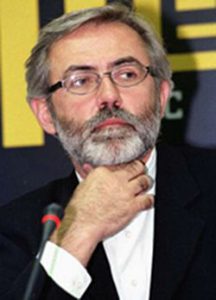
Editor Slavko Ćuruvija was murdered in 1999.
The long-running trial of four ex-members of the Serbian intelligence service accused of the murder of Dnevni Telegraf editor Slavko Ćuruvija – shot dead in April 1999 a few days after the pro-government Politika Ekspres accused him of welcoming the NATO bombardment – is now in its final stages, and Smajlović is convinced that the current campaign against her is designed to influence the judges in the case.
“The attacks come from the same Milosevic-era editors who also targeted my colleague Ćuruvija as a traitor prior to his assassination,” she told Mapping Media Freedom. “What is also sinister is that they are published and printed by the same state-owned media company that targeted Slavko nearly twenty years ago.”
“The clear implication is that I am the same kind of traitor as he was. How will that affect the judges? Will they fear this is not a good time to hold state security chiefs to account?” she added.
While Smajlović admits that Ilustrovana Politika’s denunciation has made her feel insecure, she insists she is less concerned for her own safety than worried about the consequences for the outcome of the Ćuruvija trial. Quoting Marx’s dictum that “History repeats itself, first as tragedy and then as farce”, Smajlović said. “I hope this is the farce part.”
Laying the blame
In Serbia and other central and eastern European countries, the assignment of responsibility for historic causes of resentment and the potential of these to further divide a polarised public often form the background to attacks on independent journalists by their state-approved colleagues.
The thorny topic of Poland’s relations with Germany during the last century recently gave pro-government media in Poland a chance to accuse independent media of being insufficiently patriotic and even of falsifying facts.
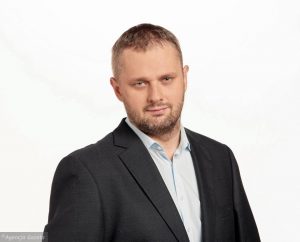
Journalist Bartosz Wieliński was targeted by the head of TVP Info’s news site.
In November, after Bartosz Wieliński, a journalist with the independent daily Gazeta Wyborcza, gave a critical account of a speech made by the Polish ambassador to Berlin at a conference devoted to the centenary of Poland’s independence, the head of the state broadcaster’s news website, TVP Info, accused him of lying and of putting the interests of Germany before those of his own country.
Only a few days before this attack, two media outlets that support Poland’s ruling national-conservative Law and Justice (PiS) party accused the independent US-owned channel TVN of fabricating the evidence on which a report about the resurgence of neo-Nazism in Poland was based.
Since it came to power in 2015, PiS – which has been accused by its critics of tolerating organisations that espouse far-right ideologies – has put pressure on independent media outlets, many of which are foreign-owned, as part of its campaign to “re-polonise” the media, and now appears to be using the public broadcaster and other tame outlets as accessories in this drive.
Willing accomplices
In Hungary, where the government led by Viktor Orbán has succeeded in imposing tight control on all but a few determinedly independent media outlets, a number of loyal publications are available for the purposes of vilification.
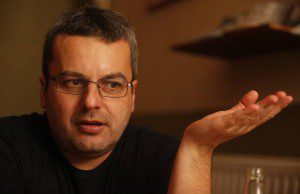
2015 Freedom of Expression Journalism Award winner Tamás Bodoky, founder of Atlatszo.hu
In September, a whole raft of pro-government media outlets vied with each other to depict Tamás Bodoky, the editor-in-chief of the investigative journalism platform Átlátszó and winner of the 2015 Index on Censorship Freedom of Expression Award for Journalism, as a “Soros hireling”. Bodoky became the target of a co-ordinated smear campaign after he posted on Facebook a picture of himself taken in Brussels with Dutch Green MEP Judith Sargentini, whose report on the Fidesz government’s infringement of core EU values had formed the basis for the European parliament’s censure motion against Hungary a few weeks earlier.
Another Hungarian journalist, András Dezső, who works for the independent news website Index.hu, also recently came under attack from pro-government media outlets after a Budapest court let him off with a reprimand over a case in which he was alleged to have made unauthorised use of personal information. In an article published before April’s general election, Dezső had cast doubt on the account of a woman who declared on Hungarian TV that she felt safer in Budapest than in Stockholm because of the lower level of immigration in Hungary. The airing of the interview by the public broadcaster was seen as providing support for Fidesz’s anti-immigration stance and aiding its election victory.
A criminal charge was issued against Dezső for “misuse of personal data”, and after he received what was described in the Hungarian media as “the mildest possible punishment”, two pro-government news websites, 888.hu and Origo.hu, accused him of deliberately propagating fake news and seeking to mislead his readers.
Why do they do it?
What motivates those journalists who smear their colleagues who seek to hold power to account?
There does not appear to be a simple answer to this question. While some may vilify fellow journalists to order purely for financial gain (or because of a desire for job security, government-sponsored media outlets generally being on a more secure financial footing than their independent counterparts), some appear to approach the task with at least a measure of conviction.
Ilcho Cvetanoski, who reports on Bosnia, Croatia, Macedonia and Montenegro for Mapping Media Freedom and has observed many smear campaigns over the years, believes that financial and ideological motivating factors are often inextricably intertwined. He points out that two decades on from the armed conflicts in the region, Balkans societies are still deeply divided along ideological and ethnic lines, and many people still find it extremely difficult to accept the right of others to see things differently. Cvetanoski notes that there are many “true believers” who are genuinely convinced that they have a duty to defend their country from the “other” – a group in which they tend to lump critical journalists along with mercenaries, spies and traitors.
Lazara Marinković, who covers Serbia for Mapping Media Freedom, believes that the main motivation there is a need to be on the winning side and to please those in power. “Often they actually enjoy doing it, either for ideological reasons or because they feel more powerful when they are on the side of the ruling party,” she told Mapping Media Freedom. Marinković noted that the majority of Serbian tabloids and TV stations that conduct smear campaigns against independent journalists are owned by businessmen who have close links to President Aleksandar Vučić’s national conservative Serbian Progressive Party (SNS). Vučić began his political career during the Milosević era, when he served as Minister of Information.
In Poland, the divisions in society and the consequent lack of tolerance in political culture have been blamed for the increasing polarisation of the media. Michal Głowacki, a professor of media studies at Warsaw University, told Mapping Media Freedom that journalists take their cue from politicians in failing to show respect for fellow journalists associated with the “other side”. “They even use the same language as politicians,” Głowacki notes.
This is a view echoed by Hungarian journalist Anita Kőműves, a colleague of Bodoky’s at Átlátszó. Kőműves, however, insists that while journalists who work for independent media outlets strive to uphold the principles of journalistic ethics, the same cannot be said of those employed by pro-government outlets. “Some of those serving the government at propaganda outlets think that the two ‘sides’ of the Hungarian media are equally biased and that they are not acting any differently from their counterparts in the independent media sphere. However, this is not true: pro-government propaganda outlets do not adhere to even the basic rules of journalism,” she told Mapping Media Freedom.[/vc_column_text][vc_raw_html]JTNDaWZyYW1lJTIwd2lkdGglM0QlMjI3MDAlMjIlMjBoZWlnaHQlM0QlMjI0MDAlMjIlMjBzcmMlM0QlMjJodHRwcyUzQSUyRiUyRm1hcHBpbmdtZWRpYWZyZWVkb20udXNoYWhpZGkuaW8lMkZ2aWV3cyUyRm1hcCUyMiUyMGZyYW1lYm9yZGVyJTNEJTIyMCUyMiUyMGFsbG93ZnVsbHNjcmVlbiUzRSUzQyUyRmlmcmFtZSUzRQ==[/vc_raw_html][vc_basic_grid post_type=”post” max_items=”4″ element_width=”6″ grid_id=”vc_gid:1545385969139-cb42990e-b3e2-3″ taxonomies=”9044″][/vc_column][/vc_row]
18 Dec 2018 | Campaigns -- Featured, Statements
[vc_row][vc_column][vc_column_text]
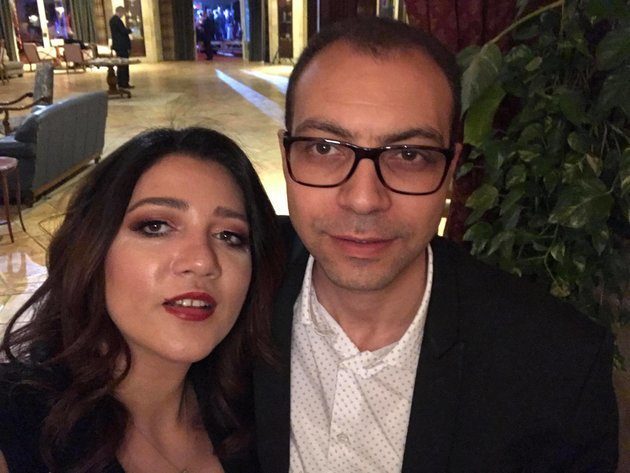
Mohamed Lotfy (right) with his wife, the imprisoned activist Amal Fathy
A Cairo criminal court has ordered that Egyptian activist Amal Fathy, who was arrested on 11 May after posting a video criticising sexual harassment in Egypt, be released.
Rachael Jolley, editor of Index on Censorship magazine, said: “No one should face arbitrary detention for freely expressing their opinions, in this case about how she felt about being sexually harassed. These charges have never made sense. While we welcome the order to release Amal, she must now actually be freed and all charges against her dropped.”
Fathy stood accused of “belonging to a terrorist group”, “using a website to promote ideas calling for terrorist acts”, and “intentionally disseminating false news that could harm public security and interest”.
During her appeal session on 25 November, Fathy told the judge: “I am afraid to go out to streets alone, every time I walk in the street alone someone harasses me. Last time, my son was going to be kidnapped from my arms by a motorcycle rider in Mohandiseen area. I am afraid to get out of my house, but I had to get out that day.”
Fathy took a taxi to the bank and was sexually assaulted by the driver. A crowd gathered, but let the man go. “I was in a shock and tried to understand what just has happened,” she told the judge.
A police officer showed up at the scene. “I looked at him, he was opening his trousers’ zipper and saying to me come here and I will make you feel comfortable. I experienced another shock and started to shout and scream,” Fathy said. “I felt powerless and subjugated and that’s what I said in the video. I never felt safe as a woman in my country, and this is not the first time that this happens to me.”
Fathy’s husband Mohamed Lotfy said of the ruling: “I am delighted to inform you that today a Cairo Criminal court has accepted Amal Fathy’s appeal against her preventive detention and ordered her release on probation (in case 621 of 2018 state security prosecution). She should be released within the next few days and check in a couple of times every week at a police station. On 26 December she will appear in front of another Cairo Criminal court to (most probably) extend her period of probation in the same case. On 30 December, the Maadi Appeals Misdemeanor court will issue its verdict in the other case (case 7991 of 2018 Maadi Misdemeanors). Maadi Misdemeanor court gave her a 2 years prison sentence and a fine and bail to suspend the sentence until the appeals court issues its verdict. The bail and fine were paid and we are now awaiting the final verdict by the appeals court on 30 December.”
Doughty Street Chambers — along with ECRF and Index on Censorship — have worked together on this case by lodging complaints with the United Nations Special Rapporteurs on freedom of expression and the protection of human rights defenders. Additionally, they had an ongoing appeal against Egypt with the UN Working Group on Arbitrary Detention, which was being considered.[/vc_column_text][vc_basic_grid post_type=”post” max_items=”4″ element_width=”6″ grid_id=”vc_gid:1545208658227-39c5d90f-2d7b-3″ taxonomies=”25926″][/vc_column][/vc_row]
17 Dec 2018 | Magazine, News, Volume 47.04 Winter 2018
[vc_row][vc_column][vc_custom_heading text=”Vital moments during our lifetimes are complicated by taboos about what we can and can’t talk about, and we end up making the wrong decisions just because we don’t get the full picture, says Rachael Jolley in the winter 2018 issue of Index on Censorship magazine” google_fonts=”font_family:Libre%20Baskerville%3Aregular%2Citalic%2C700|font_style:400%20italic%3A400%3Aitalic”][vc_column_text]
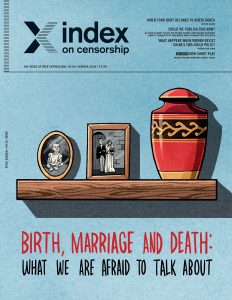
Birth, Marriage and Death, the winter 2018 issue of Index on Censorship magazine.
Birth, marriage and death–these are key staging posts. And that’s one reason why this issue looks at how taboos around these subjects have a critical impact on our world.
Sadly, there are still many of us who feel we can’t talk about problems openly at these times. Societal pressure to conform can be a powerful element in this and can help to create stultifying silences that frighten us into not being able to speak.
Being unable to discuss something that has a major and often complex impact on you or your family can lead to ignorance, fear and terrible decisions.
Not knowing about information or medical advice can also mean exposing people to illness and even death.
The Australian Museum sees death as the last taboo, but it also traces where those ideas have come from and how we are sometimes more shy to talk about subjects now than we were in the past.
The Sydney-based museum’s research considers how different cultures have disposed of the dead throughout history and where the concepts of cemeteries and burials have come from.
For instance, in Ancient Rome, only those of very high status were buried within the city walls, while the Ancient Greeks buried their dead within their homes.
The word “cemetery” derives from the Greek and Roman words for “sleeping chamber”, according to the Australian Museum, which suggests that although cremation was used by the Romans, it fell out of favour in western Europe for many centuries, partly because those of the Christian faith felt that setting fire to a body might interfere with chances of an afterlife.
Taboos about death continue to restrict speech (and actions) all around the world. In a six-part series on Chinese attitudes to death, the online magazine Sixth Tone revealed how, in China, people will pay extra not to have the number “4” in their mobile telephone number because the word sounds like the Mandarin word for “death”.
It also explores why Chinese families don’t talk about death and funerals, or even write wills.
In Britain, research by the charity Macmillan Cancer Support found just over a third of the people they surveyed had thoughts or feelings about death that they hadn’t shared with anyone. Fears about death concerned 84% of respondents, and one in seven people surveyed opted out of answering the questions about death.
These taboos, especially around death and illness, can stop people asking for help or finding support in times of crisis.
Mental health campaigner Alastair Campbell wrote in our winter 2015 issue that when he was growing up, no one ever spoke about cancer or admitted to having it.
It felt like it would bring shame to any family that admitted having it, he remembered. Campbell said that he felt times had moved on and that in Britain, where he lives, there was more openness about cancer these days, although people still struggle to talk about mental health.
Hospice director Elise Hoadley tells one of our writers, Tracey Bagshaw, for her article on the rise of death cafes (p14), that British people used to be better at talking about death because they saw it up close and personal. For instance, during the Victorian period it would be far more typical to have an open coffin in a home, where family or friends could visit the dead person before a funeral. And vicar Laura Baker says of 2018: “When someone dies we are all at sea. We don’t know what to do.”
In a powerful piece for this issue (p8), Moscow-based journalist Daria Litvinova reports on a campaigning movement in Russia to expose obstetric abuse, with hundreds of women’s stories being published. One obstacle to get these stories out is that Russian women are not expected to talk about the troubles they encounter during childbirth. As one interviewee tells Litvinova: “And generally, giving birth, just like anything else related to women’s physiology, is a taboo subject.” Russian maternity hospitals remain institutions where women often feel isolated, and some do not even allow relatives to visit. “We either talk about the beauty of a woman’s body or don’t talk about it at all,” said one Russian.
Elsewhere, Asian-American women talk to US editor Jan Fox (p27) about why they are afraid to speak to their parents and families about anything to do with sex; how they don’t admit to having partners; and how they worry that the climate of fear will get worse with new legislation being introduced in the USA.
As we go to press, not only are there moves to introduce a “gag rule” – which would mean removing funding from clinics that either discuss or offer abortion – but in the state of Ohio, lawmakers are discussing House Bill 565, which would make abortions illegal even if pregnancies arise from rape or incest or which risk the life of the mother. These new laws are likely to make women more worried than before about talking to professionals about abortion or contraception.
Don’t miss our special investigation from Honduras, where the bodies of young people are being discovered on a regular basis but their killers are not being convicted. Index’s 2018 journalism fellow Wendy Funes reports on p24.
We also look at the taboos around birth and marriage in other parts of the world. Wana Udobang reports from Nigeria (p45), where obstetrician Abosede Lewu tells her how the stigma around Caesarean births still exists in Nigeria, and how some women try to pretend they don’t happen — even if they have had the operation themselves. “In our environment, having a C-section is still seen as a form of weakness due to the combination of religion and culture.”
Meanwhile, there’s a fascinating piece from China about how its new two-child policy means women are being pressurised to have more children, even if they don’t want them — a great irony when, only a decade ago, if women had a second child they had to pay.
[/vc_column_text][vc_row_inner][vc_column_inner width=”1/4″][vc_icon icon_fontawesome=”fa fa-quote-left” color=”custom” size=”xl” align=”right” custom_color=”#dd3333″][/vc_column_inner][vc_column_inner width=”3/4″][vc_custom_heading text=”Taboos, especially around death and illness, can stop people asking for help or finding support in times of crisis” font_container=”tag:h3|text_align:left” google_fonts=”font_family:Libre%20Baskerville%3Aregular%2Citalic%2C700|font_style:400%20italic%3A400%3Aitalic”][/vc_column_inner][/vc_row_inner][vc_column_text]
In other matters, I have just returned from the annual Eurozine conference of cultural journals, this year held in Vienna. It was interesting to hear about a study into the role of this specific type of publication. Research carried out by Stefan Baack, Tamara Witschge and Tamilla Ziyatdinova at the University of Groningen, in the Netherlands, is looking at what long-form cultural journalism does and what it achieves.
The research is continuing, but the first part of the research has shown that this style of magazine or journal stimulates creative communities of artists and authors, as well as creating debates and exchanges across different fields of knowledge. Witschge, presenting the research to the assembled editors, said these publications (often published quarterly) have developed a special niche that exists between the news media and academic publishing, allowing them to cover issues in more depth than other media, with elements of reflection.
She added that in some countries cultural journals were also compensating for the “shortcomings and limitations of other media genres”. Ziyatdinova also spoke of the myth of the “short attention span”.
At a time when editors and analysts continue to debate the future of periodicals in various forms, this study was heartening. It suggests that there still is an audience for what they describe as “cultural journals” such as ours – magazines that are produced on a regular, but not daily basis which aim to analyse as well as report what is going on around the world. Lionel Barber, the editor of the Financial Times newspaper, spoke of his vision of the media’s future at the James Cameron Memorial Lecture at London’s City University in November. As well as arguing that algorithms were not going to take over, he said he was convinced that print had a future. He said: “I still believe in the value and future of print: the smart, edited snapshot of the news, with intelligent analysis and authoritative commentary.”
His belief in magazines as an item that will continue to be in demand, if they offer something different from something readers have already consumed, was made clear: “Magazines, which also count as print – are they going to just disappear? No. Look at The Spectator, look at the sales of Private Eye.”
The vibrancy of the magazine world was also clear at this year’s British Society of Magazine Editors awards in London, with hundreds of titles represented. Jeremy Leslie, the owner of the wonderful Magculture shop in London (which stocks Index on Censorship) received a special award for his commitment to print. This innovative shop stocks only magazines, not books, and has carved out a niche for itself close to London’s City University. Well done to Jeremy. Index was also shortlisted for the specialist editor of the year award, so we are celebrating as well.
We hope you will continue to show your commitment to this particular magazine, in print or in our beautiful digital version, and think of buying gift subscriptions for your friends at this holiday time (check out https://shop.exacteditions.com/index-on-censorship for a digital subscription from anywhere in the world). We appreciate your support this year, and every year, and may you have a happy 2019.
[/vc_column_text][/vc_column][/vc_row][vc_row][vc_column][vc_column_text]
Rachael Jolley is editor of Index on Censorship. She tweets @londoninsider. This article is part of the latest edition of Index on Censorship magazine, with its special report on Birth, Marriage and Death.
Index on Censorship’s winter 2018 issue is Birth, Marriage and Death, What are we afraid to talk about? We explore these taboos in the issue.
Look out for the new edition in bookshops, and don’t miss our Index on Censorship podcast, with special guests, on Soundcloud.
[/vc_column_text][/vc_column][/vc_row][vc_row][vc_column width=”1/3″][vc_custom_heading text=”Birth, Marriage and Death” font_container=”tag:h3|text_align:left” link=”url:https%3A%2F%2Fwww.indexoncensorship.org%2F2018%2F12%2Fbirth-marriage-death%2F|||”][vc_column_text]The winter 2018 issue of Index on Censorship magazine explores taboos surrounding birth, marriage and death. What are we afraid to talk about?
With: Liwaa Yazji, Karoline Kan, Jieun Baek[/vc_column_text][/vc_column][vc_column width=”1/3″][vc_row_inner][vc_column_inner][vc_single_image image=”104225″ img_size=”full” onclick=”custom_link” link=”https://www.indexoncensorship.org/2018/12/birth-marriage-death/”][/vc_column_inner][/vc_row_inner][/vc_column][vc_column width=”1/3″][vc_custom_heading text=”Subscribe” font_container=”tag:h3|text_align:left”][vc_row_inner][vc_column_inner][vc_column_text]In print, online. In your mailbox, on your iPad.
Subscription options from £18 or just £1.49 in the App Store for a digital issue.
Every subscriber helps support Index on Censorship’s projects around the world.
SUBSCRIBE NOW[/vc_column_text][/vc_column_inner][/vc_row_inner][/vc_column][/vc_row]
