2 Apr 2017 | Magazine, Magazine Contents, Volume 46.01 Spring 2017
[vc_row][vc_column][vc_custom_heading text=”Contributors include Richard Sambrook, Dominic Grieve, Roger Law, Karim Miské, Mark Frary and Canan Coşkun”][vc_row_inner][vc_column_inner width=”1/2″][vc_column_text]
The spring issue of Index on Censorship magazine looks at how pressures on free speech are currently coming from many different angles, not just one. Richard Sambrook, former director of global news at the BBC, shows how journalists are in a bind, caught between what advertisers want and what readers want. Also looking at journalists, Duncan Tucker casts his eye on the grave situation in Mexico, where getting to the truth involves working against the government, violent cartels and even coworkers.
[/vc_column_text][/vc_column_inner][vc_column_inner width=”1/2″][vc_single_image image=”88802″ img_size=”full”][/vc_column_inner][/vc_row_inner][vc_column_text]
Meanwhile, in the Maldives Zaheena Rasheed shows how a mix of forces conspire against those who want to write anything beyond the usual tourist sale pitch.
But the squeezes on free expression don’t just concern journalists. Annemarie Luck reports from Japan, where penis festivals are popular, but women struggle to discuss their own bodies. Can they find a voice through art and manga? For musician Smockey from Burkina Faso, art should indeed be a way to confront truth and yet that’s not always the case. Expectations run high for him to not be “too political” in his lyrics.
Universities, normally the cradle of free expression, aren’t faring too well either, as two articles show. Jan Fox reports from the USA, where bias response teams are becoming a staple of US collegiate life. In South Africa Fees Must Fall has created a divide between right and left, writes Natasha Joseph, with neither side talking to each other and those in the middle being silenced altogether.
Outside of our special report, Roger Law, creator of the iconic TV satire Spitting Image, talks about the great fun he had with the series back in the day and questions whether the show would be able to air today. Alfonso Lázaro de la Fuente might say no. He was one of the Spanish puppeteers arrested last year for a show that referenced Basque-separatist organisation ETA. In an Index exclusive, he explains what the charges have meant for his personal and professional life.
Want to know how to spot fake news? Then read Reel-time news in which Index’s team of experienced global reporters offer tips on how to spot fake news from a mile/screen away. And don’t miss Martin Rowson‘s fake o’clock news, a hilarious – and sinister – take on what a future of alternative facts would look like.
Index also publish an interview with Turkish journalist Canan Coşkun, whose coworkers are currently in jail, and a pair of writers discuss the situation of free speech in Poland, which is tumbling down global charts following the election of the Law and Justice party. And in the UK, former attorney general Dominic Grieve reveals that MPs are avoiding hard talk in parliament.
Finally, the culture section includes a short story from award-winning French writer Karim Miské and original work from Vyacheslav Huk, a Crimean novelist who is unable to publish work in his mother tongue.
[/vc_column_text][/vc_column][/vc_row][vc_row][vc_column][vc_custom_heading text=”SPECIAL REPORT: THE BIG SQUEEZE” css=”.vc_custom_1481731933773{margin-right: 0px !important;margin-left: 0px !important;border-bottom-width: 1px !important;padding-top: 15px !important;padding-bottom: 15px !important;border-bottom-color: #455560 !important;border-bottom-style: solid !important;}”][vc_column_text]
The Big Squeeze: Freedom of speech under pressure
Fact-filled future? by Rachael Jolley: Journalists need to step up, and produce more detailed news coverage. The public needs it
Between a rock and a hard place, by Duncan Tucker: Mexico’s journalists face threats from cartels, the government and each other
Reality rapped, by Smockey: An award-winning musician from Burkina Faso explains why he won’t water down his lyrics to avoid rocking the boat, despite pressure to do so
Talking a tightrope, by
Kaya Genç: Despite the crackdown in Turkey, the post-Gezi spirit still survives among the determined
Taking the bait, by Richard Sambrook: The quest for instant gratification online is seriously compromising news reporting
Dangerous minds, by Natasha Joseph: Rather than creating an alliance, Fees Must Fall is limiting free speech at South Africa’s universities, leaving some early supporters disheartened
Japan’s Madonna complex, by Annemarie Luck: Japan’s contradictory attitudes include highly sexualised images of women and women not being allowed to talk about sex-related subjects
Squeezed in the closet, by Hannah Leung: Get married and be quiet are the messages China’s LGBT community is given
Degrees of separation, by Jan Fox: The author investigates units appearing on US campuses suggesting students should report lecturers who they feel are biased
Dying to tell a story, by Sadaf Saaz: The list of what Bangladesh writers cannot talk about is getting longer, but that isn’t stopping some from writing
Trouble in paradise, by Zaheena Rasheed: Behind the image of palm-lined beaches is a side of the Maldives the government doesn’t want you to see
Your cover is shown, by Mark Frary: Tech giants and governments are out to get your data. Soon it might be impossible to remain anonymous
Stripsearch cartoon, by Martin Rowson: Tune in to the fake o’clock news
Composing battle lines, by Steven Borowiec: Why have South Korean pop stars found themselves caught in crossfire between their country and China?
[/vc_column_text][/vc_column][/vc_row][vc_row][vc_column][vc_custom_heading text=”IN FOCUS” css=”.vc_custom_1481731813613{margin-right: 0px !important;margin-left: 0px !important;border-bottom-width: 1px !important;padding-top: 15px !important;padding-bottom: 15px !important;border-bottom-color: #455560 !important;border-bottom-style: solid !important;}”][vc_column_text]
We have no time for fear, by Canan Coşkun: A Turkish journalist on the perils of reporting in her country when fellow reporters are imprisoned
Reel-time news, by Natasha Joseph, Kaya Genç, Jemimah Steinfeld, Duncan Tucker, Abraham T Zere, Raymond Joseph: As “fake news” dominates headlines, Index’s global team of experienced journalists offers tips on how to spot falsehoods before you click and share
Singing from the same hymn sheet, by Suhrith Parthasarathy: Rising Indian nationalism is creating a repressive state where non-conformity is deemed unpatriotic
Poland: Special Focus, by Wojciech Przybylski, Marcin Król: Poland has gone from free speech hero to villain almost overnight. Two writers discuss the shift and why history is being rewritten
Shooting from the hip, by Irene Caselli: A new mayor in a Mexican border city believes he will make it less dangerous for journalists
Silence in the house, by Dominic Grieve: The former UK attorney general says MPs are shying away from tough topics in parliament
Puppet masters, by Roger Law: The creator of iconic TV satire Spitting Image on whether we still have our sense of humour
Drawing the line, by John Power: Australia is debating free speech, one cartoon at a time. Cartoonist Bill Leak interviewed just before he died
Puppet state, by Alfonso Lázaro de la Fuente: A Spanish puppeteer, arrested after terrorism charges related to a show, discusses the impact on his life
[/vc_column_text][/vc_column][/vc_row][vc_row][vc_column][vc_custom_heading text=”CULTURE” css=”.vc_custom_1481731777861{margin-right: 0px !important;margin-left: 0px !important;border-bottom-width: 1px !important;padding-top: 15px !important;padding-bottom: 15px !important;border-bottom-color: #455560 !important;border-bottom-style: solid !important;}”][vc_column_text]
Novel take on terror, by
Karim Miské: The award-winning crime writer on why fiction and reality overlap. Plus his short story featuring a future where tech rules supreme. Interview by Sally Gimson
The war of the words, by Amira Hanafi: Translated extracts from an American-Egyptian writer’s project to capture the shifting linguistic landscape in Egypt since 2011. Interview by Sally Gimson
Crimean closedown, by Vyacheslav Huk: The Crimean novelist on being unable to publish in his mother tongue and a story of the narrator’s memories. Introduced and translated by Steve Komarnyckyj
[/vc_column_text][/vc_column][/vc_row][vc_row][vc_column][vc_custom_heading text=”COLUMNS” css=”.vc_custom_1481732124093{margin-right: 0px !important;margin-left: 0px !important;border-bottom-width: 1px !important;padding-top: 15px !important;padding-bottom: 15px !important;border-bottom-color: #455560 !important;border-bottom-style: solid !important;}”][vc_column_text]
Index around the world, by
Kieran Etoria-King: What to look out for at Index’s Freedom of Expression Awards 2017, alongside news of other projects that Index has been working on in the last few months
[/vc_column_text][/vc_column][/vc_row][vc_row][vc_column][vc_custom_heading text=”END NOTE” css=”.vc_custom_1481880278935{margin-right: 0px !important;margin-left: 0px !important;border-bottom-width: 1px !important;padding-top: 15px !important;padding-bottom: 15px !important;border-bottom-color: #455560 !important;border-bottom-style: solid !important;}”][vc_column_text]
Getting print out, by Jemimah Steinfeld: Self-publishing may be a new solution to censorship in China and other countries
[/vc_column_text][/vc_column][/vc_row][vc_row][vc_column][vc_custom_heading text=”SUBSCRIBE” css=”.vc_custom_1481736449684{margin-right: 0px !important;margin-left: 0px !important;border-bottom-width: 1px !important;padding-bottom: 15px !important;border-bottom-color: #455560 !important;border-bottom-style: solid !important;}”][vc_column_text]Index on Censorship magazine was started in 1972 and remains the only global magazine dedicated to free expression. Past contributors include Samuel Beckett, Gabriel García Marquéz, Nadine Gordimer, Arthur Miller, Salman Rushdie, Margaret Atwood, and many more.[/vc_column_text][vc_row_inner][vc_column_inner width=”1/2″][vc_single_image image=”76572″ img_size=”full”][/vc_column_inner][vc_column_inner width=”1/2″][vc_column_text]In print or online. Order a print edition here or take out a digital subscription via Exact Editions.
Copies are also available at the BFI, the Serpentine Gallery, MagCulture, (London), News from Nowhere (Liverpool), Home (Manchester), Calton Books (Glasgow) and on Amazon. Each magazine sale helps Index on Censorship continue its fight for free expression worldwide.
 SUBSCRIBE NOW[/vc_column_text][/vc_column_inner][/vc_row_inner][/vc_column][/vc_row]
28 Mar 2017 | Belarus, Campaigns -- Featured, Statements
[vc_row][vc_column][vc_column_text]We, the undersigned members of the Civic Solidarity Platform (CSP), a coalition of human rights NGOs from Europe, the former Soviet Union region and North America, and other non-governmental organisations decry the mass detentions of peaceful demonstrators, journalists and human rights defenders, as well as the use of violence and abusive treatment targeting them in Belarus on 25-26 March 2017. These events were the culmination of a series of repressive measures taken by the authorities of the country since the beginning of March to stifle the public expression of grievances. Given the severity of this human rights crisis of unprecedented scale since December 2010, it is crucial that the international community takes resolute action to push for an end to the crackdown in Belarus and justice for those targeted by it.
We condemn the gross violations of the right to peaceful assembly, freedom of expression, freedom from arbitrary detention, and the right to fair trial in Belarus in connection with the recent peaceful protests, and call on the international community to use all available means to put pressure on the Belarusian authorities to immediately end these violations.
Such measures by the authorities should include:
- immediately releasing those currently behind bars because of their involvement in the peaceful protests or their efforts to monitor them;
- dropping charges against all those prosecuted on these grounds;
- carrying out prompt, thorough and impartial investigations into all allegations of arbitrary detention, ill-treatment and other violations of the rights of protesters, passers-by, journalists, human rights defenders and political activists in connection with the protests; and
- bringing those responsible for violations to justice.
We call in particular for the following concrete actions by international community in response to the current crackdown in Belarus:
To the OSCE:
- The OSCE participating States should initiate and support the renewal of the Moscow Mechanism in relation to Belarus and the appointment of a new rapporteur for this process, in view of the fact that the current developments mirror those on the grounds of which this mechanism was invoked in 2011;
- The OSCE Chairmanship should appoint a Special Representative on Belarus, whose mandate should include investigating the recent violations;
- The Office of Democratic Institutions and Human Rights should monitor the trials of those facing charges because of their participation in the recent peaceful protests, or their efforts to monitor and report on them;
- The OSCE Parliamentary Assembly should reconsider holding its annual session in Minsk in July 2017 and identify another host country and city for this event.
To the Council of Europe:
- The Parliamentary Assembly of the Council of Europe should replace its current rapporteur on the situation in Belarus, ensuring that the individual holding this position forcefully speaks out against human rights violations in the country.
To the UN:
- Members of the Human Rights Council should extend the mandate of the Special Rapporteur on the human rights situation in Belarus, continue urging the Belarusian authorities to allow the Special Rapporteur to visit the country, and adopt a strong resolution on the human rights situation in Belarus at the next session of the Council;
- High Commissioner on Human Rights should publicly condemn the crackdown in Belarus and engage in direct contact with the Belarusian authorities on this matter.
To international financial institutions:
- International financial institutions should apply strong human rights conditionality in the implementation of their programs in Belarus and refrain from allocating funding to government projects until the human rights situation in the country has substantially improved. Specifically, the European Bank for Reconstruction and Development should reinstate its calibrated strategy on Belarus.
To the EU:
- The EU member states and institutions should apply stronger and more consistent human rights conditionality to the development of its relations with Belarus and consider the prospects of reinstating sanctions similar to those applied in 2011-12 for widespread human rights violations.
To the USA:
- The US government should consider reinstating the sanctions against Belarus that it suspended in 2015-16.
Background information, based on reports from the ground:
In the afternoon of 25 March 2017, people took to the streets in the Belarusian capital of Minsk for planned peaceful protests on the occasion of the Day of Freedom, which commemorates the Belarusian declaration of independence in 1918. There was as a heavy police and security presence in the city, the downtown area where protests were due to be held was cordoned off, and traffic was blocked on the main Independence Avenue. Local and international human rights monitors representing the CSP member organisations documented the use of heavy-handed tactics by the law enforcement and security authorities to prevent the peaceful protests, for which authorities had not given advance permission as required by Belarusian law and in violation of international standards. At least 700 people were detained on 25 March, including elderly and passers-by. As can be seen on available photos and footage, police forcefully rounded up and beat protesters with batons, although these made no resistance. More than 30 journalists and photographers from both Belarusian and international media outlets were detained; cameras and other equipment of some of them were damaged by police. Toward the evening, police started releasing detainees from the detention facilities, in many cases without charge. However, others remain in detention, and dozens of individuals are expected to stand trial starting Monday 27 March on charges relating to their participation in the peaceful protests.
The following episode requires particular attention: At 12.45 pm local time on 25 March, about an hour before the start of the planned peaceful protest, anti-riot police raided the offices of the Human Rights Center Viasna and detained a total of 57 Belarusian and foreign human rights defenders and volunteers as well as journalists. Human rights defenders and volunteers had gathered there for a training on monitoring the protests and were planning to go to the streets of Minsk for observation of the assemblies. Among them were representatives of Viasna, the Belarusian Helsinki Committee, the Belarusian Documentation Center, Frontline Defenders, International Partnership for Human Rights and other organisations. The police shouted at all present, intimidated them, and ordered to lie down on the floor face down. 57 people were detained without any charges, packed in the buses and brought to the Pervomaisky district police station, where their belongings were searched and their personal information recorded. The detainees were held there for two and a half hours and were released afterwards without charges. One of the detained needed medical treatment because of injuries sustained when being beaten by police. The raid of the offices of Viasna and the detention of the monitors were clearly aimed at intimidating and preventing them from observing the peaceful assembly and documenting possible violations.
The crackdown continued on 26 March, with dozens of people being detained by police as they gathered at October Square in Minsk at noon to express solidarity with those detained the day before. Among the detained on 26 March were at least one human rights defender, one civil society activist and one journalist. Representatives of national and international human rights NGOs, including members of the CSP, continue to document violations perpetrated in connection with the events of the last few days.
The detentions on 25-26 March followed the earlier detention of about 300 people, including opposition members, journalists and human rights defenders in the last few weeks. These detentions have taken place against the background of a wave of peaceful demonstrations that were carried out across Belarus since mid-February 2017 to protest against so-called “social parasites” law which imposes a special tax on those who have worked for less than six months during the year without registering as unemployed. The legislation, which has affected hundreds of thousands of people in the economically struggling country, has caused widespread dismay. On 9 March, President Lukashenko suspended the implementation of the law but refused to withdraw it, resulting in further protests. Many of those detained have been fined or arrested for up to 15 days on administrative charges related to their participation in the peaceful protests. Over two dozen people are facing criminal charges on trumped-up charges of preparation to mass riots.
Signed by the following CSP members:
- Analytical Center for Inter-Ethnic Cooperation and Consultations (Georgia)
- Article 19 (United Kingdom)
- Association UMDPL (Ukraine)
- Bir Duino (Kyrgyzstan)
- Bulgarian Helsinki Committee
- Center for Civil Liberties (Ukraine)
- Centre for the Development of Democracy and Human Rights (Russia)
- Committee against Torture (Russia)
- Crude Accountability (USA)
- Freedom Files (Russia/Poland)
- German-Russian Exchange – DRA (Germany)
- Helsinki Association of Armenia
- Helsinki Citizens’ Assembly – Vanadzor (Armenia)
- Helsinki Committee of Armenia
- Helsinki Committee for Human Rights in Serbia
- Helsinki Foundation for Human Rights (Poland)
- Human Rights Center of Azerbaijan
- Human Rights First (USA)
- Human Rights House Foundation (Norway)
- Human Rights Information Center (Ukraine)
- Human Rights Monitoring Institute (Lithuania)
- The institute for Reporters’ Freedom and Safety (Azerbaijan/Georgia/Switzerland)
- Index on Censorship (United Kingdom)
- Institute Respublica (Ukraine)
- International Partnership for Human Rights (Belgium)
- Kazakhstan International Bureau for Human Rights and Rule of Law
- The Kosova Rehabilitation Center for Torture Victims
- Macedonian Helsinki Committee
- Moscow Helsinki Group (Russia)
- The Netherlands Helsinki Committee
- Norwegian Helsinki Committee
- Office of Civil Freedoms (Tajikistan)
- Promo-LEX (Moldova)
- Protection of Rights without Borders (Armenia)
- Public Association “Dignity” (Kazakhstan)
- Public Alternative Foundation (Ukraine)
- Public Foundation Golos Svobody (Kyrgyzstan)
- Public Verdict Foundation (Russia)
- Regional Center for Strategic Studies (Azerbaijan/ Georgia)
- Serbian Helsinki Committee for Human Rights
- SOLIDARUS e.V. (Germany)
- The Swiss Helsinki Committee
- Ukrainian Helsinki Human Rights Union
- Women’s International League for Peace and Freedom
- World Organisation against Torture (OMCT)
Other organisations who have joined the statement:
- Belarus Free Theatre
- Libereco – Partnership for Human Rights (Switzerland)
- PEN International
[/vc_column_text][/vc_column][/vc_row][vc_row][vc_column][vc_basic_grid post_type=”post” max_items=”4″ element_width=”6″ grid_id=”vc_gid:1490686433484-ad7cf42c-cf25-10″ taxonomies=”172″][/vc_column][/vc_row]
27 Mar 2017 | Belarus, Mapping Media Freedom, News
[vc_row][vc_column][vc_column_text]
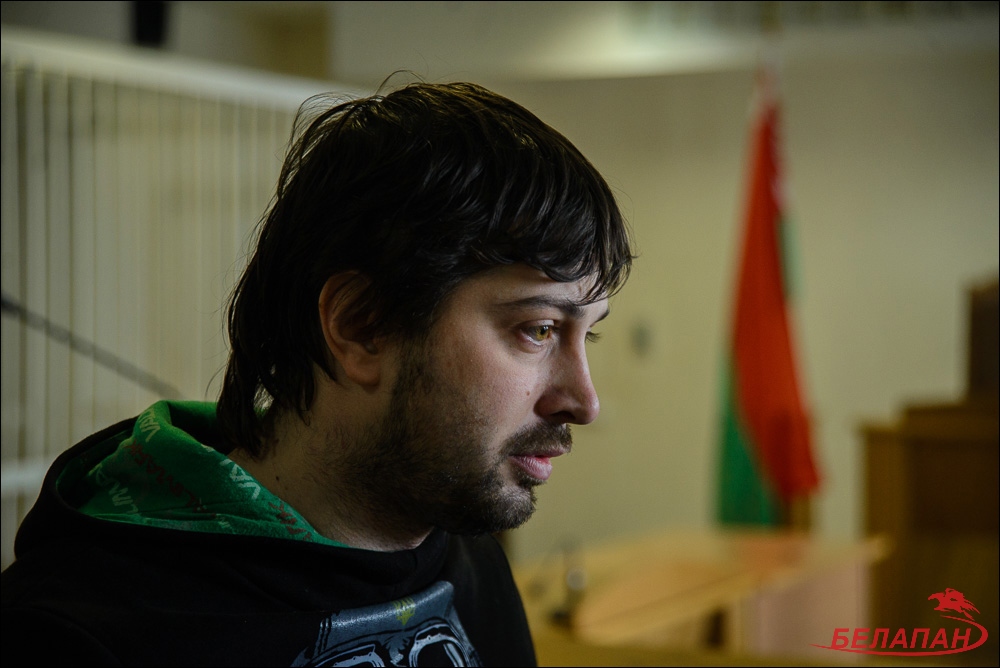
Aliaksandr Barazenka, a camerperson for Belsat TV was sentenced to 15 days detention after filming Freedom Day protests in Minsk. (Photo: Siarhei Balai, BelaPAN)
“I am a journalist!” This is a phrase that is officially regarded as obscene by the authorities of Belarus today.
Aliaksandr Barazenka, a cameraman for Belsat TV, a Poland-based Belarusian language media outlet, was sentenced to 15 days arrest in Minsk on Monday 27 March. He was detained while filming a live stream from a peaceful protest in the centre of the Belarusian capital on 25 March. Witnesses say Barazenka was with a camera and other journalistic equipment that made it obvious he was not a protester. To prove it to the riot police, who had begun detaining people on the street, Aliaksandr kept shouting: “I am a journalist! I am a journalist!”
Police officers testified in court on Monday that Barazenka was swearing in public, “waved his hands and showed disrespect to public order”.
The Belarusian Association of Journalists reported that more than 50 journalists were detained in the country during protests on 25 and 26 March 2017. Most of the journalists were released after short detentions, but at least six journalists and bloggers have been sentenced to administrative arrests of 10 to 15 days. Thirty-six journalists were detained on Freedom Day, 25 March.
The demonstrations erupted after the implementation of Presidential Decree No.3, which fines people (about 150-200 GBP annually) who are unable to prove an official workplace or income. Calling these individuals “social parasites”, authorities said they have to pay a share of state social expenditure.
A large number of Belarusians consider this attitude disrespectful. Coupled with economic problems that are felt by ordinary people the decree sparked protests across the country bringing thousands of people into the streets of Belarusian cities.
President Lukashenka, who has been in power since 1994, ordered law enforcement to end the protests. Police responded with heavy-handed tactis that included reported assaults on demonstrators. Hundreds of people were detained just before or during the events of 25 March, celebrated unofficially by the country’s political opposition as Freedom Day, which commemorates the founding of the first independent Belarusian state in 1918.
The detainees are now are being prosecuted, fined and sentenced to administrative arrests. Fifty-seven human rights activists were detained in an office of Viasna Human Rights Centre, an organization lead by the Nobel Prize and Index Award nominee and a former political prisoner Alies Bialiatski.
“The authorities fail to preserve a social contract with the population of the country. Now the regime tries to prevent a social protest to get political claims, and try to frighten the society like they used to do before”, says Uladzimir Matskevich, a philosopher and a leader of the Agency of Humanitarian Technologies, an independent Belarusain think tank. “There is a need for united response from the civil society; we need to come up with a real and united opposition force in Belarus”.
[/vc_column_text][vc_basic_grid post_type=”post” max_items=”4″ element_width=”6″ grid_id=”vc_gid:1490630698283-d066c6e3-2c4d-5″ taxonomies=”172″][/vc_column][/vc_row]
23 Mar 2017 | Belarus, Campaigns, Campaigns -- Featured, Statements
Dear Mr. President
We, 48 undersigned organizations from 24 countries, strongly condemn the continuing wave of detentions and harassment of peaceful protesters, journalists, human rights defenders, civil society activists, anarchists and opposition party members in Belarus.
Most of the detentions and harassment are linked to participation in peaceful protests demanding the cancellation of Presidential Decree No. 3, the so-called “social parasite” legislation, which imposes a tax on unemployed people in Belarus. Decree No. 3 obligates citizens to work a specific number of days or pay a special duty to the State under threat of arrest. This is contrary to Art. 41 of the Belarusian Constitution and violates international human rights law.
According to reports from Belarusian and international human rights organizations, as of 22 March 2017 more than 250 people have been detained since 3 March 2017, including at least 31 journalists. At least 110 people have been sentenced to 3-15 days of administrative arrest. Many of them remain in detention, while others have been subject to different forms of harassment.
We strongly condemn the fact that several detentions of peaceful protesters at different places across Belarus have been carried out with the excessive use of force by Belarusian security officers.
Several Belarusian organizations have announced a demonstration that will take place in Minsk and in other cities in Belarus on 25 March 2017. We are deeply concerned about the physical and psychological integrity of the participants of these protest marches.
As the president of Belarus we urge you:
- to respect the right to peaceful assembly and expression
- to ensure that there are no obstructions to the exercising of these rights in Belarus, including in relation to the planned demonstration on 25 March 2017 in Minsk and in other cities across the country
- to guarantee in all circumstances the physical and psychological integrity of all peaceful protesters at the demonstration on 25 March 2017 in Minsk as well as at all other peaceful demonstrations across Belarus
- to refrain from the use of excessive force by security officers on 25 March 2017 in Minsk as well as at all other peaceful demonstrations across Belarus
- to ensure that journalists are able to fully exercise their professional duties, including during peaceful demonstrations
- to immediately and unconditionally release all protesters, journalists, human rights defenders, civil society activists and opposition members who have been detained in connection with the current wave of demonstrations solely for peacefully exercising their right to freedom of assembly and expression
- to refrain from preventively detaining journalists, human rights defenders, civil society activists, anarchists and opposition activists
- to immediately stop the persecution, harassment and intimidation of those who exercise their right to freedom of assembly, expression and association and ensure these rights to all Belarusian citizens
- to abolish Presidential Decree No. 3 since it violates international human rights law
Signatories:
Albanian Helsinki Committee
Analytical Center for Interethnic Cooperation and Consultations (Georgia)
Article 19 (UK)
Association UMDPL (Ukraine)
Bir Duino (Kyrgyzstan)
Bulgarian Helsinki Committee
Center for Civil Liberties (Ukraine)
Center for the Development of Democracy and Human Rights (Russia)
Charity foundation “East-SOS” (Ukraine)
Civic Belarus (Czech Republic)
CIVICUS: World Alliance for Citizen Participation, Johannesburg
Committee to Protect Journalists (USA)
Crude Accountability (USA)
FIDH, Paris
Freedom Files (Russia/Poland)
German-Russian Exchange (Germany)
Helsinki Committee for Human Rights in Serbia
Helsinki Committee of Armenia
Helsinki Foundation for Human Rights (Poland)
Human Rights Center “Postup” (Ukraine)
Human Rights Center (Azerbaijan)
Human Rights Information Center (Ukraine)
Human Rights Monitoring Institute (Lithuania)
Humanrights.ch (Switzerland)
Index on Censorship (UK)
Institute Respublica (Ukraine)
International Partnership for Human Rights (Belgium)
IRFS (Azerbaijan)
JEF Europe: Young European Federalists, Brussels
Kazakhstan Interantional Bureau for Human Rights and the Rule of Law
Kharkiv Human Rights Protection Group (Ukraine)
KRF Public Alternative (Ukraine)
Libereco – Partnership for Human Rights (Switzerland/Germany)
Macedonian Helsinki Committee
Memorial International, Moscow
Menschenrechte in Belarus e.V. (Germany)
Moscow Helsinki Group (Russia)
NESEHNUTI – Independent Social Ecological Movement (Czech Republic)
Norwegian Helsinki Committee
Ostgruppen – Swedish Initiative for Democracy and Human Rights
Promo LEX (Moldova)
Protection of Rights without Borders NGO (Armenia)
Public Verdict Foundation Russia)
Reporters Without Borders International, Paris
The Netherlands Helsinki Committee
The Swiss Helsinki Committee
Ukrainian Helsinki Human Rights Union
World Organisation Against Torture (OMCT), Geneva