5 Jan 2016 | Lithuania, Mapping Media Freedom, mobile, News
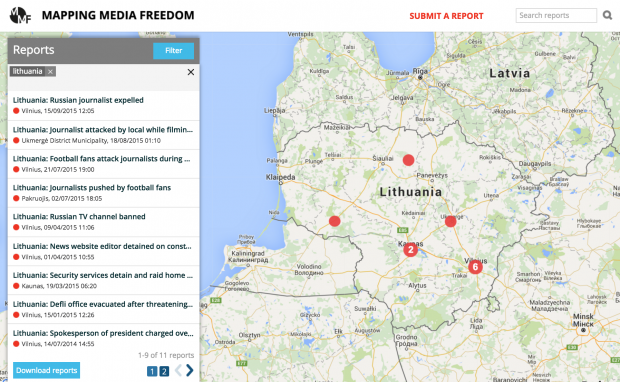
RTR Planeta, a Russian language channel broadcasting in Lithuania, has repeatedly run into conflict with the country’s television regulator.
In December, the Lithuanian Radio and Television Commission ordered RTR Planeta to be moved to paid TV packages after it broadcast material that the agency said instigated racial hatred and warfare. The programme in question was the 29 November episode of Sunday Evening with Vladimir Solovyov, which discussed the downing of a Russian plane by the Turkish airforce.
Russian MP Vladimir Zhirinovsky, who was a guest on the programme, said Turkish people were “a nation of wild barbarians,” and said that Turkey should be “brought to its knees” through military attacks.
“We need an air raid on any part of Turkey (…), the Turkish army must be destroyed,” said Zhirinovsky.
This is the second time the programme has prompted the regulator to take action. In April 2015, RTR Planeta was blocked from broadcasting for three months for allegedly “inciting discord and warmongering” over the conflict in Ukraine.
The content in question included a tirade against the Baltic countries by ultra-nationalist Russian politician Vladimir Zhirinovsky on the Sunday Evening With Vladimir Solovjev programme. Zhirinovsky said that Poland and the Baltic states would be “wiped out” should a war break out between Russia and NATO.
Although Lithuanian politicians and media experts agreed on the inflammatory nature of RTR Planeta content, especially the comments made by Zhirinovsky, some media pundits have expressed doubt over the decision to shut the channel down for three months. It resumed broadcasting on 13 July 2015.
In April, Audris Matonis, news service director at Lithuania’s national LRT broadcaster, rejected criticism that the ban was excessive and amounted to censorship. He insisted that “all should realise that what they’re advocating is non-compliance with Lithuanian law”.
But Gintautas Mazeikis, director of the Political Theory Department at Vytautas Magnus University in Kaunas, took issue when speaking to Delfi.lt. “Do we want and seek diplomatic and other means to influence Russian channels, or are we only trying to co-operate with cable TV service providers so they change their packages and broadcast more Polish or Ukrainian TV?” he said. “Do we want to explain and encourage critical thinking among speakers of Ukrainian, Belarusian, Russian and Polish who live in Lithuania?”
Aidas Puklevičius, a journalist and author, insisted that the broadcast ban may not have been the best decision and reasoned that the situation should improve once the generation of people who speak only Russian as a foreign language gives way to one which is more fluent in English.
“Russia will then lose its only vehicle for exporting soft power, something it has very little of,” Puklevičius said to Delfi.it. “Russia did not invent Pepsi Cola, nor jeans, nor Hollywood. Russia’s only strength is its ability to play on Soviet nostalgia.”
Media professionals in Lithuania have increasingly found themselves taking sides in the Ukraine conflict.
“Unfortunately, Russia-Ukraine warfare has become part of journalism in Lithuania and not surprisingly, all the Lithuanian news, except for some reports on the State Lithuanian TV, are concerned with the same issue: how atrocious the Kremlin-backed Russian insurgents are and how courageous the Ukrainians are,” a Lithuanian journalist, who agreed to speak on the condition of anonymity, told Index on Censorship. “Why is it happening? In any warfare, you’d expect analysis and different points of view, but none of it could be found on Lithuanian TV.”
The journalist said he had stopped watching Lithuanian TV news and has switched to German TV channels which air many different views on the conflict.
In January 2015, Dainius Radzevicius, the chairman of Lithuania’s Union of Journalists, wrote a commentary piece in which he said “polarisation of the media is something we all have to admit is happening, and it has been very palpable for the last couple of years not only in the Lithuanian media but elsewhere too”.
Radzevicius said the problem began as a result of economic conditions, but it is fueled by the geopolitical situation, including the conflict in Ukraine.
“Against this backdrop, we may now have less of a variety of opinions on the radio waves, the TV screens or the newspaper pages; but it is necessary to resist the powerful and obtrusive propaganda coming from the East, therefore, what I call our ‘white propaganda’ is necessary during the times,” he said in the piece.
Mapping Media Freedom
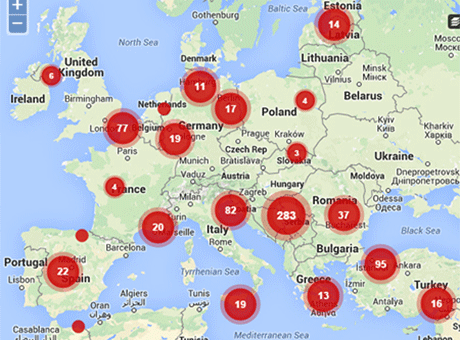
Click on the bubbles to view reports or double-click to zoom in on specific regions. The full site can be accessed at https://mappingmediafreedom.org/
|
17 Sep 2015 | Campaigns, Mapping Media Freedom, mobile, News
Ukrainian President Petro Poroshenko signed a decree on Wednesday 16 September banning at least 38 international journalists and bloggers from Ukraine for one year. The decree, published on the presidential website, says those listed are banned for being “actual or potential threat to national interests, national security, sovereignty and territorial integrity of Ukraine.”
Poroshenko said the people targeted were involved in Russia’s 2014 annexation of Crimea and the current aggression in eastern Ukraine.
“This ban is a serious blow to media freedom,” Index senior advocacy officer Melody Patry said. “There is no explanation whatsoever on what press coverage constitutes an actual or potential threat to national security. We appreciate that the situation in eastern Ukraine is sensitive but preventing journalists from reporting from within the country is not the solution and it’s undermining freedom of information.”
The Committee to Protect Journalists reports that the 34 journalists and seven bloggers named in the ban come from Bulgaria, Estonia, Germany, Hungary, Israel, Kazakhstan, Latvia, Macedonia, Moldova, Poland, Russia, Serbia, Slovakia, Spain, Switzerland and the United Kingdom.
The original list included three BBC media staff members – Moscow correspondent Steve Rosenberg, producer Emma Wells and cameraman Anton Chicherov – who were later removed from the ban list, media reported.
“We cannot accept that kind of censorship”, said Mogens Blicher Bjerregård, president of the European Federation of Journalists. Censorship is never the right answer, even to counter propaganda or to sanction journalists who allegedly crossed the Russian-Ukrainian border illegally. The ban is simply inappropriate. Peace and Development of our democracies need press freedom not banning journalists. We and the international society must firmly urge the Ukraine government to lift immediately the ban on named journalists.”
Over 380 people in total have been banned, including activists and Russian officials.
This measure was added to the Mapping Media Freedom platform, which monitors and map threats and violations to media freedom in Europe, including Ukraine and Russia.
The environment for media freedom in Ukraine has been deteriorating against the backdrop of the conflict in the eastern part of the country, making it one the the deadliest countries for journalists, with at least eight media workers killed since the beginning of 2014.
This statement was updated to reflect the later removal of three BBC journalists from the ban list.
Mapping Media Freedom
Click on the bubbles to view reports or double-click to zoom in on specific regions. The full site can be accessed at https://mappingmediafreedom.org/
|
1 May 2015 | Denmark, European Union, France, Germany, Greece, Hungary, Ireland, Italy, Macedonia, mobile, News, Poland, Spain, Turkey, Ukraine, United Kingdom
As we approach World Press Freedom Day, the right to freedom of expression will again be celebrated as an inalienable European value across the continent — by the public, the media and politicians alike. But to many, this will mean little more than engaging in a well trodden mental routine. We hardly consider the difficulties that freedom of expression faces in practice.
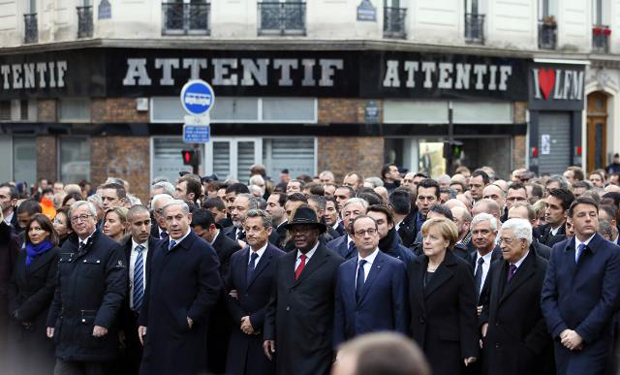
In the first part of 2015, more than a third of journalist killings in the word took place in two European countries; France and Ukraine. If it is true that Europe’s reactions to the Charlie Hebdo attack — the majority of them very emotional — were salubrious, they simultaneously gave rise to ambiguous situations. Many of the leaders that will on 3 May reaffirm their commitment free expression, supported the same message by taking part in the historic march in Paris on 11 January.
But upon seeing Angela Merkel, some were also reminded that Germany continues to treat blasphemy as a crime — as do Denmark, Spain, Poland and Greece, among others. Ireland, whose Enda Kenny was also in attendance, has a constitution which specifically mentions blasphemy and in 2010 enacted a new law against it. All these European countries defend themselves by saying that they do not apply their laws against “blasphemers”. That argument does not carry much weight when it comes to opposing those countries — Saudi Arabia, Iran, various Asian countries — that have tried to turn blasphemy into a universal crime recognised by the UN.
Spain’s Mariano Rajoy too marched in solidarity, but his government has taken steps to promote changes in the penal code that would “represent a serious threat to freedom of information, expression and the press”.
And what was Viktor Orban doing in Paris? The Hungarian president has reunified Hungary‘s public media so as to better bind them to his own party. Despite being the leader of an EU country, Orban has followed Vladimir Putin’s example. In this experimental model, the Andrei Sakharov Center and Museum is no longer ordered to close as it was in the old days, but rather fined 300,000 roubles (€5,000) for failing to register as a “foreign agent”. One day brings an announcement of compulsory registration for bloggers in Russia; another day, harassment against Russian and Hungarian NGOs perceived as “unpatriotic”.
Turkish Prime Minister Ahmet Davutohlu traveled to Paris, only to later label Charlie Hebdo’s post-attack issue a “provocation”. A reminder: Turkey is an EU candidate country where dozens of journalists have been sentenced to prison, and where various internet sites, including those that dared to reproduce some of Charlie Hebdo’s caricatures, have been blocked.
But also present at the march, were various representatives of European journalists — myself included. Just behind the Charlie Hebdo survivors, we carried a banner with the message “Nous sommes Charlie”.
Walking next to me was Franco Siddi, of the Italian National Press Federation. He talked to me about how imprisonment for defamation is still a possibility in Italy, though the European Court of Human Rights has ruled it a disproportionate punishment.
In my home country Spain too, this possibility of imprisonment remains, even if under Spanish jurisprudence freedom of expression consistently prevails over the demands of plaintiffs. In Italy, the situation is the same, yet my Italian colleagues point out that in 2014 alone, 462 journalists in the country were threatened with legal action for alleged acts of defamation. And while the current proposal for reform being considered foresees eliminating the possibility of jail time, it increases the potential fines.
This is not the only potential legal threat facing European journalists. Long before 9/11, there existed a reflexive habit of passing “urgent” laws under security pretexts, as in the UK during the most difficult years of the Northern Ireland conflict. The current model is the United States’ Patriot Act, which has recently been discussed in France. Meanwhile, in Britain and Spain are debating what free expression activists describe as “gag laws”. In Macedonia, the sentencing of the investigative journalist Tomislav Kezarovski to two years in prison under one of these security inspired laws stands out as a warning sign.
Against this worrying backdrop, across Europe journalists, freedom advocates, campaigners and even politicians are standing up for press freedom. When Gvozden Srecko Flego, member of the Parliamentary Assembly of the Council of Europe, recently highlighted the cases of Russia, Ukraine, Turkey and Azerbaijan as particularly problematic, he also suggested a countermeasure. He recommends “organising annual debates […], with the participation of journalists’ organisations and media outlets” in the respective parliaments of each state.
Media concentration, one of the most serious challenges to media pluralism and free expression in Europe, is being tackled. One proposal, which some international bodies have already accepted, would create a “Media Identity Card” requiring owners to publicly identify themselves and thus create an environment of more open and transparent media ownership.
When defending freedom of expression as a European value, we cannot allow ourselves to simply fall in into mental routines. This World Press Freedom Day we need both words and actions.
Paco Audije is a member of the Steering Committee of the European Federation of Journalists (EFJ)
World Press Freedom Day 2015
• Media freedom in Europe needs action more than words
• Dunja Mijatović: The good fight must continue
• Mass surveillance: Journalists confront the moment of hesitation
• The women challenging Bosnia’s divided media
• World Press Freedom Day: Call to protect freedom of expression
This column was posted on 1 May 2015 at indexoncensorship.org
23 Apr 2015 | Azerbaijan Statements, Campaigns, mobile, Statements
Mr Ilham Aliyev
President of the Republic of Azerbaijan
Azerbaijan Avenue 7
1005 Baku
Republic of Azerbaijan
Fax: +994124923543 and +994124920625
Email: [email protected]
Mr President,
We, the undersigned members and partners of the Human Rights House Network (HRHN) and the South Caucasus Network of Human Rights Defenders, are dismayed by the sentences upheld against human rights defender Rasul Jafarov and against human rights lawyer Intigam Aliyev, two prominent and internationally respected voices of the Azerbaijani civil society. We call upon the Azerbaijani authorities, through you, Mr President, to put an end to the unprecedented repression against civil society.
We call upon you to immediately and unconditionally release all human rights defenders, journalists and activists currently detained, including and especially human rights defenders Leyla and Arif Yunus, Rasul Jafarov, Intigam Aliyev and the journalist Khadija Ismayilova. Anar Mammadli must also be released, as his detention is solely due to his non-governmental organisation’s monitoring of elections in the Azerbaijan.
During the summer and fall of 2014 the main leaders of civil society were arrested. Many others decided to flee the country, rather than facing court hearings, of which the outcome is well known in advance. A few others have been forced into hiding.
On 22 April 2015, the Court for Grave Crimes in Baku sentenced Intigam Aliyev to 7 years and 6 months of detention on bogus charges of illegal business, misappropriation, tax evasion, abuse of office and forgery. Although Intigam Aliyev’s defence brought documentation to the court that all his grants were registered, as of the entry into force of such an obligation for NGOs in Azerbaijan, in violation of basic principles in regard to freedom of association as found by the Council of Europe’s Venice Commission. We denounce the sentencing of Intigam Aliyev and believe the charges brought against him are politically motivated, and a direct consequence of his human rights work .
Intigam Aliyev is one of the most widely-respected human rights lawyers in Azerbaijan and leader of the Legal Education Society, an organization that both promotes awareness of the law and provides legal support to individuals and organizations, The Legal Education Society is a member of the Human Rights House Azerbaijan. Intigam Aliyev is also a lawyer active regionally, including by his participation in the Human Rights House Network’s International Law in Advocacy Programme.
Intigam Aliyev has strived for the legal protection of victims of human rights violations for more than 15 years and has to date represented them in proceedings before the European Court of Human Rights in more than 200 cases (around 40 cases are currently awaiting decision). When he was detained, he was defending more than 140 people in the Court. By detaining Intigam Aliyev the Azerbaijani authorities also deprive their citizens the right to appeal and seek justice before the Court.
In detention, Intigam Aliyev’s health condition has deteriorated and remains inadequately addressed by detention authorities. His conditions prior to his pre-trial detention since 8 August 2014 have continuously gotten worse, giving a strong indication that in fact the medication he is receiving in detention only addresses his pain and not his illness. We believe Intigam Aliyev’s detention conditions might have irremediable consequences on his health.
In the backdrop of an unprecedented repression against civil society in Azerbaijan, charges were also brought against many other human rights defenders, journalists and activists in Azerbaijan, either sentenced or held on pre-trial detention, such as Leyla Yunus, and her husband, Arif Yunus, Anar Mammadli, Rauf Mirkadirov and Hilal Mammadov, Tofiq Yaqublu, Ilgar Mammadov, various NIDA activists, as well as investigative journalist Khadija Ismayilova. Charges are also brought against many human rights NGOs, such as the Institute for Reporters’ Freedom and Safety (IRFS) and human rights defenders either forced into hiding, such as IRFS’s leader Emin Huseynov, or have left the country.
On 16 April 2015, the human rights defender Rasul Jafarov was sentenced to 6.5 years imprisonment, also on similar charges as Intigam Aliyev. The court ignored that out of the many so-called “victims” who were interrogated by the court did in fact have no knowledge of any damage supposedly committed by Rasul Jafarov against them. We also denounce the sentencing of Rasul Jafarov and believe the charges brought against him are politically motivated, due to his human rights work.
Rasul Jafarov is a widely respected human rights defender and advocate on the issue of wrongful imprisonment in Azerbaijan. After forming the Human Rights Club in December 2010. He is the initiator of the human rights and democracy campaign “Sing for Democracy,” as well as “Art for Democracy” and later in preparation of the upcoming European Olympic Games to be held in Baku in June 2015, the campaign “Sport for Rights.”
We call upon the Azerbaijani authorities, through you, Mr President, to put an end to the unprecedented repression against civil society in your country. We specifically call upon you to immediately and unconditionally release all above mentioned civil society actors, and drop all charges
held against them.
Yours sincerely,
Human Rights House Azerbaijan:
• Human Rights Centre of Azerbaijan
• Due to the risk of retaliation against Azerbaijani human rights defenders, we decided not to indicate the names of other Azerbaijani NGOs who would be signing this letter.
Barys Zvozskau Belarusian Human Rights House in exile, Vilnius (on behalf of the following NGOs):
• Belarus Watch (ByWatch)
• Belarusian Association of Journalists
• Belarusian Helsinki Committee
• Belarusian PEN Centre
• City Public Association “Centar Supolnasc”
• Human Rights Centre “Viasna”
Human Rights House Belgrade (on behalf of the following NGOs):
• Lawyers Committee for Human Rights YUCOM
Education Human Rights House Chernihiv (on behalf of the following NGOs):
• Chernihiv Public Committee of Human Rights Protection
• Center of Humnistic Tehnologies “AHALAR”
• Center of Public Education “ALMENDA”
• Human Rights Center “Postup”
• Local Non-governmental Youth organizations М’АRТ
• Transcarpathian Public Center
• Ukrainian Helsinki Human Rights Union
Human Rights House Kyiv (on behalf of the following NGOs):
• Association of Ukrainian Human Rights Monitors on Law Enforcement
• Center for Civil Liberties
• Civil Service
• Human Rights Information Center
• Institute of Mass Information
• International Women’s Rights Center
• Kharkiv Human Rights Protection Group
• Social Action Center
• Ukrainian Helsinki Human Rights Union
• Ukrainian Legal Aid Foundation
Human Rights House Oslo (on behalf of the following NGOs):
• Human Rights House Foundation
• Norwegian Helsinki Committee
Human Rights House Tbilisi (on behalf of the following NGOs):
• Georgian Centre for Psychosocial and Medical Rehabilitation of Torture Victims
Human Rights House Voronezh (on behalf of the following NGOs):
• Charitable Foundation
• Civic Initiatives Development Centre
• Confederation of Free Labor
• For Ecological and Social Justice
• Free University
• Golos
• Interregional Trade Union of Literary Men
• Lawyers for labor rights
• Memorial
• Ms. Olga Gnezdilova
• Soldiers Mothers of Russia
• Voronezh Journalist Club
• Voronezh-Chernozemie
• Youth Human Rights Movement
Human Rights House Zagreb (on behalf of the following NGOs):
• APEO/UPIM Association for Promotion of Equal Opportunities for People with Disabilities
• B.a.B.e.
• CMS – Centre for Peace Studies
• Documenta – Centre for Dealing with the Past
• GOLJP – Civic Committee for Human Rights
• Svitanje – Association for Protection and Promotion of Mental Health
Helsinki Foundation for Human Rights (HFHR), Poland
Index on Censorship, United Kingdom
Public Association for Assistance to Free Economy, Azerbaijan
Resource Centre for Human Rights, Moldova
Copies to:
• Office of the Commissioner for Human Rights of the Council of Europe
• Private Office of the Secretary General of the Council of Europe
• Delegation of the Council of Europe in Azerbaijan
• United Nations Special Rapporteur on the situation of human rights defenders
• United Nations Special Rapporteur on the rights to freedom of association and peaceful assembly
• Office for Democratic Institutions and Human Rights of the Organisation for Security and
Cooperation in Europe (OSCE ODIHR)
• Cabinet of Commissioner Johannes Hahn for European Neighbourhood Policy and Enlargement
Negotiations
• Delegation of the European Union in Azerbaijan
• Subcommittee on Human Rights of the European Parliament
• Diplomatic community in Baku, Brussels, Geneva, New York and Strasbourg
• Various ministries of foreign affairs and parliamentary committees on foreign affairs
About the Human Rights House Network (www.humanrightshouse.org)
The Human Rights House Network (HRHN) unites 90 human rights NGOs joining forces in 18 independent Human Rights Houses in 13 countries in Western Balkans, Eastern Europe and South Caucasus, East and Horn of Africa, and Western Europe. HRHN’s aim is to protect, empower and support human rights organisations locally and unite them in an international network of Human Rights Houses.
The Human Rights House Azerbaijan is one of the members of HRHN and served as an independent meeting place, a resource centre, and a coordinator for human rights organisations in Azerbaijan. In 2010, 6’000 human rights defenders, youth activists, independent journalists, and lawyers, used the facilities of the Human Rights House Azerbaijan, which has become a focal point for promotion and protection of human rights in Azerbaijan. The Human Rights House Azerbaijan ceased all its activities following an order of the Ministry of Justice of the Republic of Azerbaijan on 10 March 2011.