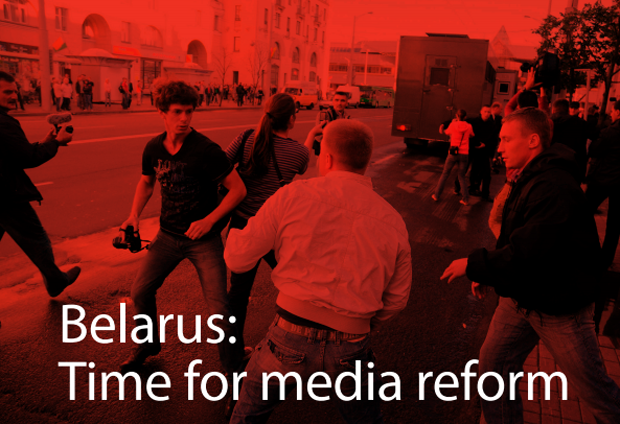
17 Mar 2014 | Volume 43.01 Spring 2014
[vc_row][vc_column][vc_custom_heading text=”In the Spring issue of the magazine, we include a special report, the war of words, on the use of propaganda and censorship during conflicts.”][vc_row_inner][vc_column_inner width=”1/2″][vc_column_text]
This theme seems particularly timely with the current situation in Crimea, where we are seeing classic propaganda techniques being rolled out to rally support for the vote to join Russia. Our special report of 15 articles and essays, starts with WWI where the current use of the term propaganda was invented and looks at poster campaigns, and propaganda journalism in the USA, but our writers, who include Lyse Doucet, David Aaronovitch, Rana Mitter, and serving army officer Ric Cole, also look at WWII, Iraq, Afghanistan and Syria.
[/vc_column_text][/vc_column_inner][vc_column_inner width=”1/2″][vc_single_image image=”80560″ img_size=”large”][/vc_column_inner][/vc_row_inner][vc_column_text]
Natasha Joseph interviews a journalist who worked in South Africa during apartheid, and what it was like to file stories from a newsroom knowing one of your colleagues was a spy; and Scottish journalist John MacLeod reports on a bombing cover-up in Clydebank, near Glasgow, where a huge swath of the town was flattened, and the rest of the country was left completely unaware because of wartime censorship. This Scottish story is still not that well known, even today. Something that illustrates the power of the cover-up during wartime, is the way details of the wartime flu epidemic was kept from millions of people all over the world.
In the other sections of the magazine, Irena Maryniak looks at the rise of racism and nationalism in Hungary; and Konstanty Gebert reports on hate crime and anti-semitism in Poland. The magazine includes two articles about censorship in science, one from Canada and one from the United States.
Also in this issue:
• Samizdat still going: underground newspapers in Belarus
• First extract in English of a controversial Turkish play
• Film fans go head to head on which decade has seen the strongest women’s voices on film. And don’t miss our competition to votes on the decade, and win tickets to a screening at Rich Mix cinema
• How do you feel about propaganda? Take our survey.
[/vc_column_text][/vc_column][/vc_row][vc_row][vc_column][vc_custom_heading text=”SUBSCRIBE” css=”.vc_custom_1481736449684{margin-right: 0px !important;margin-left: 0px !important;border-bottom-width: 1px !important;padding-bottom: 15px !important;border-bottom-color: #455560 !important;border-bottom-style: solid !important;}”][vc_column_text]Index on Censorship magazine was started in 1972 and remains the only global magazine dedicated to free expression. Past contributors include Samuel Beckett, Gabriel García Marquéz, Nadine Gordimer, Arthur Miller, Salman Rushdie, Margaret Atwood, and many more.[/vc_column_text][vc_row_inner][vc_column_inner width=”1/2″][vc_single_image image=”76572″ img_size=”full”][/vc_column_inner][vc_column_inner width=”1/2″][vc_column_text]In print or online. Order a print edition here or take out a digital subscription via Exact Editions.
Copies are also available at the BFI, the Serpentine Gallery, MagCulture, (London), News from Nowhere (Liverpool), Home (Manchester), Calton Books (Glasgow) and on Amazon. Each magazine sale helps Index on Censorship continue its fight for free expression worldwide.
 SUBSCRIBE NOW[/vc_column_text][/vc_column_inner][/vc_row_inner][/vc_column][/vc_row]
13 Feb 2014 | Belarus, News
Join Index at a presentation of a new policy paper on media freedom in Belarus on 19 February, 2014, 15.00 at the Office for Democratic Belarus in Brussels.
This article is the fourth of a series based on the Index on Censorship report Belarus: Time for media reform.
One of the greatest chills on the freedom of expression in Belarus is the disappearance, murder, suspicious suicide and impunity against media workers that has demonstrated the very real physical risks that those who practice independent journalism in Belarus face. Since the beginning of Alexander Lukashenko’s presidency, a number of journalists have been murdered or died in suspicious circumstances to considerable international condemnation. Journalists today inside Belarus still face physical violence and threats. A number of high profile journalists have fled the country to protect their personal safety.
No progress has been made on investigations of the deaths of the journalists Dzmitry Zavadski (disappeared on 7 July 2000), Veranika Charkasava (brutally murdered on 20 October 2004), Vasil Hrodnikau (found dead on 18 October 2005), Aleh Biabenin (found dead on 3 September 2010). The public still has no clear answers over the circumstances of their deaths, nor have any of the perpetrators of these crimes been brought to justice. Zavadski’s body has never been found and instigators of his murder has never been identified and tried; Charkasava’s murderer has never been found and the investigation into the case was suspended; details of Hrodnikau’s and Biabenin’s cases have led their family and colleagues to question official results of the investigations. The European Parliament has called for a full investigation into Biabenin’s death.
“As long as even one journalist is prosecuted or intimidated for critical speech, the whole media community feels threatened and the chilling effect remains,” said the OSCE Representative on Freedom of the Media, Dunja Mijatović, during her official visit to Minsk in June 2013. Unfortunately, physical violence against journalists and preventing them from conducting of their professional duties have become one of the major concerns over the past several years in Belarus.
Detentions of journalists
The constitution of Belarus grants any citizen the right to gather and impart information. Moreover, Article 34 of the Law “On Mass Media” provides for the right of a journalist to be present “in the area of armed conflicts or emergencies, mass actions, in places of other socially important events and transmit information from there.”
Despite of these legal provisions, the arbitrary detention of journalists and the interference into their professional activities continues unabated, especially during street actions by civil society and the opposition. For instance, at least 24 journalists were detained and at least 21 were attacked and injured by the riot police on 19 December 2010 in Minsk while they covered a major rally by the opposition in Independence Square that protested against the results of the presidential election.
Monitoring by the Belarusian Association of Journalists noted at least 265 cases of the detention of journalists in Belarus in 2011-2013.
In 2011 there were 160 of such cases, and at least seven instances of use of physical violence by the police against journalists. The most significant number of detentions happened during the summer of 2011, during peaceful street actions organised by the Revolution Through Social Networks movement. At least 103 instances of detentions of journalists across the country were noted. The arrests were brutal; the police prevented reporters from filming the rallies, in some cases by using excessive force and damaging journalists’ professional equipment. At least 22 journalists who were detained while covering the actions were summoned to courts for alleged “participation in unsanctioned actions”, 13 of them served actual administrative arrests, and the rest were sentenced to fines.
In 2012, 60 cases of detention of journalists, distributors of non-state press and social media activists were noted. In most cases the detentions lasted for 2-3 hours, but in several cases they led to fines and detention for up to 15 days. At least 13 journalists received official warnings of prosecutors’ offices in 2012; most of them were warned for cooperation with foreign media without accreditation. At least four journalists were summoned for interrogation by the KGB.
In 2013 45 instances of journalists’ detentions have been noted as of November. Four of them led to administrative arrests of 3 to 12 days each. Prosecutors’ offices issues at least eight official warnings to journalists for their activities.
Leaders of the Belarusian Association of Journalists, Zhanna Litvina and Andrei Bastunets, met the head of Minsk city police Aliaksandr Barsukou on 23 October 2013 to discuss the issue of the police interference in journalists’ professional activities. During the meeting Barsukou noted the number of detentions of journalists decreased in comparison with 2011-2012. Just a week after the meeting, seven journalists were detained by the police in Minsk while covering the Mourning Marathon, an event to commemorate victims of Stalin’s repressions.
Travel restrictions
Several journalists and media experts were banned for travelling abroad by the authorities of the country in 2012. It became a new form of pressure on independent media community.
Zhanna Litvina, the chairperson of the Belarusian Association of Journalists, Andrei Dynko, the editor of Nasha Niva newspaper, and Mihas Yanchuk, a representative of Belsat TV channel, were denied the right to leave the country. Litvina was not allowed out at the Minsk National Airport; Dynko and Yanchuk were forced to leave trains on the borders with Lithuania and Poland respectively by Belarusian border guards. No legal grounds for such restrictions were provided; the ban was lifted only in September after appeals of the persons affected to courts. Officers of the department of citizenship and migration explained the situation as a software glitch. It is noteworthy that the alleged bug disproportionately affected independent journalists, opposition leaders and civil society activists.
Restrictions of activities of foreign correspondents
The authorities use different methods to restrict the distribution of information about Belarus’ internal situation abroad. Reporters for Belsat TV channel and Radio Racyja, a media operator based in Poland that broadcasts in the Belarusian language, have both been refused official accreditation to operate within Belarus. European broadcasters have also been affected. In March 2012 camera crews of SVT (Sweden) and TV3 (Estonia) television channels were detained in Minsk, despite both having being officially accredited in Belarus.
Several foreign journalists faced obstacles during the September 2012 parliamentary elections. Three hundred fifty foreign reporters were officially accredited to cover the elections, but four journalists from Germany and Sweden were denied entry visas. Two more Swedish journalists, Erik Von Platen and Gustaff Andresson, had to spend 16 hours at the Minsk International Airport before their accreditation was confirmed and their visas were issued. It is unclear what criteria the authorities apply to issue visas for foreign correspondents.
On the same day, 21 September 2012, Amos Roberts, Australian SBS TV journalist, was searched at the customs of the Minsk airport as he was trying to leave Belarus after a week of legitimate work in the country. His professional equipment was confiscated; the procedures of a search and confiscation were not followed. The journalist was allowed to leave the country the following day, but his equipment was not returned to him until one year later, in October 2013.
Physical safety of journalists and impunity remain serious problems that have a chilling effect of media freedom in Belarus. The most acute issue is police interference with journalistic activities and arbitrary detentions of reporters that cover mass street actions. At least 265 cases of the detention of journalists in Belarus in 2011-2013 are noted. The police chiefs are reluctant to recognise and address the problem, despite constant calls from Belarusian and international organisations.
Physical violence against journalists: Recommendations
The practice of arbitrary detention of journalists, including those that cover street actions, should be immediately stopped.
All cases of interference of the police and other state officials into legitimate journalistic activity should be investigated, and those responsible should be brought to account.
Part 1 Belarus: Europe’s most hostile media environment | Part 2 Belarus: A distorted media market strangles independent voices | Part 3 Belarus: Legal frameworks and regulations stifle new competitors | Part 4 Belarus: Violence and intimidation of journalists unchecked | Part 5 Belarus must reform its approach to media freedom
A full report in PDF is available here
This article was published on 13 February 2014 at indexoncensorship.org
11 Feb 2014 | Belarus, News
Join Index at a presentation of a new policy paper on media freedom in Belarus on 19 February, 2014, 15.00 at the Office for Democratic Belarus in Brussels.
This article is the second of a series based on the Index on Censorship report Belarus: Time for media reform.
The present media market started to take shape at the beginning of 1990s as Belarus became an independent state after the Soviet Union disintegrated. Unlike other post-Soviet states, the process of the denationalisation and privatisation of the state media was not in fact ever launched leaving state control and ownership over most of national media. While a number of independent media outlets were established in the 1990s, very few have managed to survive.
Current media are significantly affected by the political and economic situation after the presidential election of December 2010 that was followed by a severe clampdown on political opposition and civil society and periods of financial instability.
The authorities keep tight regulatory and economic control over the news media market. State-run media that are used as means of government propaganda enjoy significant financial support, while independent news media face economic discrimination that makes their position in the market more vulnerable.
Broadcast media
Broadcast media remain the primary source of information for most Belarusians. The overall reach of television is 98.4% of the population aged over 15, and its share in the media advertising market is over 50% of the total. This dominant position of television is the reason the state keeps this sphere under strict control. Most of broadcast media in Belarus are state-owned, and they enjoy significant financial support from the authorities. The state budget of Belarus for 2014 allocated 548 bn roubles (about £34m) for direct support of television and radio.
There are 262 TV and radio stations registered, 178 of them–68% of the total–are owned by the state. There is no formal Public Service Broadcaster (PSB) with an independent board and a commitment to impartiality. Four national channels are owned by the National State Television and Radio Company which also owns five radio channels and five regional TV and radio companies. Two more national channels, ONT and STV, are formally joint stock companies, but they are not publicly listed, and all their founders are state companies.
There is not a single independent national TV channel or a public service broadcaster in the country. Independent broadcast media that operates from abroad face restrictions. For instance, Belsat TV channel, which has been broadcasting in Belarusian from Poland since 2007, has been refused permission to open an official editorial office in Belarus. Belsat’s reporters face constant pressure and are subjected to warnings and detentions.
At the same time, a decision taken in November 2013 to prolong accreditation in Minsk of the editorial office of Euroradio, an independent radio station that also broadcasts in Belarusian from Poland, can be considered as a positive step.
The general process of licensing and frequency allocation in Belarus is complicated, not transparent and is controlled entirely by the government through licensing and frequency allocation processes.
Printed media
Economic leverages are used by the authorities of the country to control the printed news media market in Belarus. While state-owned newspapers have preferences in advertising market and distribution, independent publications fail to enjoy equal conditions, being restricted from distribution systems and advertising. Economic difficulties threaten operations of non-state socio-political newspapers, and thus restrict the access of the audience to independent sources of information.
The majority of printed media – 1,146 out of the total of 1,556 registered in Belarus as of 1 January 2014 – are privately owned. Most of the non-state newspapers are not news publishers but mainly advertising or publications for entertainment. According to BAJ, there are less than 30 socio-political newspapers, both national and regional, in Belarus that are publications with actual news journalism.
There is a significant amount of evidence to suggest that the non-state owned press in Belarus faces economic discrimination. Direct state subsidies to the state-owned printed media in 2014 are projected to be 64 bn roubles (about £4 m). It is claimed by the editors of several non-state newspapers, that the costs of paper and printing for independent newspapers are higher than for state-owned ones.
Another form of direct economic discrimination by the government is the influence of the state over the advertising market. The economy of Belarus is dominated by the state, with 70 per cent of its GDP being the output of state-owned companies. In practice this gives opportunities for the direct interference of the government in the distribution of advertising revenues. It is also the case that there is compulsory subscription to state-owned newspapers, both national and local, for employees of state-owned enterprises and organisations.
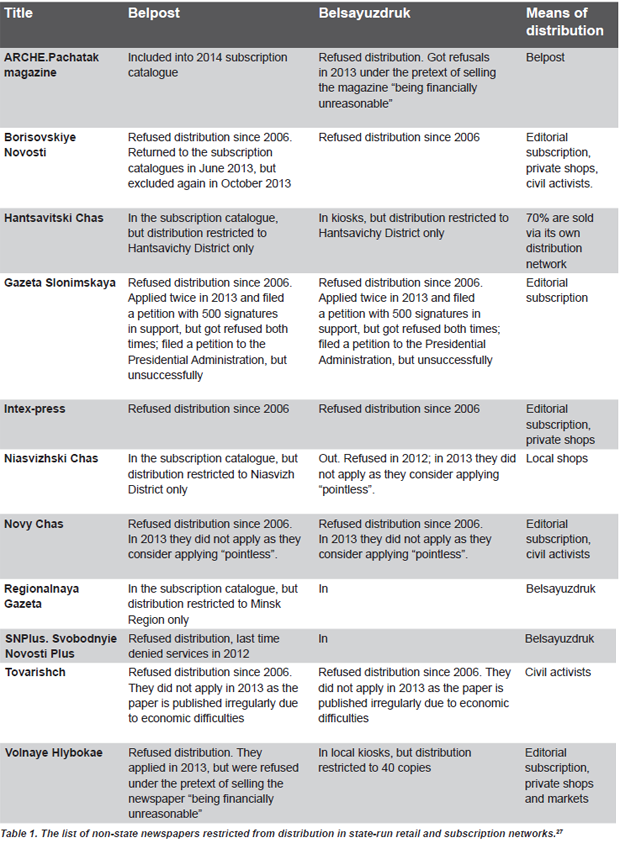
There is direct state intervention in the distribution of independent newspapers, which prevents their sale. At least eleven independent publications face restrictions to their distribution via state-run retail press distribution and subscription networks (Table 1). The distribution ban was imposed on the eve of the presidential election of 2006, when at least 16 independent newspapers were excluded from the subscription catalogue of Belposhta (Belarusian Post) and 19 had their contracts with Belsayuzdruk retail sales system cancelled. Due to the distribution restrictions several of them ceased to exist. Most of those that survived remain barred from state distributors and have had to either develop their own distribution systems or move completely online.
The authorities of the country persistently refuse to acknowledge the problem of distribution restrictions. Dzmitry Shedko, Deputy Minister of Information, wrote to Index request that “non-state media equally with state ones have a free access to state printing facilities and possibilities to distribute their publications through state press distribution structures.” The Deputy Minister points out that the law provides for the freedom of contract, and the authorities cannot interfere with the will of distribution companies to sign contracts with any particular mass media outlet.
In practice the reality is very different. In 2008 two independent newspapers, Nasha Niva and Narodnaya Volia, were returned to state distribution systems as a part of commitments the authorities of Belarus made to the European Union in order to re-launch a political dialogue with the EU. It proves a decision to lift the distribution restriction is political and can be dictated by the state.
Online media
The internet in Belarus is developing extensively, although it cannot still boast of the same audiences as broadcast media. Over 4.85 m Belarusians aged over 15 access the internet–12% more than a year ago–and over 80% of those with access go online every day. Sixty-eight percent of Belarus’s internet users go online through a high-speed broadband connection. The internet remains a relatively free domain of freedom of expression in the country, despite recent attempts by the government to put it under tighter control, as revealed in Belarus: Pulling the Plug report, produced by Index on Censorship in January 2013.
Growing internet penetration and the restrictions traditional media face offline has led to a significant development of online news media. For instance, several independent publications that stopped issuing printed versions due to distribution restrictions now only exist as websites. This is the case with Belorusskaya Delovaya Gazeta, once one of the leaders of non-state press, Salidarnasc or Khimik regional newspaper. Online versions of several existent newspapers reach a larger audience that their printed versions.
In general, independent online publications enjoy significantly greater popularity among internet users than pro-regime websites of state-run media.
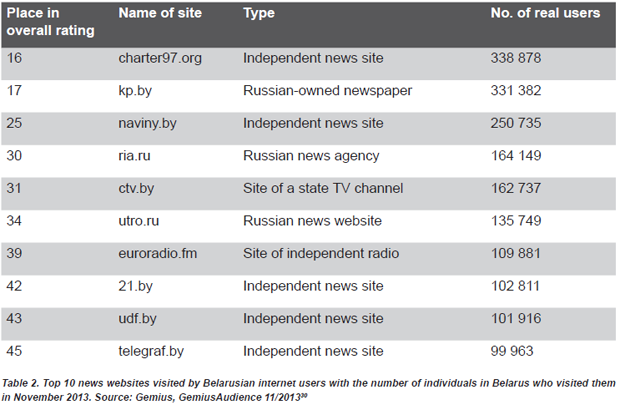
This table represents online news publications only, but does not include the news sections of larger internet portals. It should be noted that they are much more popular then dedicated news publications. For instance, the news section of the largest Belarusian portal TUT.BY is visited by about 1 m Belarusians aged over 15 monthly. News sections of major Russian portals Mail.ru and Yandex.ru are ranked 2nd and 3rd as sources of online news for visitors from Belarus.
The two important trends of Belarus’s online news market are:
• Dedicated news websites are not the most popular online destinations for Belarusians;
• Russian websites have a significant market share in terms of Belarusian audience.
The top 20 news publications have a joint reach of no more than 25% of the total number of Belarusians online. If news sections of major portals are taken into consideration, this share is still around 45%. At the same time, Mail.ru, a Russian portal that is the most popular website among the Belarusian audience, has an audience share of 61.7% alone. Users appear to favour reading news on portals, where they can get other services and on news aggregators.
Social media sites are visited by 72.5% of Belarusian internet users, with Russian Odnoklassniki.ru and Vkontakte leading in this group as well. Four of the six most popular websites in Belarus are Russian portals or services.
There are serious limitations to the development of the online news media market. This is not due to government restrictions, but primarily due to economic factors. The total annual volume of the online advertising market in Belarus in 2013 is estimated to be $10.5 million US dollars. Despite 50% growth to 2012, Belarus still has one of the lowest advertising expenditure budgets per internet user in Europe. The market is very much dominated by its leaders, including Russian media companies that have significant resources to expand and currently enjoy a significant market share.
Case study: State and non-state press: Different media realities
Index on Censorship in cooperation with Mediakritika.by, a Belarusian project dedicated to analysing and monitoring the national media landscape, conducted field research into the content published by state-owned and independent media (that is privately owned media that is free from political direction from the president and government). The research found clear differences between editorial policies of the media based on their ownership including the topics they cover and their approaches to coverage. The difference was particularly noticeable during major political campaigns, such as elections.
The research looked at the content of six Belarusian media outlets, analysed as presented at their websites in October 2013. They are two leading information agencies, state-owned BELTA and privately owned BelaPAN (presented online as Naviny.by), and four national newspapers, state-owned Sovetskaya Belorussiya (SB) and Zviazda, and independent Narodnaya Volia (NV) and Nasha Niva (NN).
The content was analysed in terms of presence of several specific topics (quantitative) and the way they were approached by the media (qualitative). The table below represents the number of articles covered or mentioned by the specified topics from the respective media outlets in October 2013:
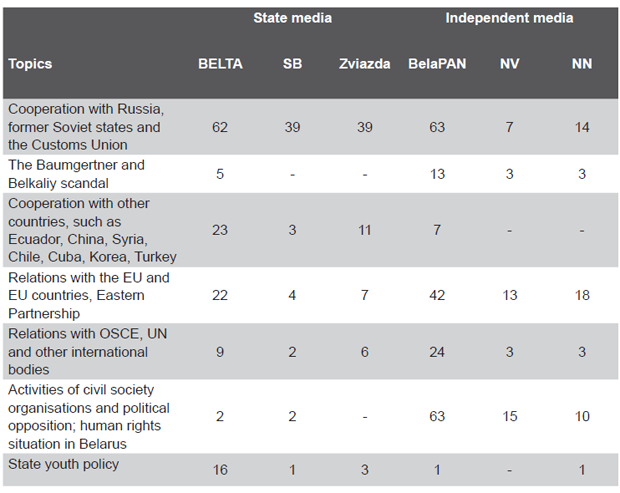
On the first category, the coverage of relations with states from the former Soviet Union and the creation of a Customs Union (between Russia, Belarus and Kazakhstan) which is part of the official foreign policy of Belarus, the state news agency BELTA dedicates significant coverage. BELTA also gives significant coverage to successful foreign policy partnerships by the Ministry of Foreign Affairs and countries in South-East Asia and Latin America. The state media’s significant coverage of the Customs Union and relations with Russia is not matched by coverage of Belarus – EU relations. The analysis found there was little coverage of foreign policy analysis except the opinions of state officials.
The independent media also pays significant attention to the Russian – Belarusian relations, but there is significantly more coverage of Belarusian relations with the EU and other international institutions and organisations. For example, the number of news items on the “eastern” and “western” vectors produced by BelaPAN is almost the same; BELTA pays twice more attention to ex-Soviet countries, Russia first of all, than to cooperation with the West.
Even more dramatic differences are noted in the way state and independent media cover domestic politics. Within the state media politics is associated with (and consists of little more than) the statements and public speeches of the President. State media outlets even have “President” as a separate news section. BELTA’s “President” section, for instance, had more than 80 news items on activities and statements of the head of the state in October 2013.
The most significant difference between the state-owned media and the privately owned media is that there is almost no mention of the activities of the political opposition, while the independent media provides significant coverage of the activities of opposition political parties but also independent trade unions, civil society organisations and activists.
Human rights issues or repressive measures taken by the authorities are widely covered by the independent media. As can be seen in the table, the state media almost entirely ignores these issues. While the recent scandal with Vladislav Baumgertner, the CEO of the Russian Uralkaliy company, who was arrested in Minsk,34 generated significant headlines in the independent media in Belarus – and the media in Russia as well – it was hardly covered by the Belarusian state media; their coverage was reduced to quotes from President Lukashenko on the matter.
There have been no visible improvements of the situation with traditional news media since 2009 in Belarus. The state keeps dominating the broadcast media market and preserves tight control over printed publications. State-owned media are used as a tool for government propaganda, while independent socio-political press faces discrimination that limits their operational capacity and thus restricts the development of free and pluralistic media in the country. The internet re-shapes the news media market as it provides new opportunities for free flow of information and ideas, but its full-scale development as a free speech domain is hindered by economic peculiarities and attempts of state regulation.
Belarus media landscape: Recommendations
All forms of economic discrimination against non-state independent press should be eliminated, in particular:
• independent publications should be treated equally by the state system of press distribution and Belposhta subscription catalogues;
• the state has a pro-active duty to protect and promote freedom of expression and so should investigate anti-competitive practices including the charging of unequal prices for paper and the distribution services for publications for different types of ownership.
Reforms of the Belarusian media field should be launched, including de-monopolising of the electronic media, introducing public service media and creating a competitive media market. The outline of these reforms should result from a dialogue with professional community and civil society of the country.
Part 1 Belarus: Europe’s most hostile media environment | Part 2 Belarus: A distorted media market strangles independent voices | Part 3 Belarus: Legal frameworks and regulations stifle new competitors | Part 4 Belarus: Violence and intimidation of journalists unchecked | Part 5 Belarus must reform its approach to media freedom
A full report in PDF is available here
This article was published on 12 February 2014 at indexoncensorship.org
10 Jan 2014 | Digital Freedom, Europe and Central Asia, European Union, News

(Illustration: Shutterstock)
This article is part of a series based on our report, Time to Step Up: The EU and freedom of expression
The EU has made a number of positive contributions to digital freedom: it plays a positive part in the global debate on internet governance; the EU’s No-Disconnect Strategy, its freedom of expression guidelines and its export controls on surveillance equipment have all be useful contributions to the digital freedom debate, offering practical measures to better protect freedom of expression. Comparatively, some of the EU’s member states are amongst the world’s best for protecting online freedom. The World Wide Web Foundation places Sweden at the top of its 2012 Index of internet growth, utility and impact, with the UK, Finland, Norway and Ireland also in the top 10. Freedom House ranks all EU member states as “free”, and an EU member state, Estonia, ranks number one globally in the organisation’s annual survey, “Freedom in the World”. But these indices merely represent a snapshot of the situation and even those states ranked as free fail to fully uphold their freedom of expression obligations, online as well as offline.
As the recent revelations by whistleblower Edward Snowden have exposed, although EU member states may in public be committed to a free and open internet, in secret, national governments have been involved in a significant amount of surveillance that breaches international human rights norms, as well as these governments’ own legal commitments. It is also the case that across the EU, other issues continue to chill freedom of expression, including the removal or takedown of legitimate content.
The EU’s position on digital freedom is analysed in more detail in Index on Censorship’s policy paper “Is the EU heading in the right direction on digital freedom?” The paper points out that the EU still lacks a coherent overarching strategy and set of principles for promoting and defending freedom of expression in the digital sphere.
Surveillance
Recent revelations by former US National Security Agency (NSA) whistleblower Edward Snowden into the NSA’s PRISM programme have also exposed that mass state surveillance by EU governments is practised within the EU, including in the UK and France.
Mass or blanket surveillance contravenes Article 8 (the right to respect for private and family life) and Article 10 (the right to freedom of expression) of the European Convention on Human Rights. In its jurisprudence, the European Court of Human Rights has repeatedly stated that surveillance, if conducted without adequate judicial oversight and with no effective safeguards against abuse, will never be compatible with the European Convention.[1]
This state surveillance also breaches pledges EU member states have made as part of the EU’s new cybersecurity strategy, which was agreed in February 2013 and addresses mass state surveillance. The Commission stated that cybersecurity is predominantly the responsibility of member states, an approach some have argued gives member states the green light for increased government surveillance. Because the strategy explicitly states that “increased global connectivity should not be accompanied by censorship or mass surveillance”, member states were called upon to address their adherence to this principle at the European Council meeting on 24th October 2013. The Council was asked to address revelations that external government surveillance efforts, such as the US National Security Agency’s Prism programme, undermining EU citizens’ rights to privacy and free expression. While the Council did discuss surveillance, as yet there has been no common EU position on these issues.
At the same time, the EU has also played a role in laying the foundations for increased surveillance of EU citizens. In 2002, the EU e-Privacy Directive introduced the possibility for member states to pass laws mandating the retention of communications data for security purposes. In 2006, the EU amended the e-Privacy Directive by enacting the Data Retention Directive (Directive 2006/24/EC), which obliges member states to require communications providers to retain communications data for a period of between six months and two years, which could result in member states collecting a pool of data without specifying the reasons for such practice. A number of individual member states, including Germany, Romania and the Czech Republic, have consulted the European Convention on Human Rights and their constitutions and have found that the mass retention of individual data through the Data Retention Directive to be illegal.
While some EU member states are accused of colluding in mass population surveillance, others have some of the strongest protections anywhere globally to protect their citizens against surveillance. Two EU member states, Luxembourg and the Czech Republic, require that individuals who are placed under secret surveillance to be notified. Other EU member states have expanded their use of state surveillance, in particular Austria, the UK and Bulgaria. Citizens of Poland are subject to more phone tapping and surveillance than any other citizens in the European Union; the European Commission has claimed the police and secret services accessed as many as 1,300,000 phone bills in 2010 without any oversight either by the courts or the public prosecutor.
Internet governance
At a global level the EU has argued for no top-down state control of internet governance. There are efforts by a number of states including Russia, China and Iran to increase state control of the internet through the International Telecommunication Union (ITU). The debate on global internet governance came to a head at the Dubai World Conference on International Telecommunications (WCIT) summit at the end of 2012 which brought together 193 member states. At the WCIT, a number of influential emerging democratic powers aligned with a top-down approach with increased state intervention in the governance of the internet. On the other side, EU member states, India and the US argued the internet should remain governed by an open and collaborative multistakeholder approach. The EU’s influence could be seen through the common position adopted by the member states. The European Commission as a non-voting WCIT observer produced a common position for member states that opposed any new treaty on internet governance under the UN’s auspices. The position ruled out any attempts to make the ITU recommendations binding and would only back technology neutral proposals – but made no mention of free expression. The absence of this right is of concern as other rights including privacy (which was mentioned) do not always align with free speech. After negotiations behind closed doors, all 27 EU member states and another 28 countries including the US abstained from signing the final treaty. That states with significant populations and rising influence in their regions did not back the EU and leant towards more top-down control of the internet should be of significant concern for the EU.
Intermediate liability, takedown and filtering
European laws on intermediate liability, takedown and filtering are overly vague in defining what constitutes valid and legitimate takedown requests, which can lead to legal uncertainty for both web operators and users. Removal of content without a court order can be problematic as it places the content host in the position of judge and jury over content and inevitably leads to censorship of free expression by private actors. EU directorate DG MARKT[2] is currently looking into the results of a public consultation into how takedown requests affect freedom of expression, among other issues. It is expected that the directorate will outline a directive or communication on the criteria takedown requests must meet and the evidence threshold required, while also clarifying how “expeditiously” intermediaries must act to avoid liability. A policy that clarifies companies’ legal responsibilities when presented with takedown requests should help better protect online content from takedown where there is no legal basis for the complaint.
The EU must take steps to protect web operators from vexatious claims from individuals over content that is not illegal. Across the EU, the governments of member states are increasingly using takedown requests. Google has seen a doubling of requests from the governments of Germany, Hungary, Poland and Portugal from 2010-2012; a 45% increase from Belgium and double-digit growth in the Netherlands, Spain and the UK. Governments are taking content down for dubious reasons that may infringe Article 10 rights of the ECHR. In 2010, a number of takedown requests were made in response to ‘”government criticism” and four in response to “religious offence”. A significant 8% of takedown requests were in response to defamation offences. With regard to defamation charges, it must be noted that the public interest is not protected equally across all EU countries (see Defamation above).
Although corporate takedown is more prevalent than state takedown, particularly in the number of individual URLs affected, the outcome of the DG MARKT consultation must be to address both vexatious state and corporate takedown requests. The new communication or directive must be clearer than the EU e-Commerce directive has been with respect to the responsibility of member states. While creating a legal framework that was intended to protect internet intermediaries, the EU e-Commerce directive has failed to be entirely effective in a number of high-profile cases. EU member states use filters to prevent the distribution of child pornography with questionable effectiveness. However, filters have not been used by states to block other content after a Court of Justice of the European Union ruling stated EU law did not allow states to require internet service providers to install filtering systems to prevent the illegal distribution of content. The Court made it clear at the time that such filtering would require ISPs to monitor internet traffic, an infringement under EU law. This has granted European citizens strong protections against systematic web filtering on behalf of states. There continue to be legal attempts to force internet intermediaries to block content that is already in the public domain. In a recent case, brought by the Spanish Data Protection authority on behalf of a complainant, the authority demanded that the search engine Google remove results that pointed to an auction note for a reposessed home due to social security debts. The claimant insisted that referring to his past debts infringed on his right to privacy and asked for the search results to be removed. In June 2013, the Advocate General of the European Court of Justice decided Google did not need to comply to the request to block “legal and legitimate information that has entered the public domain” and that it is not required to remove information posted by third parties. Google has estimated that there are 180 cases similar to this one in Spain alone. A final decision in the case is expected before the end of this year, which could have profound implications for intermediate liability.
[1] In Liberty v. UK (58243/00) the ECHR stated: “95. In its case-law on secret measures of surveillance, the Court has developed the following minimum safeguards that should be set out in statute law in order to avoid abuses of power: the nature of the offences which may give rise to an interception order; a definition of the categories of people liable to have their telephones tapped; a limit on the duration of telephone tapping; the procedure to be followed for examining, using and storing the data obtained; the precautions to be taken when communicating the data to other parties; and the circumstances in which recordings may or must be erased or the tapes destroyed”; A. v. France (application no. 14838/89), 23.11.1993: found a violation of Article 8 after a recording was carried out without following a judicial procedure and which had not been ordered by an investigating judge; Drakšas v. Lithuania, 31.07.2012, found a violation of Article 13 (right to an effective remedy) on account of the absence of a judicial review of the applicant’s surveillance after 17 September 2003.
[2] The Internal Market and Services Directorate General