8 Jan 2013 | Awards
Hillsborough Family Support Group: UK lobbying group
 For more than 20 years, the Hillsborough Family Support Group lobbied the UK government for a second investigation into the Hillsborough disaster, the human crush at the Sheffield Wednesday stadium, which claimed 96 lives in 1989.
The group, set up by families who had lost loved ones in the disaster, worked tirelessly to keep the case open and to make public information that had been suppressed by the authorities following the disaster. This included the alteration of 164 police statements, 116 of them to delete or change reports, as police sought to shift the blame on to the victims. Their years of effort won the group an Amnesty ‘Long Walk’ award.
Families were integral to a process that focused on finding and publishing documents, rather than a judicial inquiry-style cross-examination of witnesses.
James Jones, the Anglican bishop of Liverpool, who chaired an independent investigation panel into the case, told the Financial Times: “The documents speak for themselves.”
Their work has promoted freedom of expression in the UK by challenging the police cover up and persevering in their campaign for the truth behind the disaster. Following the publication of the independent panel’s report in September 2012, the HFSG has called for fresh inquests to be held and for criminal prosecutions to be brought against those responsible both for the deaths and for perverting the course of justice.
As a result of their combined efforts, the Independent Police Complaints Commission has launched an investigation into police action following the disaster. In December, a high court accepted the attorney general’s application to quash the verdict of a disputed 1990 enquiry, opening the way for new inquests to take place.
Malala Yousafzai, Pakistani education campaigner
 15 year old Pakistani schoolgirl Malala Yousafzai has received global attention for her courage in standing up to the Taliban and her defence of girls’ education. Yousafzai first came to attention when, at the age of 11, she wrote a pseudonymous diary for BBC Urdu, describing the Taliban’s closure of her school in the city of Mingora.
The closure followed the destruction of more than 100 schools in the district. Later in 2009, a journalist and filmmaker from the New York Times made a film about Yousafzai and her struggle to keep up her education. The same year, she began to make public appearances including on television, to advocate for girls’ education.
In October 2012, a Taliban gunman shot Yousafzai in the head and chest for her activism, as she was returning home from school in Pakistan’s Swat district. After receiving life-saving surgery in Pakistan, she was flown to a Birmingham hospital for specialist medical care. She was released in January but will return to undergo cranial reconstruction surgery.
Yousafzai’s rise in prominence has been rapid. In 2011, she chaired a session of the Unicef-supported Child Assembly in Pakistan’s Swat district, was nominated for the International Children’s Peace Prize by Bishop Desmond Tutu and won Pakistan’s National Youth Peace Prize. Following the attempt on her life, in November 2012, more than 60,000 people called for her to be awarded the Nobel peace prize.
In 2012, Yousafzai was named by Foreign Policy magazine on its 2012 list of top global thinkers and nominated for Time magazine’s Person of the Year.
Ales Bialiatski, Belarusian human rights defender
 Ales Bialiatski is a prominent human rights defender in Belarus. As chairman of the Viasna Human Rights Centre and vice president of the International Federation for Human Rights, he dedicated his life to helping victims of human rights until his imprisonment in August 2011. Bialiatski was sentenced to four and a half years for alleged tax evasion.
A defender of freedom of expression and human rights since Soviet days, when he led efforts to memorialise Belarusian victims of Stalin’s purges, Bialiatski founded the human rights NGO Viasna in Minsk in 1996 to provide financial and legal aid to prisoners of conscience and their families.
The vice president of the International Federation for Human Rights, his work was honoured internationally several times before his arrest. Bialiatski was jailed for using money in personal bank accounts in Lithuania and Poland to support Viasna’s human rights work in Belarus. The organisation was unable to register in Belarus, and therefore unable to open a bank account there.
The Minsk authorities claimed he had been tried and jailed lawfully. In December 2012 a UN Working Group rejected this position and ruled that Bialiatski was in fact being arbitrarily detained by the government in contravention of UN Human Rights conventions and that he should be immediately released and awarded compensation.
Bialiatski’s arrest was part of an on-going crackdown against critics of President Alexander Lukashenko, known as Europe’s last dictator. Following his disputed re-election in December 2010, seven opposition candidates were arrested.
Meanwhile freedom of expression continues to be severely restricted in Belarus. Lukashenko’s regime has passed several laws to muzzle critics, including one to ban silent protests and even clapping in the streets.
Girifna, Sudanese youth movement
 Girifna, a Sudanese youth movement calling for non-violent resistance, has been taking the country by storm. The group, whose name comes from the Arabic for “We are fed up”, was set up by university students in October 2009 to encourage their peers to vote in the 2010 election.
Combining demands for freedom of association with monitoring and information campaigns, members distribute information about human rights violations and organise peaceful protests.
Girifna stands apart not just because of the age of its members but also its ethnic diversity.
Though women’s voices are widely suppressed in Sudan, they play an important role in Girifina’s campaign and information work. In July 2012, mothers, daughters and sisters marched alongside each other as part of the Kandake Protest (the Protest of Strong Women). As well as traditional methods of campaigning such as leafleting and organising youth forums on issues of social justice, Girifna uses the power of the internet to spread its message.
One of the group’s most successful campaigns involved posting the testimony of a woman who was kidnapped and gang-raped by members of the security forces on YouTube – an unprecedented move in a country where speaking out about rape is considered shameful. But Girifna’s actions have not been without repercussions. Around 2,000 people were arrested following the June protests with detainees held incommunicado and without access to lawyers. Many members of the group have been arrested, detained, tortured and sexually assaulted.
Girifna has been targeted by the Sudanese authorities following a wave of demonstrations that began in June 2012. Several members of Girifna have been detained without being able to speak to their families or lawyers. Some say they were tortured in detention. Despite this attempt to silence them, Girifna continue to distribute information and organise activities, including peaceful protests calling for the respect and protection of human rights in Sudan.
3 Dec 2012 | Digital Freedom, News, Volume 41.04 Winter 2012

It’s late January 2012. Governments all over the world are considering signing up to a new US-led trade proposal intended to curtail copyright violation, the Anti-Copyright Trade Agreement (ACTA). There have been widespread protests, on and offline: the loose-knit collective of activists, hackers and internet denizens of all stripes known as ‘Anonymous’ believe ACTA represents an attempt by governments to limit and control the core freedoms of the internet, in particular the massive cultural exchange of ideas and information made possible by file-sharing online.
In Poland, the agreement has already been signed off; all that is needed for it to be adopted into law is a majority vote in parliament. The government website is offline, taken down by a distributed denial of service (DDoS) attack launched by Anonymous, which sends a message to politicians who are considering voting in favour. By the final week of January, over 10,000 people gather in Krakow in a last-ditch protest to influence the vote.
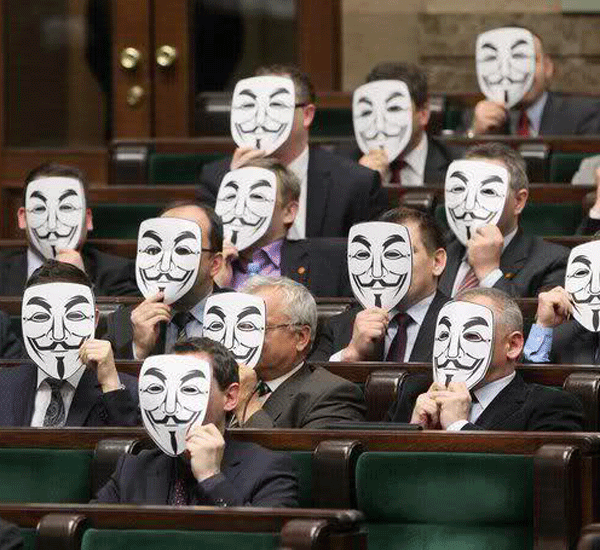
Members of the Palikot Movement Party protest against the ratification of the Anti-Counterfeiting Trade Agreement
And then something unexpected happens: on 26 January 2012, while casting their votes in parliament, some members of the Polish government conceal their faces with paper Guy Fawkes masks. The mask, by now the signature icon for Anonymous, has become common protest regalia among rabble-rousers across the globe, from Egypt’s Tahrir Square to London’s Occupy protests. But this is the first case of public servants adopting the symbol. The image is circulated far and wide on social media platforms. Although Polish politicians used it to launch a specific protest against ACTA, the gesture and its photographic memorialisation worked in a much broader capacity to legitimate Anonymous. ‘These parliamentarians were wearing Anonymous Guy Fawkes masks,’ one Anonymous activist blogged, ‘while the parliament’s website was down due to DDoS by Anonymous. We can’t emphasise that point enough – this is a game-changer.’
Less than a month later a very different image of Anonymous was circulated. On 21 February 2012, the Wall Street Journal reported that General Keith Alexander, the director of the United States National Security Agency (NSA), had briefed officials at the White House in secret meetings, claiming Anonymous ‘could have the ability within the next year or two to bring about a limited power outage through a cyberattack’. So only weeks after the ‘game changer’, the group was described as an imminent and credible threat.
The ‘ability’ to bring about a power outage was undefined. Could it mean that hackers had already acquired passwords that would give them access to power facilities? Or was the warning based on information supplied by an informant who had been working with Anonymous? Either way, General Alexander’s claims were frightening and bold, as well as vague. An attack on the power grid systems would cause havoc and potentially even threaten lives.
It is unlikely that we will ever find out whether the NSA assessment was based on credible intelligence or whether it was simply meant to smear and discredit Anonymous. Further news reports quoted activists and security experts and dismissed NSA claims as ‘fear-mongering’. The group, for all its varied tactics, both legal and illegal, has to date never been known to publicly call for such an attack – and there is no evidence to suggest that it would so much as consider it. A tactic like this would be very out of character for the collective, which, though often subversive, generally conforms to ethical norms and defends civil liberties.
While Anonymous has never occupied a controversy-free place on the world stage, by February 2012 it began to be portrayed as an open source brand of radical protest politics and not necessarily as hooligans hell-bent on unleashing extremist, chaotic acts like taking down power grids. More significantly, while the name has been used to pull together a range of unrelated causes, from environmental rights to snuffing out paedophilia rings, Anonymous activists are most effective and forceful when fighting censorship.
With campaigns like Operation Payback, which targeted corporations like MasterCard when it stopped providing services to WikiLeaks, OpTunisia, which responded to Tunisian government tactics against protesters and journalists, and OpJapan and OpMegaupload, launched in response to proposed copyright legislation, it is when Anonymous activists defend the internet’s core freedoms and expose the shadowy workings of state and corporate surveillance that it has the most impact. The NSA news story about the exigent threat from Anonymous failed to gain traction in the public consciousness. Perhaps it would have if it had come earlier, for instance between May and July 2011, at the height of attacks led by Lulzsec.
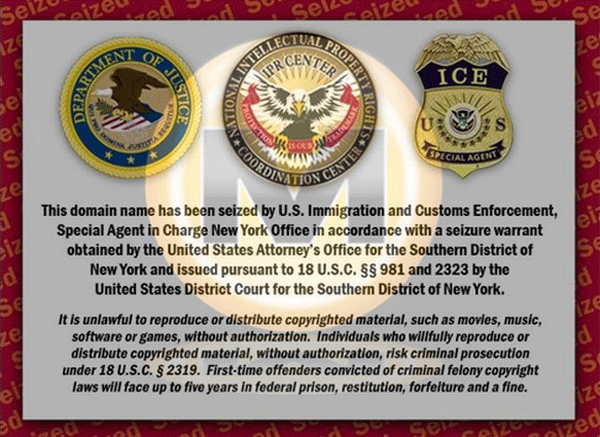
Anonymous launched Operation Megaupload
In contrast to most Anonymous actions, Lulzsec, a break-away hacker group, acted whimsically, its hacks not always tethered to a political issue. Lulzsec sometimes hacked to make a political statement and, in other instances, for lulz, internet slang for laughs. During this period, media attention, which was colossal, was most heavily focused on Anonymous as hackers rather than as a general protest group. Activities under the Anonymous banner, such as those of Lulzsec, show that even though Anonymous has gained a measure of respect because it champions free speech and privacy causes, it is also notorious for its irreverent and controversial approach to dissent.
To be sure, most of its activities are legal, but a small subset of tactics – such as DDoS attacks and hacking – are illegal, a criminal offence under all circumstances. These tactics also score the most headlines. Some, like ‘doxing’ (the leaking of personal, sensitive information, such as social security numbers and home addresses), reside in a legal grey zone because mined information is found on publicly accessible websites. During the course of a single operation different participants might deploy all three modes – legal, illegal and legally grey tactics.
Take Operation Bart, in August 2011. Anonymous focused on getting the word out when San Francisco Bay Area Rapid Transit (BART) officials disabled mobile phone reception on station platforms to thwart planned anti-police brutality protests. Soon after, Anonymous helped organise street demonstrations. But a couple of individuals also hacked into BART’s computers and released customer data in order to garner media attention – at least that’s how one participant explained the incident to Amy Goodman on television and radio programme Democracy Now. Someone also found a racy, semi-nude photo of BART’s official spokesperson Linton Johnson on his personal website, which was then republished on the ‘bartlulz’ website with considerable fanfare, along with the brazen rationalisation: ‘if you are going to be a dick to the public, then I’m sure you don’t mind showing your dick to the public.’
During the course of an operation, vulnerability and weakness is often identified and exploited. These sorts of actions provoke controversy (even within Anonymous) and also find their way into headlines, boosting the group’s public profile. At times, members of the loose collective are purposely deceitful and propagate false information about their activities. This can be a tactic for self-protection in some cases, and in other cases an antic to coax headlines out of the media, which can be somewhat enamoured with hacking.
Antisec, one of the more well-known hacker groups affiliated with Anonymous, might claim an exploit without having actually been involved in the activity. Hackers will often rely on botnets – networks of compromised computers – to momentarily knock a website offline, but won’t advertise this fact in press releases. Between 10 and 11 September 2012, for instance, Antisec claimed to have procured 12 million unique device identification numbers from Apple iOS devices by hacking into an FBI agent’s laptop computer. As it turns out, while the identification numbers were verified, the source turned out to be an iPhone and iPad app developer, Blue Toad. Because tactics range from the frivolous to the controversial to the illegal and because it has been known to generate hype around its own activities, it can be easily targeted itself. Obfuscation and deceit contributes to Anonymous’s mystique and its power, but also makes it vulnerable to misinformation campaigns spread by others.
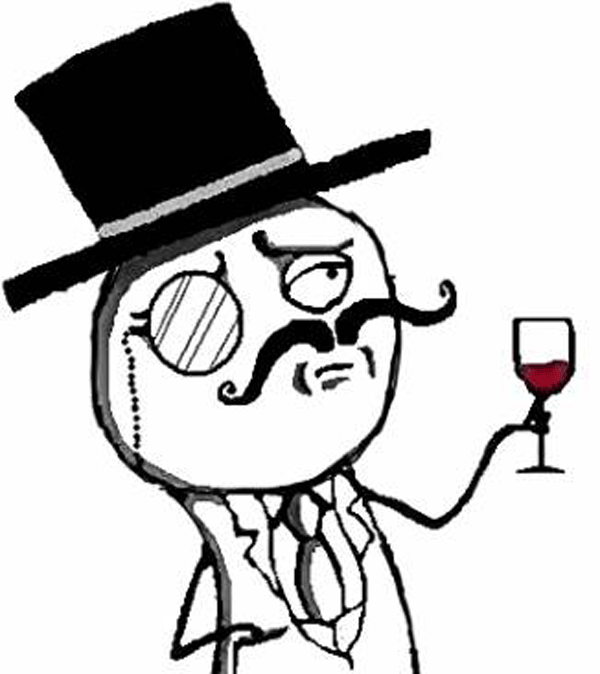
Antisec – One of the more well-known hacker groups affiliated with Anonymous
The biggest lesson that can be learned from Anonymous is that the internet will judge – often quite swiftly – the actions of individuals, corporations and governments. And by the internet I mean the countless hackers and geeks from São Paulo to Sydney who understand how the web works, a smaller class who know how to subvert routers and protocols, and a larger number who will rally when the internet and values associated with it are in danger.
This is not to say that every geek and hacker supports Anonymous. In fact, many rather dislike it or its controversial tactics, such as DDoS; some hackers are resolute and unyielding in their view that DDoS is a species of censorship in itself. There are also many different ways to defend the internet, such as writing open source software or joining the Pirate Party. Anonymous is a distinct, emerging part of this diverse and burgeoning political landscape. Its real threat may lie not so much in its ability to organise cyberattacks but in the way it has become a beacon, a unified front against censorship and surveillance.
It might be best thought of as the irascible and provocative protest wing of the internet’s nascent free speech and privacy movement. Though it works to publicise specific issues at the most inconvenient time for the individual, group or company being exposed, it also brings into sharp focus an important trend, dramatising the value of privacy and anonymity in an era where both are rapidly eroding.
Anonymous, of course, champions anonymity, and this is echoed in both the iconography associated with it and its ethical codes. Seeking individual recognition and especially fame is taboo, for example; you are expected to do work for the team, not for one’s own personal benefit or status. The movement, therefore, provides a rare countermeasure in deeds, words and symbols against a world that encourages people to reveal their lives, where the internet remembers everything about us, where our histories are permanently stored in search indexes and government databases – and at a time when governments’ ability to surveil its citizens has grown exponentially thanks to low-cost, ubiquitous digital technologies and new public-private partnerships.
However explosive Anonymous is today, its continued presence on the world stage is certainly not guaranteed to last. It is plagued by infighting, fragmentation, as well as brand fatigue. Paranoia exploded in spring 2012 after the news broke that Hector Xavier Monsegur, known more commonly by his hacker handle ‘Sabu’, had been exposed as an FBI informant. Most troubling for its long-term survival is government crackdown: since summer 2011, over 100 alleged participants have been arrested around the globe, from Romania, Turkey, Italy, the UK, the US, Chile and Germany. But even if the loose-knit collective fades away, irreverent political protest on the internet is unlikely to end.
Since 2008, when individuals started to organise diverse collective actions under the banner of Anonymous, a living model was created, demonstrating to the world what a radical politics of dissent on the internet looks like. Even if Anonymous was to vanish, its history, exploits and propaganda material are here to stay; there will likely be others — in different forms and with distinct twists — who will take its place.
What is a little less clear is what will eventually become of freedom of expression online, given the increasing capabilities for surveillance, censorship and control all over the world. Is Anonymous merely the party at the funeral of online freedom? Or does it represent the irreverent clowns, rabble rousers, and tricksters who are keeping the reaper at bay and enabling others, from protesters on the street to elected representatives in parliament, to join the raucous political carnival and challenge threats to personal privacy and freedom?
Gabriella Coleman is Wolfe Chair in Scientific and Technological Literacy at the Department of Art History and Communication Studies at McGill University. She tweets from @BiellaColeman
25 Oct 2012 | News
Journalist Andrzej Poczobut is getting ready to go to prison — again. He faces criminal charges for libeling Belarus president Alexander Lukashenko. Prosecutors claim that more than 20 articles Poczobut wrote for Belarus websites Charter97.org and Belaruspartizan.org are defamatory. He was arrested on 21 June and his flat was searched. His computers were confiscated, and he spent ten days in detention before being bailed.
Poczobut, who was fined and jailed in 2011 for taking part in protests deemed illegal by the Belarus authorities, believes there is almost no chance he will remain free because he was convicted of libeling the president in July 2011 and given a three-year suspended jail sentence.
“A year ago, I saw a huge file of my articles during an interrogation at the prosecutor’s office,” he says.
That showed they collect everything I had written. But even that did not help them much. I burst into laughter when I learnt what they had based their accusations on. They just picked on a word ‘dictator’ in some of my articles.
Before being sentenced last year, Poczobut spent three months behind bars. Poczobut is a correspondent for the Polish national daily Gazeta Wyborcza in Belarus and his case prompted international protests. It was discussed during a meeting of presidents of the United States and Poland, and the European Parliament and the Council of Europe both demanded his release. As a result, the Belarus authorities dropped some of their charges against him and released him under police supervision. But now the story starts all over again.
How defamation laws are used to jail and silence critics

Editor Mikola Markevich logging while serving his sentence for insulting the president
Belarus’ criminal code contains six articles related to defamation. It is a crime to insult a state official – and the most serious offence, punishable with up to five years in prison, is defaming or insulting the president.
Belarus has a long history of using the law on defamation to silence journalists and opposition activists. In 1999, one of Lukashenko’s main allies, Viktor Sheiman, then the regime’s security chief, sued the independent newspaper Naviny for libel after it published an article about his luxury houses. The paper was forced to pay massive damages – the equivalent of $50,000 – which led to its closure. Lukashenko gave Sheiman full support, declaring:
Newspapers like that should be closed down juridically, or else!
In 2001, the independent newspaper Nasha Svaboda, launched by the former publisher of Naviny, met the same fate after it was sued by Anatol Tozik, head of the State Control Committee. It was made to pay the equivalent of $60,000 in damages (Tozik had demanded $120,000) and ceased publication. Lukashenko publicly denounced “people who deliberately disseminate distorted facts and intentionally exacerbate tensions in society.” The judge in both the Sheiman and Tozik cases was Anatol Savich, who authorised the seizure of the defendants’ property and freezing of their bank accounts. Both cases were rushed through: the Sheiman case took six days from writ to judgment, the Tozik case five.

Pavel Mazhejka, journalist at Pahonia newspaper serving his sentence
Over the past decade there has been a series of defamation cases against journalists and activists – the most serious of which have landed defendants in jail. Three journalists, Mikola Markevich, Pavel Mazhejka and Viktar Ivashkevich, were jailed in 2002 for insulting the president after they criticised Lukashenko In 2004, in the run-up to the referendum on Lukashenko’s change to the constitution to allow him to serve a third term as president, opposition activists Valery Levaneuski and Aliaksandr Vasilieu were both sentenced to two years in jail for defaming him. They had published a leaflet inviting citizens to an opposition meeting that drew attention to an all-expenses-paid holiday Lukashenko had taken in Austria in 2002.
In 2007, the writer and opposition activist Andrei Klimau was sentenced to two years in high-security prison for publishing critical articles on the internet. He was released in early 2008. Other journalists and activists have been fined for insulting local officials, among them Aliaksandr Ihnatsiuk, editor of Vecherniy Stolin newspaper, and Anatol Bukas, editor of Borisovskie Novosti. In 2010, four journalists from the Charter 97 website, Maryna Koktysh, Sviatlana Kalinkina, Natalia Radzinaand Iryna Khalip, were interrogated and had their offices and apartments searched and their equipment confiscated after Ivan Korzh, a KGB general, filed a libel suit.
The Belarusian Association of Journalists has campaigned to change the law on defamation, but without success. In 2003 it collected 7,000 signatures on a petition calling for the removal of the articles on defamation of state officials from the criminal code, on the grounds that they contravened the constitution’s statement that all citizens are equal before the law – but the constitutional court ruled that the law on defamation was consistent with the principles of the constitution. Until the law is changed, journalists and activists facing defamation actions in Belarus will be up against the might of the whole state machine.
Andrzej Poczobut knows this, but refuses to give up. He says:
When I go out in the street. I meet people who were involved in my case. I don’t avert my eyes while they try to pretend they don’t know me … I keep walking with my head up and a smile on my face because I know I’m fighting for the right cause
Andrei Bastunets is a media lawyer and a Vice Chair of the Belarusian Association of Journalists
25 Oct 2012 | Uncategorized
Journalist Andrzej Poczobut is getting ready to go to prison — again. He faces criminal charges for libeling Belarus president Alexander Lukashenko. Prosecutors claim that more than 20 articles Poczobut wrote for Belarus websites Charter97.org and Belaruspartizan.org are defamatory. He was arrested on 21 June and his flat was searched. His computers were confiscated, and he spent ten days in detention before being bailed.
Poczobut, who was fined and jailed in 2011 for taking part in protests deemed illegal by the Belarus authorities, believes there is almost no chance he will remain free because he was convicted of libeling the president in July 2011 and given a three-year suspended jail sentence.
“A year ago, I saw a huge file of my articles during an interrogation at the prosecutor’s office,” he says.
That showed they collect everything I had written. But even that did not help them much. I burst into laughter when I learnt what they had based their accusations on. They just picked on a word ‘dictator’ in some of my articles.
Before being sentenced last year, Poczobut spent three months behind bars. Poczobut is a correspondent for the Polish national daily Gazeta Wyborcza in Belarus and his case prompted international protests. It was discussed during a meeting of presidents of the United States and Poland, and the European Parliament and the Council of Europe both demanded his release. As a result, the Belarus authorities dropped some of their charges against him and released him under police supervision. But now the story starts all over again.
How defamation laws are used to jail and silence critics

Editor Mikola Markevich logging while serving his sentence for insulting the president
Belarus’ criminal code contains six articles related to defamation. It is a crime to insult a state official – and the most serious offence, punishable with up to five years in prison, is defaming or insulting the president.
Belarus has a long history of using the law on defamation to silence journalists and opposition activists. In 1999, one of Lukashenko’s main allies, Viktor Sheiman, then the regime’s security chief, sued the independent newspaper Naviny for libel after it published an article about his luxury houses. The paper was forced to pay massive damages – the equivalent of $50,000 – which led to its closure. Lukashenko gave Sheiman full support, declaring:
Newspapers like that should be closed down juridically, or else!
In 2001, the independent newspaper Nasha Svaboda, launched by the former publisher of Naviny, met the same fate after it was sued by Anatol Tozik, head of the State Control Committee. It was made to pay the equivalent of $60,000 in damages (Tozik had demanded $120,000) and ceased publication. Lukashenko publicly denounced “people who deliberately disseminate distorted facts and intentionally exacerbate tensions in society.” The judge in both the Sheiman and Tozik cases was Anatol Savich, who authorised the seizure of the defendants’ property and freezing of their bank accounts. Both cases were rushed through: the Sheiman case took six days from writ to judgment, the Tozik case five.

Pavel Mazhejka, journalist at Pahonia newspaper serving his sentence
Over the past decade there has been a series of defamation cases against journalists and activists – the most serious of which have landed defendants in jail. Three journalists, Mikola Markevich, Pavel Mazhejka and Viktar Ivashkevich, were jailed in 2002 for insulting the president after they criticised Lukashenko In 2004, in the run-up to the referendum on Lukashenko’s change to the constitution to allow him to serve a third term as president, opposition activists Valery Levaneuski and Aliaksandr Vasilieu were both sentenced to two years in jail for defaming him. They had published a leaflet inviting citizens to an opposition meeting that drew attention to an all-expenses-paid holiday Lukashenko had taken in Austria in 2002.
In 2007, the writer and opposition activist Andrei Klimau was sentenced to two years in high-security prison for publishing critical articles on the internet. He was released in early 2008. Other journalists and activists have been fined for insulting local officials, among them Aliaksandr Ihnatsiuk, editor of Vecherniy Stolin newspaper, and Anatol Bukas, editor of Borisovskie Novosti. In 2010, four journalists from the Charter 97 website, Maryna Koktysh, Sviatlana Kalinkina, Natalia Radzinaand Iryna Khalip, were interrogated and had their offices and apartments searched and their equipment confiscated after Ivan Korzh, a KGB general, filed a libel suit.
The Belarusian Association of Journalists has campaigned to change the law on defamation, but without success. In 2003 it collected 7,000 signatures on a petition calling for the removal of the articles on defamation of state officials from the criminal code, on the grounds that they contravened the constitution’s statement that all citizens are equal before the law – but the constitutional court ruled that the law on defamation was consistent with the principles of the constitution. Until the law is changed, journalists and activists facing defamation actions in Belarus will be up against the might of the whole state machine.
Andrzej Poczobut knows this, but refuses to give up. He says:
When I go out in the street. I meet people who were involved in my case. I don’t avert my eyes while they try to pretend they don’t know me … I keep walking with my head up and a smile on my face because I know I’m fighting for the right cause
Andrei Bastunets is a media lawyer and a Vice Chair of the Belarusian Association of Journalists