4 Mar 2022 | Opinion, Russia, Ruth's blog, Ukraine
Today marks nine days since Putin unilaterally declared war on Ukraine, invading a sovereign state and attempting to redraw the world order as we know it. Thanks to our independent and free media we have all witnessed the coordinated Russian military attacks from land, sea and air against an innocent population who sought nothing more than to be free. Every one of us is now a witness, for better or worse, to the heart-breaking events happening in mainland Europe. There can be no excuses of ignorance, no turning the other way and no pretence that this isn’t happening on our watch.
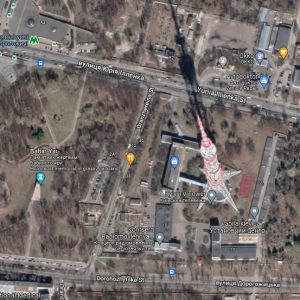
An aerial view of the TV tower and Babyn Yar Holocaust Memorial in Kyiv. Photo: Google
On Tuesday Putin’s forces committed what can only be considered a war crime in Kyiv – where they targeted the main TV tower and also hit the Babyn Yar Holocaust memorial, the site of the largest mass grave in Europe. Five civilians were burned alive, in a European capital, in the twenty-first century. This is only one of the devastating atrocities we have seen reported in the last week – the International Criminal Court has already determined that there is enough evidence to launch a probe into war crimes perpetuated by Russian forces and 38 world leaders have made the largest ever referral to ICC with evidence of potential war crimes perpetuated by Putin’s forces.
On Wednesday Ukrainian Emergency Services announced that over 2,000 Ukrainian civilians have been killed by Russian actions since the invasion began.
Overnight, for the first time in world history, Russian troops targeted a nuclear power facility in Zaporizhzhia, something which could have had terrible consequences for us all.
And this morning the Russian government blocked access to the BBC Russian service website after the Russian language website’s audience had grown from 3.1 million people to 10.7 million since the invasion.
The news is bleak; every day there is more despair, more death and more destruction. Every conversation I have had over the last week has not just touched on events in Ukraine but returned to them again and again. Tears have been shed throughout Europe and impartial and independent media coverage has never been more important.
But even in the midst of war there is hope. Humanity does indeed prevail. Small acts of kindness, of resistance, of rebellion have inspired us all. From the unarmed Ukrainians who refused to let the tanks pass to the exceptional bravery of the journalists who are at the frontline reporting hourly on events, and those in Russia who have been trying to report the facts of the war.
Whilst I could have dedicated this entire blog to the incredibly impressive Volodymyr Zelenskiy and other politicians in Ukraine who are leading from the front, there are others whose bravery I would like to highlight. Every day since the invasion began anti-war protestors have made their voices heard across Russia and Belarus.
Ovd-Info reports that as of this morning 8,163 Russians have been arrested for protesting the war in towns and cities across the country. The Duma has brought in emergency legislation which will now enable jail terms of up to 15 years for spreading ‘fake information’ about the armed forces – this would include saying that the war isn’t going to plan. In response one of the final independent TV stations – Dozhd has closed up shop – their final programme an act of defiance as it showed the staff walking off the set. In Putin’s Russia challenging him or the status quo is a very dangerous thing to do – these people are heroes, using all the tools at their disposal to demonstrate their dissent.
While there are people who are willing to say No, to highlight the impact of an authoritarian regime, to fight for our shared human rights – then there is hope.
Index stands with Ukraine and we stand with the people of Russia who oppose Putin’s aggression.
3 Mar 2022 | News
In the very first edition of Index on Censorship, published 50 years ago almost to the day, we raised the case of Mykhaylo Osadchy, a Ukrainian journalist and poet, who had been arrested for “anti-Soviet agitation and propaganda”. In a secret trial in his hometown of Lviv in September 1972 he was sentenced to seven years in prison and five years of exile.
An extract from The Mote, Osadchy’s lightly fictionalised memoir of a dissident writer, was published in the Autumn 1972 edition of Index. It provides a unique picture of the life of an intellectual in Ukraine under Soviet rule. “I had committed every vile deed that mankind throughout his existence could ever commit,” he writes. “I had never had the slightest suspicion of what a hostile element I was, or how hostile my thoughts had been.”
Cat and Mouse in the Ukraine by Victor Swoboda from 1973 is a lengthy but fascinating study of contemporary writers struggling, and often failing, to stay on the right side of the censor. Swoboda highlights the significance of the unpublished poem To the Kurdish Brother by Vasyl Symonenko, a writer celebrated by the Soviets as a hero of Communism but taken up by dissidents after the posthumous samizdat publication of his critical diaries. The poem tells “the Kurd” to fight chauvinists who “have come to rob you of your name and language”. It continues: “our fiercest enemy, chauvinism, fattens on the blood of harassed peoples”. It is not hard to see who the “Kurd” in the poem was intended to represent. In 1968 Mykola Kots, an agricultural college lecturer, was arrested for circulating 70 copies of the poem in which “the Kurd” had been replaced with “the Ukrainian”. He received the same sentence as Osaschy.
After the fall of the Berlin Wall, Index continued to support writers from Ukraine. As a result, we were the first to publish the work of Ukraine’s most celebrated contemporary writer, Andrei Kurkov, in English. The November 1993 issue contained an excerpt from The Cosmopolitan Anthem, a short story denounced at the 1991 All-Union Writers Conference in Yalta as “anti-Russian”. The story is, if anything, an attack on unthinking nationalism. Its narrator, an American with mixed Polish-Palestinian heritage, finds himself fighting on both sides of the Vietnam War and Afghanistan. The title of the story refers to the soldier’s utopian dreams of creating a unifying anthem to appeal to people’s better nature.
In 1999 we published extracts from Ukraine’s Forbidden Histories, which combined oral histories collected by the British Library with contemporary photographs by Tim Smith. It remains a striking document of the imprint Ukraine’s past atrocities left on the country. The authors pay tribute to the work of the organisation Memorial (now banned by Putin) in documenting the crimes of the Stalin era. The extracts include testimonies of the Babi Yar massacre of the city’s Jewish population, which has only been officially recognised in 1991. A monument to Babi Yar was reported to have been bombed during the recent invasion.
In 2001, Vera Rich, who devoted her life to translating Ukrainian and Belarusian literature, wrote Who is Ukraine? on the tenth anniversary of the country’s independence. Despite her obvious passion for the country (she translated the national poet Taras Shevchenko) it provides a clear-eyed look at the complicated nature of Ukrainian identity. “For a country to survive… a sense of national identity is required. But the question of what that identity should be has by no means been resolved,” she writes.
Finally, no collection of archive articles from Index on Ukraine would be complete without something from Andrei Aliaksandrau, who worked for Index for several years before returning to his native Belarus. He has now been in prison for over a year after being arrested by the Lukashenka regime. His piece, Brave New War from December 2014, reports on the information war being waged in Ukraine. It is a brilliant piece of reporting. “The principles of an information war remain unchanged: you need to de-humanise the enemy. You inspire yourself, your troops and your supporters with a general appeal which says: ‘We are fighting for the right cause – that is why we have the right to kill someone who is evil.’ What has changed is the scale of propaganda and the number of different platforms used to distribute it. In a time of social networks and with the whole world online, there is no need to throw leaflets over enemy lines, instead you hire 1,000 internet trolls.”
Aliaksandrau has been silenced, for now. But we will continue to report on Ukraine in tribute to him and the other courageous dissidents who have inspired the work of Index over the past five decades.
Research by Guilherme Osinski and Sophia Rigby
1 Mar 2022 | News, Russia, Statements, Ukraine
The undersigned journalists’ and civil society organisations, which are partner organisations of the Council of Europe’s Platform to Promote the Protection of Journalism and Safety of Journalists, utterly condemn the threats to the lives and safety of journalists resulting from the Russian Federation’s illegal invasion of Ukraine and call for the protection of Ukrainian and international reporters covering the war.
The free flow of independent and accurate news and information is essential in conflict situations. Our organisations call for urgent and practical international assistance and support for the brave journalists in Ukraine seeking to provide the Ukrainian people and the global public with a timely and realistic picture of developments, as well as foreign journalists risking their lives for reporting in and about Ukraine. Their work helps keep people safe and ensures that the international community can understand the full consequences of this invasion and its appalling impact on human lives.
The immediate physical safety of journalists on the ground – Ukrainian and foreign – is our primary concern amid the incessant escalation of hostilities. We emphasise that journalists are considered civilians under international humanitarian law and are not legitimate targets. The U.N. Security Council in 2015 adopted – by unanimous vote – Resolution 2222 affirming that states must respect and protect journalists as civilians. Resolution 2222 also confirms that media equipment and installations constitute civilian objects and shall not be the object of attack or reprisals.
The same resolution requires states to respect the professional independence and rights of journalists. The Council of Europe Platform partners condemn all efforts to restrict independent coverage of the Russian invasion and the ensuing hostilities, in particular within the Russian Federation itself. Journalists in Russia covering anti-war demonstrations have faced harassment and arbitrary detention. Russia’s media regulator continues to threaten independent media, block their websites, and force the removal of articles for deviating from the official state line on the war. This is a completely unacceptable violation of the Russian public’s right to independent information. We also condemn the continued and widespread crackdown on independent media in Belarus, where 32 journalists and media actors remain behind bars, according to the Belarusian Association of Journalists.
The Council of Europe Platform, the first ever Europe-wide monitoring and reporting mechanism aimed at countering all forms of attacks on journalists’ physical safety and protections in law, has grown into an important means of holding European states to account for serious violations. This role has now become all the more necessary, and we are committed to documenting all attacks on journalists and other efforts to restrict journalists’ ability to report on the war. The Platform partners have regularly expressed concern that the Russian Federation has declined to reply to alerts or engage with the work of the Platform.
This unprecedented attack requires a united effort to protect the rights and safety of journalists working in Ukraine. Urgent humanitarian assistance for journalists working in Ukraine is needed to ensure that they can continue doing their job safely and securely. This includes financial support to independent media outlets as well as appropriate safety equipment and other forms of practical support. We call on Council of Europe member states to make available emergency financial support that can be distributed to journalists, journalists’ organisations and media outlets in Ukraine. At the same time, we ask all concerned governments as well as international NGOs to do everything they can to support journalists who will be forced to flee the country and set up reporting bases abroad.
Signatories:
Index on Censorship
ARTICLE 19
Association of European Journalists
Committee to Protect Journalists
European Centre for Press and Media Freedom (ECPMF)
Free Press Unlimited
European Federation of Journalists (EFJ)
International Federation of Journalists (IFJ)
International Press Institute (IPI)
Justice for Journalists Foundation
PEN International
Reporters without Borders (RSF)
Rory Peck Trust (RPT)
25 Feb 2022 | Belarus, Opinion, Russia, Ruth's blog, Ukraine
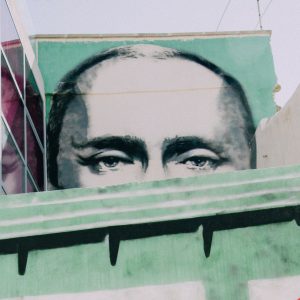
Graffiti of Vladimir Putin. Photo: Don Fontijn/Unsplash
I have struggled to write this blog. There don’t seem to the right words for something so serious, so terrifying but so utterly predictable.
Putin has invaded Ukraine – again.
As I write there are Russian bombs falling across Ukraine. Innocent people are dying, families are sheltering from bombing raids in the underground and people are fleeing.
This act of war, from a tyrant, cannot be explained or excused. This is an effort to destabilise Europe. To re-build a Russian Empire. To secure Putin’s legacy. It is not about NATO expansionism or a security threat from Ukraine. This is all Putin. This is not about the Russian or Ukrainian people.
Putin has brought war and death to mainland Europe and the world is more unstable than at any time since the Cuban Missile Crisis. That is our shared reality in 2022. This is the consequence of allowing a dictator to operate unchecked as readers of our work at Index know only too well.
Index does not exist to pontificate about international relations and defence policy – as frustrated as we may be. Our role, always, is to provide a space and a voice for dissidents and those being persecuted. But, and it’s a big but, we were founded in the midst of the Cold War half a century ago – to promote and protect the liberal democratic value of free expression. To work behind the Iron Curtain to provide a platform for the work and personal reflections of dissidents. We did this because we believe in democracy. That the foundations of free expression are protected at the ballot box. That the ultimate expression of freedom is the right to self-determination and to peace in a free society.
The invasion of Ukraine brings to the fore the reasons why Index exists. Even in the early hours and days of this aggression we have seen misinformation used as a propaganda tool. Journalists in Russia have been instructed to only use official comment on events in Ukraine. Protesters against the war in Moscow are being arrested in the dozens. And DDoS attacks on Ukrainian cyber infrastructure is becoming the norm. Putin is seeking to control every form of communication – that is not free speech.
In the months and years ahead Index will continue to provide a platform for dissidents. We will tell the stories of those writers, artists and academics who are being silenced by Putin’s regime. We will do what we do best – be a voice for the persecuted.
But as scared as I am of events in Eastern Europe – I worry about censorship through noise (as so ably articulated by Umberto Eco) that we are about to live through. Every repressive government could move against their citizens in the coming months with little global condemnation as our world leaders seek to find peace and secure the world as we know it. As we have for over half a century Index will be a home for those dissidents too – wherever they live – highlighting their stories and publishing their work.
The months ahead are going to be awful for too many people. Tyrants will believe they have a free hand to move against their citizens. Europe faces more war and the Chinese Communist Party may well seek to manipulate events to suit themselves.
In this unstable world the work of Index has never been more vital and we will do everything we can to support those who need us most.
