25 Feb 2022 | Belarus, News, Russia, Statements, Ukraine
We, the undersigned organisations, stand in solidarity with the people of Ukraine, but particularly Ukrainian journalists who now find themselves at the frontlines of a large-scale European war.
We unequivocally condemn the violence and aggression that puts thousands of our colleagues all over Ukraine in grave danger.
We call on the international community to provide any possible assistance to those who are taking on the brave role of reporting from the war zone that is now Ukraine.
We condemn the physical violence, the cyberattacks, disinformation and all other weapons employed by the aggressor against the free and democratic Ukrainian press.
We also stand in solidarity with independent Russian media who continue to report the truth in unprecedented conditions.
Join the statement of support for Ukraine by signing it here.
#Журналісти_Важливі
Signed:
- Justice for Journalists Foundation
- Index on Censorship
- International Foundation for Protection of Freedom of Speech “Adil Soz”
- International Media Support (IMS)
- Yerevan Press Club
- Turkmen.news
- Free Press Unlimited
- Human Rights Center “Viasna”
- Albanian Helsinki Committee
- Media Rights Group, Azerbaijan
- European Centre for Press and Media Freedom
- Association of European Journalists
- School of Peacemaking and Media Technology in Central Asia
- Human Rights Center of Azerbaijan
- Reporters Without Borders, RSF
- Association of Independent Press of Moldova, API
- Public Association “Dignity”, Kazakhstan
- PEN International
- Human Rights House Foundation, Norway
- IFEX
- UNITED for Intercultural Action
- Human Rights House Yerevan
- Helsinki Citizens’ Assembly – Vanadzor, Armenia
- Rafto Foundation for Human Rights, Norway
- Society of Journalists, Warsaw
- The Swedish OSCE-network
- Hungarian Helsinki Committee
- Legal policy research centre, Kazakhstan
- Public Foundation Notabene – Tajikistan
- HR NGO “Citizens’ Watch – St. Petersburg, Russia
- English PEN
- Public organization “Dawn” – Tajikistan
- International Press Institute (IPI)
- The Union of Journalists of Kazakhstan
- ARTICLE 19
- Human Rights House Tbilisi
- Rights Georgia
- Election Monitoring and Democracy Studies Center, Azerbaijan
- International Service for Human Rights (ISHR)
- Bulgarian Helsinki Committee
- Global Forum for Media Development (GFMD)
- European Federation of Journalists
- Social Media Development Center, Georgia
- Independent Journalists’ Association of Serbia
- OBC Transeuropa
- The Bureau of Investigative Journalism
- Journalists Union YENI NESIL, Azerbaijan
- Media and Law Studies Association (MLSA) , Istanbul
- Baku Press Club
- Centre for Journalism Innovation and Development
- Union Sapari
- The Coalition For Women In Journalism (CFWIJ)
- Committee to Protect Freedom of Expression, Armenia
- FEDERATIA SINDICATELOR DIN SOCIETATEA ROMANA DE RADIODIFUZIUNE, Bucharest, ROMANIA
- CD FILMS (FRANCE)
- CFDT-Journalistes
- Belarusian Association of Journalists
- SafeJournalists network
- Association of Journalists of Kosovo
- Association of Journalists of Macedonia
- BH Journalists Association
- Croatian Journalists’ Association
- Independent Journalists Association of Serbia
- Trade Union of Media of Montenegro
- Analytical Center for Central Asia (ACCA)
- Trade Union of Croatian Journalists
- European Press Prize
- Ethical Journalism Network
- European Journalism Centre
- Slovene Association of Journalists
- Investigative Studios
- PEN Belarus
- Public Media Alliance (PMA)
- Estonian Association of Journalists
- Federación de Sindicatos de Periodistas (FeSP) (Spain)
- DJV, German Journalist Federation
- Free Russia Foundation
- Association for Human Rights in Central Asia – AHRCA
- “Human Rights Consulting Group” Public Foundation, Kazakhstan
- Committee to Protect Journalists
- Ski Club of International Journalists (SCIJ)
- Women In Journalism Institute, Canada – associate of CFWIJ
- Romanian Trade Union of Journalists MediaSind
- Romanian Federation Culture and Mass-Media FAIR, MediaSind
- New Generation of Human Rights Defenders Coalition, Kazakhstan
- Coalition for the Security and Protection of Human Rights Defenders, Activists, Kazakhstan
- Legal policy Research Centre, Kazakhstan
- Eurasian Digital Foundation, Kazakhstan
- Legal Analysis and Research Public Union, Azerbaijan
- German Journalists Union
- Digital Rights Expert Group, Kazakhstan
- Bella Fox, LRT/Bellarus Media, Lithuania
- Syndicat national des journalistes CGT (SNJ-CGT), France
- Karin Wenk, Editor in Chief Menschen Machen Medien
- Press Emblem Campaign
- Federacion de Servicios, Consumo y Movilidad (FeSMC) – UGT (Spain)
- Sindicato dos Jornalistas, Portugal
- International media project Август2020/August2020 (august2020.info), Belarus
- Independent Association of Georgian Journalists (journalist.ge)
- Independent Trade Union of Journalists and Media Workers, Macedonia
- Adam Hug, Director, Foreign Policy Centre
- Zlatko Herljević, Croatian journalist, lecturer of journalism at University VERN, Zagreb, Croatia
- Independent Journalists’ and Media Workers’ Union (JMWU), Russia
- The Daphne Caruana Galizia Foundation
- Hungarian Press Union (HPU), Hungary
- Lithuanian Journalists Union
- National Union of Journalists UK & Ireland
- Federazione Nazionale Stampa Italiana (Italy)
- Dutch Association of Journalists (NVJ)
- Uzbek Forum for Human Rights
- Association of Journalists, Turkey
- Slovak Syndicate of Journalist, Slovakia
- GAMAG Europe (European Chapter of the Global Alliance for Media and Gender)
- Slovenian Union of Journalists (SNS)
- Federación de Asociaciones de Periodistas de España (FAPE)
- Syndicate of Journalists of Czech Republic
- 360 Degrees, Media outlet, North Macedonia
- Frontline, Skopje, North Macedonia
- Community Media Solutions (UK)
- The Norwegian Union of Journalists, Norway
- Rentgen Media (Kyrgyz Republic)
- Union of Journalists in Finland (UJF)
- Syndicat National des Journalistes (SNJ), France
- The Swedish Union of Journalists, Sweden
- Asociación Nacional de Informadores de la Salud. ANIS. España
- Association Générale des Journalistes professionnels de Belgique (AGJPB/AVBB)
- Macedonian Institute for Media (MIM), North Macedonia
- Lithuanian Journalism Centre, Lithuania
- Club Internacional de Prensa (CIP), España
- Periodical and Electronic Press Union
- Fojo Media Institute, Sweden
- Mediacentar Sarajevo
- Media Diversity Institute
- Impressum – les journalistes suisses
- Agrupación de Periodistas FSC-CCOO
- South East European Network for Professionalization of Media (SEENPM)
- TGS, Turkey
- Investigative Journalism Center, Croatia
- Verband Albanischer Berufsjournalisten der Diaspora, Schweiz
- IlijašNet
- Journalists Union of Macedonia and Thrace (Greece)
- The Union of Journalists of Armenia (UJA)
- Associació de Periodistes Europeus de Catalunya (APEC)
- International Association of Public Media Researchers (IAPMR)
- FREELENS e.V. – German Association of Photojournalists & Photographers
- LawTransform (CMI-UiB Centre on Law & Social Transformation, Bergen, Norway)
- Bangladesh NGOs Network for Radio & Communication
- Platform for Independent Journalism (P24), Turkey
- Novi Sad School of Journalism (Serbia)
- Col·legi de Periodistes de Catalunya (Catalunya)
18 Feb 2022 | Statements, United States
The undersigned organisations express their serious concern at the legal proceedings, also known as SLAPPs, that have been brought against investigative journalist Scott Stedman, his US media company Forensic News, and three of his colleagues.
Between June 2019 and June 2020, Forensic News published six articles and a podcast about the business affairs of British-Israeli security consultant and businessman Walter Soriano, after he was summoned by the United States’ Senate Intelligence Committee. The Committee was reportedly interested in Soriano’s connections to several people of interest, including the Russian oligarch Oleg Deripaska, who had been a former business associate of Donald Trump’s campaign chairman Paul Manafort.
The Forensic News team was sued by Soriano in July 2020, one month after they published their last article about him. Although the defendants are all based in the United States and Forensic News is incorporated in the state of California, the lawsuit has been brought in London.
A total of five claims were made in relation to data protection, libel, misuse of private information, harassment, and malicious falsehoods. Two of the claims, harassment and malicious falsehoods, have since been dismissed.
“We believe that the lawsuit that has been brought against Forensic News is a SLAPP,” the undersigned organisations said. SLAPPs abuse the law in order to silence critical coverage on matters of public interest. Index on Censorship has filed a media freedom alert to the Council of Europe Platform for the Protection of Journalism and Safety of Journalists.
“The case has many of the hallmarks of a SLAPP, including that Soriano is not only suing the news organisation, but also the four individual reporters. He also has lawsuits pending against investigative journalists in France and Israel, as well as against Twitter in Ireland,” the organisations said.
Due to the extremely expensive nature of mounting a legal defence in England and Wales, Forensic News is having to raise funds through an online crowdfunding campaign. The case is expected to go to trial before the end of 2022.
SIGNED:
Index on Censorship
Blueprint for Free Speech
The Campaign for Freedom of Information in Scotland (CFoIS)
Coalition For Women In Journalism (CFWIJ)
The Daphne Caruana Galizia Foundation
English PEN
European Centre for Press and Media Freedom (ECPMF)
IFEX
International Press Institute (IPI)
Justice for Journalists Foundation
Organized Crime and Corruption Reporting Project
Osservatorio Balcani Caucaso Transeuropa (OBCT)
PEN International
Reporters Without Borders (RSF)
Spotlight on Corruption
17 Feb 2022 | Opinion, Ruth's blog
Tyrants love a distraction. There are only so many issues, so many countries, so many crises that our global institutions can focus on at any given time. So the worst but most effective of authoritarian regimes seek to implement their most repressive acts when the world is looking elsewhere. Of all those that seek to use misdirection and obfuscation I think it’s fair to suggest that Vladimir Putin is one of the masters.
In recent weeks we’ve seen a terrifying but all consuming escalation in Russian threats against Ukraine. 60% of their land army is now deployed on the borders of Ukraine and Belarus – but we are meant to believe that they have no plans to invade, or rather continue their war against Ukraine that began in 2014 when they invaded Crimea.
The world has rightly been focused on troop movements on the Ukrainian border. Every leader has spoken publicly of events in Eastern Europe. NATO leaders have talked daily, and nearly every democratic power has met with or spoken directly to President Putin. Their conversations have not touched on human rights violations within Russia, Putin’s support for a ruthless dictatorship in Belarus or even their weaponising of cyber activism to undermine democracies.
In the phoney propaganda war Putin is winning. On his own terms. And the world is letting him. He has determined the agenda at hand, world leaders are flocking to meet him in order to stop World War Three (rightly) and the rest of his indiscretions and human rights violations are, for now at least, off the table.
Which brings me to the subject of this blog. Alexei Navalny. On Tuesday, as our world leaders sought to prevent a new war, Putin’s biggest critic was put on trial, again.
The popular Russian opposition leader is accused of embezzling donations to his FBK anti-corruption organisation, which spearheaded investigations into Russian officials and sparked large protests against Putin. Navalny has denied the charges and says they’re politically motivated.
Putin is so fearful of dissent that he has held the trial not in Moscow, in a court, but rather in the prison that Navalny is already detained in. Navalny is being tried three to four hours from Moscow, a journey which is less than straightforward. If lawyers and observers do manage to get to the IK-2 penal colony then no phones or recording equipment may be taken inside, no evidence of impropriety obtained.
Hi wife Yulia wrote on Instagram on the eve of the trial: “[The authorities] want to hide him from all people, from his supporters, from journalists. It is so pathetic that they are afraid to hold the trial in Moscow.”
If Navalny is found guilty, again, then he will face a further 15 years in prison. Every day his family fear for his safety, not unreasonably after the attempted assassination attempt with Novichock in 2020.
Navalny’s case embodies Putin’s dismissal of the rule of law and his callous disregard for basic human rights. Index will continue to stand with Navalny and will keep telling his story to make sure that Putin knows the world is still watching.
2 Feb 2022 | Europe and Central Asia, News, Russia, Ukraine
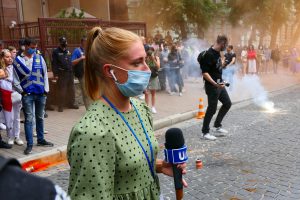
A journalist covering a demonstration in Kyiv, Ukraine, August 2020. Credit: Oleksandr Polonskyi/Shutterstock
While media crews from around the world are arriving in Ukraine to cover the situation amid a build-up of Russian troops on Ukraine’s border, local journalists are trying to overcome the many obstacles that stand in the way of their media freedom. The working environment is challenging: from disinformation campaigns and orchestrated propaganda to limited resources in newsrooms, attacks on journalists and the often inadequate response of law enforcement.
In Ukraine, the armed conflict has been going on for almost eight years, ever since Russia annexed the Crimean peninsula and put armed forces in eastern Ukraine. In the wake of this, the Ukraine government has trod a difficult path as they have tried to balance media freedom and plurality against the risks that could be posed from an unregulated media landscape. They have not always made the right decisions. For example, one year ago, President Volodymyr Zelensky imposed sanctions that resulted in three TV channels associated with a pro-Russian politician – ZIK, NewsOne and 112 Ukraine – being taken off air. While some Ukrainian media experts supported the move, others saw it as repressive and criticised the authorities because they bypassed legal procedures and did not provide enough information to justify emergency restrictive measures.
At the same time Ukraine does face a real problem when it comes to misinformation. The ecosystem of online platforms and various social media in Ukraine that are being used by both state, influential non-state and political players is extensive. According to a report from Freedom House, paid commentators and trolls have proliferated Ukraine’s online public space. In many cases, these online platforms are anonymous and are spreading and amplifying messages that benefit the Russian government and seek to destabilise the Ukrainian political landscape. Many of these accounts have tens of thousands of subscribers and are being used by interested parties from inside or outside the country. They spread anything from malicious disinformation to banal clickbait to attract news audiences and they also attack journalists. According to the Institute of Mass Information survey, the majority of Ukrainian journalists have experienced some form of cyberbullying.
Independent journalists suffer from the damage related to misinformation, and their day-to-day duties are not easy either. Media workers in Ukraine are often defenseless against attacks and police responses to them can be inadequate. About 100 Ukrainian media workers were physically assaulted in 2021, revealed Ukraine’s National Union of Journalists (NUJU). This is hardly an improvement on the last year, when 101 journalists were physically assaulted.
Despite the tightening of legislation regarding accountability for attacks on journalists, the efficiency of the law enforcement system remains low, so the perpetrators often go unpunished. Several murders of famous journalists have not yet led to the punishment of those responsible. In 2019, Vadim Komarov, a journalist and blogger from Cherkasy, was violently attacked by an unknown person in a city center. Komarov was known for his exposes of corruption. He died in hospital after several months in a coma. Police still haven‘t found the perpetrator and the investigation remains open.
Another frightening example of the violence that Ukrainian journalists encounter in their work is the murder of Pavel Sheremet in 2016. Sheremet, who was a harsh critic of Ukrainian, Belarusian and Russian authorities, died in a car explosion in downtown Kyiv. Three years later, after a new president came to power, the police detained five suspects. The trial is ongoing and as yet no one has been sentenced.
Sometimes difficulties arise from where they were not expected. For example, the NUJU says that rising prices for natural gas and fuel have caused many regional newsrooms to be unable to heat their editorial offices.
It’s hardly a surprise that about 48% of journalists reported self-censoring in the Ukrainian media, according to a 2019 study by the Ilko Kucheriv Democratic Initiatives Foundation. Topics related to patriotism, separatism, terrorism and Russia were the ones most avoided. And almost 65% believe that the war has increased self-censorship. Then there are those who literally get told what to say. For example, former employees of the state TV channel DOM have spoken about censorship by the Office of the President of Ukraine, which has demanded positive news about the president and his initiatives.
Given all of these attacks, how exactly can Ukraine’s journalists hold power to account?
And yet, thanks to the efforts of the journalistic community there is progress, the head of the NUJU Sergiy Tomilenko believes. Representatives of media and journalistic organisations have consistently raised concerns about the safety of journalists publicly and in face-to-face meetings with government officials for years. According to Tomilenko, the police have begun to investigate faster than before, and now see attacks against journalists as what they are – threats to the very nature of their work.
Media freedom and pluralism is crucial in general and no more so now. We need to see more positive change and fast.
