27 Sep 2018 | Europe and Central Asia, Mapping Media Freedom, Media Freedom, media freedom featured, News, Russia
[vc_row][vc_column][vc_single_image image=”102893″ img_size=”full”][vc_column_text]
A country with the largest territory in the world and a turbulent modern history, Russia is home to one of the most difficult media landscapes and censorship has been tightening its grip with new-found strength.
Free media was virtually non-existent during the decades of Soviet rule. It wasn’t until 1991 that Soviet leader Mikhail Gorbachev signed a decree allowing the first independent media outlets to emerge. This was also the year the Soviet Union ceased to be, and Russia was born in its stead. The constitution of Russia, adopted in 1993, guaranteed, among other rights and freedoms, the freedom of speech.
In 2018 it is still the same country with the same constitution, but the initial euphoria for freedom ended abruptly in 2003 after the shake-up of the television channel NTV. From its foundation in 1993 through the early 2000s, NTV was the largest private broadcaster in Russia and a stronghold of free speech, which didn’t suit Vladimir Putin, who first became president in 2000. Witty, free-spoken hosts openly criticised the government, reported on its failures and produced sharp political satire. The undermining of the channel began in 1999 with governmental lawsuits, and the final blow was dealt soon after the tragic events around Nord Ost, the three-day theatre siege in 2002, also known as the Dubrovka terror attack. Putin’s displeasure with NTV’s honest coverage and investigation into the death of 129 hostages, who inhaled an unidentified state-administered gas, resulted in the firing of the network’s CEO Boris Jordan. Soon after, the channel ceased to exist only to be reborn as a state-controlled media outlet with the same name.
Today, mass media in Russia is quite a different scene. The government sets the tone for many things, including the attitude towards journalists. Who are the good guys and who are the bad guys? Which news events should be covered in state media and which are too upsetting to show to the country?
State-owned and state-friendly TV channels like Channel 1 and Rossiya are known for meticulously filtering the inflow of news and dropping the themes and subjects that may throw shadow on the government. The few independent outlets left standing, like Ekho Moskvy, Novaya Gazeta and Dozhd TV, have to endure harassment from power structures and take part in legal battles against governmental institutions and businesses willing to censor them.
Recent additions to Russian legislation make it easier to prosecute media outlets for their reporting. Financial struggle is also real for many Russian media, which are being purchased and reshaped according to the tastes of the new owners, who often happen to have close ties to the Kremlin. That’s what happened to RBC newspaper and TV channel, among others.
Self-censorship is prevalent in newsrooms as well.
The number of threats and acts of violence against journalists has increased three-fold within the last two years, reported Natalia Kostenko, the head of the ONF Centre for Legal Support of Journalists, at a conference in March 2018. Kostenko cited restriction of access, verbal threats, physical violence, damage to personal belongings and lawsuits as the most common misdemeanours against media workers.
However, media freedom is not the only concern in today’s Russia. The political climate has changed drastically over the last few years: the country has seen a surge of nationalism, xenophobia and religious fervour, and the revival of Soviet methods of dealing with “thought criminals”. Under recently passed legislation, a person can be imprisoned for a social media like or repost if anyone considers it to be hateful or extremist. The economic stagnation and financial crisis, which began in 2014 as the result of sanctions against Russia’s actions in Crimea and Donbass, has been an important factor in all of this and contributed to a new wave of emigration, or “brain drain”, that has hit the country. [/vc_column_text][/vc_column][/vc_row][vc_row][vc_column][vc_single_image image=”102871″ img_size=”full”][/vc_column][/vc_row][vc_row][vc_column][vc_column_text]Journalists are emigrating from the country for the same reasons as other groups. Some leave to pursue better career opportunities at foreign news outlets. Some follow their families or marry abroad. Some simply want a safer, more open environment for themselves and their children.[/vc_column_text][/vc_column][/vc_row][vc_row][vc_column][vc_single_image image=”102872″ img_size=”full”][/vc_column][/vc_row][vc_row][vc_column][vc_column_text]Veteran TV host Tatiana Lazareva found herself unable to find any work on Russian television after she and her husband Mikhail Shatz took part in covering opposition leader Alexey Navalny‘s protests in 2012. This got them blacklisted on most Russian TV channels. “I don’t have a profession anymore,” Lazareva told Dozhd TV in an interview last year. “As I see it now, they wanted to take not only television away from us, but any chance to make money, wanted us, like, to crawl on our knees and beg.”
She moved to Spain, where she and her family had been spending their holidays for 15 years, to raise her youngest daughter. Lazareva continues her charity work in Russia and heads a motivational programme for people over 50, but the door to journalism in her country remains closed.
Lazareva’s example is not unique, and many young journalists now prefer to either start their careers abroad or change professions. For some journalists, leaving Russia is the only possible choice.
Vocal and straightforward, Karina Orlova had been a journalist at Ekho Moskvy radio for over a year when the attack on the French magazine Charlie Hebdo took place. A few days after the massacre, she hosted a show with Maxim Shevchenko, a right-wing journalist and then-member of the Russian Presidential Council on Human Rights. Orlova asked Shevchenko to comment on the threatening statement made by Chechen Republic leader Ramzan Kadyrov in response to exiled businessman Mikhail Khodorkovsky’s suggestion that every media outlet should republish Charlie Hebdo’s controversial Prophet Mohammed caricatures as an act of solidarity. Kadyrov called Khodorkovsky “the enemy of all Muslims” and his “personal enemy”, and said he hoped someone “would make the fugitive answer” for his words. Shevchenko kept defending Kadyrov’s point of view, while Orlova attempted to get Shevchenko to acknowledge the severity of the threats and report them to the council. For this, she too became a target. [/vc_column_text][/vc_column][/vc_row][vc_row][vc_column][vc_single_image image=”102873″ img_size=”full” add_caption=”yes”][/vc_column][/vc_row][vc_row][vc_column][vc_column_text]Orlova’s mother discovered that threats were being made under the journalist’s profile on a website for local journalists. Orlova then began receiving threats through her Facebook account. She could tell there was something different about these threats – they weren’t like the usual outbursts she encountered while on air. The men, residents of Chechnya and Ingushetia, didn’t try to hide their identity. They called Orlova “the enemy of Islam” and promised to kill her in many different ways. At the same time, Kadyrov directed threats to Ekho’s staff chief editor Alexey Venediktov.
In haste, Orlova packed her things and boarded a flight to the United States, which she believed to be the safest place for her. It took her some time to feel comfortable in the new environment and polish her English skills. She still contributes to Ekho, but her main job is with an American political magazine.
“Return to Russia? I can’t, I don’t want to and I won’t. Russia is a dangerous country where the raging of the power structures got even more out of hand in the last three years,” Orlova says. “There are no independent courts, the police only chases the “enemies of the state” and robs local businesses.”
Despite being away from Russia for three years, Orlova’s name hasn’t been forgotten. “In January 2018 director Nikita Mikhalkov filmed an episode of his TV show, Besogon (“Exorcist” in Russian), about me. He called me Goebbels and a fascist for an old article in which I suggested that Russia needed a lustration, and all people who worked in the Soviet system should be excluded from the government. Last time Besogon covered an Ekho journalist, Tanya Felgengauer was brutally attacked,” Orlova said.

Echo Moskvy’s Tatiana Felgengauer, a host and one of the editor-in-chief’s deputies, was stabbed several times in the neck in the station’s office. (Photo: Facebook)
Ekho host Tatiana Felgengauer was stabbed in the throat in October 2017 at the station’s headquarters. The attacker pepper-sprayed a guard and went for Felgengauer once he reached the office. He was deemed to be a paranoid schizophrenic and sentenced to compulsory medical treatment by the court.

Yulia Latynina (Twitter)
As one of the most noticeable and outspoken radio hosts in Moscow, Felgengauer was criticised by Russian state outlets more than once. Just a week before the attack she was called a “traitor of the motherland” on state television for attending a conference sponsored by foreign human rights organisations. She survived thanks to quick medical attention and has since fully recovered and returned to work. Nevertheless, it was a very close call.
Soon after the attack Ksenia Larina, another Ekho journalist, began receiving death threats. Not taking any chances, she promptly left the country for Europe.
Yulia Latynina hosted her own show at Ekho while also contributing to the newspaper Novaya Gazeta. The sharp-tongued novelist and journalist has been an object of criticism for many years, but the final straw for her came in September 2018 when her car was burned out right outside her country house, which had previously been sprayed with a dangerous military-grade chemical. Latynina now spends her time between different countries and has no plans to return to Russia.[/vc_column_text][/vc_column][/vc_row][vc_row][vc_column][vc_separator color=”black”][vc_column_text]
No other Russian outlet has seen more of their journalists threatened, attacked and murdered over the years than Novaya Gazeta. One of the last bastions of Russian free press standing, the newsroom works under extreme pressure, carrying on in the same line of work as their fallen colleagues, who paid with their lives to get the truth out.
[/vc_column_text][vc_row_inner][vc_column_inner width=”1/4″][vc_single_image image=”102877″ img_size=”full”][/vc_column_inner][vc_column_inner width=”3/4″][vc_column_text]2000, Igor Domnikov, reported on business corruption in Moscow. Beaten to death outside his apartment by multiple men wielding hammers. Some of the murderers were arrested and sentenced in 2007, while the mastermind of the crime was let go.[/vc_column_text][/vc_column_inner][/vc_row_inner][vc_row_inner][vc_column_inner width=”1/4″][vc_single_image image=”102880″ img_size=”full”][/vc_column_inner][vc_column_inner width=”3/4″][vc_column_text]2003, Yury Schekochikhin, investigative journalist. Died of a mysterious 16-day illness, possibly poison. Real cause of death never determined, independent investigation banned, case closed.[/vc_column_text][/vc_column_inner][/vc_row_inner][vc_row_inner][vc_column_inner width=”1/4″][vc_single_image image=”85407″ img_size=”full”][/vc_column_inner][vc_column_inner width=”3/4″][vc_column_text]2006, Anna Politkovskaya, most famous for reporting about the Second Chechen War. First poisoned in 2004, recovered; then shot dead in her apartment building right on Vladimir Putin’s birthday. Murderers found and jailed, mastermind never found, investigation closed. Politkovskaya won an Index on Censorship Freedom of Expression Award for her courageous journalism.[/vc_column_text][/vc_column_inner][/vc_row_inner][vc_row_inner][vc_column_inner width=”1/4″][vc_single_image image=”102879″ img_size=”full”][/vc_column_inner][vc_column_inner width=”3/4″][vc_column_text]2009, lawyer Stanislav Markelov and freelance reporter Anastasia Baburova. Both shot in the head on a Moscow side street in broad daylight. Both the killers and the mastermind found and jailed.[/vc_column_text][/vc_column_inner][/vc_row_inner][vc_row_inner][vc_column_inner width=”1/4″][vc_single_image image=”102878″ img_size=”full”][/vc_column_inner][vc_column_inner width=”3/4″][vc_column_text]2009, Natalia Estemirova, human rights activist and journalist in Chechnya. Abducted near her home and found dead with bullet wounds in a woodland miles away. The killer was identified by the officials and allegedly killed in ambush. The newspaper staff is skeptical of this version, as the man’s DNA samples didn’t match the ones found on the crime scene.[/vc_column_text][/vc_column_inner][/vc_row_inner][vc_separator][/vc_column][/vc_row][vc_row][vc_column][vc_column_text]
It would only be fair to say that Novaya Gazeta management knows pretty well when a threat is real. So instead of waiting for governmental protection, they take their own precautions. Here are just some of the recent stories of those who left the country before it was too late, related by the paper’s former chief editor Dmitry Muratov:
[/vc_column_text][vc_row_inner][vc_column_inner width=”1/4″][vc_single_image image=”102890″ img_size=”full”][/vc_column_inner][vc_column_inner width=”3/4″][vc_column_text]Sergey Zolovkin used to be a police officer who solved many crimes, co-founded Sochi newspaper and was a Novaya Gazeta author. He was threatened many times, his car sabotaged, relatives beaten up, an attempt on his life made in 2002 – the would-be killer was caught on the spot as Zolovkin was armed; he moved to Germany soon after.[/vc_column_text][/vc_column_inner][/vc_row_inner][vc_row_inner][vc_column_inner width=”1/4″][vc_single_image image=”102891″ img_size=”full”][/vc_column_inner][vc_column_inner width=”3/4″][vc_column_text]Maynat Abdulaeva (Kurbanova) was reporting from Grozny, Chechnya, for years, until she and her family started receiving death threats. She has been living in Germany under PEN program Writers in Exile since 2004.[/vc_column_text][/vc_column_inner][/vc_row_inner][vc_row_inner][vc_column_inner width=”1/4″][vc_single_image image=”102889″ img_size=”full”][/vc_column_inner][vc_column_inner width=”3/4″][vc_column_text]Evgeniy Titov left in 2016. He reported on human rights violations in Krasnodar and corruption around Sochi 2014 Olympics, was threatened by the police and private individuals, and requested asylum in Lithuania.[/vc_column_text][/vc_column_inner][/vc_row_inner][vc_row_inner][vc_column_inner width=”1/4″][vc_single_image image=”102888″ img_size=”full”][/vc_column_inner][vc_column_inner width=”3/4″][vc_column_text]Elena Milashina co-authored the 2017 world-famous investigation about hundreds of gay men kidnapped, tortured and killed in Chechnya in a covert attempt to “purge” the region. Having been previously attacked and beaten up in 2006 and 2012, she fled Russia following death threats from Chechen officials and Muslim preachers, but continued to cover the region.[/vc_column_text][/vc_column_inner][/vc_row_inner][vc_row_inner][vc_column_inner width=”1/4″][vc_single_image image=”102885″ img_size=”full”][/vc_column_inner][vc_column_inner width=”3/4″][vc_column_text]Ali Feruz (pen name) reported on hate crimes, LGBTQ and migrant worker’s rights. He was born in Uzbekistan, though his mother was Russian. He escaped from the country after being detained and tortured by the Uzbek National Security Service, who wanted his cooperation. Feruz moved to Russia and tried to obtain a Russian citizenship on jus sanguinis principle. His initial appeal was turned down, but a new case looked promising. He was suddenly arrested in August 2017 and sentenced to deportation to Uzbekistan. In the following three and a half months Feruz was abused and tortured in detention – and no one got punished for it. He was rescued and granted asylum by the German government, and will never be able to return to Russia. [/vc_column_text][/vc_column_inner][/vc_row_inner][vc_row_inner][vc_column_inner width=”1/4″][vc_single_image image=”102886″ img_size=”full”][/vc_column_inner][vc_column_inner width=”3/4″][vc_column_text]Elena Kostychenko was one of Novaya Gazeta’s most fearless and fierce reporters, having covered complex stories all over Russia. She is also a feminist and LGBTQ activist, and in 2011 was left with a concussion after being attacked at a pride parade in Moscow. In 2016 Kostychenko was brutally beaten in Beslan while covering a protest of the mothers whose children died in the 2004 school terror attack. She is still recovering from psychological aftershocks, abroad.[/vc_column_text][/vc_column_inner][/vc_row_inner][/vc_column][/vc_row][vc_row][vc_column][vc_row_inner][vc_column_inner][vc_column_text]
528 press freedom violations in Russia verified by Mapping Media Freedom as of 27/9/2018
[/vc_column_text][/vc_column_inner][/vc_row_inner][vc_raw_html]JTNDaWZyYW1lJTIwd2lkdGglM0QlMjI3MDAlMjIlMjBoZWlnaHQlM0QlMjIzMTUlMjIlMjBzcmMlM0QlMjJodHRwcyUzQSUyRiUyRm1hcHBpbmdtZWRpYWZyZWVkb20udXNoYWhpZGkuaW8lMkZzYXZlZHNlYXJjaGVzJTJGMTAwJTJGbWFwJTIyJTIwZnJhbWVib3JkZXIlM0QlMjIwJTIyJTIwYWxsb3dmdWxsc2NyZWVuJTNFJTNDJTJGaWZyYW1lJTNF[/vc_raw_html][/vc_column][/vc_row][vc_row][vc_column][vc_basic_grid post_type=”post” max_items=”12″ style=”load-more” items_per_page=”4″ element_width=”6″ grid_id=”vc_gid:1538042702741-bc2cc3fd-837d-0″ taxonomies=”7349, 6564″][/vc_column][/vc_row]
27 Jun 2018 | Campaigns -- Featured, Digital Freedom, Digital Freedom Statements, Russia, Statements
[vc_row][vc_column][vc_single_image image=”100082″ img_size=”full”][vc_column_text]The following statement signed by 52 international organisations was delivered by Article 19 at the UN Human Rights Council on 27 June 2018.[/vc_column_text][vc_column_text]Thank you Mr. President,
The Russian Federation is pursuing policies that are significantly and rapidly encroaching online freedoms affecting not only the rights of people living in Russia but Internet users everywhere. Through the steady adoption of a raft of regressive legislation contravening international standards on freedom of expression, including access to information and the right to privacy, as well as placing unjustified pressure on Internet intermediaries, the Russian Federation is creating a framework, which, if fully implemented, would not only severely limit the free flow of information online but potentially give them access to the personal communication data of anyone, anywhere.
Last month, ARTICLE 19 together with 56 international and Russian human rights, media and Internet freedom organisations condemned the mass Internet disruption caused by the Russian Federation’s attempts to block the Internet messaging service Telegram, which resulted in extensive violations of freedom of expression including access to information. Almost 20 million Internet Protocol (IP) addresses were ordered to be blocked causing an unprecedented level collateral website blocking.
The basis of the authorities’ action was Telegram’s noncompliance with the highly problematic 2016 so-called ‘Yarovaya Law’, justified on the grounds of “countering extremism”, which requires all communications providers and Internet operators to store metadata about their users’ communications activities, to disclose decryption keys at the security services’ request, and to use only encryption methods approved by the Russian government – in practical terms, to create a backdoor for Russia’s security agents to access internet users’ data, traffic, and communications. In July 2018, other articles of the ‘Yarovaya Law’ will come into force requiring companies to store the content of all communications for six months and to make them accessible to the security services without a court order. This would affect the communications of both people in Russia and abroad, violating their right to privacy and creating a further chilling effect to freedom of expression and access to information.
Such attempts by the Russian authorities to restrict online communications and violate privacy, supposedly for the protection of national security, are neither necessary nor proportionate. The Russian Government must repeal ‘Yarovaya Law’ and refrain from pressuring Internet intermediaries to comply with requests that will violate their users’ rights or face having their services blocked inside the country.
Since 2012, Russia has operated a blacklist of Internet websites and incrementally extended the grounds upon which websites can be blocked, including without a court order. The permanent blocking of several online media outlets and also LinkedIn – are completely unjustified and can only be seen as examples to intimidate others into compliance. Individual Internet users have also been persecuted for online expression or even simply liking or sharing content on social media platforms.
Legislation currently under consideration includes further social media regulation (Proposed Bill № 223849-7) which would among other concerns eradicate the possibility of online anonymity and pressure companies to take down “unverifiable” information; as well as proposed amendments to the Criminal Code (Article 284.2) (Proposed Bill № 464757-7) that would criminalise information leading to ‘international sanctions’, which could be used to prevent the media reporting on public interest matters or NGOs conducting international advocacy. Both pieces of legislation, if adopted, would have a negative impact on the free flow of information and should not be brought into law.
Signed by
- ARTICLE 19
- Agora International
- Access Now
- Amnesty International
- Asociatia pentru Tehnologie si Internet – ApTI
- Associação D3 – Defesa dos Direitos Digitais
- Centre for the Development of Democracy and Human Rights
- Committee to Protect Journalists
- Citizens’ Watch
- Civil Rights Defenders
- Electronic Frontier Foundation
- Electronic Frontier Norway
- Electronic Privacy Information Centre (EPIC)
- European Federation of Journalists
- FIDH – International Federation for Human Rights
- Freedom House
- Free Word Association
- Glasnost Defence Foundation
- Human Rights House Foundation
- Human Rights Watch
- The Independent Historical Society
- Index on Censorship
- International Media Support
- International Partnership for Human Rights
- International Youth Human Rights Movement (YHRM)
- Internet Protection Society
- Kharkiv Human Rights Protection Group
- Mass Media Defence Centre
- Moscow Helsinki Group
- Movement ‘For Human Rights’
- Norwegian Helsinki Committee
- Open Media
- Open Rights Group
- OVD-Info
- PEN America
- PEN International
- PEN St Petersburg
- People in Need
- Press Development Institute-Siberia
- Privacy International
- Reporters without Borders
- RosKomSvoboda
- Russia Beyond Bars
- Russian Journalists’ and Media Workers’ Union
- Russian LGBT Network
- Sakharov Center
- SOVA Center
- Team 29
- Transparency International Russia
- Webpublishers Association (Russia)
- World Wide Web Foundation
- Xnet
Background Information
New Legislation
- On 15 May 2018, Russia’s State Duma approved in the first reading proposed amendments (Proposed Bill № 464757-7) to the Criminal Code (Article 284.2), amendments that would criminalise ‘the provision of recommendations and transfer of information that has lead or might have led to the introduction’ of international sanctions, providing for up to three years’ imprisonment and fines of $8,000. (see ARTICLE 19, 17 May 2018, Russia: Proposed amendments to Criminal Code threaten media freedom – https://www.article19.org/resources/russia-proposed-amendments-to-criminal-code-threaten-media-freedom/ )
- On 12 April 2018, a new draft law (Proposed Bill № 223849-7) on social media regulation was adopted in the first reading by the Russian State Duma. The law draws inspiration from the German 2017 NetzDG law and would require social media companies to remove information that violated Russian law (within 24 hours) or face huge fines (up to 50 million RUB). In addition, social media companies would be required to establish representation in Russia and identify their users by their telephone numbers effectively preventing online anonymity (as all phone numbers are registered with the owner’s passport in Russia).
- Both bills are awaiting their second and third readings in the State Duma.
Yarovaya Law
- Various requirements of the ‘Yarovaya Law’ are plainly incompatible with international standards on encryption and anonymity as set out in the 2015 report of the UN Special Rapporteur on Freedom of Expression report (A/HRC/29/32). The UN Special Rapporteur himself has written to the Russian government raising serious concerns that the ‘Yarovaya Law’ unduly restricts the rights to freedom of expression and privacy online (see http://www.ohchr.org/Documents/Issues/Opinion/Legislation/RUS_7_2016.pdf )
Telegram Case
- In October 2017, a magistrate found Telegram guilty of an administrative offense for failing to provide decryption keys to the Russian authorities – which the company states it cannot do due to Telegram’s use of end-to-end encryption. The company was fined 800,000 rubles (approx. 11,000 EUR). Telegram lost an appeal against the administrative charge in March 2018, giving the Russian authorities formal grounds to block Telegram in Russia, under Article 15.4 of the Federal Law “On Information, Information Technologies and Information Protection”.
- For Russian users, apps such as Telegram and similar services that seek to provide secure communications through the use of encrypted messages are crucial for users’ safety and, inter alia, rights to freedom of expression and privacy. They provide an important source of information on critical issues of politics, economics and social life, free of undue government interference.
- Between 16-18 April 2018, almost 20 million Internet Protocol (IP) addresses were ordered to be blocked by Russia’s communications regulator, Roskomnadzor, as it tried to restrict access to Telegram. The majority of the blocked addresses are owned by international Internet companies, including Google, Amazon and Microsoft and had a detrimental effect on a wide range of web-based services that have nothing to do with Telegram, including media. For more details see:
Russia: 50+ international and Russian NGOs condemn Telegram block and Russia’s assault on Internet freedom, 15 May 2018 – https://www.article19.org/resources/russia-international-and-russian-ngos-condemn-telegram-block-and-russias-assault-on-freedom-of-expression-online/[/vc_column_text][/vc_column][/vc_row][vc_row full_width=”stretch_row_content”][vc_column][three_column_post title=”Digital Freedom” full_width_heading=”true” category_id=”4883″][/vc_column][/vc_row]
30 May 2018 | Campaigns -- Featured, Statements
[vc_row][vc_column][vc_column_text]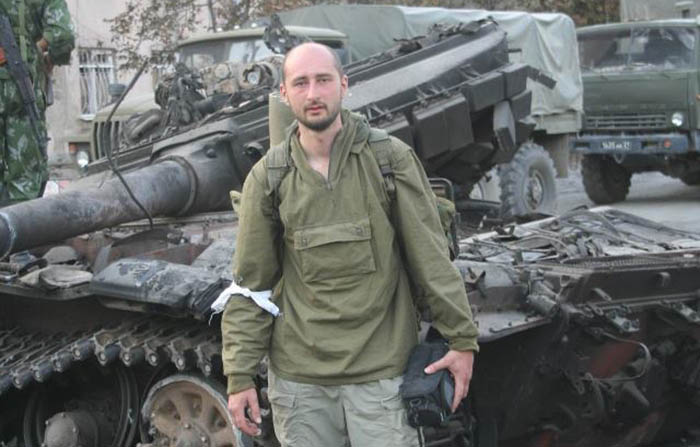
Updated statement: High profile Russian journalist and Kremlin critic Arkady Babchenko staged his own “murder”, it was revealed in a press conference where the journalist appeared on Wednesday 30 May. Earlier news reports have said he was shot and killed in Kiev, Ukraine, at his home, where he lived with his wife. However, that has since been revealed to be untrue.
Babchenko claimed it was necessary to do this in order to catch people who were trying to kill him.
Babchenko left Russia in February 2017, writing that it was “a country I no longer feel safe in”. Babchenko, a former war correspondent for Novaya Gazeta, was known for his fierce criticism of Russia’s annexation of Crimea, its support for separatists in eastern Ukraine and its military intervention in Syria.
Index calls on the Ukrainian police to continue their investigations into the 2016 murder of journalist Pavlo Sheremet, which has yet to be solved.[/vc_column_text][/vc_column][/vc_row][vc_row][vc_column][vc_basic_grid post_type=”post” max_items=”4″ element_width=”6″ grid_id=”vc_gid:1527698401910-293e4fff-01bc-10″ taxonomies=”15″][/vc_column][/vc_row]
16 May 2018 | Campaigns -- Featured, Digital Freedom, Digital Freedom Statements, Russia, Statements
[vc_row][vc_column][vc_column_text]We, the undersigned 53 international and Russian human rights, media and Internet freedom organisations, strongly condemn the attempts by the Russian Federation to block the internet messaging service Telegram, which have resulted in extensive violations of freedom of expression and access to information, including mass collateral website blocking.
We call on Russia to stop blocking Telegram and cease its relentless attacks on internet freedom more broadly. We also call the United Nations (UN), the Council of Europe (CoE), the Organisation for Security and Cooperation in Europe (OSCE), the European Union (EU), the United States and other concerned governments to challenge Russia’s actions and uphold the fundamental rights to freedom of expression and privacy online as well as offline. Lastly, we call on internet companies to resist unfounded and extra-legal orders that violate their users’ rights.
Massive internet disruptions
On 13 April 2018, Moscow’s Tagansky District Court granted Roskomnadzor, Russia’s communications regulator, its request to block access to Telegram on the grounds that the company had not complied with a 2017 order to provide decryption keys to the Russian Federal Security Service (FSB). Since then, the actions taken by the Russian authorities to restrict access to Telegram have caused mass internet disruption, including:
- Between 16-18 April 2018, almost 20 million internet Protocol (IP) addresses were ordered to be blocked by Roskomnadzor as it attempted to restrict access to Telegram. The majority of the blocked addresses are owned by international internet companies, including Google, Amazon and Microsoft. On 30 April, the number of blocked IP addresses was 14.6 million. As of 16 May 2018, this figure is currently 10.9 million.
- This mass blocking of IP addresses has had a detrimental effect on a wide range of web-based services that have nothing to do with Telegram, including, but not limited to, online banking and booking sites, shopping, and flight reservations.
- Within a week, Agora, the human rights and legal group, representing Telegram in Russia, reported it received requests for assistance with issues arising from the mass blocking from about 60 companies and website owners, including online stores, delivery services, and software developers. The number of requests has now reached 100.
- At least six online media outlets (Petersburg Diary, Coda Story, FlashNord, FlashSiberia, Tayga.info, and 7×7) found access to their websites was temporarily blocked.
- On 17 April 2018, Roskomnadzor requested that Google and Apple remove access to the Telegram app from their App stores, despite having no basis in Russian law to make this request. At the time of publication, the app remains available, but Telegram has not been able to provide upgrades that would allow better proxy access for users.
- Virtual Private Network (VPN) providers – such as TgVPN, Le VPN and VeeSecurity proxy – have also been targeted for providing alternative means to access Telegram. Federal Law 276-FZ bans VPNs and internet anonymisers from providing access to websites banned in Russia and authorises Roskomnadzor to order the blocking of any site explaining how to use these services.
- On 3 May 2018, Rozkomnadzor stated that it had blocked access to around 50 VPN services and anonymisers in relation to the Telegram block. On the same day, the Russia’s Communications Minister refused to rule out that other messaging services, including Viber, could potentially be blocked in Russia if they do not hand over encryption keys upon request. The minister had previously warned, during an interview on 6 April 2018, that action could be taken against Viber, as well as WhatsApp and Facebook Messenger.
[/vc_column_text][/vc_column][/vc_row][vc_row][vc_column width=”1/4″][vc_icon icon_fontawesome=”fa fa-file-excel-o” color=”black” background_style=”rounded” size=”xl” align=”right”][/vc_column][vc_column width=”3/4″][vc_column_text]
[/vc_column_text][/vc_column][/vc_row][vc_row][vc_column][vc_column_text]Background on restrictive internet laws
Over the past six years, Russia has adopted a huge raft of laws restricting freedom of expression and the right to privacy online. These include the creation in 2012 of a blacklist of internet websites, managed by Roskomnadzor, and the incremental extension of the grounds upon which websites can be blocked, including without a court order.
The 2016 so-called ‘Yarovaya Law’, justified on the grounds of “countering extremism”, requires all communications providers and internet operators to store metadata about their users’ communications activities, to disclose decryption keys at the security services’ request, and to use only encryption methods approved by the Russian government – in practical terms, to create a backdoor for Russia’s security agents to access internet users’ data, traffic, and communications.
In October 2017, a magistrate found Telegram guilty of an administrative offense for failing to provide decryption keys to the Russian authorities – which the company states it cannot do due to Telegram’s use of end-to-end encryption. The company was fined 800,000 rubles (approx. 11,000 EUR). Telegram lost an appeal against the administrative charge in March 2018, giving the Russian authorities formal grounds to block Telegram in Russia, under Article 15.4 of the Federal Law “On Information, Information Technologies and Information Protection”.
The Russian authorities’ latest move against Telegram demonstrates the serious implications for people’s freedom of expression and right to privacy online in Russia and worldwide:
- For Russian users apps such as Telegram and similar services that seek to provide secure communications are crucial for users’ safety. They provide an important source of information on critical issues of politics, economics and social life, free of undue government interference. For media outlets and journalists based in and outside Russia, Telegram serves not only as a messaging platform for secure communication with sources, but also as a publishing venue. Through its channels, Telegram acts as a carrier and distributor of content for entire media outlets as well as for individual journalists and bloggers. In light of direct and indirect state control over many traditional Russian media and the self-censorship many other media outlets feel compelled to exercise, instant messaging channels like Telegram have become a crucial means of disseminating ideas and opinions.
- Companies that comply with the requirements of the ‘Yarovaya Law’ by allowing the government a back-door key to their services jeopardise the security of the online communications of their Russian users and the people they communicate with abroad. Journalists, in particular, fear that providing the FSB with access to their communications would jeopardise their sources, a cornerstone of press freedom. Company compliance would also signal that communication services providers are willing to compromise their encryption standards and put the privacy and security of all their users at risk, as a cost of doing business.
- Beginning in July 2018, other articles of the ‘Yarovaya Law’ will come into force requiring companies to store the content of all communications for six months and to make them accessible to the security services without a court order. This would affect the communications of both people in Russia and abroad.
Such attempts by the Russian authorities to control online communications and invade privacy go far beyond what can be considered necessary and proportionate to countering terrorism and violate international law.
International Standards
- Blocking websites or apps is an extreme measure, analogous to banning a newspaper or revoking the license of a TV station. As such, it is highly likely to constitute a disproportionate interference with freedom of expression and media freedom in the vast majority of cases, and must be subject to strict scrutiny. At a minimum, any blocking measures should be clearly laid down by law and require the courts to examine whether the wholesale blocking of access to an online service is necessary and in line with the criteria established and applied by the European Court of Human Rights. Blocking Telegram and the accompanying actions clearly do not meet this standard.
- Various requirements of the ‘Yarovaya Law’ are plainly incompatible with international standards on encryption and anonymity as set out in the 2015 report of the UN Special Rapporteur on Freedom of Expression report (A/HRC/29/32). The UN Special Rapporteur himself has written to the Russian government raising serious concerns that the ‘Yarovaya Law’ unduly restricts the rights to freedom of expression and privacy online. In the European Union, the Court of Justice has ruled that similar data retention obligations were incompatible with the EU Charter of Fundamental Rights. Although the European Court of Human Rights has not yet ruled on the compatibility of the Russian provisions for the disclosure of decryption keys with the European Convention on Human Rights, it has found that Russia’s legal framework governing interception of communications does not provide adequate and effective guarantees against the arbitrariness and the risk of abuse inherent in any system of secret surveillance.
We, the undersigned organisations, call on:
- The Russian authorities to guarantee internet users’ right to publish and browse anonymously and ensure that any restrictions to online anonymity are subject to requirements of a court order, and comply fully with Articles 17 and 19(3) of the ICCPR, and articles 8 and 10 of the European Convention on Human Rights, by:
-
-
- Desisting from blocking Telegram and refraining from requiring messaging services, such as Telegram, to provide decryption keys in order to access users private communications;
- Repealing provisions in the ‘Yarovaya Law’ requiring internet service providers (ISPs) to store all telecommunications data for six months and imposing mandatory cryptographic backdoors, and the 2014 Data Localisation law, which grant security service easy access to users’ data without sufficient safeguards.
- Repealing Federal Law 241-FZ, which bans anonymity for users of online messaging applications; and Law 276-FZ which prohibits VPNs and internet anonymisers from providing access to websites banned in Russia
-
- Amending Federal Law 149-FZ “On Information, IT Technologies and Protection of Information” so that the process of blocking websites meets international standards. Any decision to block access to a website or app should be undertaken by an independent court and be limited by requirements of necessity and proportionality for a legitimate aim. In considering whether to grant a blocking order, the court or other independent body authorised to issue such an order should consider its impact on lawful content and what technology may be used to prevent over-blocking.
- Representatives of the United Nations (UN), the Council of Europe (CoE), the Organisation for the Cooperation and Security in Europe (OSCE), the European Union (EU) the United States and other concerned governments to scrutinise and publicly challenge Russia’s actions in order to uphold the fundamental rights to freedom of expression and privacy both online and-offline, as stipulated in binding international agreements to which Russia is a party.
- Internet companies to resist orders that violate international human rights law. Companies should follow the United Nations’ Guiding Principles on Business & Human Rights, which emphasise that the responsibility to respect human rights applies throughout a company’s global operations regardless of where its users are located and exists independently of whether the State meets its own human rights obligations.
Signed by
- Asociatia pentru Tehnologie si Internet – ApTI
- Associação D3 – Defesa dos Direitos Digitais
- Centre for the Development of Democracy and Human Rights
- Committee to Protect Journalists
- Electronic Frontier Foundation
- Electronic Frontier Norway
- Electronic Privacy Information Centre (EPIC)
- European Federation of Journalists
- Glasnost Defence Foundation
- Human Rights House Foundation
- The Independent Historical Society
- International Media Support
- International Partnership for Human Rights
- Internet Society Bulgaria
- International Youth Human Rights Movement (YHRM)
- Interregional Human Rights Group
- Kharkiv Human Rights Protection Group
- Mass Media Defence Centre
- Memorial Human Rights Center
- Movement ‘For Human Rights’
- Norwegian Helsinki Committee
- Press Development Institute-Siberia
- Reporters without Borders
- Russian Journalists’ and Media Workers’ Union
- Transparency International
- Transparency International Russia
- Webpublishers Association (Russia)
- World Wide Web Foundation
[/vc_column_text][/vc_column][/vc_row][vc_row][vc_column][vc_column_text][/vc_column_text][/vc_column][/vc_row][vc_row][vc_column][vc_basic_grid post_type=”post” max_items=”12″ style=”load-more” items_per_page=”4″ element_width=”6″ grid_id=”vc_gid:1526459542623-9472d6b1-41e3-0″ taxonomies=”15″][/vc_column][/vc_row]
