The Council of Europe, the Organization for Security and Cooperation in Europe (OSCE) and the Index on Censorship organization campaigning for freedom of expression have criticized Estonia this week for refusal to give accreditation to three Russian journalists to an European Union ministerial meeting to be held in Tallinn, Postimees said. Read the full article
The Council of Europe, the OSCE and the Index on Censorship, an organization which campaigns for freedom of expression, have criticized Estonia this week for the country’s refusal to accredit three Russian journalists for an EU ministerial meeting to be held in Tallinn this month, daily Postimees reported. Read the full article
[vc_row][vc_column][vc_column_text]8 August: Index on Censorship welcomes a ruling by a Russian court temporarily halting the deportation of independent journalist Khudoberdi Nurmatov, better known by his pen name Ali Feruz. The decision follows a European Court of Human Rights order to delay the deportation until it can rule on the journalist’s appeal.
Index calls on the Russian authorities to allow accept Nurmatov’s asylum application and ensure he is treated safely.[/vc_column_text][vc_single_image image=”94957″ img_size=”full” add_caption=”yes” alignment=”center”][vc_column_text]Journalist Khudoberdi Nurmatov, who works for independent Russian newspaper Novaya Gazeta, is set to be deported back to Uzbekistan, where it is feared he will be tortured.
“Deportation to Uzbekistan puts his life at serious risk. If sent back Nurmatov faces a long prison sentence under cruel conditions, including torture. We call on Russia to stop the deportation and accept Nurmatov’s asylum application,” Hannah Machlin, manager for Index on Censorship’s Mapping Media Freedom project, said.
A Moscow court ruled on 1 August 2017 that Nurmatov (also known as Ali Feruz) violated immigration laws. He is currently being held in a deportation centre in Moscow where he faces immediate expulsion from the country. In May 2016 and in February 2017, Russia refused to grant the journalist temporary asylum.
In 2008, Novaya Gazeta reported that Nurmatov was abducted by Uzbek security forces who demanded he provide information on his contacts. He was subsequently beaten and threatened. He later applied for asylum in Kyrgyzstan and Kazakhstan, but decided to flee to Russia in 2011, where he feared extradition. Because of his refusal to work for Uzbek security forces, friends and supporters are concerned that he could be abducted or tortured.
According to his lawyer Daniil Khaimovich, on 2 August Feruz attempted to commit suicide in a hallway at the courthouse. The journalist then told his lawyer: “I would rather die than return to Uzbekistan.”
Nurmatov has covered a wide range of topics at the paper including on abuse of power, LGBT issues and conditions of central asian immigrants in Russia.
“Ali is an extremely valuable asset as he’s been covering the migrant community in Russia that media normally can’t report on easily. He is committed to his work and shows real compassion to the problems he reports on. We can’t imagine losing him,” Anna Baydakova, a politics reporter for the Novaya Gazeta newspaper, told Index on Censorship. [/vc_column_text][/vc_column][/vc_row][vc_row][vc_column][vc_basic_grid post_type=”post” max_items=”12″ style=”load-more” items_per_page=”4″ element_width=”6″ grid_id=”vc_gid:1502188585770-4b2b310d-e3a3-9″ taxonomies=”7349, 15″][/vc_column][/vc_row][vc_row][vc_column][/vc_column][/vc_row]
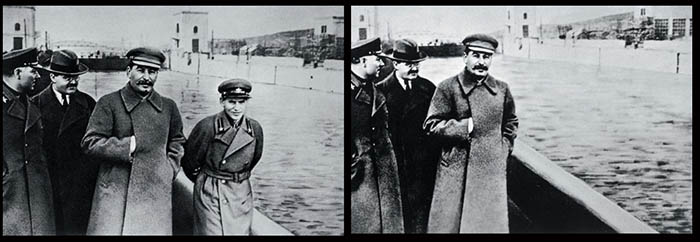
The Commissar Vanishes, the late David King’s visual history of the falsification of images as a means of propaganda in the Soviet Union, explores how Stalin manipulated photography to erase all memory of his victims.
The murder of rivals and former comrades was very often followed the removal of these “counter-revolutionaries” from photographs with scalpel and airbrush. At the same time, ordinary citizens, fearful of being in possession of banned material, defaced their copies books and photographs with scissors and India ink. King’s book offers a contrast between the original photographs alongside their doctored counterparts, for a chilling look into one of darkest periods in history.
It was in 1970, 17 years after Stalin’s death that King first encountered these photos in Moscow. “When I inquired about photographs of Trotsky, the reply would invariably be, ‘Why do you ask for Trotsky? Trotsky not important in Revolution. Stalin important!’,” King wrote in the introduction to the book. “In the dark green metal boxes containing mug shots of subjects starting with ‘T’ were hundreds of photographs of famous Russians: Tolstoy, Turgenev, etc.–but no Trotsky. They had completely wiped him out. It was at this moment that I determined to start my collection.”
“Propaganda did not work just on what was shown; it worked also on what was omitted. Stalin was a master of this. Long before the advent of Photoshop, technicians in Russia manipulated photos so much that they became outright lies. David King, in The Commissar Vanishes: The Falsification of Photographs and Art in Stalin’s Russia, wrote that during the Great Purges, in the 1930s, ‘a new form of falsification emerged. The physical eradication of Stalin’s political opponents at the hands of the secret police was swiftly followed by their obliteration from all forms of pictorial existence’. The book highlights classic cases of ‘now you see me, now you don’t’. It includes series of images featuring the same backdrops but with rotating casts, depending on who was or wasn’t in favour at the time.”
As Yale philosophy professor Jason Stanley, author of How Propaganda Works, told Steinfeld: “At the heart of authoritarian propaganda is the manipulating of reality. The authoritarian must undermine this.”
[/vc_column_text][/vc_column][/vc_row][vc_row content_placement=”top”][vc_column width=”1/3″][vc_custom_heading text=”100 Years On” font_container=”tag:p|font_size:24|text_align:left” link=”url:https%3A%2F%2Fwww.indexoncensorship.org%2F2017%2F06%2F100-years-on%2F|||”][vc_column_text]Through a range of in-depth reporting, interviews and illustrations, the summer 2017 issue of Index on Censorship magazine explores how the consequences of the 1917 Russian Revolution still affect freedoms today, in Russia and around the world.
With: Andrei Arkhangelsky, BG Muhn, Nina Khrushcheva[/vc_column_text][/vc_column][vc_column width=”1/3″][vc_single_image image=”91220″ img_size=”medium” alignment=”center” onclick=”custom_link” link=”https://www.indexoncensorship.org/2017/06/100-years-on/”][/vc_column][vc_column width=”1/3″ css=”.vc_custom_1481888488328{padding-bottom: 50px !important;}”][vc_custom_heading text=”Subscribe” font_container=”tag:p|font_size:24|text_align:left” link=”url:https%3A%2F%2Fwww.indexoncensorship.org%2Fsubscribe%2F|||”][vc_column_text]In print, online. In your mailbox, on your iPad.
Subscription options from £18 or just £1.49 in the App Store for a digital issue.
Every subscriber helps support Index on Censorship’s projects around the world.