As thousands of people took to the streets across Russia on 12 June 2017 to protest corruption, journalists were among those detained by police, according to verified incidents reported to Mapping Media Freedom.
The Russia Day demonstrations followed calls from the Foundation Against Corruption, an NGO headed by political opposition leader Aleksei Navalny. Rallies took place across the country, with the largest gatherings taking place in Moscow and St Petersburg.
According to OVD-INFO, an independent police monitoring website, at least 1,769 people were detained in 31 cities throughout the day. Rights groups also registered serious human rights violations. The largest number of arrests took place in St Petersburg where roughly 700 people were detained. Around 200 of the detainees were minors who were released after their parents intervened. Russian authorities can hold individuals for 48 hours before they are arrested.
Another 150 demonstrators were sentenced to administrative arrest of up to 15 days in detention, and yet others received fines of between 10,500 and 15,000 rubles (€150 to €250).
Journalists were threatened and detained throughout the country.
As of 31/07/2017, there were 361 verified reports of media freedom violations associated with Russia in the Mapping Media Freedom database.[/vc_column_text][/vc_column_inner][vc_column_inner width=”1/2″][vc_column_text]
My 30 hours in detention
As an independent journalist, I was one of the media professionals detained by police at the St Petersburg rally. I was taken to a police station and held with 40 other people for 30 hours before being fined 10,500 rubles (€150) for participating in an illegal demonstration. I am appealing the court’s decision.
In Moscow, Andrey Poznaykov, a reporter for the Echo of Moscow radio station covering the demonstrations, was detained while he was taking a break on a cafe’s terrace. Though he showed officers his press card, he was taken to a police van and released soon after.
Other detainees in Moscow include: Novaya Gazeta photographer Evgeni Feldman, a correspondent for Open Russia Nikita Safronov, independent photographer Georgi Malets and independent journalist Denis Styazhkin. Aleksei Abanin, a photographer for the RTVi, wrote later that a police officer had threatened “to break my camera and break my face if I continue to photograph.”
Ignacio Ortega, a Moscow-based reporter for Spanish news agency EFE, was also detained while he was reporting from the anti-corruption rally. Officers held Ortega in a van with dozens of other individuals before bringing him and the others to a police station. Ortega was released after he identified himself at the station, EFE reported.
Blogger Yan Katelevski said that he was physically assaulted by police officers while being detained: “They dropped my press card, kicked me and hit me with batons, grabbed me by the throat, and beat me on my head while I was on a police bus”.
In Sochi, Andrey Kiselyov, a correspondent for Radio RFE/RL, was detained and issued him a warning to not commit any further legal violations.
In Makhachkala, Dagestan, Caucasian Knot journalist Patimat Makhmudova said that unknown people had broken her camera during the 12 June protests. Additionally, Bariyat Idrisova and Saida Vagabova, correspondents for the independent Dagestani news website Chernovik were assaulted and prevented from filming at the same anti-corruption rally, Chernovik reported.
In Saratov, an unknown person attempted to prevent filming by correspondents from the Open Channel, a local TV station. The unknown individual approached the TV crew, asked whether everything was OK and then tried to run away with the camera.
Frenkel was soon released while Morozova was taken to the police station, where she was kept overnight before facing a trial for “public order disturbance”. After spending 35 hours in the police station, Morozova was brought to the court for trial. She was sentenced to 10 days administrative arrest and a fine of 15,000 rubles (€250). The court argued that Morozova had no “accreditation” to work at the protest.
The Russian Union of Journalists (UJ) released a statement condemning the harsh police actions taken at the anti-corruption rallies across the country. The UJ demanded the release of all detained journalists and sent an appeal to the Chief Police Department of the Ministry of Interior. The head of the journalists’ union Pavel Gusev stated in his interview that the police had disturbed journalists from accomplishing their professional duties.
The St. Petersburg Ombudsman Aleksandr Shyshlov also issued a press release condemning police actions during the rallies where “hundreds of people were detained, among them minors, media representatives, observers and passing civilians who did not commit any unlawful actions”.
Click on the bubbles to view reports or double-click to zoom in on specific regions. The full site can be accessed at https://mappingmediafreedom.org/[/vc_column_text][/vc_column][/vc_row]
To mark the release of the issue, Index has compiled a reading list for people wishing to learn more about its legacy in the world today. This list includes works from Soviet Russia and post-Soviet Russia, including Russia under Putin today.
An excerpt of a longer poem written by Solzhenitsyn while in a labour camp in North Kazakhstan. The camp later became the inspiration for Solzhenitsyn’s novel A Day in the Life of Ivan Denisovich.
Glezer was responsible for organising the now famous unofficial art exhibitions in Moscow in 1974. The first exhibition, on 15 September, was ‘”bulldozed” by police and KGB agents, and a number of artists who tried to exhibit their work were arrested. Two weeks later, however, an open-air exhibition did take place, after the authorities gave permission, and some 10,000 people turned up to see paintings and sculptures by modern Soviet artists who did not enjoy official favour.
This article examines Soviet interpretations of 1984, including the assertion that George Orwell was actually critiquing capitalism, not the USSR, with his novel.
This is an article about the musician Vladimir Vysotsky, once called “the most idolised figure in the Soviet Union”. His songs were circulated on homemade tapes, though never officially recorded until after his death.
An Estonian reporter’s exposé prompts a call from the army. Madis Jurgen, who brought to light the dark side of the Soviet armed forces, left Tallinn on Friday 13 October, bound for New York and Toronto, from where he decided to await events.
Early on 26 April 1986, a series of explosions destroyed the nuclear reactor and building of the fourth power generator unit of Chernobyl atomic power station. These extracts are not about the Chernobyl disaster but about a world of Chernobyl of which we know almost nothing. They are the unwritten history.
As they say, still waters run deep. On 8 February 2000, an announcement was made in the St Petersburg Gazette by members of the St Petersburg State University Initiative Group. Shortly beforehand they had, in competition with others, nominated Putin as a presidential candidate and now wished to demonstrate their enthusiasm for their former pupil. What they published was a denunciation.
An article on the disappeared in Chechnya, who officially number about 1,000, but unofficially are almost 2,000. They disappeared throughout the war. The author, Anna Politkovskaya, was murdered in her Moscow apartment in a contract killing in 2006.
Ali Kamalov, the head of Dagestan’s journalists’ union fears for the future of press freedom following the murder of the country’s most prominent editor. On 15 December 2011, Hadjimurad Kamalov was murdered in Makhachkala, the seaboard capital of Dagestan.
Although the Russian constitution enshrines freedom of expression, the authorities routinely clamp down on anybody who treasures this fundamental right. State officials, judges, deputies, prosecutors and police officers serve the ruling regime and control society, rather than defend the constitution or protect human rights.
Helen Womack interviews the founder of the last free radio station in Putin’s Russia. These men are not dissidents, just journalists dedicated to professional principles of objectivity and balance. But in Putin’s Russia, where almost all the media spout state propaganda, that position looks like radical nonconformity, and it seems a wonder that Echo survives.
In the winter 2014 issue of Index on Censorship magazine, Andrei Aliaksandrau investigates the new information war between Russia and Ukraine as he travels across the latter country.
Andrei Aliaksandrau examines the evolution of censorship in Russia, from Soviet institutions to today’s blend of influence and pressure, including the assassination of journalists.
Andrey Arkhangelsky explores Russian journalism a decade on from Anna Politkovskaya’s murder and argues that the press still struggles to offer readers the full picture.
*Articles which are free to read on Sage. All other articles are available via Sage in most university libraries. To find out more about subscribing to the magazine in print or digitally, click here.
Index on Censorship magazine celebrated the launch of its summer 2017 issue with an evening exploring the 1917 Russian Revolution and its effects on our freedoms today.
The Calvert 22 Foundation-hosted event examined the role of propaganda, culture and politics from around the globe.
Speakers included Don Guttenplan, editor-at-large for The Nation, who spoke on the cultural Cold War; Katya Rogatchevskaia, lead curator of Central and East European collections at the British Library, who examined the role of Russian propaganda both during the Cold War and today; and Adam Cathcart, a specialist in Chinese history at Leeds University, who spoke on the impact of Soviet art and music in North Korea.
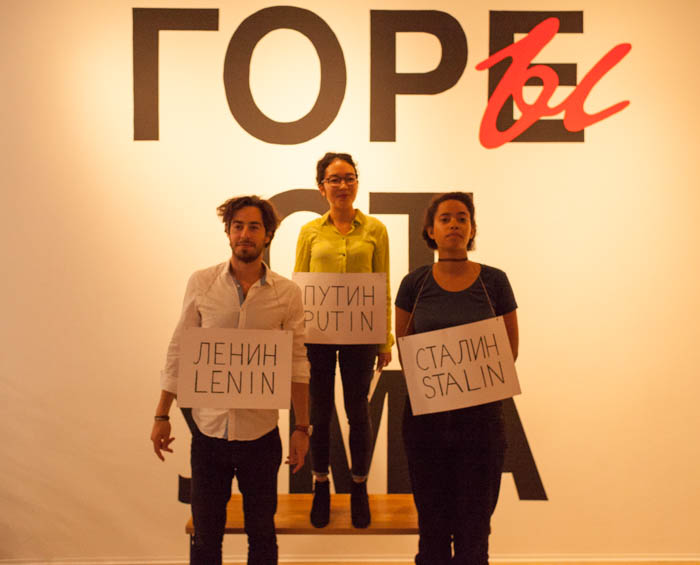
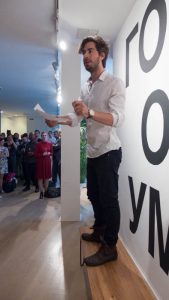
Guests were invited to listen to actors performing excerpts from speeches by Lenin, Stalin and Putin. Guttenplan noted the speeches reminded him of the dialogue he hears in today’s political realm. “When we were listening to Lenin’s speech, I was thinking, well that doesn’t sound that different from John McDonnell and Jeremy Corbyn,” he said.
Rogatchevskaia discussed how art and propaganda influenced the Russian Revolution. “It was important that a revolution was happening at the same time in art and in social and political life,” she said. “These two revolutions actually met at one point and that created a fantastic abundance of really great art, and that’s why we remember this period.”
Cathcart spoke of the “cultural cold war” with South Korea on one side and China and North Korea on the other. He explained how cultural revolutions in South Korea have influenced the Chinese mindset and their favour of North Korean customs. “Chinese scholars have to come to grips with the Korean wave,” Cathcart said. “This is a country that has done extremely well, everybody’s on high broadband internet, the pop bands are doing extremely well. North Korea exports almost nothing culturally. North Korean music is something they’ve [the Chinese] tried to bring in competition with South Korea.”
Index’s summer publication, which was given to all attendees, features reports from across the globe including Uzbekistan, China, Russia, Cuba and Turkey. Writers for this issue include David Aaronovitch, Nikita Khrushchev’s great-granddaughter Nina Khrushcheva, and an interview with author Margaret Atwood.
The event was held on at Calvert 22 Foundation, which celebrates the culture and creativity of the New East.
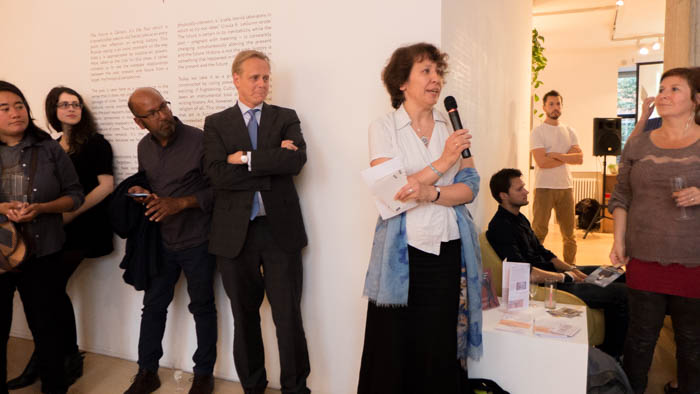
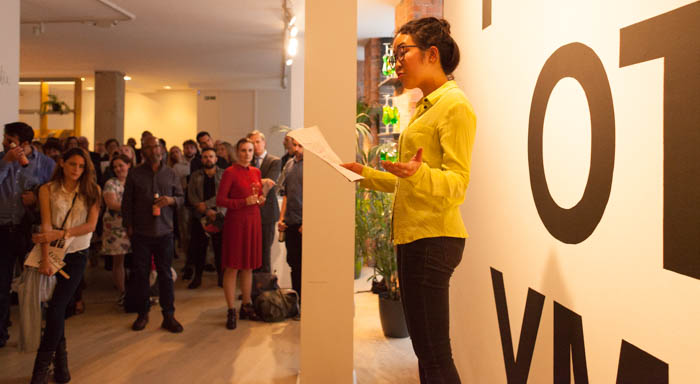
Katya Rogatchevskaia, lead Curator of Central and East European collections at the British Library, discusses Russia’s revolutionary propaganda. (Photo: Sean Gallagher / Index on Censorship)
An actor reads from a speech by Vladimir Lenin. (Photo: Sean Gallagher / Index on Censorship)
Adam Cathcart, a specialist and lecturer in Chinese history at Leeds University, explores the impact of Soviet art on North Korean art and culture. (Photo: Sean Gallagher / Index on Censorship)
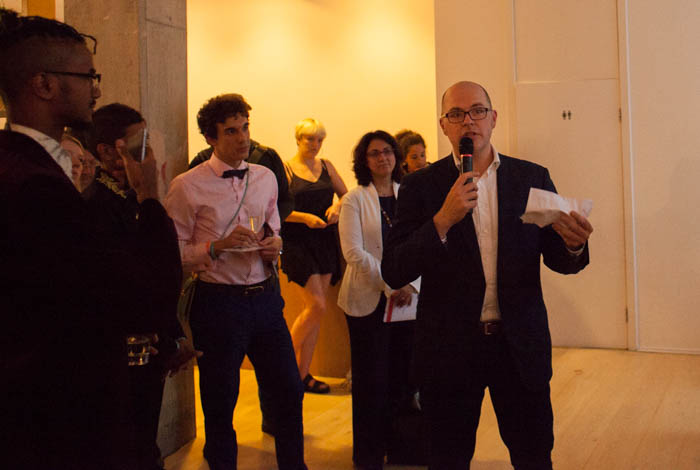
Index on Censorship magazine editor Rachael Jolley introduces the summer 2017 issue. (Photo: Sean Gallagher / Index on Censorship)
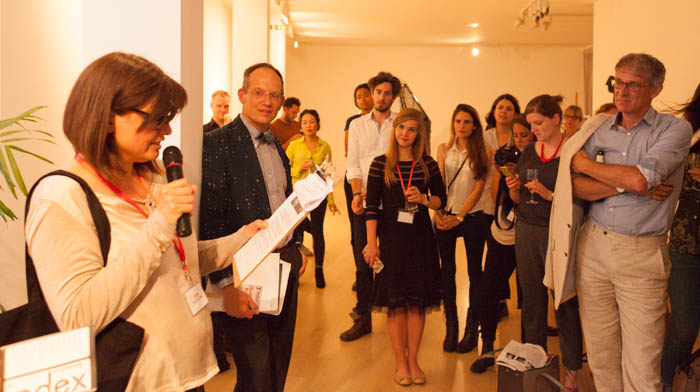
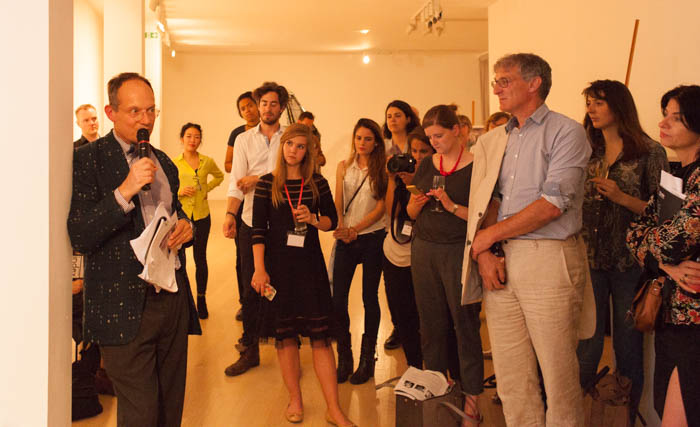
Don Guttenplan, Editor-at-Large for The Nation, shares his take on the cultural cold war, (Photo: Sean Gallagher / Index on Censorship)
Actors read from speeches by Lenin (Matthew Romain), Stalin (Amanda Wilkin) and Putin (Jennifer Leong). (Photo: Sean Gallagher / Index on Censorship)
An actor reads from a speech by Vladimir Putin. (Photo: Sean Gallagher / Index on Censorship)
[/vc_column_text][/vc_column][/vc_row][vc_row content_placement=”top”][vc_column width=”1/3″][vc_custom_heading text=”100 Years On” font_container=”tag:p|font_size:24|text_align:left” link=”url:https%3A%2F%2Fwww.indexoncensorship.org%2F2017%2F06%2F100-years-on%2F|||”][vc_column_text]Through a range of in-depth reporting, interviews and illustrations, the summer 2017 issue of Index on Censorship magazine explores how the consequences of the 1917 Russian Revolution still affect freedoms today, in Russia and around the world.
With: Andrei Arkhangelsky, BG Muhn, Nina Khrushcheva[/vc_column_text][/vc_column][vc_column width=”1/3″][vc_single_image image=”91220″ img_size=”medium” alignment=”center” onclick=”custom_link” link=”https://www.indexoncensorship.org/magazine”][/vc_column][vc_column width=”1/3″ css=”.vc_custom_1481888488328{padding-bottom: 50px !important;}”][vc_custom_heading text=”Subscribe” font_container=”tag:p|font_size:24|text_align:left” link=”url:https%3A%2F%2Fwww.indexoncensorship.org%2Fsubscribe%2F|||”][vc_column_text]In print, online. In your mailbox, on your iPad.
Subscription options from £18 or just £1.49 in the App Store for a digital issue.
Every subscriber helps support Index on Censorship’s projects around the world.
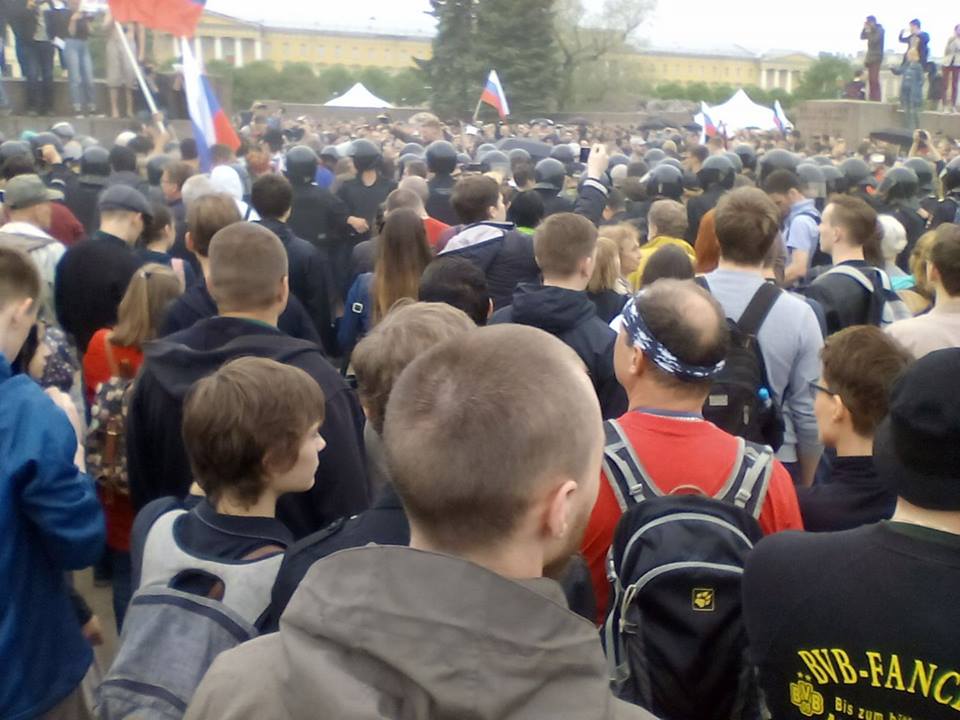
Protesters in St. Petersburg demonstrated against corruption in Russia (Photo: Andrey Kalikh)
Over the last seven days protests, lawsuits, and self-proclaimed governments have stopped journalists from doing their jobs in countries covered by Index on Censorship’s project Mapping Media Freedom.
Project Manager Hannah Machlin explains why incidents in Russia and Albania are particularly alarming.
“It’s appalling that around 1500 individuals were arrested — including journalists — at the anti-corruption rallies across Russia on Monday,” Machlin said.
Despite showing their press credentials, five journalists were detained including Index’s Mapping Media Freedom correspondent, Andrey Kalikh.
Machlin said, “Our previous reports and our monitoring of wave of anti-corruption rallies indicate that the trend of arresting journalists for doing their job will not abate.”
Machlin said the situation in Albania is also worrying because “a judge, who is in a position of influence, is now attempting to silence journalists who were investigating criminal investigations into him and his family.” She explained, “investigative reporters are consistently targeted when uncovering corruption of state officials and we must call on government institutions to allow journalists to freely report.”
Russia: Five journalists detained including one Mapping Media Freedom correspondent
12 June, 2017 – An anti-corruption rallies proved to be a dangerous place for journalists on 12 June. The rallies were called by opposition figure Alexei Nalvalny in a long-term attempt to overthrow Vladimir Putin.
At a rally in Moscow, reporter Ignacio Ortega for a Spanish news agency, EFE, in Moscow was arrested while reporting on the event. After identifying himself with his press card at the station, he was released.
Photographer David Frenkel, contributor to Kommersant and Mediazona, and Ksenia Morozova, a journalist for Sobaka.ru a local website, were both detained despite showing their press cards while covering the anti-corruption rally in St. Petersburg. Frenkel was soon released but Morozova was held overnight before a trial for “public order disturbance.”
Reporter Andrey Poznaykov of Echo of Moscow radio station went to a café for a break where he was detained by policemen even after showing his press card. In his blog, he said he was detained for covering the anti-corruption rally in Moscow. Poznaykov was released shortly after being taken to a police van.
Mapping Media Freedom correspondent, Andrey Kaikh, was detained at an anti-corruption rally in St. Petersburg. From a police bus he wrote he was amongst 40 others at a peaceful demonstration. So far, about 300 protesters have been detained in St. Petersburg. Kaikh was fined 150 Euros and released him at the end of the day on 13 June.
The charges were filed against Balkan Investigative Reporting Network (BIRN) along with their journalist Besar Likmeta and Aleksandra Bogdani and Shqiptarja newspaper, along with their journalists Adriatic Doci and Elton Qyno.
The judge and his wife are asking for 7 million Lek (54, 000 EUR) in compensation from Balkan Investigative Reporting Network, BIRN in Tirana and two of their journalists; They are asking for 4 million Lek (30,000 EUR) from Shqiptarja newspaper and two from their journalists.
BIRN Albania, Adriatik Doci and the Union of Albanian Journalists have all spoken out about the lawsuit.
2 June, 2017 – Ukrainian blogger and writer Stanyslav Aseev disappeared in territory controlled by the self-proclaimed Donetsk People’s Republic. Aseev was reportedly detained by militants of the self-proclaimed DPR. Aseev uses the alias Stanislav Vasin and contributes to a number of news outlets including Radio Liberty Donbas Realities project, Ukrayinska Pravda, Ukrainian week, Dzerkalo Tyzhnya. He also runs a prominent blog via Facebook.
Radio Liberty Donbass realities project editor-in-chief Tetyana Jakubowicz said their contact with Aseev had been lost on 2 June. That day Aseev’s latest report from territories held by separatists for Radio Liberty.
The journalist’s mother said his flat was broken into and noticed several of his belongings were missing including his laptop.
Fiona Frazer, the Head of the United Nations Human Rights Monitoring Mission in Ukraine, said that the mission was searching for Aseev, Radio Liberty reported. “We are trying to understand exactly what was happening to him. We are still trying to gain access there to understand where he is “, Frazer said. She added that, as in other cases, “when militants detain people, responsibility for this is placed on those who control the territory”.
9 June, 2017 – New French labour minister Muriel Pénicaud filed a complaint against an unknown person for theft, breach of professional confidentiality and possession of confidential information following the publication of an article in the Libération newspaper about the government’s labour reform projects, Libération reported. “They were mad with anger,” a source at the Labour Ministry told Libération, about the reaction to the story. “They reacted with such violence that they terrorised all of the affected department.”
Click on the bubbles to view reports or double-click to zoom in on specific regions. The full site can be accessed at https://mappingmediafreedom.org/[/vc_column_text][/vc_column][/vc_row][vc_row full_width=”stretch_row_content_no_spaces” content_placement=”middle”][vc_column][vc_single_image image=”91122″ img_size=”full” alignment=”center” onclick=”custom_link” link=”https://www.indexoncensorship.org/2017/05/stand-up-for-satire/”][/vc_column][/vc_row]

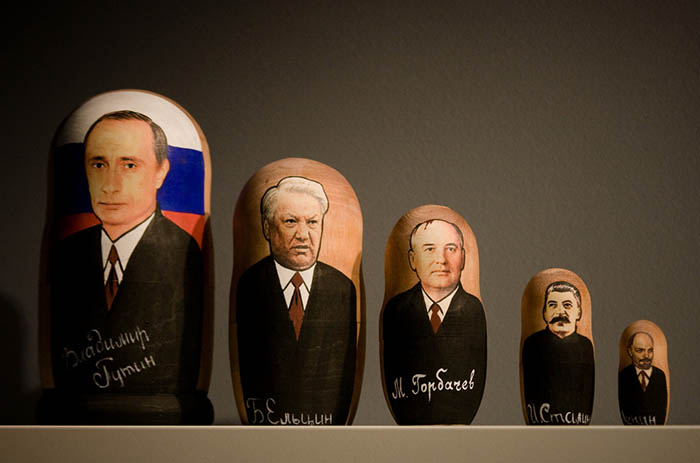
 Guests were invited to listen to actors performing excerpts from speeches by Lenin, Stalin and Putin. Guttenplan noted the speeches reminded him of the dialogue he hears in today’s political realm. “When we were listening to Lenin’s speech, I was thinking, well that doesn’t sound that different from John McDonnell and Jeremy Corbyn,” he said.