11 Sep 2015 | Magazine, mobile, Volume 44.03 Autumn 2015
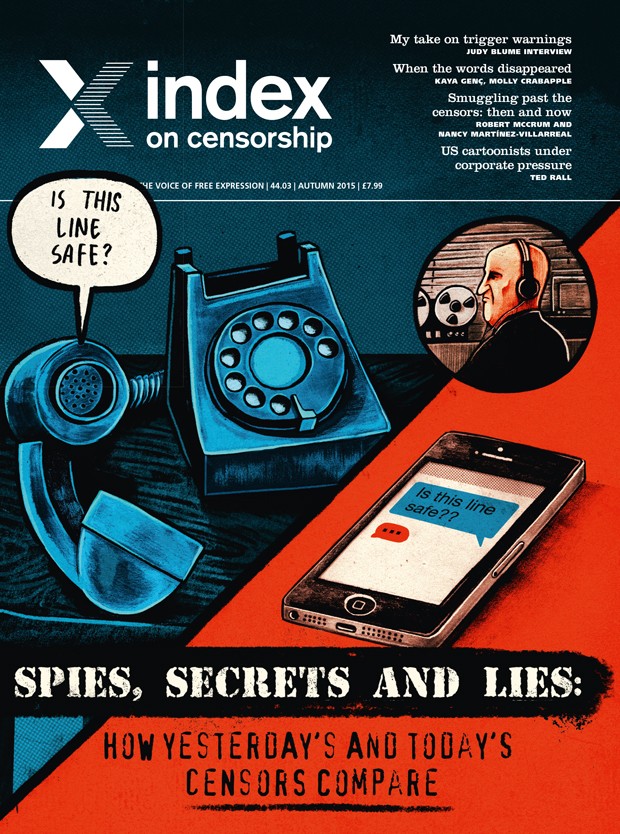
The autumn 2015 issue of Index on Censorship magazine focuses on comparisons between yesterday’s and today’s censors and will be available from 14 September.
In the latest issue on Index on Censorship magazine Spies, secrets and lies: How yesterday’s and today’s censors compare, we look at nations around the world, from South Korea to Argentina, and discuss if the worst excesses of censorship have passed or whether new techniques and technology make it even more difficult for the public to attain information.
Smuggling documents and writing out of restricted countries has helped get the news out, and into Index on Censorship magazine over the years. In this issue, you can hear three stories of how writing and ideas were smuggled into or out of countries. Robert McCrum swapped bananas for smuggled documents in Communist Czechoslovakia; Nancy Martínez-Villarreal used lipstick containers to hide notes in Pinochet’s Chile and Kim Joon Young tells of how flash drives hidden in car tyres take information into North Korea.
Also in this issue, an interview with Judy Blume on over-protective parents’ stopping children from reading, Molly Crapabble illustrates a new short story from Turkish novelist Kaya Genç, Jamie Bartlett on crypto wars and Iranian satirist Hadi Khorsandi on how writers are muzzled and threatened in Iran. Don’t miss Mark Frary mythbusting the technological tricks that can and can’t protect your privacy from corporations and censors.
There’s also a cartoon strip by award-winning artist Martin Rowson, newly translated Russian poetry and a long extract of a Brazilian play that has never before been translated into English.
CONTENTS: Issue 44, 3
Spies, secrets and lies: How yesterdays and today’s censors compare?
SPECIAL REPORT
New dog, old tricks – Jemimah Steinfeld compares life and censorship in 1980s China with that of today
Smugglers’ tales – Three people who’ve smuggled documents from around the world discuss their experiences
Stripsearch cartoon – Martin Rowson’s regular cartoon is a challenge from Chairman Miaow
From murder to bureaucratic mayhem – Andrew Graham-Yooll assesses what happened to Argentina’s journalists after the country’s dictatorship crumbled
Words of warning – Raymond Joseph, a young reporter during apartheid, compares press freedom in South Africa then and now
South Korea’s smartphone spies– Steven Borowiec reports on a new law in South Korea embedding a surveillance tool on teenagers’ phones
“We lost journalism in Russia” – Andrei Aliaksandrau examines the evolution of censorship in Russia from the Soviet era to today
Indian films on the cutting-room floor – Suhrith Parthasarathy discusses the likes and dislikes of India’s film boards over the decades
The books that nobody reads – Iranian satirist Hadi Khorsandi reports on how it is harder than ever for writers in his homeland to evade censorship
Lessons from McCarthyism – Judith Shapiro looks at the impact of the McCarthyite accusations and fasts forward to address the challenges to free speech in the US today
Doxxed – When prominent women express their views online, they can face misogynist abuse. Video game developer Brianna Wu, who was targeted during the Gamergate scandal, gives her view
Reporting rights? – Milana Knezevic looks at threats to journalism in the former Yugoslavia since the Balkan wars
My life on the blacklist – Uzbek writer Mamadali Makhmudov tells Index how his works continue to be suppressed having already served 14 years on bogus jail charges
Global view – F0r her regular column, Index’s CEO Jodie Ginsberg writes about libraries; how they are vital communities and why censorship should be left at their doors
IN FOCUS
Battle of the bans – US author Judy Blume talks to Index’s deputy editor Vicky Baker about trigger warnings, book bannings and children’s literature today
Drawing down – Ted Rall discusses why US cartoonists are being forced to play it safe to keep their shrinking pay cheques
Under the radar – Jamie Bartlett explores how people keep security agencies in check
Mythbusters – Mark Frary debunks some widely held misconceptions and discusses which devices, programs and apps you can trust
Clearing the air: investigating Weibo censorship in China – Academics Matthew Auer and King-Wa Fu discuss new research that reveals the censorship of microbloggers who spoke out after a documentary on air pollution was shown in China
NGOs: under fire, under surveillance – Natasha Joseph looks at how some of South Africa’s civil rights organisations are fearing for the future
“Some words are more powerful than guns” – Alan Leo interviews Nobel Peace Prize nominee Gene Sharp
Taking back the web – Jason DaPonte takes a look at the technology companies putting free speech first
CULTURE
New world (dis)order – A short story by Kaya Genç about words disappearing from the Turkish language, featuring illustrations by Molly Crabapple
Send in the clowns – A darkly comic play by Miraci Deretti, lost during Brazil’s dictatorship, translated into English for the first time
Poetic portraits – Russian poet Marina Boroditskaya introduces a Lev Ozerov poem, never before published in English, translated by Robert Chandler
Index around the world – Max Goldbart rounds up Index’s work and events in the last three months
A matter of facts – For her regular Endnote column, Vicky Baker looks at the rise of fact-checking organisations being used to combat misinformation
Take out a digital annual magazine subscription (4 issues) from anywhere in the world, £18.
Have four stunning print copies delivered to your doorstep (US and UK), £32.
9 Sep 2015 | Magazine, mobile, Volume 44.03 Autumn 2015
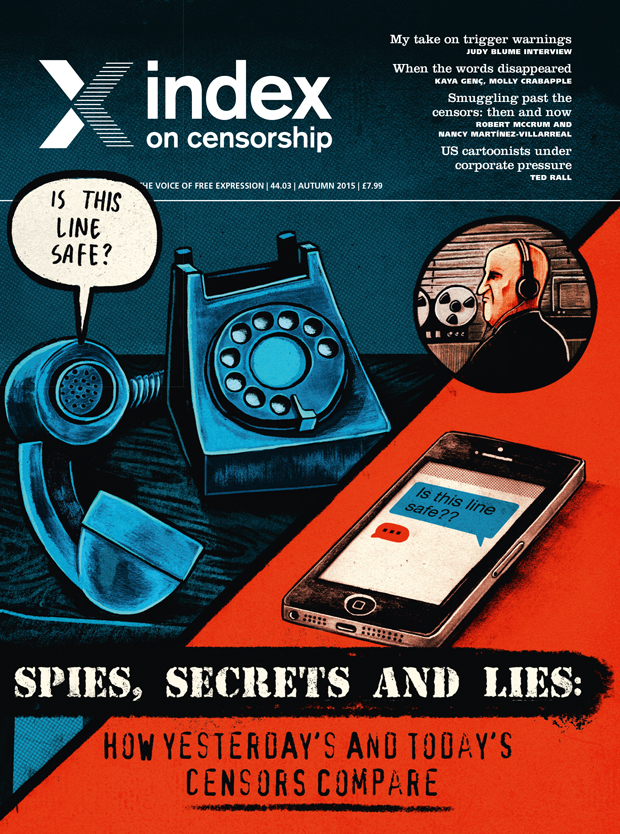 In the old days governments kept tabs on “intellectuals”, “subversives”, “enemies of the state” and others they didn’t like much by placing policemen in the shadows, across from their homes. These days writers and artists can find government spies inside their computers, reading their emails, and trying to track their movements via use of smart phones and credit cards.
Post-Soviet Union, after the fall of the Berlin wall, after the Bosnian war of the 1990s, and after South Africa’s apartheid, the world’s mood was positive. Censorship was out, and freedom was in.
But in the world of the new censors, governments continue to try to keep their critics in check, applying pressure in all its varied forms. Threatening, cajoling and propaganda are on one side of the corridor, while spying and censorship are on the other side at the Ministry of Silence. Old tactics, new techniques.
While advances in technology – the arrival and growth of email, the wider spread of the web, and access to computers – have aided individuals trying to avoid censorship, they have also offered more power to the authorities.
There are some clear examples to suggest that governments are making sure technology is on their side. The Chinese government has just introduced a new national security law to aid closer control of internet use. Virtual private networks have been used by citizens for years as tunnels through the Chinese government’s Great Firewall for years. So it is no wonder that China wanted to close them down, to keep information under control. In the last few months more people in China are finding their VPN is not working.
Meanwhile in South Korea, new legislation means telecommunication companies are forced to put software inside teenagers’ mobile phones to monitor and restrict their access to the internet.
Both these examples suggest that technological advances are giving all the winning censorship cards to the overlords.
But it is not as clear cut as that. People continually find new ways of tunnelling through firewalls, and getting messages out and in. As new apps are designed, other opportunities arise. For example, Telegram is an app, that allows the user to put a timer on each message, after which it detonates and disappears. New auto-encrypted email services, such as Mailpile, look set to take off. Now geeks among you may argue that they’ll be a record somewhere, but each advance is a way of making it more difficult to be intercepted. With more than six billion people now using mobile phones around the world, it should be easier than ever before to get the word out in some form, in some way.
When Writers and Scholars International, the parent group to Index, was formed in 1972, its founding committee wrote that it was paradoxical that “attempts to nullify the artist’s vision and to thwart the communication of ideas, appear to increase proportionally with the improvement in the media of communication”.
And so it continues.
When we cast our eyes back to the Soviet Union, when suppression of freedom was part of government normality, we see how it drove its vicious idealism through using subversion acts, sedition acts, and allegations of anti-patriotism, backed up with imprisonment, hard labour, internal deportation and enforced poverty. One of those thousands who suffered was the satirical writer Mikhail Zoshchenko, who was a Russian WWI hero who was later denounced in the Zhdanov decree of 1946. This condemned all artists whose work didn’t slavishly follow government lines. We publish a poetic tribute to Zoshchenko written by Lev Ozerov in this issue. The poem echoes some of the issues faced by writers in Russia today.
And so to Azerbaijan in 2015, a member of the Council of Europe (a body described by one of its founders as “the conscience of Europe”), where writers, artists, thinkers and campaigners are being imprisoned for having the temerity to advocate more freedom, or to articulate ideas that are different from those of their government. And where does Russia sit now? Journalists Helen Womack and Andrei Aliaksandrau write in this issue of new propaganda techniques and their fears that society no longer wants “true” journalism.
Plus ça change
When you compare one period with another, you find it is not as simple as it was bad then, or it is worse now. Methods are different, but the intention is the same. Both old censors and new censors operate in the hope that they can bring more silence. In Soviet times there was a bureau that gave newspapers a stamp of approval. Now in Russia journalists report that self-censorship is one of the greatest threats to the free flow of ideas and information. Others say the public’s appetite for investigative journalism that challenges the authorities has disappeared. Meanwhile Vladimir Putin’s government has introduced bills banning “propaganda” of homosexuality and promoting “extremism” or “harm to children”, which can be applied far and wide to censor articles or art that the government doesn’t like. So far, so familiar.
Censorship and threats to freedom of expression still come in many forms as they did in 1972. Murder and physical violence, as with the killings of bloggers in Bangladesh, tries to frighten other writers, scholars, artists and thinkers into silence, or exile. Imprisonment (for example, the six year and three month sentence of democracy campaigner Rasul Jafarov in Azerbaijan) attempts to enforces silence too. Instilling fear by breaking into individuals’ computers and tracking their movement (as one African writer reports to Index) leaves a frightening signal that the government knows what you do and who you speak with.
Also in this issue, veteran journalist Andrew Graham-Yool looks back at Argentina’s dictatorship of four decades ago, he argues that vicious attacks on journalists’ reputations are becoming more widespread and he identifies numerous threats on the horizon, from corporate control of journalistic stories to the power of the president, Cristina Fernández de Kirchner, to identify journalists as enemies of the state.
Old censors and new censors have more in common than might divide them. Their intentions are the same, they just choose different weapons. Comparisons should make it clear, it remains ever vital to be vigilant for attacks on free expression, because they come from all angles.
Despite this, there is hope. In this issue of the magazine Jamie Bartlett writes of his optimism that when governments push their powers too far, the public pushes back hard, and gains ground once more. Another of our writers Jason DaPonte identifies innovators whose aim is to improve freedom of expression, bringing open-access software and encryption tools to the global public.
Don’t miss our excellent new creative writing, published for the first time in English, including Russian poetry, an extract of a Brazilian play, and a short story from Turkey.
As always the magazine brings you brilliant new writers and writing from around the world. Read on.
© Rachael Jolley
This article is part of the autumn issue of Index on Censorship magazine looking at comparisons between old censors and new censors. Copies can be purchased from Amazon, in some bookshops and online, more information here.
20 Aug 2015 | mobile, News, Russia, Youth Board
This is the eighth of a series of posts written by members of Index on Censorship’s youth advisory board.
Members of the board were asked to write a blog discussing one free speech issue in their country. The resulting posts exhibit a range of challenges to freedom of expression globally, from UK crackdowns on speakers in universities, to Indian criminal defamation law, to the South African Film Board’s newly published guidelines.
Anastasia Vladimirova is a member of the Index youth advisory board. Learn more
On July 29, Russia’s independent media support fund, Sreda, announced it would be liquidated due to lack of funding.
Russia’s Ministry of Justice declared the fund a “foreign agent” after its mandatory check into the organisation’s finances.
Direct interference by the Russian government became possible in 2012 after President Vladimir Putin approved a law requiring all non-governmental organisations that receive foreign funding and engage in vaguely defined political activity to register as foreign agents with the Russian Ministry of Justice.
Since its inception, however, Sreda had received money from Dmitry Zimin, a Russian entrepreneur and investor in science and education, whose nonprofit foundation Dynasty closed earlier this year due to the scrutiny imposed by the Ministry of Justice under the same law. Given the absence of foreign funding, the liquidation of Sreda is an example of Russia’s ruthless crackdown on independent media masquerading as a legal fight against the alleged foreign influence on Russia’s political and civic life.
Colta, Novaya Gazeta and TV Rain Channel are just a few examples of Sreda’s now former grantees that struggle to keep up their independent voices in the media landscape dominated by state-sponsored outlets.
Anastasia Vladimirova, Russia
Related:
• Simeon Gready: An over-the-top regulation policy
• Ravian Ruys: Without trust, free speech suffers
• Muira McCammon: GiTMO’s linguistic isolation
• Jade Jackman: An act against knowledge and thought
• Harsh Ghildiyal: Defamation is not a crime
• Tom Carter: No-platforming Nigel
• Matthew Brown: Spying on NGOs a step too far
• About the Index on Censorship youth advisory board
• Facebook discussion: no-platforming of speakers at universities
11 Aug 2015 | Academic Freedom, Magazine, mobile, Student Reading Lists
Articles from this list explore the topic of how minority groups are both being censored and also evade censorship. Includes Kerry Brown on the censored minorities of China at the time of the 2008 Olympic Games and Akeel Bilgrami on the plight of India’s Muslims after 9/11.
Students and academics can browse the Index magazine archive in thousands of university libraries via Sage Journals.
Minority groups and censorship articles
Minorities and the media by Anthony Smith
Anthony Smith, March 1975; vol. 4, 1: pp. 105-106
A study in the use of media by the Mexican Chicano Movement
Enemies Within by Kerry Brown
Kerry Brown, May 2008; vol. 37, 2: pp. 152-161
Kerry Brown on the censored minorities of China
Speaking in Tongues by Lambros Baltsiotis, Leonidas Embiricos
Lambros Baltsiotis, Leonidas Embiricos, March 2001, vol. 30, 2: pp. 145-151
A deconstruction of minority languages in Greece and a look at the battle to keep these languages alive
Just a Question of Money? By Moussa Awuonda
Moussa Awuonda, April 2003, vol. 32 no. 2 187-191
Kenyan journalist Moussa Awuonda details the report pressing the Swedish government to pay more attention to its minority presses
India’s Muslims Post 9/11 by Akeel Bilgrami
Akeel Bilgrami, November 2006, vol. 35, 4: pp. 15-21
Akeel Bilgrami delivers an explosive narrative on how India’s Muslim minority has responded to the aggressive ideology of the majority Hindus
Silencing the disabled: Only the state may help the disabled; others who try are repressed by Steven Marc Glick
Steven Marc Glick, October 1981, vol. 10, 5: pp. 32-33
Author Steven Marc Glick reports from the former Soviet Union on the plight of disabled individuals and new attempts by some to help them
Down The Welsh Road by George Jones
George Jones, July 2001, vol. 30, 3: pp. 206-211
George Jones on the linguistic rights of the Welsh-speaking minority in Wales
Speaking in Tongues by Ayer Neier
Ayer Neier, March 1996, vol. 25, 2: pp. 139-141
The ex-executive director of Human Rights Watch on the danger of suppressing minority languages worldwide
Daring to speak one’s name: A reflection on gay censorship by Alberto Manguel
Alberto Manguel, January 1995, vol. 24, 1: pp. 14-31
As Russian law relaxes and allows homosexual writers a voice, Alberto Manguel reflects on gay censorship in the country
The landscape for religious freedom in the new Egypt by Shahira Amin
Shahira Amin, June 2013, vol. 42, 2: pp. 102-109
Two years after the revolution in Egypt, Shahira Amin reflects on the minority communities who are still trying to get their voices heard
The reading list for minority groups and censorship can be found on the Sage website
