6 Nov 2014 | News, Politics and Society
![People taking part in the funeral procession of Lasantha Wickrematunge (By Indi Samarajiva [CC-BY-2.0 (http://creativecommons.org/licenses/by/2.0)], via Wikimedia Commons](https://www.indexoncensorship.org/wp-content/uploads/2014/11/Lasantha_Wickrematunge_funeral_banners_1.jpg)
People taking part in the funeral procession of murdered journalist Lasantha Wickrematunge (Photo by: Indi Samarajiva [CC-BY-2.0], via Wikimedia Commons)
This would be no defence for Lasantha. President Mahinda Rajapaksa repeatedly referred to him as a “terrorist journalist” and “Kotiyek” (a Tiger).
According to exiled journalist Uvindu Kurukulasuriya, shortly before Lasantha was killed, the president offered to buy the Sunday Leader, with the intention of muting its voice. Lasantha declined the generous offer. On 8 January 2009, he was shot dead.
Days later, an astonishing editorial, written by Lasantha before his death, appeared in the Sunday Leader, and subsequently in newspapers throughout the world. After describing his pride in the Sunday Leader’s journalism, Wickrematunge wrote chillingly: “When finally I am killed, it will be the government that kills me.”
Lasantha’s murder was shocking. As was the murder of Hrant Dink, the Armenian editor who “insulted Turkishness” by daring to speak of the genocide of his people; as was the murder of Anastasia Barburova, the young Novaya Gazeta reporter who investigated the Russian far right; as was the murder of Martin O’Hagan, who took on the criminality of Northern Ireland’s loyalist gangs. As were the murders of the dozens of Filipino journalists killed in the Maguindanao massacre in 2009, too numerous to name, caught up in a ruthless turf war.
Then there are the reporters killed in war zones. The conflict in Syria has been a killing field for journalists. Where once the media were seen as protected, even potential allies, now they are seen as targets. The killings of Steven Sotloff and James Foley by ISIS in Iraq brought back memories of the beheading of Daniel Pearl in Pakistan in 2002. As Joel Simon of Committee to Protect Journalists relates in his forthcoming book, the New Censorship, that crime marked a turning point. In the Pearl case, even Osama bin Laden, who viewed the media as a potential tool in his global war, was shocked by the tactic employed by his lieutenant Khalid Sheikh Mohammed, who claimed to have carried out the murder himself. From that point on, journalists were not just fair game, but trophies.
As money is drained from news, many organisations choose not to send correspondents to areas where reporters are needed most. Too dangerous, too expensive. As a result, freelancers, local journalists and fixers take ever greater risks. Under-resourced, undersupported and out on a limb, they are picked off.
Regional journalists covering tough domestic beats are easy prey. In Mexico, drug cartels boast of their ability to murder reporters. In Burma, the army kills a reporter who dares report its activities.
The numbers are horrifying: over 1,000 media workers have been killed because of their work since 1992.
Every single time, the message is sent: don’t get involved; don’t ask questions; don’t do your job. No journalism here. No inconvenient truths, no dissenting voices.
With rare exceptions, those responsible for these crimes act with impunity. Sometimes, as in the case of Anna Politkovskaya, outspoken on war crimes in Chechnya, the man who pulled the trigger is traced but those who gave the orders remain untouched. In over 90 per cent of cases of attacks on journalists, there are no convictions.
There is no greater infringement of human rights than to deliberately take an innocent life. The killing of a journalist also signals contempt for the concept of free expression as a right. As the United Nation’s Plan of Action on the Safety of Journalists and the Issue of Impunity, states, violent attacks on journalists and free expression do not happen in a vacuum: “[T]he existence of laws that curtail freedom of expression (e.g. overly restrictive defamation laws), must be addressed. The media industry also must deal with low wages and improving journalistic skills. To whatever extent possible, the public must be made aware of these challenges in the public and private spheres and the consequences from a failure to act.”
In that famous final editorial, Lasantha Wickrematunge wrote: “In the course of the last few years, the independent media have increasingly come under attack. Electronic and print institutions have been burned, bombed, sealed and coerced. Countless journalists have been harassed, threatened and killed. It has been my honour to belong to all those categories.”
Like many journalists, Lasantha prided himself on bravery: there is no higher compliment in the profession than to call a colleague “courageous”.
But there is a danger in this that we create martyrs: that we become enamoured of the idea that a good journalist should die for the cause. That persecution and suffering are marks of valour.
They are not. Journalism should be intrepid, of course, but we shouldn’t accept the idea that intrepid journalism comes with a price. Journalism, the exercise of free expression, is a basic right both for practitioners and for the readers, viewers and listeners who benifit from it. They should be able to practice this right without fear of persecution from states, criminals or terrorists. If they are to suffer, their oppressors must face justice.
Correction 10:02, 10 November: An earlier version of this article stated that a government minister offered to buy the Sunday Leader.
Index on Censorship is mapping harassment and violence against journalists across the European Union and candidate countries at mediafreedom.ushahidi.com.
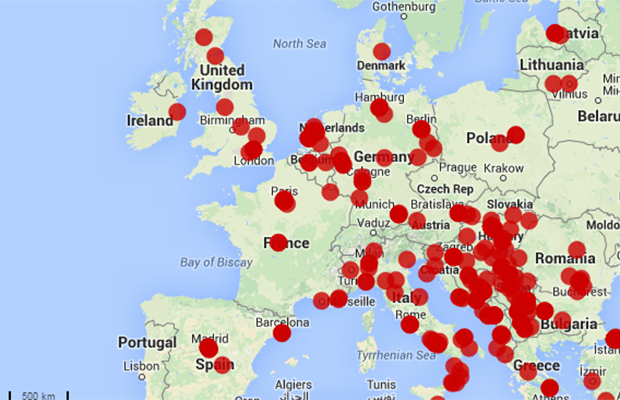
This article was posted on 6 November 2014 at indexoncensorship.org
4 Nov 2014 | Belarus, Campaigns, Statements
Ambassador Extraordinary and Plenipotentiary of the Republic of Belarus
to the United Kingdom of Great Britain and Northern Ireland
Ambassador Extraordinary and Plenipotentiary of the Republic of Belarus
to Ireland with concurrent accreditation
Mr. Sergei Aleinik
6 Kensington Court, London W8 5DL
3 November 2014
APPEAL
Dear Mr. Aleinik,
Index on Censorship is alarmed by the news that a well-known human rights defender, Elena Tonkacheva, has had her permit to reside in Belarus canceled and may be deported from the country.
Elena Tonkacheva, Chairperson of the Board of the Legal Transformation Center, although being a citizen of the Russian Federation has permanently resided in Belarus since 1985, and for years has been engaged in educational, analytical and research work in the field of human rights. Ms Tonkacheva is a highly qualified expert in law and human rights; the organisation headed by her is one of the leading human rights NGOs in Belarus.
On 30 October 2014, Ms Tonkacheva was notified about the cancelation of her residence permit and on 5 November 2014 a decision will be made as to whether she is to be deported from Belarus. The formal reason for that are administrative breaches (insignificantly exceeding speed limit when driving).
However, the disproportionate measures used by the Belarusian authorities in this case give grounds to believe that these minor breaches are used solely as a pretext to punish Ms Tonkacheva for her principled position and long-term human rights work and either to stop or create considerable obstacles in her human rights activities.
In this connection, we appeal to the Belarusian authorities to:
− Repeal the decision to cancel Ms Tonkacheva’s residence permit and not to deport her from Belarus;
− Take effective measures to protect human rights defenders and provide them with a possibility to carry out their human rights activities without any obstacles, as stipulated in the UN Declaration on the Right and Responsibility of Individuals, Groups and Organs of Society to Promote and Protect Universally Recognized Human Rights and Fundamental Freedoms from 9 December 1998;
− Be guided by the recommendation of the UN Special Rapporteur on the situation of human rights in Belarus to “recognize the important role of human rights defenders, whether individuals or members of civil society organizations, and guarantee the independence of civil society organizations and human rights defenders, enabling them to operate without
the fear of reprisal.”1
Sincerely,
Index on Censorship
1 A/69/307 Report of the Special Rapporteur on the situation of human rights in Belarus
CC.
President of the Republic of Belarus
Aliaksandr Lukashenka
Belarus, 220016, Minsk, K.Marks Str., 38
Fax + 375 17 226 06 10
E-mail: [email protected]
Minister of Internal Affairs of the Republic of Belarus
Ihar Shunevich
Belarus, 220030, Minsk, Gorodskoy Val Str., 4
Fax + 375-17-218-76-02
E-mail: [email protected]
Office of Citizenship and Migration Affairs
Main Internal Affairs Directorate of Minsk Municipal Executive Committee
Belarus, Minsk, Nezavisimost Ave, 48Б
Fax +375-17 331-81-6
E-mail: [email protected]
Department of Citizenship and Migration
Pervomajski District Office of Internal Affairs of Minsk
Belarus, Minsk, Belinski Str., 10
Fax+375-17-280-01-62
29 Oct 2014 | Europe and Central Asia, News, Serbia
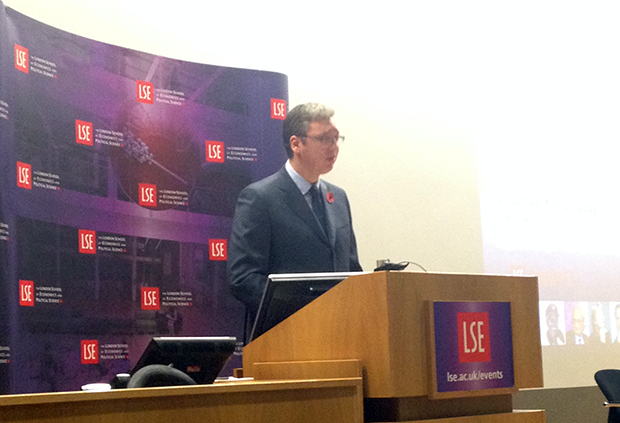
Serbian Prime Minister Aleksandar Vucic speaking at LSE (Photo: Milana Knezevic)
It wasn’t quite a remote controlled drone carrying a provocative political message, but Serbian Prime Minister Aleksandar Vucic’s Monday night lecture at the London School of Economics (LSE) came with its own controversial incident.
“What can you say about the total censorship of all opposition media”, Vucic was asked by a young woman in the audience just as the premier sat down for the question and answer portion of the event. She explained that she was representing Nikola Sandulovic, an opposition politician from the Serbian Republican Party, who was sitting beside her. Sandulovic said later he had travelled to London to confront Vucic.
Chaos ensued. Sandulovic claimed, among other things, that a police officer connected to Vucic had threatened to kill him and that he had evidence contained on a CD he held aloft. Vucic hit back that the Republican Party had only 0.01% of public support, and disputed Sandulovic’s assertion that he had been an adviser to former Serbian Prime Minister Zoran Djindjic, who was assassinated in 2003. Accusations flew across the room until LSE’s moderator James Ker-Lindsay finally managed regain control of the situation.
After the event, Sandulovic told Index he came to London because the media in Serbia ignore him and his party, apart from when government-friendly outlets attack him.
That press freedom was a popular topic on the night did not comes as a surprise. Serbia has seen a string of censorship incidents during Vucic’s time in power, as Index and many others have reported.
The prime minister himself brought up the press in his introductory lecture. He explained how his government has passed several new laws aimed at improving the media landscape, and complained that despite this, they are “scapegoated”. He directly addressed the recent controversial cancellation of a political talk show, Utisak Nedelje (Impressions of the Week), saying authorities have been subjected to a blame campaign for what was a commercial decision. Supporters of the show, including host Olja Beckovic, say it was down to political pressure.
In a joking reference to his infamous role under Slobodan Milosevic, he said he had been the “worst minister of information”. Curiously, he also used this former job as a counterargument to critics, arguing that his past had made it easy to blame him for any instance of censorship.
But this didn’t seem to stop the press-related questions, though none of the journalists present were chosen to ask one. Apart from the memorable Sandulovic intervention, an audience-member pointed out that Utisak Nedelje wasn’t the only show to have been taken off air in recent times.
If there was an overarching theme to the night, it was that it seemed to showcase different — some would say conflicting — sides of Vucic and his administration. He reminded the audience that Belgrade had recently organised a successful Pride parade, before adding that he didn’t want to attend. To have that choice, he argued, was a real mark of freedom.
There were, of course, questions about the football drone. While Vucic said he didn’t want to share his own views, he said UEFA (European football’s governing body) saw Serbia’s side of the story by awarding them the win, before pointing out that Serbia carries its share of the responsibility. The planned state visit from Albanian Prime Minister Edi Rama — the first in 68 years — will go ahead, he also confirmed, despite the post-drone postponement.
In response to questions about relations with Russia — just weeks after the Belgrade military parade where Vladimir Putin was the guest of honour — he said the two countries would continue to build their relationship, but that this would have no impact on Serbia’s ultimate goal of European Union accession.
Much has been made of Vucic’s apparent journey from Milosevic man to EU enthusiast. He seemed to reference this as he said he is “not perfect” and that he works “every single day” to change and better himself. But on Monday, he left more questions than answers about the direction he is taking Serbia in.
Mapping Media Violations in Europe: Serbia
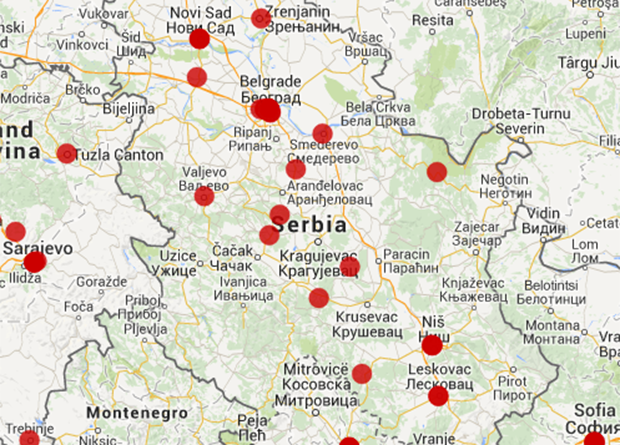
Five media outlets targeted with DDoS attacks
Protesters criticise cancellation of political talk shows
Deputy mayor fined for insulting journalist
Macedonian journalist released from extradition detention
Photographer injured by anti-pride parade protesters
This article was originally posted on 29 October at indexoncensorship.org
16 Oct 2014 | Draw the Line, Youth Board
This month the Index Youth Advisory Board is discussing legal regimes and how they nurture or stifle the free expression of ideas. Examples of draconian laws abound: from Russia’s law banning “homosexual propaganda” to the UK’s use of RIPA legislation to violate the confidentiality of journalists’ sources.
When it comes to free speech: laws, what are they good for?
Legal frameworks protect speech and broader free expression. Take for instance Article 19 of the Universal Declaration of Human Rights which tells us that we all have the right to freedom of opinion and expression. Most of us, I’m sure, would cherish this right – who wouldn’t want to be able to express themselves freely and say what they like without the interference of the state?
In the United Kingdom, Article 10 of the Human Rights Act grants citizens freedom of expression. Most countries have different forms of Article 10. It is these laws – the ones that promote and protect our right to free speech – that form the crucial pillars of any democracy.
But do all laws protect our right to free speech?
Article 10 does a good job of granting us the confidence to speak out and ensure our voices are heard, but do other laws do the same? Or are there laws that, in some way, serve to restrict free speech? The example from Russia underline the use of legislation to restrict the right to expression. The law also curtails the right to assembly, another important part of a democratic society.
When you look into Article 10 itself, you begin to learn about the restrictions of the law and begin to understand how, in many ways, the state still does have authority over our freedom of expression. For example, Article 10 can be restricted “in the interests of national security” and in order to “maintain the authority of the judiciary”.
And what about the countries that don’t have specific laws that promote freedom of expression as strongly as the UK’s Article 10? Many may find it easy to conclude that countries like Iran have more laws that serve to restrict free speech, rather than protect it. It’s interesting to look at blasphemy laws in this instance to examine whether it protects the rights of those who are religious or restricts the rights of those who wish to criticise religion.
This month on Draw the Line, we discuss the impact a country’s laws have on our freedom of expression. Join the discussion and let us know whether laws serve to protect or restrict your right to free speech.
This article was posted on 16 Oct, 2014 at indexoncensorship.org
