11 Jul 2014 | About Index, Comment, News, Religion and Culture
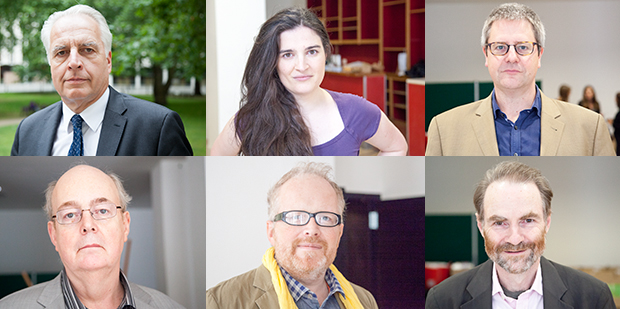
Martin Roth, Kate Maltby, Sebastion Borger, David Edgar, Tomasz Kitlinski and Timothy Garton Ash.
In 1977, the Russian dissident Alexander Ginzburg — whose detention and sentencing almost a decade earlier helped to spur the creation of Index on Censorship — was again arrested by the Soviet authorities. For 17 months, a team of KGB officers interrogated the poetry publisher, threatening to arrest friends and colleagues unless he co-operated, attempting to scare him with the prospect of the death penalty and denying him medical treatment.
In the midst of this, Ginzburg recalled: At least I knew they would not kill me before the trial. “This is because I was a defended person, someone whom the West knew about and was likely to make a fuss about. Without this form of defence, political prisoners just die”.
I was reminded of Ginzburg’s comments last night as we discussed freedom in Europe 25 years after the fall of the Berlin Wall. A question was posed: Are we more free than we were in 1989? In a surprisingly tightly contested vote, the majority edged it with the decision that we were freer.
Kate Maltby, one of our panellists, pointed out that her Hungarian family could now travel freely to meet loved ones outside the country, something they could not do before the wall fell. Others on the panel, which included historian Timothy Garton Ash and playwright David Edgar, pointed to political plurality and greater protections for free expression. Martin Roth, director of the V&A museum, recalled the East Germany’s transition to capitalism in Dresden, with graffiti reading “Elect money”. But a warning note was also sounded that reminded the audience that hard won freedoms need to be protected. Tomasz Kitliński, Polish political philosopher and civic activist, put it best when he described the new dissidents: artists and writers who continue to face threats from the authorities. He pointed to cases like that of Dorota Nieznalska, who was convicted of blasphemy, fined and prevented by a judge from leaving the country for displaying a piece of art that included an image of a penis on a cross. The exhibition of which her installation formed part was closed down by authorities.
Elsewhere, as we see in the reports coming into our EU media mapping project, authorities, particularly in the Balkans, are taking an increasingly hard line on the media and other civil society groups, while in countries like Russia and Turkey new laws are being used to suppress freedom of expression online. Threats also persist offline. Last week, Index joined calls for Tajikistan to release a Canada-based academic, Alexander Sodiqov, who was arrested for “spying” while on a research trip and who now faces a jail sentence of between 12 and 20 years. Sodiqov is also accused of treason a charge that was similarly laid at the door of Ginzburg by the Soviet authorities nearly 40 years ago.
Are we more free in Europe and the former Soviet Union than in 1989? Certainly. Are we all more free? No. And, as cases like those of Sodiqov remind us, we can never be complacent.
This article was posted on July 11, 2014 at indexoncensorship.org
7 Jul 2014 | Draw the Line, Events, Young Writers / Artists Programme
As cheers from the World Cup rumbled in the background, Index set up an online platform to debate the tussle between sport and freedom of speech. As part of the Draw the Line series of discussions, last month’s question was: Should repressive regimes be banned from sport? If countries have poor human rights record, do they deserve to participate?
Twitter erupted with opinions. Immediately the question of defining a repressive regime was raised – whose duty would it be to decide? Although many might agree that Iran’s government-controlled press was anti-free speech, would the US’s treatment of whistleblower Edward Snowden fall into the same category?
Others argued that banning offending countries would leave their crimes in the shadows. Instead they believed oppressive regimes should suffer the spotlight of global media – hoping that the publicity would encourage conversation and spark change.
Opinions seemed split at the first Draw the Line event, where ten young human rights activists gathered to discuss the same issue. Although some declared passionately that repressive regimes must be punished, there were fears that a ban would misdirect that punishment – affecting a country’s people rather than its leaders.
Defining the World Cup’s worst countries for free speech – or the “group of death” – seemed to make a much easier task for the young activists. Examining democracy, civil liberties, press regulations, internet freedom and corruption, participants unanimously decided that Cameroon, Iran, Nigeria and Russia qualified as the countries that held freedom of speech in the lowest regard.
As the debate evolved, a common consensus emerged: A campaign should be set up to stop countries that stifle free speech from hosting high profile sports events, like the world cup. With host countries benefiting from huge boosts to the economy, infrastructure and community spirit, this should be incentive enough to halt human rights abuses without punishing innocent citizens by banning countries completely.
More about Draw the Line
2 Jul 2014 | Draw the Line, Events, News, Young Writers / Artists Programme
Index hosted the first of our Draw the Line events on Monday, as ten young adults met to discuss issues surrounding the free expression records of the countries participating in the World Cup.
The big question was, should we blow the whistle on free-speech offending countries? During this World Cup, democratic countries will engage with regimes with poor records on freedom of expression, so what should we do? Should some countries be kicked out? Which ones? And what about the hosts of these tournaments?
Members of the group started off by voicing their opinion on whether or not some repressive countries should be allowed to participate, but the conversation soon developed from there.
The group was split in half and asked to determine which four of this year’s World Cup countries they thought would be included in a free expression “Group of Death”. Index provided cards that gave statistics on each country’s press freedom, democracy, civil liberties, net freedom, and corruption. After much shuffling and discussion, both groups decided on the same four countries: Cameroon, Iran, Nigeria, and Russia.
Participants were split into smaller groups, each researching one country, and made their case for why their country was the “winner” in repressing freedom of expression. This sparked conversations on topics including the idea of government versus civil responsibility, as well as conditioning of citizen behaviour and use of propaganda.
After much debate and idea sharing, the group reached a common consensus: countries repressing free speech should not be banned from global sports, but they believe a campaign should be set up to prevent freedom of expression and human rights offending countries hosting events like the World Cup.
Tweet us your thoughts with #IndexDrawtheLine to participate in the Draw the Line debate.
This article was posted on July 2, 2014 at indexoncensorship.org
26 Jun 2014 | About Index, Campaigns, Statements, Ukraine
President Petro Poroshenko
11 Bankova street
01220 Kyiv
Ukraine
26 June 2014
Mr President,
We, the undersigned members and partners of the Human Rights House Network (HRHN), condemned in the strongest terms human rights violations which took place throughout Ukraine since 29 November 2013, and now call upon you to extend the mandate of the International Criminal Court investigations (taking into account events in Crimea and Eastern Ukraine) and to ratify the Rome Statute, in order to encourage such investigations, as an essential part of bringing peace to the country.
We welcome the repeated pledges of Ukrainian authorities to investigate all human rights violations committed since 29 November 2013 and hold those accountable, throughout the country and irrespective of which side the violator belongs to in the ongoing armed conflict in East Ukraine. The current situation of impunity must end.
The International Criminal Court is the only international body able to not only document grave human rights violations, amounting to core international crimes (war crimes, crimes against humanity, or genocide), but also investigate individuals responsible for such crimes. In order to restore peace and strengthen trust into State institutions, those responsible for such human rights violations have to be held accountable. We have for a long time called for a comprehensive reform of the judicial system in the country, which still remains to be initiated. Unfortunately, the national judicial system now shows its limits and in our view it is clear that it does not have the adequate knowledge, independence and resources to investigate all human rights violations since 29 November 2013 throughout the country.
Therefore, it is necessary to activate the international justice system, based on the complementarity principle, to guarantee that investigation into core international crimes committed by all parties in Ukraine, including by members of law enforcement and State agents, is credible and transparent, bringing those responsible to justice.
The Court’s jurisdiction should however not be limited in time, as it is now. On 17 April 2014, the Government of Ukraine indeed lodged a declaration under Article 12(3) of the Rome Statute accepting the jurisdiction of the ICC over crimes committed on its territory from 21 November 2013 to 22 February 2014.[3] We now call upon the Government to issue a declaration extending ICC jurisdiction from 21 November 2013 until the date of the entry into force of the Rome Statute for Ukraine.
We also call upon the authorities in Ukraine to accede to the Rome Statute as soon as possible. By doing this, Ukraine will make an important step to permanently depart from the culture of impunity that is prevailing.
In addition to the investigation into human rights violations, and action taken to end the use of violence in the country, Ukraine needs to undertake a massive reform of its legislation and practice in many fields. Ukraine’s law enforcement agencies have needed radical reform for a long time now: It is not about changing the names of institutions and units or about window-dressing, but about systemic changes, starting from the principles for establishing and structuring enforcement agencies, and ending with approaches to evaluating their performance.
We therefore support Ukraine’s efforts to propose a resolution at the United Nations Human Rights Council’s on-going session, although we deeply regret the draft resolution’s silence about the role of civil society in the country and the need for an investigation by the Court.
In Ukraine, human rights NGOs have proven their strong commitment to the rule of law and the respect of all human rights for all people, as well as their high level of professionalism and excellence. No country can build a sustainable future without full inclusion of civil society in decision-making, especially Ukraine in its present situation. Furthermore, States and leaders in all sectors of society must acknowledge publicly the important and legitimate role of human rights defenders in the promotion of human rights, democracy and rule of law, and avoid stigmatisation, as stated by the Human Rights Council resolution 22/6 of 21 March 2013.
Finally, we also welcome the reference in the draft resolution on Ukraine at the Human Rights Council to the extremely worrying human rights situation in Crimea and join Ukrainian authorities, the United Nations, the Organisation for Security and Cooperation in Europe, and other international voices, in condemning the enforcement of legislation of the Russian Federation on the territory of Crimea, at variance with the United Nations General Assembly resolution 68/262.
The role of civil society is essential in documenting human rights violations in Crimea and providing support to victims of such violations. A field mission has been launched by Ukrainian and Russian human rights defenders in co-operation, with which we expect full cooperation by all governmental agents in Ukraine.
On this background, we call upon you Mr President and the Government, with no further delay, to issue a declaration to extend the jurisdiction of the International Criminal Court from 21 November 2013 until the date of Ukraine’s accession to the Rome Statute either through appeal of the competent body of the Government or by adopting the Draft Law #4081a.
We further call upon you to:
- Take all necessary measures to support the work of human rights NGOs, journalists and bloggers and other media, including by investigating any threats, intimidation, harassment and violence against them, including arbitrary detentions, abductions, attacks and killings;
- Strongly and publicly acknowledge the important and legitimate role of human rights defenders in the promotion of human rights, democracy and the rule of law as an essential component of ensuring their protection; In line with United Nations Human Rights Council resolution 22/6 of 21 March 2013, paragraph 5
- Ensure that the reform process in the country, as well as all dialogue about the future of the country, is inclusive and transparent, giving space to civil society.
Sincerely,
Human Rights House Kyiv (on behalf of the following NGOs):
- Association of Ukrainian Human Rights Monitors on Law Enforcement (Association UMDPL)
- Centre for Civil Liberties
- Human Rights Information Center
- Institute of Mass Information
- Kharkiv Human Rights Protection Group
- La Strada Ukraine
- NGO “For Professional Journalism” – Svidomo
- Ukrainian Helsinki Human Rights Union
Education Human Rights House Chernihiv (on behalf of the following NGOs):
- Chernihiv Public Committee of Human Rights Protection
- Center of Humnistic Tehnologies “AHALAR”
- Center of Public Education “ALMENDA”
- Human Rights Center “Postup”
- Local Non-governmental Youth organizations М’АRТ
- Transcarpathian Public Center
- Ukrainian Helsinki Human Rights Union
Azerbaijan Human Rights House (on behalf of the following NGOs):
- Association for Protection of Women’s Rights – APWR
- Azerbaijan Human Rights Centre (AHRC)
- Institute for Peace and Democracy
- Human Rights Centre
- Legal Education Society
- Legal Protection and Awareness Society
- Media Rights Institute
- Public Union of Democracy Human Rights Resource Centre
- Women’s Association for Rational Development (WARD)
Barys Zvozskau Belarusian Human Rights House in exile, Vilnius
- Belarusian Association of Journalists
- Belarusian PEN Centre
- Belarusian Helsinki Committee
Human Rights House Belgrade (on behalf of the following NGOs):
- Belgrade Centre for Human Rights
- Helsinki Committee for Human Rights, Serbia
- Human Rights House Belgrade and Lawyers’ Committee for Human Rights –YUCOM
Human Rights House London (on behalf of the following NGOs):
- Index on Censorship
- Vivarta
Human Rights House Tbilisi (on behalf of the following NGOs):
- Article 42 of the Constitution
- Caucasian Centre for Human Rights and Conflict Studies (CAUCASIA)
- Georgian Centre for Psychosocial and Medical Rehabilitation of Torture Victims
- Media Institute
- Human Rights Center
- Union Sapari – Family Without Violence
Human Rights House Oslo (on behalf of the following NGOs):
- Human Rights House Foundation
- Norwegian Helsinki Committee
- Health and Human Rights Info
Human Rights House Voronezh (on behalf of the following NGOs):
- Civic Initiatives Development Centre
- Confederation of Free Labor
- For Ecological and Social Justice
- Free University
- Golos
- Interregional Trade Union of Literary Men
- Lawyers for labor rights
- Memorial
- Ms. Olga Gnezdilova
- Soldiers Mothers of Russia
- Voronezh Journalist Club
- Roronezh – Chernozemie
- Youth Human Rights Movement
Human Rights House Yerevan (on behalf of the following NGOs):
- Helsinki Citizens’ Assembly – Vanadzor
- Journalists’s Club Asparez
- Public Information and Need of Knowledge – PINK
Human Rights House Zagreb (on behalf of the following NGOs):
- APEO / UPIM Association for Promotion of Equal Opportunities for People with Disabilities
- B.a.B.e.
- CMS – Centre for Peace Studies
- Documenta – Centre for Dealing with the Past
- GOLJP – Civic Committee for Human Rights
- Svitanje – Association for Protection and Promotion of Mental Health
The Rafto House in Bergen – Norway (on behalf of the following NGOs):
The House of the Helsinki Foundation For Human Rights – Poland (on behalf of the following NGOs):
- Helsinki Foundation for Human Rights, Poland
Copies have been sent to:
- Mr Oleksandr Turchynov, Chairman of Verkhovna Rada
- Office of the Commissioner for Human Rights of the Council of Europe
- Private Office of the Secretary General of the Council of Europe
- Chairman of the Organisation for Security and Cooperation in Europe (OSCE)
- OSCE Special Monitoring Mission to Ukraine
- OSCE’s Office for Democratic Institutions and Human Rights
- United Nations Human Rights Monitoring Mission in Ukraine
- Delegation of the European Union in Ukraine
- Subcommittee on Human Rights of the European Parliament
- Diplomatic community in Kyiv, Brussels, Geneva and Strasbourg
- Various ministries of foreign affairs and parliamentary committees on foreign affairs
About the Human Rights House Network (www.humanrightshouse.org)
The Human Rights House Network (HRHN) unites 87 human rights NGOs joining forces in 18 independent Human Rights Houses in 13 countries in Western Balkans, Eastern Europe and South Caucasus, East and Horn of Africa, and Western Europe. HRHN’s mandate is to protect, empower and support human rights organisations locally and unite them in an international network of Human Rights Houses.
The Human Rights House Kyiv and the Education Human Rights House Chernihiv are members of HRHN. 10 independent Ukrainian human rights NGOs are members of both Human Rights Houses.
The Human Rights House Foundation (HRHF), based in Oslo (Norway) with an office in Geneva (Switzerland), is HRHN’s secretariat. HRHF is international partner of the South Caucasus Network of Human Rights Defenders and the emerging Balkan Network of Human Rights Defenders.
HRHF has consultative status with the United Nations and HRHN has participatory status with the Council of Europe.
