1 Dec 2025 | Europe and Central Asia, News, Russia, Ukraine
The long-running corruption scandal surrounding the diversion of funds from Ukraine’s energy sector proved to be both a prelude and stimulus to yet another round of “peace talks” initiated by the US Trump administration.
The scandal seemed to create fertile soil into which the White House could plant ideas for achieving peace in Ukraine. We now know that they were not trying to plant fresh saplings, but Putin’s old “forever” plan of total domination over Ukraine. The apparently fertile soil was the Ukrainian leadership’s weakened position due to the corruption scandal, which led to resignation of apparently the most powerful man after President Volodmyr Zelensky – the head of President’s office Andriy Yermak.
Ukrainians didn’t believe Yermak would resign until the very moment of his resignation. Essentially, Zelensky will have to reinvent himself as a president-without-Yermak. How easy or possible this will be is unclear. Regardless of the outcome of the criminal investigation, Yermak protected Zelensky from his own people and from others, practically controlling access to him.
Many in Ukraine believed that Yermak made all the decisions in the presidential office. In fact, if you analyse all of Yermak’s statements, you’ll see that Zelensky and Yermak said the same thing. In essence, Yermak was an “extension” of Zelensky – a kind of doppelganger only without the charisma. Some people who have met Yermak have noted that he possesses a rather negative charisma, but he always repeated Zelensky’s ideas, using more or less the same words.
At meetings with foreign partners, like Zelensky, he demanded military aid and support rather than asking for it. As the president of a country at war, foreign partners have forgiven Zelensky his forthrightness and occasionally insufficiently explicit expressions of gratitude for assistance provided. However, since the scandal with JD Vance at the White House over “ingratitude”, Zelensky has made a point of thanking foreign partners, especially President Trump much more often than before.
Some high-level guests to Ukraine didn’t immediately understand that Yermak was an extension of Zelensky, his most trusted confidant. However, they would almost certainly picked up on the feeling in Ukrainian society that Yermak was disliked.
Yermak’s reputation among Ukrainians was very negative, but not as sinister as the oligarch Viktor Medvedchuk’s under Ukraine’s Russian-sympathising second president Leonid Kuchma who was in office until 2005 and whose legacy still casts a shadow.
But then again, Yermak represented Zelensky’s inner circle of friends and business partners, which existed before Zelensky entered politics. Now, no one from this “inner circle” remains. At first, it seemed that the entire corruption affair, starting with Zelensky’s and Yermak’s attempt to wrest independence from National Anti-Corruption Bureau of Ukraine, (NABU) and the Specialised Anti-Corruption Prosecutor’s Office (SAP), to businessman Timur Mindych’s reported escape to Israel (just before his office was due to be raided by anti-corruption police over kickbacks from the energy sector), coincided too closely with the new negotiations about Trump peace plan.
Since independence, Ukrainian presidents have had eighteen heads of administration, and not all of them earned themselves negative reputations. Some came and went without being embroiled in high-profile corruption or political scandals. The latest scandal, however, is bound to cast a shadow over the entire office of the President since Mindych was co-owner of Zelensky’s Kvartal 95 production company, for which Yermak provided legal services before Zelensky’s official entry into politics.
Few Ukrainians can understand how it could be that a group of people like Mindych, his partner Oleksandr Zukerman and others so close to the presidential office, could have allegedly spent months siphoning money from state-owned enterprises in the energy sector. Why was it that only NABU signaled that something was wrong and that it involved Mindych? Why didn’t other intelligence agencies and law enforcement bodies stop their criminal activities sooner?
On Tuesday of last week, NABU representatives announced that more than 520 files containing personal information on 15 NABU detectives, National Security Services employees, journalists who write about corruption, and deputy ministers of justice, members of Parliament were discovered in a secret office belonging to Mindych’s group. This personal information, including home addresses, phone numbers, and so on, could only have been obtained through the police or other law enforcement agencies.
Now it appears that a real possibility that the peace negotiations could have been an attempt by the Zelensky administration (which meant Yermak) to resume negotiations in order to shift attention of Ukrainians from the Mindych case to the “peace process.” In other words, the initiative this time may have come from Zelensky.
Today Zelensky’s position, and therefore Ukraine’s one, is much weaker than before the Mindych scandal. Only very quick and decisive personnel changes can improve (but not correct) the situation. It would be better to change the tradition altogether and either rename the position of “head of the presidential administration” to something more political, or abolish it, replacing it with some narrow “office of political advisers.”
As to the peace plan, the obvious Russian origins of the plan, which was also proved by statements from US secretary of state Marco Rubio, sparked immediate controversy, first in Ukraine, and then in the United States itself.
It was precisely because of the protests from inside the USA that President Trump was at first forced to abandon his plan to aggressively force what he considered a weakened Zelensky into publicly accepting these most recent proposals. Within two days, the pressure on Zelensky was relaxed and the “plan” – a list of demands Ukraine should accept in exchange for peace or a ceasefire – began to shrink in scope and mutate, resulting quickly in rejection by Russia.
Under the original Putin-Witkoff plan, Ukraine was supposed to reduce its army, renounce possession of long-range missiles, withdraw from its own territory, and guarantee non-accession to NATO. For good measure, the plan also promised the US a 50% share of the profits from the reconstruction of devastated Ukraine, but omitted to make any demands on Russia – the aggressor country that has violated all possible international treaties and obligations. The idea that the USA should take 50% profits from reconstruction of Ukraine is so surreal it is hardly worth mentioning, except as a joke.
Even if Ukraine had agreed to all the demands, the plan would have remained a roadmap for Russia’s further aggression against Kyiv because it lacked the one element required to bring the aggression to an end – a change to the Russian Constitution.
The original 28-point plan guarantees the continuation of the war because it does not demand that Russia rescind the inclusion of four Ukrainian regions and the Autonomous Republic of Crimea in the Russian Constitution. At the very least, Russia should first remove from its constitution the two regions through which the front line currently runs – Kherson and Zaporizhia oblasts.
In Russia, every captured Ukrainian village is called “liberated” precisely because, in early October 2022, Putin signed constitutional amendments, which the Russian State Duma dutifully voted for. According to the amendments, five Ukrainian regions became the so-called “new territories” of Russia. Until they are are repealed, Russia will continue not only to occupy Ukrainian territories but also to seize further territory.
In just a couple of days, a 28-point pro-Russian plan has morphed into a draft of a 19-point, more pro-justice plan that Russia will not sign up to. Trump is no longer demanding Zelensky’s immediate agreement to negotiate, but preliminary talks are ongoing. Moreover, information has emerged about contacts in Abu Dhabi between Russian and Ukrainian intelligence officials and while Putin’s spokesman, Dmitry Peskov, states that Russia rejects this “American” plan, other Russian politicians are less categorical.
Last week another information bomb exploded across the world. Bloomberg gained access to recordings of phone calls between Steve Witkoff and Russian negotiator Kirill Dmitriev, as well as a conversation between Dmitriev and Putin aide Ushakov. These conversations confirmed the theory of the “peace plan’s” Russian origin.
But, what appears far more dangerous for Ukraine, it became clear that Witkoff, through Dmitriev, was advising Putin on when to call Trump and how best to communicate with the US president. Although Trump has so far defended Witkoff in this situation, just as Zelensky defended Yermak until it wasn’t possible any more, it is clear that Trump represents Russian interests more than those of Ukraine and Europe in the peace negotiations.
These are very dangerous times for Ukraine as the country seeks to negotiate a peace plan with Russia, backed by an unreliable US administration, all the while uncovering a major corruption scandal which goes to the heart of its president’s office.
21 Nov 2025 | Americas, News, United States, Volume 54.03 Autumn 2025
How the second Trump administration is using AI imagery, spreading misinformation that often intimidates with repercussions for free expression
7 Nov 2025 | Africa, Americas, Bahrain, Europe and Central Asia, News, Russia, Sudan, Tanzania, United States
Bombarded with news from all angles every day, important stories can easily pass us by. To help you cut through the noise, every Friday Index publishes a weekly news roundup of some of the key stories covering censorship and free expression. This week, we look at journalists under threat in Sudan and a Russian street musician continuing to take a stand.
Sudan: RSF releases video of missing journalist
Sudan’s RSF (Rapid Support Forces) have released a video admitting to the detention of a missing journalist.
Muammar Ibrahim, a freelance journalist, went missing on 26 October in El-Fasher, with a video circulating on Telegram of him being surrounded by armed men.
Ibrahim was thought to have been detained by RSF fighters, a fact that was confirmed in a video released by the RSF on 3 November in which Ibrahim is accused of being biased, and himself states that the investigation against him is due to his description of the RSF as a militia.
The video follows a statement from an RSF spokesperson to Al-Jazeera in which he said: “I have no knowledge of the arrest of Sudanese journalist Muammar Ibrahim”
Bahrain: Calls for release of prisoner after hunger strike
Calls have been made for the release of a prominent human rights defender in Bahrain following a hunger strike.
Abdulhadi Al-Khawaja, co-founder of the Gulf Centre for Human Rights and the Bahrain Center for Human Rights, has been imprisoned in Bahrain since 2011 and is currently serving a life sentence for his involvement in demonstrations during the pro-democracy uprisings in the country.
This coincides with a wider hunger strike throughout Bahrain’s Jaw prison involving more than 90 prisoners who are protesting against deteriorating conditions in the prison. This type of protest is not uncommon in the prison, with 800 prisoners taking part in a 2023 hunger strike.
Russia: Another sentence for 18-year-old street protest singer
Russian street musician Diana Loginova, also known as Naoko, has been sentenced to 13 days in jail for her performances of banned songs that went viral recently.
Loginova is the singer of St Petersberg band Stoptime, known for their street performances around the city.
This is the second detention she has faced in the last month, having just finished her previous sentence of 13 days; the singer still faces charges of discrediting the army, a charge that may lead to longer imprisonment.
Watch the video of one of Stoptime’s performances that has caused these charges here. For non-Russian speakers, the translation is here.
Tanzania: Crackdown on protest after incumbent wins 98% of presidential vote
A violent crackdown has begun following country-wide demonstrations that erupted during last week’s presidential elections in Tanzania.
Opposition party Chadema claims there have been 2,000 people killed so far, however these numbers have not been independently verified. The government has denied the use of excessive force against protesters.
The demonstrations began on election day last week and led to the deployment of the military to enforce a curfew across the city of Dar es Salaam.
On 1 November Tanzania’s electoral body declared Samia Suluhu Hassan, the incumbent president, winner with 97.66% of votes. Most of her rivals were either imprisoned or barred from taking part in the elections.
Internet watchdog Netblocks announced on 3 November that a five-day internet shutdown had been eased.
USAI: Trump facsimile takes the stage
US President Donald Trump has been accused of posting AI-generated videos of himself on social media again this week.
Trump is no stranger to AI video generation at this point, becoming a regular poster of content such as a video depicting himself flying a fighter jet and images of himself as a character from the Halo video games.
As AI videos become more and more realistic, Trump’s use of the technology sets an alarming precedent for its use by politicians globally, with the risk of it being used against political enemies increasing daily.
Watch one of the uncanny videos here, in which the apparent AI Trump stands behind a podium and recites his own TruthSocial posts.
7 Nov 2025 | Asia and Pacific, Burma, China, News, Volume 54.03 Autumn 2025
If you had told Sai a month ago that his latest exhibition would force him to flee across the world, he might not have been surprised.
After spending hundreds of days hiding above an interrogation centre in his home country of Myanmar, sneaking cameras illegally through military checkpoints and risking his life raising awareness about the horrors of the junta through art, he seems immune to shock.
He told Index that to get out of the country and come to Thailand in 2021, he had to “imagine himself dead”.
This experience influenced his work as an artist and curator who has become renowned for his powerful works about the trauma of political persecution and Myanmar’s military coup.
His latest Bangkok show, co-curated with his wife, is Constellation of Complicity: Visualising the Global Machine of Authoritarian Solidarity. It links his experiences with artists from around the world in a powerful exploration of how authoritarian regimes collude internationally in systems of repression. But for some, its message struck too close to home.
It opened at the end of July at the Bangkok Arts and Cultural Centre (BACC), where Sai and his wife had settled in exile. But shortly after it opened, he says that Chinese embassy officials arrived with Thai authorities and demanded that it be shut down.
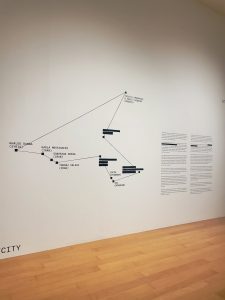
A display showing artist names which were redacted after complaints from Chinese embassy officials in Thailand. Photo: Pran Limchuenjai
A compromise was reached, but what followed was a wave of censorship that stripped the audacious exhibition of artists’ names, politically sensitive references and some of its bravest works.
The names of Uyghur artist Mukaddas Mijit, Tibetan artist Tenzin Mingyur Paldron and Hong Kong artist duo Clara Cheung and Gum Cheng Yee Man were all blacked out and their works pared down or removed entirely.
Tenzin Mingyur Paldron was the most heavily censored, with the televisions screening his video installations about the Dalai Lama and LGBTQ+ Tibetans switched off.
Tibetan and Uyghur flags were removed and a description of the censored artists’ homelands was concealed with black paint. An illustrated postcard comparing China’s treatment of Muslim populations to Israel’s was also taken down.
Sai, who goes by a single name to protect his identity after repeated warnings that he is being sought by the junta, is no stranger to state power.
His father, the former chief minister of Myanmar’s biggest state, was abducted and jailed on falsified charges after the 2021 coup. His mother lives under 24-hour surveillance, constantly fearing for her safety.
This experience has shaped both his politics and his practice. “My works usually combine social experiment with institutional critique,” he explained. “But since 2021, it has mostly been reflective of my lived experience.”
This inspired the most recent exhibition, which brings together exiled Russian, Iranian, Syrian, Burmese, Tibetan, Uyghur and Hong Kong artists. It’s a snapshot of life under repression, mapping the contours of a global authoritarian network.
“We formulated what would happen if all of the oppressed united together against the few [oppressors],” Sai explained about his defiant stance which quickly stoked retaliation.
“We were very used to absurdity, with what happened to my father, my country, my loved ones. But this was another international-level absurdity happening – the absurdity of transnational repression.”
Thailand, which Sai had once seen as a place of refuge where a large community of pro-democracy artists and dissidents from Myanmar could work with relative freedom suddenly felt perilously unsafe.
“Thailand has long tried to balance being a host for dissidents with keeping strong relations with China,” he said. “The intervention by the CCP, and Thailand’s willingness to comply with it, shows just how fragile that space really was.”
After being informed that police were looking for them, Sai and his wife booked flights out of the country. They fled within hours and are now seeking asylum in the UK.
But he is sympathetic towards the BACC. It is funded by the Bangkok Metropolitan Administration, and he said it decided to censor the show due to its “connection to city authorities and the political sensitivities such as threats to diplomatic relations between Thailand and China”.
“They were under immense pressure and chose partial censorship as a way of protecting the institution,” he concluded.
However, the irony was almost too much to bear as the Chinese response handed the exhibition, which might otherwise not have been noticed, a global platform. The artists who had their names blocked out have gone viral, reaching new heights of fame. Visitors have flocked to the exhibition, while the gallery has faced uproar for its decision to bow to censorship.
Sai also says it also taught him a valuable lesson. “When we got out [of Myanmar] we promised that we would make something for our country. Now we’ve learned something – we can’t just do it for our own country, because all of these geographical boundaries are just constructs. We live in one world, and we need to fight against global repression together.”
