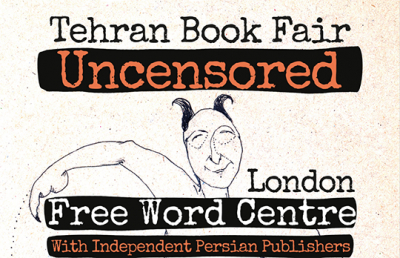
Join us for the first ever Tehran Book Fair Uncensored in Britain, an event featuring an independent book fair and a discussion on censorship in Iran since the 1979 Iranian Revolution.
Taking place on 6-7 May 2016 at London’s Free Word Centre, the book fair coincides with the Tehran Book Fair, but unlike the Iranian counterpart, it’s free from censorship, and will feature censored books from independent Iranian publishers.
Most of the event will be in Farsi, but there will be an English-language session too on Friday 6 May from 4.30pm to 5.30pm – in association with Index on Censorship and Small Media.
Displayed books will range from novels to social science and from plays to history. Participants will also have the chance to see broadcasted footage from the Tehran International Book Fair, and to get to know the publishers and authors and buy signed books.
Participating publishers at the book fair will include:
The English-language event on Friday 6 May will focus on censorship in Iran and will include a talk from Index on Censorship about its work across the Middle East. During this session, Small Media will also present Writer’s Block, an online interactive data visualisation of censorship in Iran since the 1979 revolution.
When: English-Language event with Index on Censorship and Small Media, Friday 6 May 2016, 4.30pm. Farsi events: Friday 6 May 2016, 11am – Saturday 7 May 2016, 6pm Where: Free Word Lecture Theatre at the Free Word Centre (map) Tickets: Free, but booking required through Free Word Centre’s website. Tickets grant entry to the fair but the talks cannot be pre-booked – entry to these is allocated on the day on a first come, first served basis (lecture theatre capacity: 90 people).
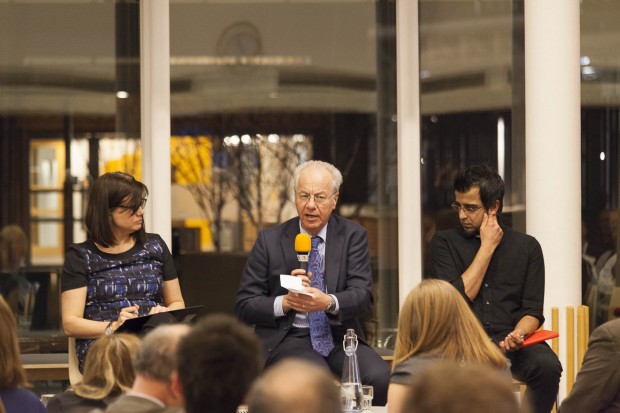
Peter Kellner speaks at the Winter 2015 Index on Censorship magazine launch event at the British Library in February 2015. The panel discussion coincided with the publication of Drafting freedom to last: The Magna Carta’s past and present influences to mark the 800th anniversary of the document’s drafting.
Peter Kellner is president of YouGov and a contributor to Index on Censorship magazine. Kellner discusses the results of a YouGov survey about rights across seven European democracies and the United States. Full results are available here.
As far as I know, North Korea is the only significant country whose citizens have never been polled. Everywhere else, it is possible to discover what people think on at least some issues; and in the world’s democracies we can ask about the most sensitive social and political topics and obtain candid answers. In less than a century, and in many countries less than half a century, opinion polls have given people a voice of a kind they never had before.
It is against this backdrop that I chose the topic for my final blog for YouGov, before stepping down as president. The rise of polling in different countries has accompanied the spreading of democracy and human rights. We can do something that our grandparents never could: find out which human rights matter most to people – and to do it, simultaneously, in a number of countries. In this case we have surveyed attitudes in seven European democracies and the United States.
This is what we did. We identified thirty rights that appear in United Nations and European Council declarations, in the British and American Bills of Rights and, in some cases, are the subject of more recent debate in one or more countries. To prevent the list being even longer, we have been selective. For example, we have omitted “the right of subjects to petition the king”, and the right of people not to be punished prior to conviction, which were promised by Britain’s Bill of Rights. Matters requiring urgent attention in one era are taken for granted in another.
Even so, thirty is a large number. So we divided the list into two, and asked people to look at each list in turn, selecting up to five of the 15 rights from each list that “you think are the most important”. This means that respondents could select, in all, up to ten rights from the thirty. This does not mean that people necessarily oppose the remaining rights, simply that they consider them less important than the ones they do select.
This is what we found:
The right to vote comes top in five of the eight countries (Britain, France, Sweden, Finland and Norway), and second in two (Denmark and the United States – in both cases behind free speech). Only in Germany does it come lower, behind free speech, privacy, free school education, low-cost health care and the right to a fair trial.
In all eight countries more than 50% select free speech as one of the most important rights. It is the only right to which this applies.
Views vary about the importance of habeas corpus – the right to remain free unless charged with a criminal offence and brought swiftly towards the courts. It is valued most in Denmark (by 49%) and the United States (40%). In Britain, where habeas corpus originated in the seventeenth century, the figure is just 27%.
Rights to free school education and low-cost health care are selected by majorities in six of the eight countries. The exceptions are France and the United States. In the US, this reflects a different history and culture of public service provision. In France, unlike the other six European countries we surveyed, financial rights (to a minimum wage and a basic pension) come higher than the rights to health and education.
France is out of line in three other respects. It has by some margin the lowest figure for the right to live free from discrimination – and the highest figures for the right to a job and the “right to take part with others in anti-government demonstrations”
Few will be surprised that far more Americans than Europeans value the right to own a gun (selected by 46% of Americans, but by no more than 6% in any European country) and “the right of an unborn child to life” (30%, compared with 13% in Germany and no more than 8% in any of the other six countries).
The French and Americans are also keener than anyone else on “the right to keep as much of one’s own income as possible with the lowest possible taxes”. In the case of the United States, this is consistent with limited expectations of public-sector provision of health, education and pensions. With France it’s more complex: public services do not rank as high as in the six other European countries, but jobs, pay and pensions matter a lot. In their quest for security, income AND low taxes, many French voters appear to make demands on the state that seem likely to lead to disappointment. Perhaps this, as well as the lingering memory of France’s revolutionary past, explains the enthusiasm of so many French voters on both Left and Right to mount anti-government demonstrations.
In Europe, property rights matter less than social rights. In Germany only 6% regard ‘the right to own property, either alone or in association with others’ as one of their most valued human rights. The figures are slightly higher for France (14%) and Britain (16%) and higher still in the four Scandinavian countries (20-29%). Only in the United States (37%) is it on a par with the rights to free school and low-cost health care.
There are striking differences in views to rights that are matters of more recent controversy. In most of the eight countries, significant numbers of people value “the right to communicate freely with others” (e.g. by letter, phone or email) without government agencies being able to access what is being said). Four in ten Germans and Scandinavians regard this as one of their most important rights, as do 35% of Americans. But it is valued by rather fewer French (29%) and British (21%) adults.
Much lower numbers choose the right of gay couples to a same-sex marriage: the numbers range from 10% (Finland) to 19% (US). This is a clear example of a reform that, separate YouGov research has found, is now popular, or at least widely accepted – but not considered by most people to be as vital a human right as the others in our list.
In six of the eight countries, many more people value “the right of women to have an abortion” than “the right of an unborn child to life”. The exceptions are France, where both rights score just 13%, and the United States, where as many as 30% choose the right of an unborn child to life as a key human right, compared with 21% who value a woman’s right to an abortion. The countries with the strongest support for abortion rights are Denmark and Sweden.
Those are the main facts. Each of them deserves a blog, even a book, to themselves. It’s not just the similarities and differences between countries that are significant, but the variations between different demographic groups within each country. (For example, British men value free speech more than women, while women place a higher priority on the rights to free schooling and low-cost health care. Discuss…)
Nor does this analysis tell us about direct trade-offs. How far are people willing to defend free speech in the face of social media trolls – and habeas corpus when the police and security services seek greater powers to fight terrorism? (Past YouGov surveys have generally found that, when push comes to shove, most people give security a higher priority than human rights.)
The results reported here, then, do not provide a complete map of how human rights are regarded in the eight countries we surveyed. But they do give us a baseline. They tell us what matters most when people are invited to consider a wide range of rights that have been promoted over recent decades and, in some cases, centuries. It is, I believe, the first survey of its kind that has been conducted.
It won’t be the last. Understanding public attitudes to human rights, like promoting and defending those rights, is a never-ending task. It is also a vital one, just like giving voters, customers, workers, patients, passengers, parents – indeed all of us in our different guises – a voice in the institutions that affect our lives. Which has been the purpose of YouGov for the past fifteen years and will continue to be so.
Campaigning for a free Eritrea since the age of 16, Vanessa Berhe can even count the Pope as a supporter. After founding One Day Seyoum to campaign for the release of her uncle, the Eritrean photojournalist Seyoum Tsehaye, Berhe has followed her uncle’s path, becoming a strong voice fighting for freedom in Eritrea.
“Eritrea has never had television,” says journalist Seyoum Tsehaye in a video interview filmed in 1994, three years after the country had won its independence. “This country waged a 30 years war, so it was completely devastated. There was no life in Eritrea, it was only a life of resistance. We resisted and we had a victory.”
The interview shows a hopeful Seyoum set on bringing television and free media to the Eritrean people. A few years later, in 2001, Seyoum and 10 Eritrean journalists were imprisoned without trial. They are still in prison today.
Their story is being forgotten, Berhe believes. Seyoum Tsehaye’s niece, Berhe’s parents were exiled from Eritrea during the 30 years of civil war. She grew up in Sweden, and at the age of 16 founded One Day Seyoum, a campaign to get her uncle out of prison.
“I was telling my friends in school about how my uncle has been imprisoned because of his journalism, and was astonished by the fact that people are so interested and passionate about this case,” Berhe told Index.
“Because Seyoum’s government let him down, the rest of us have to unite, go beyond borders, nationalities and skin colour and prove to Seyoum that he is our brother,” she said when she launched the campaign.
Tsehaye has never formally been charged with a crime, had a trial or been allowed visits from family. Little is known about where he is held, and his family has heard nothing from him since he went on hunger strike in 2002.
One of many prominent journalists to be arrested in 2001, Eritrea has had no independent media since, with only ministry of information-approved media allowed in the country. Press freedom in Eritrea is consistently ranked the lowest in the world, surpassing North Korea in its restrictions.
Berhe’s One Day Seyoum campaign uses social media, video, petitions, speaking engagements and offline actions to spread its message. Berhe has also worked to build a network of ambassadors across the world to help share her message – she now has more than 70 ambassadors across Europe, Asia, Africa, South America and North America.
And she has even had the support of the Pope. Representing Eritrea in a conference about illegal human trafficking at the Vatican, she had the chance to meet him. “I saw him and I brought a paper, took a pen and just wrote ‘I am the Pope and Seyoum is my Brother’… I told him about the case and he supported it of course and took a picture.”
She also used the opportunity to launch a second campaign, Free Eritrea. “With that campaign we aim to raise awareness about crucial issues that are going on with Eretria that also are being forgotten; national service, Eritrean refugees, the lack of freedom of religion, expression, and all those vital human rights that are being violated.”
When asked what her plans were in 2016, Berhe answered “We’re planning to free him.”
Rachael Jolley, editor of Index on Censorship magazine, in a speech to the §2 – Libraries and Democracy conference in Umea, Sweden.
When I was nine, ten and eleven, my mother, my brother and I had a weekly ritual of driving to the local library, a flat modern building with big glass windows. We’d spend a quiet hour wandering up and down its carpeted corridors, picking out two or three plastic-covered books to take home to read.
All sorts of people found stories, history and biographies within their reach.
I have measured out my life in library books: from weekly visits to Bristol libraries, to school in Pittsburgh – a city which pays tribute to the greatest library supporter of them all Andrew Carnegie – to further study at the great Colindale newspaper archive library, and perhaps the most exciting celebrity library spot, standing next to the poet and librarian Philip Larkin in the neighbourhood butchers in Hull.
US poet laureate Rita Dove believes that libraries provide: “A window into the soul and a door into the world.” There are two types of freedom captured in that thought: The freedom to think, and the freedom to find out about others.
Books, magazines and newspapers are a door into the world and that’s why over centuries governments have tried to stop them being opened.
When that door opens on to the world, who knows what people might think or do? That door is not open to everyone now, or in the past. And when it comes to the freedom to express oneself: to write, draw, paint, act or protest then restrictions have often been levied by governments and other powerful bodies to stop the wider public being allowed those too.
Over the centuries, often, books were only made available to some. Sometimes they were written in a language that only a tiny group of people knew. When paper was expensive, books were for the few, not the many. In times gone by education was also expensive (and it still is in many places); those who were allowed to learn reading and writing were once in the minority.
That’s why public libraries, open to all and funded from the public purse, are so important. Their existence helped the many get access to what the few had held close to their chests; information, literature, inspiration.
US businessman and philanthropist Andrew Carnegie was one of the world’s most enthusiastic endowers of libraries. He helped fund more than 2,000 libraries around the United States plus hundreds more in the UK and beyond, because when he was a poor teenager, a wealthy man, Colonel James Anderson, opened up his private library of 400 books to Andrew and other working boys on Saturday nights, and this, Carnegie believed, made a huge difference to his life chances, and his ability to rise from poor, struggling beginnings to be a successful and wealthy steel magnate.
Carnegie believed in libraries’ power to do good. To open people’s minds. To help build knowledge. To help the ordinary person be introduced to ideas that might never otherwise be seen.
Of course, the history of libraries is much older than Carnegie’s time, stretching back to the Romans, Greeks, Chinese and Islamic libraries, where archives of important documents were kept.
Libraries hold history; documents that tell us what was bought and sold in ancient Greece; or how a Roman senator spoke. They inform us about the reality of other times, and allow us to learn from that past.
That’s why conquering armies have looked to destroy libraries and museums. Part of imposing a new present on a population is sometimes about re-writing the past. From the Library at Alexandria, to the Mosque library at Chinguetti to the Roman library on the Palatine Hill. If documents had not been preserved, we would know far less. We can do more than guess what might have happened, we can actually KNOW details, because records are still available.
In the 21st century libraries are under threat from many directions. As governments and local councils cut public spending, libraries in many western countries, including in the United Kingdom, are being closed down. Does that point to a lack of need or desire for such things? Have libraries become redundant?
In this new age of enlightenment is our thirst for knowledge less desperate than in previous generations or is our thirst quenched by easy access to hundreds of television channels and the internet? Indeed, with electronically accessible information free to anyone with a computer, is the internet the ultimate library, rendering its brick and glass-built equivalents redundant, in the same way the printing press marginalised the illuminated manuscript?
We in Europe are more free than previous generations have ever been to learn, find and understand. With our zillions of instant access points for information and discussion, we can look at Facebook, Twitter and thousands of ideas online in the twitch of mouse click after all. But does that access bring more understanding or deeper knowledge? And what is the future role then of a library?
Librarians are much needed as valuable guides: to help students and other readers to learn techniques to sift information, question its validity and measure its importance. To understand what to trust and what to question; and that all information is not equal. Students need to be able to weigh up different sources of research. The University of California Library System saw a 54% decline in circulation between 1991 to 2001 of 8,377,000 books to 3,832,000. It is shocking that some students are failing themselves by not using a broad range of books, and journals that are free from their university libraries to widen and deepen their understanding.
Both libraries and newspapers in their analogue form gave us the opportunity to stumble over ideas that we might not have otherwise encountered. Over there, on that page opposite the one we are reading in a newspaper, is an article about Chilean architecture that we knew nothing about it, but suddenly find a spark of interest in, and over there on the library shelf next to Agatha Christie, is Henning Mankell, a new author to us, and one that suddenly sounds like one we might like to read. And then off we go on a new winding track towards knowledge; one that we didn’t even know we wanted to explore. But that analogue world of stumbled-upon exploration is closing down. We have to make sure that we still have the equipment to carry on stumbling down new avenues and finding out about new writers, and history that we never knew we would care about.
Technology tends to remove the “stumbling upon”, by taking us down straight lines. Instead it prompts us to read or consume more of the same. Technology learns what we like, but it doesn’t know and cannot anticipate what might fascinate us in a chance, a random, encounter. In a world where we remove the unexpected then we miss out on expanding our knowledge. Something that libraries have always offered. The present is all too easily an echo chamber of social media where we follow only the people we agree with, and where we fail to engage with the arguments of those with whom we disagree. Is the echo chamber being enhanced by the linear nature of the digital library, the digital bookstore and the digital newspaper? AND if we follow only those that we like and agree with, do we lull ourselves into believing that those are the only opinions and beliefs out there. And we are so unused to disagreement that we want to close it down. We are somehow afraid to have it in the same room as us. Somehow we seem to be stumbling on towards a world where disagreement is frowned upon, and not embraced as a way of finding what is out there.
This is just one challenge to freedom of expression and thought. There are others.
Recently at Index on Censorship, we heard from Chilean-American writer Ariel Dorfman, a long-time supporter and writer for us…. that his play, Death and the Maiden, was being banned by a school in New Jersey because some parents didn’t like the language contained in it. In other words it offended or upset somebody. Meanwhile Judy Blume’s books about the realities of teenage life, including swearing and teenage pregnancy, gets her banned from US libraries and schools.
But isn’t fiction, theatre and art about connecting with the real, isn’t it about challenging people to think, and to be provoked?
When a film has been banned from our cinemas or a book banned from distribution has it meant no one is keen to read it? In fact the opposite is usually true, people flock to find out what it is or to watch the film wherever they can. One Flew Over the Cuckoo’s Nest, A Clockwork Orange and DH Lawrence’s novel Sons and Lovers found new audiences because they were banned. Monty Python’s controversial film Life of Brian was once marketed here in Sweden as the film so funny, it was banned in Norway!! (As you can imagine it did very well here in Sweden.)
Increasingly there are loud voices saying that we shouldn’t think about the unpleasant bits in the world, that we should ignore the difficult or traumatic because it is too complicated, or too ugly to have in the room. In a special editorial published at the time of the Charlie Hebdo killings, the South African Mail and Guardian said; “The goals of terrorism, if we are to dignify utter insanity with aims, are fear and polarisation.” If we live in a society where we think we are not allowed to speak about subjects; where they are considered too controversial, where appearing on a platform with someone is somehow seen as a tacit nod to agreeing with them, are giving into those goals?
So what can those living in Europe do to enhance or defend freedom of expression and what are the role of libraries? Firstly, we should never stop learning about our history. Remember periods where freedoms of expression, of thought, of living in a non traditional way, or practising a religion that was not state sanctioned, were not laid out as European rights as they are today. From witch trials, to the Edict of Nantes, to social stigma of unmarried women, to children abused by adults. There are moments in every family’s history, when someone had a desperate need for some secret, some taboo, some injustice to be talked about. To be put under the public spotlight.
Given that historical, but personal, reflection, perhaps each of us can have a clearer understanding of why freedom of expression as a right is something worth defending today.
Freedom of expression has always had a role in challenging injustice and persecution. Some argue that without freedom of expression we would not have other freedoms. Freedom of expression also includes offering groups that have historically been ostracised or sidelined or ignored — a chance to put their views, to be part of the wider debate, to be chosen to join a television chat show. Europe is a diverse society, all those voices should be heard.
Another point about enhancing freedom of expression in Europe, and outside, is that a lively and vigorous and diverse media is extremely important. So we should fight against control of the media by a single corporation, or by increased government influence. We need newspapers, and broadcasters, that cover what is happening, and don’t ignore stories because someone would rather those stories were not covered.
And another role for libraries of the future is as debate houses – a living room – at the centre of communities where people of different backgrounds come together to hear and discuss issues at the heart of our societies. And to meet others in their community. These neutral spaces are increasingly needed.
The value of passionate argument is often valued less than it should be. Where debates or arguments are driven underground, those who are not allowed to speak somehow obtain a glamour, a modern martydom. We must allow dissent and argument. We must let people whose ideas we abhor speak. Freedom of speech for those we like and agree with is no freedom at all.
There are those that dismiss freedom of speech as an indulgence defended by the indulged or the middle class or the left wing or the right wing or some other group that they would like not to hear from. However throughout history, freedom of speech and thought and debate has been used by the less powerful to challenge the powerful. Governments, state institutions, religious institutions. And to argue for change. That is not an indulgence.
And if you believe someone else’s arguments are ill founded, incorrect or malicious, then arguing a different point of view in a public place, a library, or a university hall, is much more powerful, than saying you are not allowed to say those things because we don’t like or disagree with them. To make those arguments, to understand what is happening we need to be able to access knowledge, libraries must continue to be community spaces where people can delve for that research and find out about the world, and themselves.
Libraries and those who support them have often been defenders of the right to knowledge. Because at the heart of any library is the idea of a freedom to think and discover.
We should remember that reading something never killed anyone. Watching a play didn’t either. If you find something that you disagree with, even disagree strongly, it is not the same as a dagger through your heart, as someone told me it was last summer in Italy.
As Turkish writer Elif Shafak said recently the response to a cartoon is another cartoon, the response to a play is another play. We are and can be prepared to listen, read or watch things that we disagree with. Listen to the argument; argue back with your own. Consider the evidence. The point of speech is to arrive at truth, and no one should be offended by that.