8 May 2014 | Europe and Central Asia, News

Eurovision contestant Teo, in the music video for this year’s Belarusian entry Cheesecake (Image: Yury Dobrov/YouTube)
If you want a Eurovision of the future, imagine a faux-dubstep bassline dropping on a human falsetto, forever. That was how it felt watching YouTube footage of this year’s entrants in the continent’s greatest song-and-dance-spectacle.
The Eurovision Song Contest, born of the same hope for the future and fear of the past as the European Union, is approaching its 50th year. And strangely, it’s doing quite well. In spite of fears that the competition would end up as an annual carve up between former Soviet states, recent years have in fact seen a fairly equal spread of winners throughout the member states of the European Broadcasting Union (who do not actually have to be in Europe; a fact often missed by anti-Zionists who somehow see a conspiracy in the fact that Israel is a regular entrant in the competition is that channels in countries such as Libya, Jordan and Morocco are also members of the EBU, and technically could enter if they wish. Morocco did, in 1980). Since 2000, the spread of winners between Western Europe, the former Soviet states, and the Balkans and Turkey have been pretty much even.
While some of the geopolitics will always be with us — Turkey and Azerbaijan united in their hatred of Armenia, Cyprus and Greece douze-pointsing each other at every opportunity — the once-derided contest has in fact functioned as a genuine competition. Year in, year out, the best song in the competition tends to win, while the laziest entrants, not taking the event seriously as a songwriting competition (yes, we’re looking at you, Britain), tend to fall behind and then complain that Europe doesn’t “get” pop music.
The best songs and singers triumph, by and large. But Eurovision still does have a political edge.
Take Tuesday’s semi-final in Copenhagen. Russia’s entry, Shine, performed by the Tolmachevy Sisters and described by Popbitch as sounding like “almost every Eurovision song you’ve ever imagined” contained some unintentionally ominous lines:
Living on the edge / closer to the crime / cross the line a step at a time
Add an “a” to the end of that “crime”, and you’ve got the Kremlin’s current foreign policy neatly summed up in a single stanza.
I am not suggesting that the Tolmachevys were sent out to justify Putin’s expansionism. Nonetheless, the Copenhagen crowd were keen that Russia should know what the world thought of its foreign policy and domestic human rights record: as it was announced that Russia had made Saturday’s grand final, the arena erupted in jeering. The dedicated Eurovision fan is clearly not just a poppet living in a fantasy world of camp. They are engaged with the world, and particularly the regressive policies of countries such as Russia, Azerbaijan and Belarus, perhaps more so than your average European.
When Sweden’s Loreen won the competition in Baku, capital of Azerbaijan, in 2012, she pledged to meet the country’s human rights activists. That same year, BBC commentator “Doctor Eurovision” (he actually is a doctor of Eurovision) made explicit references to Belarus’s disgraceful dictatorship, rather than simply giggle at the funny eastern Europeans.
This raises an interesting question about how we engage with dubious regimes.
Before the Baku Eurovision in 2012, there was some discussion over whether democratic countries should boycott the competition, sending a message to Aliyev’s regime.
“No,” Azerbaijani civil rights activists told Index on Censorship. “Let the world come and see Azerbaijan.” They felt that for most of the world, most of the time, they are citizens of a far away country of whom we know nothing. They wanted to take their chance while the world was looking. I think they got it right. As discussed last week, Azerbaijan is engaged in a massive international PR campaign, but to most people in the world since that Eurovision and the attention it raised for the country’s opposition, it has not been able to entirely disguise its atrocious record on free speech and other rights.
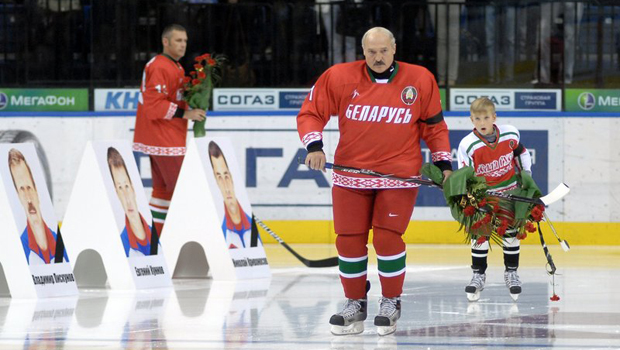
On Friday, the International Ice Hockey Federation’s world championship will open in Belarus. Though there was some discussion of boycotting that event, it has died down. Nonetheless, journalists from Europe and North America will be covering the event, and fans will travel too.
Belarus’s macho dictator Alexander Lukashenko is a keen ice hockey fan, and will be aiming to sweep up the glory of hosting a major international sporting event, not long after the country hosted the world track cycling championships in 2013.
Ice hockey fans and sports journalists are generally not the type of people who go in for Eurovision. But maybe they should try to take a leaf out of the Song Contest supporters book. Have a look at the country around them, learn a little about the politics, and spread the word about the side the dictators don’t want us to see.
Autocrats try to use these international competitions to control the world’s view of them. We should beat them at their own games.
This article was posted on May 8, 2014 at indexoncensorship.org
8 May 2014 | Belarus, News
(Photo: Ivan Uralsky / Demotix)
Authorities in Belarus have been targeting human rights activists ahead of this weekend’s start of the International Ice Hockey Federation’s world championship in Minsk.
At least 17 political and civic activists were detained between 26 April and 6 May to prevent the organising of protests during the championship, which begins on 9 May. Another five are either in detention or being sought for questioning by police. All have been accused of minor hooliganism and sentenced to administrative detention of up to 25 days.
Such “preventive arrests” are common in Belarus. One of the activists, Pavel Vinahradau, who is known for his numerous detentions, opted to leave Minsk until the end of the championship. He had previously been summoned by the police: “They made it clear that either I go to Berezino (a small town 100 km outside Minsk) till 3 June, or I go to Akrestsina (a detention centre in Minsk). I choose Berezino,” Vinahradau wrote on Facebook.
A website called Totalitizator asks its visitors make predictions about which activists will be detained next, for how many days and on what charges. For people who follow political news in Belarus it is not difficult to make a choice.
Potential foreign “troublemakers” are also being kept away from the tournament. On Wednesday, Martin Uggla, a human rights activist from Sweden, was denied entry to Belarus when he was detained at Minsk-2 National Airport. According to temporary visa-free travel requirements, hockey supporters with valid game tickets do not require visa. Despite the fact Martin had one, border guards told him he was being prohibited from entering the country.
Belarus’ president Alexander Lukashenko is known for his love for hockey – and his unfulfilled desire of a real international profile. Consistent tensions with the Western democracies and an unwillingness to ease his authoritarian grip has deprived Lukashenko’s international relations of impact. Fifty-six of the president’s last 100 international visits were to Russia and Kazakhstan, though he has travelled to Turkmenistan, Venezuela, China and Cuba, as well.
The ice hockey championship in Minsk is set to become Lukashenko’s marquee performance on the world stage. That is why the government is rounding up activist voices. Lukashenko wants to present a calm, hospitable and prosperous country led by a wise and caring leader. The picturesque façade cannot hide the problems afflicting Belarus: An unsustainable economy hooked on huge Russian subsidies and a dismal human rights record.
Belarus remains the only country in Europe that still imposes the death penalty. On 18 April, 23-year-old Pavel Sialiun was, according to reports, executed. Sialiun’s case is still under review by the UN Human Rights Committee.
Nine political prisoners are still in jail in Belarus, including well-known human rights defender Ales Bialiatski, and former presidential candidate Mikalay Statkevich. A recent report by FIDH says they are in a critical situation. Many dissidents suffer regular restrictions to “their means of support, quality of food and medical assistance”, including being deprived of meetings with relatives and subject to limits on correspondence.
“Politically motivated persecution of civil society representatives and of the opposition is a general trend, and the limitations on political and civil rights of Belarusian citizens are pervading, both in national legislation and in practice,” says another statement by 12 human rights groups that represent the ice hockey championship participating countries.
But people who raise these issues are not welcome in Minsk these days. Even foreign journalists who are accredited for the championship are obliged to receive a separate accreditation at the Belarusian Foreign Ministry if they wish to cover issues other than hockey while in Belarus.
But many in the country fear the real issues to cover will appear after the championship is over on 25 May.
“Putin invaded the Crimea four days after the Sochi Olympics. Let’s see if Lukashenko will be that quick with another clampdown on civil society. But I am sure he will settle all accounts with us after the championship,” a leader of one Belarusian NGOs told Index in Minsk last week.
Next year, the country will vote in the presidential election. So there is more ice to come in Belarus after international hockey is gone.
An earlier version of this article specifically stated that both Ales Bialiatski and Mikalay Statkevich have been deprived of meetings with relatives and subject to limits on correspondence. While this may have been true in the past, we have not been able to confirm that this is currently happening to the pair.
This article was posted on May 8, 2014 at indexoncensorship.org
1 May 2014 | Brazil, Digital Freedom, News, Russia, United States

“ICANN’s mission is stewardship and operational stability, not the defence of its existence or the preservation of the status quo.”
Stuart Lynn, ICANN President, Feb 2002
There has been much debate this month among internet circles about the future of the Internet Corporation for Assigned Names and Numbers (ICANN). Much of this was discussed at the NETmundial meeting in Sao Paolo, a suitable venue given Brazil’s desire to throw its weight behind reforming such bodies as ICANN. Reforms are on the cards, but no one seems to be clear what exactly these will do to the way the internet is used. Sentiments of doom and gloom mix with utopian forecasts of freedom.
The NETmundial Multistakeolder Statement doesn’t reveal much, other than paying lip service to various principles (freedom of expression and association, privacy) and charting the roughest of roadmaps for future directions on Internet governance. Aspiration, be it in terms of transparency, accountability and collaboration, is key.
ICANN was incorporated in California on September 18, 1998. Its creation was heralded as a loosening of the grip by US authorities on the operational side of the Internet, tasking a company to take over administrative duties. ICANN plays a leading role in dealing with the distribution of IP addresses and the management of the Domain Name System (DNS).
As far back as February 2002, the organisation’s president, Stuart Lynn, saw the need for reforms of the body. Reforms had to “replace ICANN’s unstable institutional foundations with an effective public-private ownership, rooted in the private sector but with the active backing and participation of national governments.” Tensions of management are fundamental – keeping an eye on “high-level elements of the Internet’s naming and address allocation systems” while avoiding intrusions that would stifle “creativity and innovation”. That tension has never been resolved.
On Mar 14, the National Telecommunications and Information Administration (NTIA), based in the US Department of Commerce, announced that its grip on ICANN would be loosened. “The timing is right to start the transition process,” claimed Assistant Secretary of Commerce for Communications and Information, Lawrence E. Strickling. “We look forward to ICANN convening stakeholders across the global Internet community to craft an appropriate transition plan.”
John M. Eger, Director of the Creative Economy Initiative at San Diego State University, was enthusiastic. “The US Government’s decision to end oversight of [ICANN] represents an opportunity for US leadership creating global ‘e-government’ systems to solve international law enforcement and terrorism problems, develop global education and environmental initiatives, and in turn, start using the Internet as a platform for advancing a new foreign-policy agenda.”
Eger’s overview is counter-intuitive – to shape internet governance, to seize the day, as it were, in such areas, one has to liberalise such bodies as ICANN and lessen the grip. Technology can be better managed and directed if the big holders release the creation. The Internet can become both a tool of open governance if the Obama administration embraces a “multistakeholder model”. “Letting go of ICANN gives the US momentum to more aggressively breathe life into the thousand[sic] of applications, which more truly internationalise its usefulness to nations, and to the world community.”
Eger’s observations are problematic on one direct level. US leadership in such areas has tended towards bullying and cajoling negotiating partners in accepting a supposedly universal premise in implementing its own specific policies. Nothing demonstrates that more acutely than the current secret Trans-Pacific Partnership Agreement talks. Ostensibly geared to accelerate trade liberalisation, the leaked chapters of the document suggest that Washington is keen to impress strict, even draconian intellectual property provisions on potential signatories. What can’t be done through Congress can be smuggled in via international treaty.
The suggested relinquishing of control by the US Department of Commerce has not been deemed a wise gesture on the part of such individuals as Sweden’s minister for foreign affairs, Carl Bildt. In relinquishing such control, internet governance would be altered, allowing other states to throw their hats in the ring. Bildt is convinced that widening such involvement on ICANN is not “the way to go.”
Bildt’s concern is paternalistic. Opening such doors will let in rather unsavoury characters keen on over-regulation. “Net freedom is as fundamental as freedom of information and freedom of speech in our societies.” Despite extolling such virtues, he has proven rather enthusiastic about dousing the flames over the NSA revelations of blanket surveillance, arguing that the Swedish FRA is, in fact, a defender of online freedoms. Visions of governance tend to vary.
Bildt also chairs the Chatham House and Centre for International Governance and Innovation Inquiry, created to examine the Snowden legacy and state censorship of the Internet. In a statement in January, the inquiry partners emphasised that “a number of authoritarian states are waging a campaign to exert greater state control over critical internet resources.” They are far from the only ones.
The short of it is that governments are compulsive meddlers. As attractive as the rhetoric of liberty and freedom might be, intrusive governance is still regarded as acceptable. The Brazilian Minister of Communications, Paulo Bernardo, considers virtual crimes and cybersecurity as vital areas of government policy. He did concede that “protocol standards and domain names registration can be perfectly controlled by the technical community.”
The language of Nikolai Nikiforov, Russian representative at NETmundial, proved more muscular. “Being subject to international laws, states act as grantors of rights and freedoms for citizens, play a role in the economy, security and stability of internet infrastructure, and undertaken measures to prevent, detect and deter illegal actions in the global network.”
Governments, it seems, just can’t let go.
This article was posted on May 1, 2014 at indexoncensorship.org
11 Mar 2014 | Americas, News, United States

(Image: Free Barrett Brown)
On 7 March, a US federal judge granted the government’s motion to dismiss the majority of its criminal case against journalist Barrett Brown. The 11 dropped charges, out of 17 in total, include those related to Brown’s posting of a hyperlink that led to online files containing credit card information hacked from the private US intelligence firm Stratfor.
Brown, a 32-year old writer who has had links to sources in the hacker collective Anonymous, has been in pre-trial detention since his arrest in September 2012 – weeks before he was ever charged with a crime. Prior to the government’s most recent motion, he faced a potential sentence of over a century behind bars.
The dismissed charges have rankled journalists and free-speech advocates since Brown’s case began making headlines last year. The First Amendment issues were apparent: are journalists complicit in a crime when sharing illegally obtained information in the course of their professional duties?
“The charges against [him] for linking were flawed from the very beginning,” says Kevin M Gallagher, the administrator of Brown’s legal defense fund. “This is a massive victory for press freedom.”
At issue was a hyperlink that Brown copied from one internet relay chat (IRC) to another. Brown pioneered ProjectPM, a crowd-sourced wiki that analysed hacked emails from cybersecurity firm HBGary and its government-contracting subsidiary HBGary Federal. When Anonymous hackers breached the servers of Stratfor in December 2011 and stole reams of information, Brown sought to incorporate their bounty into ProjectPM. He posted a hyperlink to the Anonymous cache in an IRC used by ProjectPM researchers. Included within the linked archive was billing data for a number of Statfor customers. For that action, he was charged with 10 counts of “aggravated identity theft” and one count of “traffic[king] in stolen authentication features”.
On 4 March, a day before the government’s request, Brown’s defence team filed its own 48-page motion to dismiss the same set of charges. They contended that the indictment failed to properly allege how Brown trafficked in authentication features when all he ostensibly trafficked in was a publicly available hyperlink to a publicly available file. Since the hyperlink itself didn’t contain card verification values (CVVs), Brown’s lawyers asserted that it did not constitute a transfer, as mandated by the statute under which he was charged. Additionally, they argued that the hyperlink’s publication was protected free speech activity under the First Amendment, and that the application of the relevant criminal statutes was “unconstitutionally vague” and created a chilling effect on free speech.
Whether the prosecution was responding to the arguments of Brown’s defense team or making a public relations choice remains unclear. The hyperlink charges have provoked a wave of critical coverage from the likes of Reporters Without Borders, Rolling Stone, the Committee to Protect Journalists, the New York Times, and former Guardian columnist Glenn Greenwald.
Those charges were laid out in the second of three separate indictments against Brown. The first indictment alleges that Brown threatened to publicly release the personal information of an FBI agent in a YouTube video he posted in late 2012. The third claims that Brown obstructed justice by attempting to hide laptops during an FBI raid on his home in March of that year. Though he remains accused of access device fraud under the second indictment, his maximum prison sentence has been slashed from 105 years to 70 in light of the dismissed charges.
While the remaining allegations are superficially unrelated to Brown’s journalistic work, serious questions about the integrity of the prosecution persist. As indicated by the timeline of events, Brown was targeted long before he allegedly committed the crimes in question.
On 6 March 2012, the FBI conducted a series of raids across the US in search of material related to several criminal hacks conducted by Anonymous members. Brown’s apartment was targeted, but he had taken shelter at his mother’s house the night prior. FBI agents made their way to her home in search of Brown and his laptops, which she had placed in a kitchen cabinet. Brown claims that his alleged threats against a federal officer – as laid out in the first indictment, issued several months later in September – stem from personal frustration over continued FBI harassment of his mother following the raid. On 9 November 2013, Brown’s mother was sentenced to six months probation after pleading guilty to obstruction of justice for helping him hide the laptops – the same charges levelled at Brown in the third indictment.
As listed in the search warrant for the initial raid, three of the nine records to be seized related to military and intelligence contractors that ProjectPM was investigating – one of which was never the victim of a hack. Another concerned ProjectPM itself. The government has never formally asserted that Brown participated in any hacks, raising the question of whether a confidential informant was central to providing the evidence used against him for the search warrant.
“This FBI probe was all about his investigative journalism, and his sources, from the very beginning,” Gallagher says. “This cannot be in doubt.”
In related court filings, the government denies ever using information from an informant when applying for search or arrest warrants for Brown.
But on the day of the raids, the Justice Department announced that six people had been charged in connection to the crimes listed in Brown’s search warrant. One, Hector Xavier Monsegur (aka “Sabu”), had been arrested in June 2011 and subsequently pleaded guilty in exchange for cooperation with the government. According to the indictment, Sabu proved crucial to the FBI’s investigation of Anonymous.
In a speech delivered at Fordham University on 8 August 2013, FBI Director Robert Mueller gave the first official commentary on Sabu’s assistance to the bureau. “[Sabu’s] cooperation helped us to build cases that led to the arrest of six other hackers linked to groups such as Anonymous,” he stated. Presuming that the director’s remarks were accurate, was Brown the mislabeled “other hacker” caught with the help of Sabu?
Several people have implicated Sabu in attempts at entrapment during his time as an FBI informant. Under the direction of the FBI, the government has conceded that he had foreknowledge of the Stratfor hack and instructed his Anonymous colleagues to upload the pilfered data to an FBI server. Sabu then attempted to sell the information to WikiLeaks – whose editor-in-chief, Julian Assange, remains holed up in the Ecuadorian embassy in London after refusing extradition to Sweden for questioning in a sexual assault case. Assange claims he is doing so because he fears being transferred to American custody in relation to a sealed grand jury investigation of WikiLeaks that remains ongoing. Though Sabu’s offer was rebuffed, any evidence linking Assange to criminal hacks on US soil would have greatly strengthened the case for extradition. It was only then that the Stratfor data was made public on the internet.
During his sentencing hearing on 15 November 2013, convicted Stratfor hacker Jeremy Hammond stated that Sabu instigated and oversaw the majority of Anonymous hacks with which Hammond was affiliated, including Stratfor: “On 4 December, 2011, Sabu was approached by another hacker who had already broken into Stratfor’s credit card database. Sabu…then brought the hack to Antisec [an Anonymous subgroup] by inviting this hacker to our private chatroom, where he supplied download links to the full credit card database as well as the initial vulnerability access point to Stratfor’s systems.”
Hammond also asserted that, under the direction of Sabu, he was told to hack into thousands of domains belonging to foreign governments. The court redacted this portion of his statement, though copies of a nearly identical one written by Hammond months earlier surfaced online, naming the targets: “These intrusions took place in January/February of 2012 and affected over 2000 domains, including numerous foreign government websites in Brazil, Turkey, Syria, Puerto Rico, Colombia, Nigeria, Iran, Slovenia, Greece, Pakistan, and others. A few of the compromised websites that I recollect include the official website of the Governor of Puerto Rico, the Internal Affairs Division of the Military Police of Brazil, the Official Website of the Crown Prince of Kuwait, the Tax Department of Turkey, the Iranian Academic Center for Education and Cultural Research, the Polish Embassy in the UK, and the Ministry of Electricity of Iraq. Sabu also infiltrated a group of hackers that had access to hundreds of Syrian systems including government institutions, banks, and ISPs.”
Nadim Kobeissi, a developer of the secure communication software Cryptocat, has levelled similar entrapment charges against Sabu. “[He] repeatedly encouraged me to work with him,” Kobeissi wrote on Twitter following news of Sabu’s cooperation with the FBI. “Please be careful of anyone ever suggesting illegal activity.”
While Brown has never claimed that Sabu instructed him to break the law, the presence of “persons known and unknown to the Grand Jury,” and whatever information they may have provided, continue to loom over the case. Sabu’s sentencing has been delayed without explanation a handful of times, raising suspicions that his work as an informant continues in ongoing federal investigations or prosecutions. The affidavit containing the evidence for the March 2012 raid on Brown’s home remains under seal.
In comments to the media immediately following the raid, Brown seemed unfazed by the accusation that he was involved with criminal activity. “I haven’t been charged with anything at this point,” he said at the time. “I suspect that the FBI is working off of incorrect information.”
This article was posted on March 11, 2014 at indexoncensorship.org
