1 Nov 2023 | Israel, Middle East and North Africa, News, Palestine
Following the brutal attacks on Israel by Hamas on 7 October, violations of free speech have occurred at such pace and scale that it has made keeping track a challenge. The situation was already difficult before that date: Israel was in the grip of a huge crisis, the country stalled by endless protests in response to the government’s attempts to neuter the Supreme Court, while Amnesty International identified “a general climate of repression” in Gaza Strip under Hamas. Since the war started, the right to freedom of expression has gone from bad to worse in both Israel and Palestine, and indeed around the world. Whilst a degree of deterioration was predictable – conflict is never the arena in which rights improve – the current state could hardly be foreseen.
Starting with media freedom, on 7 October itself, of the 1,400 people who were murdered by Hamas several were Israeli reporters on duty. Following the massacre, Israel’s response has resulted in the death of at least 5,000 (according to the latest UN figures from 23 October), again including a number of journalists. Although none of the journalists from either side of the divide were killed for what they had written, they lost their lives though their line of work, making the media landscape all the poorer.
Others have, however, been punished for their work. Journalists from outlets including the BBC, Al-Jazeera, RT Arabic and Al-Araby TV have all reported obstructions to their reporting by the Israeli military, police and others since the conflict began. On 12 October, a team of BBC Arabic reporters were dragged from their vehicle, searched and held at gunpoint by police in the Israeli city of Tel Aviv, despite their vehicle being marked “TV” and the presentation of press cards, the BBC reported. On 26 October, Lama Khater, a freelance writer with Middle East Monitor and a political activist, was arrested by the IDF in the city of Hebron, West Bank, her husband Hazem Fakhoury told CPJ. Confrontational attacks have been coupled with subtle ones: On 9 October, for example, The Jerusalem Post reported that its website was down following a series of cyberattacks. The group Anonymous Sudan claimed responsibility for the attacks, reported Axios and Time magazine.
Media freedom could deteriorate further. On 16 October, Israel proposed new emergency regulations that would allow it to block broadcasts that harm “national morale”. Officials threatened to close Al-Jazeera’s local offices under the proposed rule and to stop the global news organisation from freely reporting on the war.
With the situation on the ground increasingly difficult and with limited media from Gaza itself, the internet more broadly, and social media specifically, is a lifeline. And yet getting information within and out of Gaza has become increasingly difficult. Internet services have been disrupted by the attacks, while Palestinians and their supporters allege that social media platforms, in particular Instagram, are “shadow-banning” their content. Instagram’s owner, Meta, has denied this, but they have admitted that they inserted the word “terrorist” automatically into translated bios of Palestinian users, something they apologised for on 19 October.
Social media giant X, which has had a tumultuous ride under owner Elon Musk over the last year to say the least, has also been flooded with misinformation, as we reported on 18 October. Images have been adopted from other conflicts, fake accounts created in a smorgasbord of lies intended to sow confusion, division and hate. At a time when it could be providing an essential role in the spread of crucial information, trust is low.
As those within Israel and Palestine struggle to access reliable news, international media outlets find themselves in the middle of claims of irresponsible reporting, such as jumping too fast to conclusions over who was behind the explosion at the Al-Ahli hospital, and accusations of bias. The latter can sometimes be unhelpful noise. To instantly shout “censorship” can be erroneous. There are a host of reasons why newspapers and broadcasters might run a story or interview a person (some being mundane, merely down to the availability of one person over another). Impartiality is not a prerequisite for outlets that are not funded by taxpayers. Nor does objectivity equate to equal weight for views. Still, with a conflict as complicated as that between Israel and Palestine, as longstanding, as heated and as volatile, a plurality of views and careful attention to how information is both interrogated and reported is crucial. It’s not clear that every outlet has adhered to these fundamental principles.
As for the actual red pen, one example of direct censorship came from Yale University’s campus newspaper, the Yale Daily News, which censored a pro-Israel opinion piece by removing references to Hamas atrocities. We suspect there are others. Alas the nature of censorship and self-censorship means we don’t always know about them.
Has criticising Israel become a punishable offence for the average person? A “McCarthyite backlash” against criticism of the country’s bombardment of Gaza has been claimed by civil rights groups in the USA, as people are fired, threatened with dismissal or blacklisted from future jobs, according to the Guardian. Take one example: Michael Eisen, editor of the scientific journal eLife, was forced out of his job after reposting an article from satirical magazine the Onion with the headline: “Dying Gazans Criticized for Not Using Last Words to Condemn Hamas”. In Germany, the journalist Michael Scott Moore noted that “the tendency in Berlin right now is to squelch as much criticism of Israel as possible”, citing the arrest of a Jewish Israeli protesting the war amongst others. In the UK, home secretary Suella Braverman suggested that waving Palestinian flags and using popular pro-Palestine slogans could be illegal and a ministerial aide was sacked from his government role following his letter to the prime minister calling for a ceasefire. In Switzerland, all demonstrations related to the conflict were banned in Zurich. In Australia, New South Wales authorities vowed to stop marches from proceeding. And in Israel, in one of the more unpleasant twists, the parents of hostages, who were protesting in Tel Aviv, were spat at and abused by supporters of current leader Benjamin Netanyahu. This in addition to police saying they’ve investigated and detained more than 100 people for their social media activity and, as we reported last week, activists being arrested in Jerusalem for putting up posters with the message: “Jews and Arabs, we will get through this together.”
Staying with Israel, human rights activists worry the detentions are due to the police adopting a wider interpretation than normal of what constitutes incitement to violence. A well-known singer and influencer, Dalal Abu Amneh, was held in police custody for two days. According to Abeer Baker, her lawyer, she was accused of “disruptive behaviour” by police officers, who said her posts could incite violence, in particular one featuring an image of the Palestinian flag with the Arabic motto: “There is no victor but God.” Baker said Abu Amneh was expressing a religious sentiment, while Israeli authorities interpreted the singer’s post as a call to arms for Palestinians. This example highlights a tension right now, the question of what defines hate speech and how we balance the rights for people to protest (be it online, in the streets or through petitions) versus the rights for people to live free from fear and persecution. Some of the banners and comments made at protests have been vile. They are clearly, irrefutably hate speech and given recent events – an Orthodox Jewish man assaulted in London, a mob storming Dagestan’s airport looking for people arriving from Israel, cemeteries and synagogues set alight in Tunisia and Austria, to name just a few – one could argue incitement. Still, it is clear that there has been huge overreach. Many who have been punished for what they’ve said have been peaceful, with views that – even if you disagree with them or find them uncomfortable – should be protected.
The above is far from an exhaustive list. It could go on and on. Consider Adania Shabli, the Palestinian writer whose event at Frankfurt Book Fair was called off. Consider the Pulitzer Prize-winning novelist Viet Thanh Nguyen, whose appearance at 92NY, one of New York City’s leading cultural organisations, was pulled on the back of his criticism of Israel. Yet even this incomplete tally paints a grim picture. Free speech can be difficult and no more so than with Israel-Palestine, a conflict which is and always has been so deeply emotive and tribal. The knee-jerk response at present seems to be to silence. This is no solution. As George Orwell famously said, “If liberty means anything at all, it means the right to tell people what they do not want to hear.” This applies as much to those in Israel as it does to those in Gaza and to all of us outside. There have already been enough victims and casualties – let’s ensure free speech is not another.
1 May 2023
PAST WINNERS 2024 "Sasha" Skochilenko 2024 Freedom of Expression Arts Award Winner See more Kuchu Times 2024 Freedom of Expression Campaigning Award Winner See more Diala Ayesh 2024 Freedom of Expression Campaigning Award Winner See more Nasim Soltanbeygi 2024 Freedom...
9 Feb 2023 | BannedByBeijing, China, Greece, News, Tibet
A few months ahead of the Beijing Winter Olympics, in October 2021, activists gathered at multiple locations in Athens to protest China’s hosting of the Games. In an alarming turn of events, Greek police arrested several of the activists. Some were arrested for unfurling banners, others for simply handing out fliers or, even just attending the “No Beijing 2022” events. Some were released without charge, others were acquitted after trial. For three activists, their trials were postponed until later in 2023.
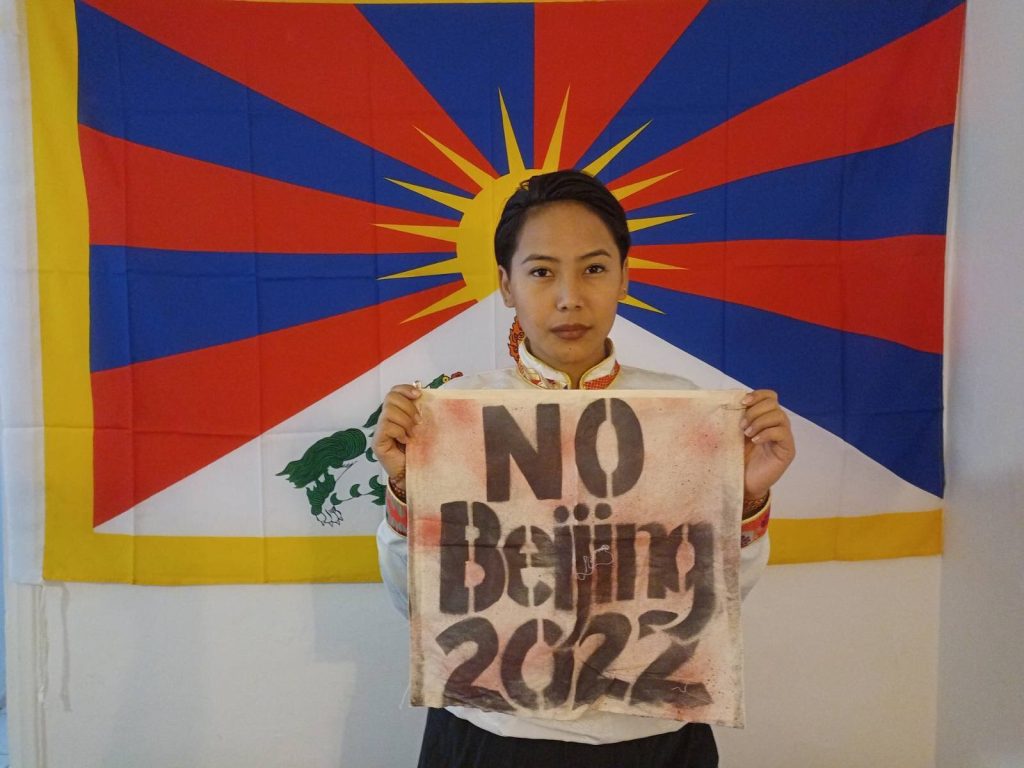
Photo: Free Tibet
Before travelling to Greece, the activists – who were mostly Hong Kongers and Tibetans from Switzerland, the USA and Canada – tried to engage with International Olympics Committee (IOC) officials. They explained that hosting the Olympics in an authoritarian country that commits genocide was a violation of the Olympic Charter, which ensures that the games promote “a peaceful society concerned with the preservation of human dignity”. However, their arguments fell on deaf ears. Frances Hui, the director of “We The HongKongers”, told Index that IOC officials dismissed them, saying “you’re young, this is a complicated issue.”
Another activist, Zumretay Arkin, director of the World Uyghur Congress Women’s Committee, told Index that protesting at the Olympic flame lighting ceremony “was an opportunity for us to counter Beijing in Greece.”
While the activists knew there are always risks involved in protesting, they were not particularly worried. The most common tactic used to silence dissidents abroad – threatening the safety of loved ones – could not work as most activists involved had no direct family left in their homelands. Tsela Zoksang, a Students for Free Tibet member, told Index: “I have the privilege to raise my voice up against the CCP, unlike many communities who remain under the brutal rule of the CCP, and so I think I have a duty to amplify their voices and their stories.” Greece’s position as a member of the EU also reassured the protesters. According to Pema Doma, one of the activists and Executive Director at Students for a Free Tibet, they believed it “very unlikely that a country of the EU would act on orders of the Chinese government”. These beliefs were unfortunately misplaced.
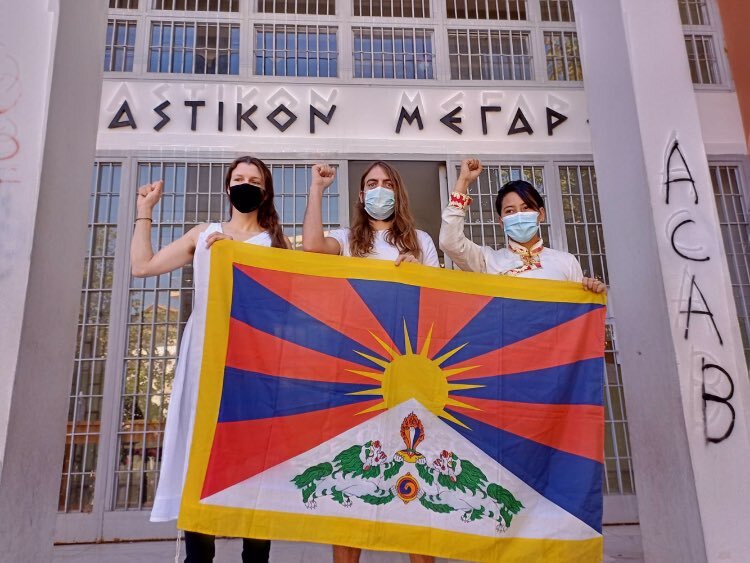
Fern MacDougal, Jason Leith and Chemi Lhamo outside the Greek jail after their action. Photo: Free Tibet
CCP involvement
On 18 October, activists congregated outside the flame lighting ceremony. The activists planned to stand outside the security cordon and hand out flyers to journalists as they entered the Temple of Hera.
The activists were first approached by a Greek police officer curious about their activity but were left undisturbed. This soon changed. According to four activists that Index spoke to, the Greek officer spoke to an individual who identified themself as and was dressed in the uniform of, a member from the Chinese Embassy. The Greek officer insisted that “They’re just sitting there, I don’t see why they shouldn’t be allowed to sit there”. According to the activists’ retelling, this was met with the firm instruction to “make them leave. Tell them they can’t stay here”. They were moved from the entrance car park to a public pavement.
The activists had spotted other plain-clothed Asian men earlier taking photos of them. These same men approached the Greek police, and after a short discussion the activists were detained by Greek police officers. They were arrested without being informed of their rights and taken in unmarked cars to Pyrgos Police Station.
The Greek police possess broad powers to arrest activists for unsanctioned actions. Avgoustinos Zenakos, an investigative journalist from the Manifold Files, told Index: “The Greek police interpret these laws in their favour…This means whether it is abused or used in an honest way depends on the culture of the police rather than the letter of the individual law.” During an official visit to Greece, the UN Working Group on Arbitrary Detention reported that they received “credible information involving non-nationals in pre-trial detention who were detained exclusively on the basis of police testimony, including when there was other evidence that did not support the guilt of the persons involved.”
The protesters believe that the decision to arrest them was not made by the police alone. Doma told Index: “We knew right from the beginning it was the Chinese Embassy staff directing the Greek police quite directly, quite closely, you know, telling them exactly what to tell us”.
The next day, another group of activists were detained after holding a press conference to discuss the CCP’s human rights abuses to members of the media. The event was monitored by unknown individuals, some of whom attempted to stare down and harass the activists. When some of the activists confronted the individuals and asked them where they were from they laughed before replying, “We’re from China”. Tsering Gonpa, a Tibetan Youth Association of Europe activist, and Tenzin Yangzom, Grassroots Director at Students for a Free Tibet, climbed into a taxi together after the event and immediately heard sirens. Their passports were confiscated and they were escorted to the Athens police station.
“We were extremely shocked by the CCP’s influence and leverage in democratic Greece. We knew the situation was bad, but we certainly didn’t expect this level of transnational repression,” Yangzom told Index.
According to Zenakos, to find criticism of Greece’s relationship with China, including Chinese state ownership of key Greek assets and Greece’s involvement in key initiatives such as the 16+1 grouping of countries and China’s “One Belt, One Road” strategy, “you would have to dig deep.” These all raise questions as to whether increasing economic entanglement is leading Greece to become overprotective of its relationship with China. For instance, in 2016 Athens pushed for an EU statement on the South China Sea to be amended to remove criticism of Beijing and a year later it vetoed an EU statement at the UN Human Rights Council condemning human rights abuses in China. According to media reporting, this was the first time the EU didn’t make a statement of this nature at the council.
Mistreatment in the police stations
On 17 October 2021, Tesla Zoksang and Joey Siu, and one other anonymous activist, planned to install a banner onto the outer-walls of the Acropolis. Within about two minutes of ascending, a security guard approached and cut down the banner. The activists remained perched on the scaffolding watching police cars arrive before they were escorted down. Greek barrister Alexis Anagnostakis, who represented the activists, told Index that “the activists’ removal from the protest site, their arrest, and their remand in police custody was a disproportionate interference with their rights for freedom of expression and assembly, as is their criminal prosecution.” Anagnostakis was also surprised by the escalation “since similar protests on the Acropolis reportedly have never before been prosecuted.”
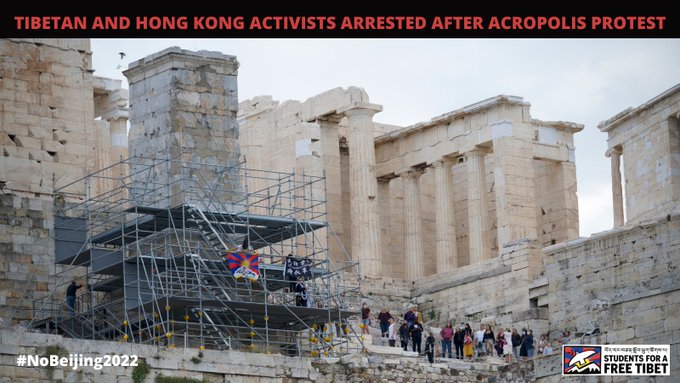
According to Tsela Zoksang, at the police station during an interrogation, one activist who wished to remain anonymous, was told by Greek officials that a representative from the US embassy was there to see them. However, the representative later allegedly admitted to being from an unspecified Greek agency. With assistance from the non-profit Vouliwatch, Index submitted an FOI request to the Greek police, attempting to verify these claims but were denied the disclosure on the basis that Index does not have “specific legitimate interest”. Index has lodged an appeal.
Other detained activists were not informed of their rights or what crime they were alleged to have committed. When the activists detained outside of the press conference asked why they were being detained an officer told them “to be completely honest with you, I don’t know why we’re taking you with us but I got orders from the higher ups”.
They were asked to sign documents without an English translation. After refusing, Zoksang reported that the officers “began getting very angry and frustrated. They were saying, ‘You are disobeying me, you are disobeying the law.’ I said, ‘No, but I can’t sign something if I don’t know what it says’”. They were told they would be punished for not signing documents and giving their fingerprints but at the time of going to press, nothing has yet come of this. The activists were also asked a series of seemingly irrelevant questions such as their parents’ names. Given the potential involvement or presence of CCP-affiliated actors in their detention, they feared this information would be shared with the Chinese authorities, potentially imperilling their ability to travel and the safety of any family members in CCP-jurisdiction.
Every Tibetan is an activist
Chemi Lhamo, a Tibetan activist, explained to Index: “Every Tibetan that was born after 1959 is born an activist … because your existence is by default political in nature when you are born stateless.”
While the Games still went ahead, the campaign nonetheless left its mark. As Lhamo told Index, “There was a moment of time, in the world, in the busy world that we are in, when people stopped for a moment to ask, ‘what’s happening? What’s happening within Tibet?’”
The diplomatic boycotts were also found to have had a major impact on viewership. Yangzom told Index that the oppression of the activists was “vindication that the work that we’re doing is making an impact and we must be doing something right – so we mustn’t give up and keep raising our voices on behalf of Tibetans inside Tibet and all those oppressed.”
All charges against the Acropolis actors were dropped on 17 November 2022. Michael Polak, their British ‘Justice Abroad’ barrister, stated “It is hoped that the acquittals today will send a strong message that legitimate peaceful protest and assembly, of the type banned totally in China and Hong Kong, will be allowed even when it hurts the fragile sensibilities of the Beijing and Hong Kong regimes.”
Yet, the charges against others for attempting to “pollute, damage and distort” the historical monument of Olympia, punishable by up to five years in prison, still stand. The original trial against Lhamo, Jason Leith and Fern MacDougal was delayed before being again pushed back to November 2023. MacDougal told Index she worries “the delay in trial has the effect of both avoiding public discussion of the human rights violations that we took action based on and of obscuring the meaning of our action.”
Lhamo also noted that “it is another year of waiting, and having a pending court case has its own consequences which seem to unfold in various ways for us.” She elaborated to Index that she is “lucky” to have continued support from the lawyers and organisations, but the charge is a significant barrier for them to engage in more direct actions and affects their ability to travel. Yet she emphasised: “Don’t feel anxious for us [about the court case] … Let’s channel that energy of solidarity and support to the folks we are actually working for, those inside Tibet.”
25 Jan 2023 | Australia, Austria, Bahrain, Belarus, Belgium, Botswana, Burma, China, Cuba, Czech Republic, Denmark, Equatorial Guinea, Eritrea, Estonia, Ethiopia, Finland, Germany, Greece, Index Index, Ireland, Laos, Latvia, Lithuania, Moldova, Netherlands, News, Nicaragua, North Korea, Norway, Portugal, Romania, Russia, Saudi Arabia, South Africa, South Sudan, Swaziland, Switzerland, Syria, Turkmenistan, United Arab Emirates, United States, Yemen
A major new global ranking index tracking the state of free expression published today (Wednesday, 25 January) by Index on Censorship sees the UK ranked as only “partially open” in every key area measured.
In the overall rankings, the UK fell below countries including Australia, Israel, Costa Rica, Chile, Jamaica and Japan. European neighbours such as Austria, Belgium, France, Germany and Denmark also all rank higher than the UK.
The Index Index, developed by Index on Censorship and experts in machine learning and journalism at Liverpool John Moores University (LJMU), uses innovative machine learning techniques to map the free expression landscape across the globe, giving a country-by-country view of the state of free expression across academic, digital and media/press freedoms.
Key findings include:
-
The countries with the highest ranking (“open”) on the overall Index are clustered around western Europe and Australasia – Australia, Austria, Belgium, Costa Rica, Denmark, Estonia, Finland, Germany, Ireland, Latvia, Lithuania, Netherlands, New Zealand, Norway, Portugal, Sweden and Switzerland.
-
The UK and USA join countries such as Botswana, Czechia, Greece, Moldova, Panama, Romania, South Africa and Tunisia ranked as “partially open”.
-
The poorest performing countries across all metrics, ranked as “closed”, are Bahrain, Belarus, Burma/Myanmar, China, Cuba, Equatorial Guinea, Eritrea, Eswatini, Laos, Nicaragua, North Korea, Saudi Arabia, South Sudan, Syria, Turkmenistan, United Arab Emirates and Yemen.
-
Countries such as China, Russia, Saudi Arabia and United Arab Emirates performed poorly in the Index Index but are embedded in key international mechanisms including G20 and the UN Security Council.
Ruth Anderson, Index on Censorship CEO, said:
“The launch of the new Index Index is a landmark moment in how we track freedom of expression in key areas across the world. Index on Censorship and the team at Liverpool John Moores University have developed a rankings system that provides a unique insight into the freedom of expression landscape in every country for which data is available.
“The findings of the pilot project are illuminating, surprising and concerning in equal measure. The United Kingdom ranking may well raise some eyebrows, though is not entirely unexpected. Index on Censorship’s recent work on issues as diverse as Chinese Communist Party influence in the art world through to the chilling effect of the UK Government’s Online Safety Bill all point to backward steps for a country that has long viewed itself as a bastion of freedom of expression.
“On a global scale, the Index Index shines a light once again on those countries such as China, Russia, Saudi Arabia and United Arab Emirates with considerable influence on international bodies and mechanisms – but with barely any protections for freedom of expression across the digital, academic and media spheres.”
Nik Williams, Index on Censorship policy and campaigns officer, said:
“With global threats to free expression growing, developing an accurate country-by-country view of threats to academic, digital and media freedom is the first necessary step towards identifying what needs to change. With gaps in current data sets, it is hoped that future ‘Index Index’ rankings will have further country-level data that can be verified and shared with partners and policy-makers.
“As the ‘Index Index’ grows and develops beyond this pilot year, it will not only map threats to free expression but also where we need to focus our efforts to ensure that academics, artists, writers, journalists, campaigners and civil society do not suffer in silence.”
Steve Harrison, LJMU senior lecturer in journalism, said:
“Journalists need credible and authoritative sources of information to counter the glut of dis-information and downright untruths which we’re being bombarded with these days. The Index Index is one such source, and LJMU is proud to have played our part in developing it.
“We hope it becomes a useful tool for journalists investigating censorship, as well as a learning resource for students. Journalism has been defined as providing information someone, somewhere wants suppressed – the Index Index goes some way to living up to that definition.”
