8 Jun 2020 | Statements
[vc_row][vc_column][vc_column_text]
The problem: gag lawsuits against public interest defenders
The EU must end gag lawsuits used to silence individuals and organisations that hold those in positions of power to account. Strategic Lawsuits Against Public Participation (SLAPP) are lawsuits brought forward by powerful actors (e.g. companies, public officials in their private capacity, high profile persons) to harass and silence those speaking out in the public interest. Typical victims are those with a watchdog role, for instance: journalists, activists, informal associations, academics, trade unions, media organisations and civil society organisations.[/vc_column_text][/vc_column][/vc_row][vc_row][vc_column width=”3/4″][vc_column_text]Recent examples of SLAPPs include PayPal suing SumOfUs for a peaceful protest outside PayPal’s German headquarters; co-owners of Malta’s Satabank suing blogger Manuel Delia for a blog post denouncing money laundering at Satabank; and Bollore Group suing Sherpa and ReAct in France to stop them from reporting human rights abuses in Cameroon. In Italy more than 6,000 or two-thirds of defamation lawsuits filed against journalists and media outlets annually are dismissed as meritless by a judge. When Maltese journalist Daphne Caruana Galizia was brutally killed, there were 47 SLAPPs pending against her.
(Index has recently published a comprehensive review of the laws being used to silence journalists – click on the report cover to the right to read it.)[/vc_column_text][/vc_column][vc_column width=”1/4″][vc_single_image image=”113782″ img_size=”full” onclick=”custom_link” img_link_target=”_blank” link=”https://www.indexoncensorship.org/campaigns/the-laws-being-used-to-silence-media/”][/vc_column][/vc_row][vc_row][vc_column][vc_column_text]SLAPPs are a threat to the EU legal order, and, in particular:
● A threat to democracy and fundamental rights. The EU is founded on the rule of law and respect for human rights. SLAPPs impair the right to freedom of expression, to public participation and to assembly of those who speak out in the public interest, and have a chilling effect on the exercise of these rights by the community at large.
● A threat to access to justice and judicial cooperation. Cross-border judicial cooperation relies on the principles of effective access to justice across the Union and mutual trust between legal systems. That trust must be based on the legally enforceable upholding of common values and minimum standards. To the extent that they distort and abuse the system of civil law remedies, SLAPPs undermine the mutual trust between EU legal systems: member states must be confident that rulings issued by other member states’ courts are not the result of abusive legal strategies and are adopted as the outcome of genuine proceedings.
● A threat to the enforcement of EU law, including in connection to the internal market and the protection of the EU budget. The effective enforcement of EU law, including the proper
functioning of the internal market, depends on the scrutiny of the behaviour of individual entities by the EU, member states and – crucially – informed individuals. Watchdogs, be it media or civil society actors, play a key enforcement role. Therefore, the absence of a system which safeguards public scrutiny is a threat to the enforcement of EU law. The same reasoning applies to the management of EU programmes and budget, which cannot be monitored through the sole vigilance of the European Commission.
● A threat to freedom of movement. The absence of rules to protect watchdogs from SLAPP has an impact on the exercise of the Treaty’s fundamental freedoms, since it affects the ability of media, civil society organisations and information services providers to confidently operate in jurisdictions where the risk of SLAPPs is higher, and discourages people from working for organisations where they can be the target of SLAPPs.
The solution: an EU set of anti-SLAPP measures
The EU can and must end SLAPPs by adopting the following complementary measures to protect all
those affected by SLAPPs:
1. An anti-SLAPP directive
An anti-SLAPP directive is needed to establish a Union-wide minimum standard of protection against SLAPPs, by introducing exemplary sanctions to be applied to claimants bringing abusive lawsuits, procedural safeguards for SLAPP victims, including special motions to contest the admissibility of certain claims and/or rules making the burden shifting to the plaintiff to demonstrate a reasonable probability of succeeding in such claims, as well as other types of preventive measures. The Whistle-Blower Directive sets an important precedent protecting those who report a breach of Union law in a work-related context. Now the EU must ensure a high standard of protection against gag lawsuits for everyone who speaks out – irrespective of the form and the context – in the public interest.
The legal basis for an anti-SLAPP directive is to be found in multiple provisions of the Treaty; for example, Article 114 TFEU on the proper functioning of the internal market, Article 81 TFEU on judicial cooperation and effective access to justice and Article 325 TFEU on combating fraudrelated to EU programmes and budgets.
2. The reform of Brussels I and Rome II Regulations
Brussels I Regulation (recast) contains rules which grant claimants the ability to choose where to make a claim. This must be amended to end forum shopping in defamation cases, which forces defendants to hire and pay for defence in countries whose legal systems are unknown to them and where they are not based. This is beyond the means of most and falls foul of the principles of fair trial and equality of arms.
Rome II Regulation does not regulate which national law will apply to a defamation case. This allows claimants to select the most favourable substantive law and therefore leads to a race to the bottom. Today, victims may be subject to the lowest standard of freedom of expression applicable to their case.
3. Support all victims of SLAPPs
Funds are needed to morally and financially support all victims of SLAPPs, especially with legal defence. Justice Programme funds should be used to train judges and practitioners, and a system to publicly name and shame the companies that engage in SLAPPs, for example in an EU register, should be created.
Finally, the EU must ensure that the scope of anti-SLAPP measures include everybody affected by SLAPPs, including journalists, activists, trade unionists, academics, digital security researchers, human rights defenders, media and civil society organisations, among others.
This paper was signed by the following 116 organisations
Abalone Alliance Safe Energy Clearinghouse
Access Info Europe
Access Now
ActionAid International
Adéquations
Amigas de la Tierra
Amis de la Terre France
ANTICOR
ARTICLE 19
Association Justice and Environment, z.s.
Bruno Manser Fonds
Terre Solidaire (CCFD)
CEE Bankwatch Network
Centre for Free Expression
Citizens Network Watchdog Poland
Civil Liberties Union for Europe
Civil Rights Defenders
Civil Society Europe
Clean Air Action Group (Hungary)
Committee to Protect Journalists
Common Weal
Consumer Association the Quality of Life
(EKPIZO)
Corporate Europe Observatory
Defend Democracy
European Digital Rights (EDRi)
Electronic Frontier Foundation
Environmental Partnership Association
ePaństwo Foundation
Environmental Paper Network International
(EPN)
Estonian Forest Aid / Eesti Metsa Abiks
ETC Group
Eurocadres / Council of European Professional
and Managerial Staff
European Center for Not-for-Profit Law
European Centre for Press and Media Freedom
European Civic Forum
European Coalition for Corporate Justice
European Coordination Via Campesina
European Environmental Bureau (EEB)
European Federation of Journalists
European Federation of Public Service Unions
(EPSU)
European Trade Union Confederation (ETUC)
Fern
Fitug
Forest Initiatives and Communities
Forum Ökologie & Papier
FOUR PAWS International
Free Press Unlimited
Friends of the Earth Europe
Friends of the Earth Nuclear Network
Friends of the Siberian Forests
Fundacja Otwarty Plan
Fundacja Strefa Zieleni
Global Justice Ecology Project
GM Watch
Gong
Government Accountability Project
Green Light Foundation
Greenpeace EU Unit
Homo Digitalis
IFEX
Index on Censorship
Institute for Sustainable Development
Institute of Water Policy
International Corporate Accountability
Roundtable (ICAR)
International Press Institute (IPI)
Iraqi Journalists Right Defence Association
JEF Europe
Jordens Vänner
Journalismfund.eu
Justice Pesticides
Legal Human Academy
Maison des Lanceurs d’Alerte
Mighty Earth
Milieudefensie / Friends of the Earth
Netherlands
MultiWatch
NGO Neuer Weg
NGO Shipbreaking Platform
Nuclear Consulting Group
Ending Gag Lawsuits in Europe – Protecting Democracy and Fundamental Rights 4
Nuclear Transparency Watch
OGM dangers
On ne se taira pas (We will not remain silent)
Osservatorio Balcani e Caucaso Transeuropa
PEN International
Polish Ecological Club Mazovian Branch
Polish Ecological Club Pomeranian Branch
Polish Institute for Human Rights and Business
Protection International
RECLAIM
Reporters Without Borders
Rettet den Regenwald e.V.
Salva la Selva
Sciences Citoyennes
Sherpa
Society for Threatened Peoples Switzerland
SOLIDAR
SOMO
Stowarzyszenie Ekologiczno-Kulturalne
Wspólna Ziemia / Common Earth
SumOfUs
The Daphne Caruana Galizia Foundation
The Ethicos Group
The Good Lobby
The Signals Network
Transnational Institute
Transparency International EU
Umweltinstitut München e.V.
Vouliwatch
Vrijschrift
vzw Climaxi
Chceme zdravú krajinu / We want a healthy
country
WeMove Europe
Whistleblower Network Germany
Whistleblowing International Network (WIN)
WildLeaks / Earth League International
Women Engage for a Common Future (WECF)
XNet
Zielone Wiadomości[/vc_column_text][/vc_column][/vc_row]
29 Apr 2020 | News
[vc_row][vc_column][vc_column_text]Attacks on press freedom in Europe are at serious risk of becoming a new normal, 14 international press freedom groups and journalists’ organisations including Index on Censorship warn today as they launch the 2020 annual report of the Council of Europe Platform to Promote the Protection of Journalism and the Safety of Journalists. The fresh assault on media freedom amid the Covid-19 pandemic has worsened an already gloomy outlook.
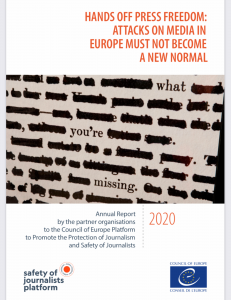 The report analyses alerts submitted to the platform in 2019 and shows a growing pattern of intimidation to silence journalists in Europe. The past weeks have accelerated this trend, with the pandemic producing a new wave of serious threats and attacks on press freedom in several Council of Europe member states. In response to the health crisis, governments have detained journalists for critical reporting, vastly expanded surveillance and passed new laws to punish “fake news” even as they decide themselves what is allowable and what is false without the oversight of appropriate independent bodies.
These threats risk a tipping point in the fight to preserve a free media in Europe. They underscore the report’s urgent wake-up call on Council of Europe member states to act quickly and resolutely to end the assault against press freedom, so that journalists and other media actors can report without fear.
Although the overall response rate by member states to the platform rose slightly to 60 % in 2019, Russia, Turkey, and Azerbaijan – three of the biggest media freedom violators – continue to ignore alerts, together with Bosnia and Herzegovina.
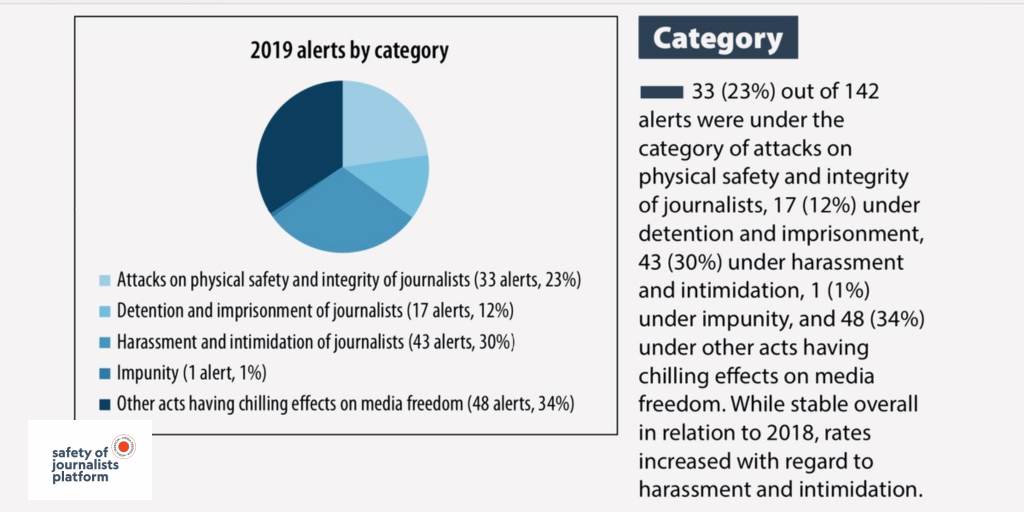
2019 was already an intense and often dangerous battleground for press freedom and freedom of expression in Europe. The platform recorded 142 serious threats to media freedom, including 33 physical attacks against journalists, 17 new cases of detention and imprisonment and 43 cases of harassment and intimidation.
The physical attacks tragically included two killings of journalists: Lyra McKee in Northern Ireland and Vadym Komarov in Ukraine. Meanwhile, the platform officially declared the murders of Daphne Caruana Galizia (2017) in Malta and Martin O’Hagan (2001) in Northern Ireland as impunity cases, highlighting authorities’ failure to bring those responsible to justice. Only Slovakia showed concrete progress in the fight against impunity, indicting the alleged mastermind and four others accused of murdering journalist Ján Kuciak and his fiancée, Martina Kušnírová.
At the end of 2019, the platform recorded 105 cases of journalists behind bars in the Council of Europe region, including 91 in Turkey alone. The situation has not improved in 2020. Despite the acute health threat, Turkey excluded journalists from a mass release of inmates in April 2020, and second-biggest jailer Azerbaijan has made new arrests over critical coverage of the country’s coronavirus response.
2019 saw a clear increase in judicial or administrative harassment against journalists, including meritless SLAPP cases, and spurious and politically motivated legal threats. Prominent examples were the false drug charges filed against Russian investigative journalist Ivan Golunov and the continued imprisonment of journalists in Ukraine’s Russia-controlled Crimea. The Covid-19 crisis has strengthened officials’ tools to harass journalists, with dangerous new “fake news” laws in countries such as Hungary and Russia that threaten journalists with jail for contravening the official line.
Other serious issues identified by 2019 alerts included expanded surveillance measures threatening journalists’ ability to protect their sources, including in France, Poland and Switzerland, as well political attempts to “capture” media through ownership and market manipulation, most conspicuously of all in Hungary. These threats, too, are exacerbated by the actions taken by several governments under the health crisis, which further include arbitrary limitations on independent reporting and on journalists’ access to official information about the pandemic.
Jessica Ní Mhainín, Index’s policy research and advocacy officer, says, “There is a growing pattern of intimidation aimed at silencing journalists in Europe. The situation in Eastern Europe – especially in Hungary, Poland, and Bulgaria – is particularly concerning. But the killing of Lyra McKee shows that we cannot take the safety of journalists for granted anywhere – not even in countries that are seen to be safe for journalists. This report provides an opportunity for us all to come to grips with the serious situation that is facing European media and to remind ourselves of the vital role that the media play in holding power to account.”
Index and the other platform partners call for urgent scrutiny of action taken by governments to claim extraordinary powers related to freedom of expression and media freedom under emergency legislation that are not strictly necessary and proportionate in response to the pandemic. Uncontrolled and unlimited state of emergency laws are open to abuse and have already had a severe chilling effect on the ability of the media to report and scrutinise the actions of state authorities.
While the platform welcomes an increased focus on press freedom by European institutions, including both the Council of Europe and European Union institutions, the ongoing crisis demands more urgent and stringent responses to protect media freedom and freedom of expression and information, and to support the financial sustainability of independent professional journalism. In the age of emergency rule, protecting the press as the watchdog of democracy cannot wait.[/vc_column_text][/vc_column][/vc_row]
16 Apr 2020 | Awards, Fellowship, Fellowship 2020
[vc_row][vc_column][vc_video link=”https://youtu.be/-cB0SsziqKk”][vc_column_text]Veysel Ok is a prominent Kurdish lawyer specialising in free speech and press freedom.
He provides pro-bono legal support to journalists, activists and academics who have been subjected to intimidation, surveillance, smear campaigns and harassment. His work has been instrumental in the release of several unlawfully detained journalists and writers.
Ok is one of the first to challenge the Turkish laws of accreditation which determine whether a journalist meets official requirements to do their job.
Ok has received a five month suspended sentence for ‘insulting the Turkish judiciary’. Asserting his right to freedom of speech; Ok commented on the ‘loyalties’ of judges. This has landed him in a position of surveillance and harassment.
Nevertheless, he stands strong in his fight for justice and freedom of expression for journalists in Turkey.
“In reality, the fight for human rights is crucial for everyone. In Turkey [all lives] are at risk for defending human rights; not just the work I do.
For the past twelve years, I have been fighting for the right to free expression for journalists and writers. For the past three years, we have continued this fight through at the Media and Law Studies Association (MLSA), where I am co-director. We provide legal support to journalists and activists who are in prison with no access to legal services. We stand by them and fight for their freedoms, we fight for access to information [and?] in Turkey. This is the wider work I do, and why MLSA is so important.
This award is a win for the fight for free speech in Turkey. It shows that our work has found support from the international community, and that there is a greater international advance. This gives me incredible hope and pride. I would like to thank you one more time for this award.”[/vc_column_text][/vc_column][/vc_row]
2 Apr 2020 | News, Turkey
[vc_row][vc_column][vc_column_text]
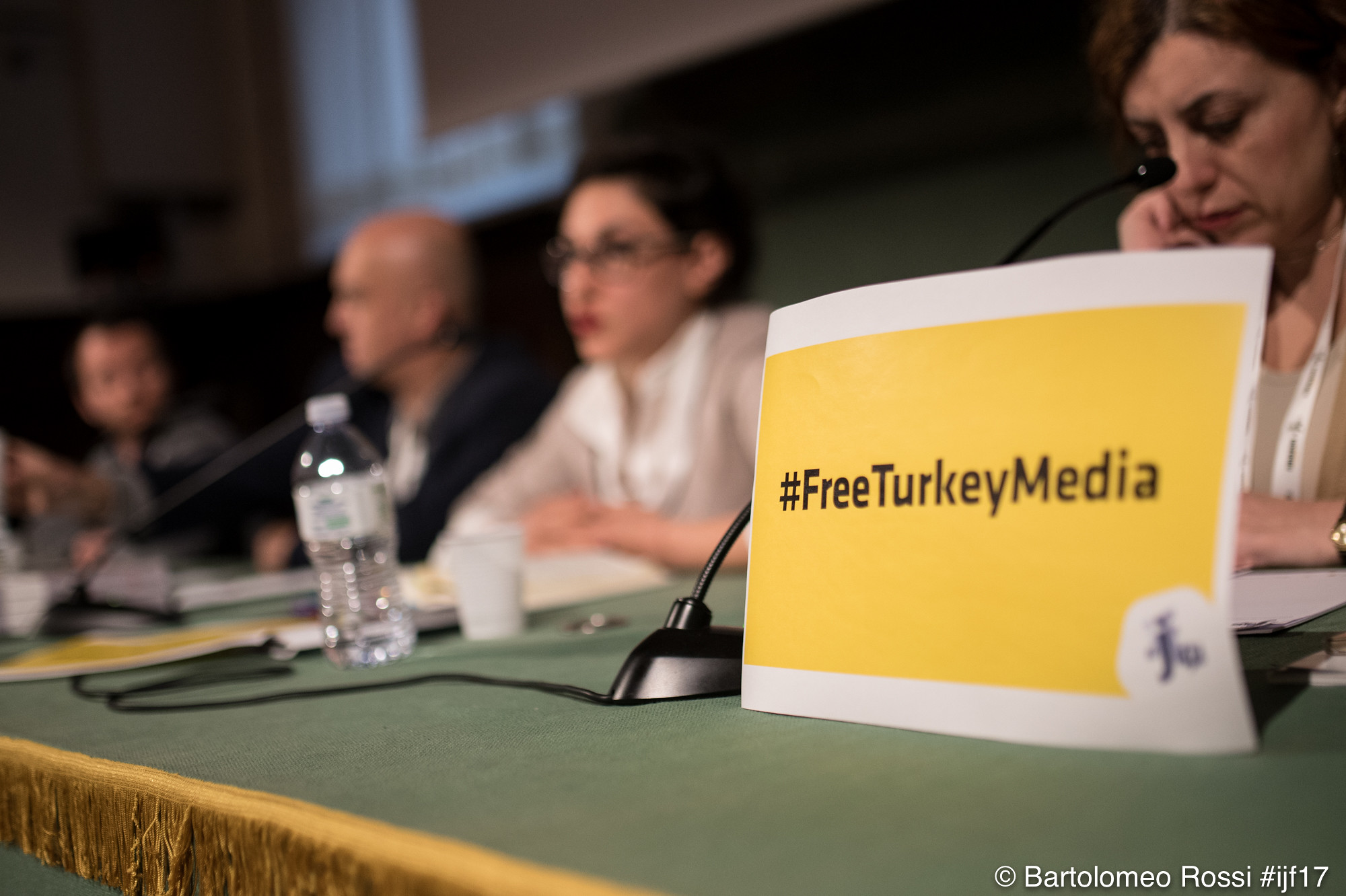
International Journalism Festival/Flickr
[/vc_column_text][/vc_column][/vc_row][vc_row][vc_column][vc_column_text]“In the Middle Ages people watched convicts getting quartered in public squares. Nowadays, on social media, they watch reporters as they live-tweet their ordeals: detention, physical attacks on the streets, losing their livelihoods,” said Turkish author and journalist Kaya Genç.
“For most Turks, watching journalists getting sacked or imprisoned or destroying each other’s careers became entertainment.”
Genç spoke to Index to answer questions posed by the Index youth advisory board about life as a journalist in Turkey under President Recep Tayyip Erdogan, and his latest book, The Lion and the Nightingale: A Journey Through Modern Turkey.
The youth board are elected for six months, and meet once a month online over that period to discuss freedom of expression issues. They are based around the world.
Hana Meihan Davis, from Hong Kong, asked how Erdogan managed to strip Turkey of journalistic freedom. Genç explained that divisions have existed between political sects in the media for decades, which the current ruling party was then able to take advantage of.
“When Islamists were in trouble in the 1990s secularists supported court cases against them; when secularists were locked up some liberals applauded; when Kurds were imprisoned most journalists looked the other way. Now as most of their colleagues are sacked or locked up conservatives act as if all is normal,” said Genç, who is also a contributing editor to Index on Censorship magazine.
Amid this sense of apathy Erdogan moved to create “a small army of loyalists in the media” as other news sites and newspapers were closed down.
Davis followed up her question, asking if people realised what was happening at the time? This is a question often asked when we look back with hindsight at the gradual erosion of freedoms. Were people like a frog who doesn’t realise the temperature of his water is slowly being increased to boiling? Genç said some journalists saw the dangers.
“Reporters and editors declared their independence, or found new patrons, and they are producing excellent work away from the influence of state power. I’m sure they were aware of what was happening while they worked at titles now tamed and indirectly owned by the government.”
The landscape for journalists in Turkey today is rocky terrain. There is an acute awareness of the censorship laws that can be imposed, coupled with a determination to provide much needed accurate reporting.
From the UK, Saffiyah Khalique asked about the laws around “public sensitivities”, which can result in imprisonment for up to a year for disrespecting the beliefs of religious groups, insulting Turkishness and other such “offences”. Genç said they are used within society to silence political dissenters.
“Twitter trolls who present themselves as pro-government journalists use these unclear laws to put their enemies behind bars. If an artist, piano player or actor says something critical about the government, they go through their timeline, find something they find insulting, and ask the public prosecutor to step in.”
Despite this possibility of prosecution being ever around the corner, Genç said he does not feel unsafe or threatened as a journalist in Turkey. “I feel free”, he answered to a question from Emily Boyle, a dual citizen of the UK and Switzerland
Recognising the value of objectivity appears to be Genç’s lifeline. When Indian national Samarth Mishra asked what is the most difficult part of being a journalist in Turkey, Genç said: “The hardest thing for a writer reporting from Turkey is to remain objective. You can’t be bitter about the government. Readers can benefit from the cold heart of a writer who does her best to be objective in her reporting.”
He said: “Our job, as writers, is to hold people with power to account, not to promote this or that political leader, defend this or that political ideology, propagate for this or that country … When a writer inhibits a space where nobody can accuse her of partisanship, believe me the effect of her writing will be much greater.”
The Lion and the Nightingale, Genç’s latest book, was published recently. It takes the reader on a journey through modern Turkey while exploring its history, via interviews he conducted on the road. Egil Sturk, from Sweden, asked Genç if there were any questions he was hesitant to ask his interviewees.
Genç said: “I am hesitant to ask questions about people’s religious beliefs and fiery ideological commitments. I prefer to give them enough space to articulate themselves where the bizarre, the eerie appears like a diamond in a mine. When people feel safe they tell you the most amazing things. Like an analyst you need to just sit there and listen.”
In answer to a question from Aliyah Orr (UK) about the emotional impact of the interviews he was conducting, Genç said:
“The prison chronicle of my friend and colleague Murat Çelikkan … had the strongest emotional effect on me. We used to work together, behind adjacent desks, and his experience in prison was empowering and unsettling. His account of imprisonment was rich with detail and you could see a great writer disappearing into the story’s characters and particulars of his story.”
Faye Gear from Canada asked what is different about today’s landscape in terms of freedom of expression. To tackle the suppression of free speech, Genç said people must think for themselves.
“I grew up idolising individual thinkers and writers: Susan Sontag, Jacques Derrida, Chantal Mouffe, VS Naipaul,” said Genç. “Nowadays we are invited to subscribe to what seems to be the most forward-thinking tribe and then follow its leaders by liking and retweeting their political snippets.”
In the face of an atmosphere of censorship, Genç remains defiant. In answer to a question from Satyabhama Rajoria, from India, about the struggles he faces as a journalist and author, Genç said: “There is of course always the anxiety that comes with publishing your writing, but that is healthy. Bullies, from the left and the right, may take your sentences out of context but that, too, is something one can deal with.”[/vc_column_text][/vc_column][/vc_row][vc_row][vc_column][vc_single_image image=”112300″ img_size=”full”][/vc_column][/vc_row][vc_row][vc_column][vc_basic_grid post_type=”post” max_items=”3″ grid_id=”vc_gid:1585828417099-e398f95f-d0bf-6″ taxonomies=”7355″][/vc_column][/vc_row]
