31 May 2018 | Mapping Media Freedom, Media Freedom, News
[vc_row][vc_column][vc_column_text]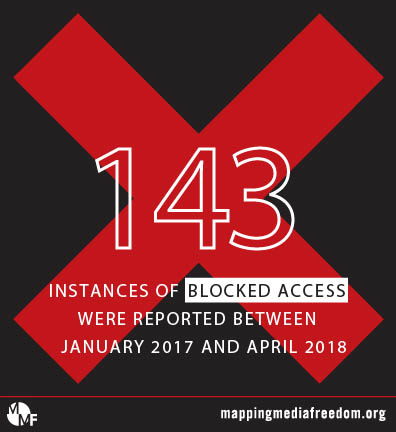 From the beginning of 2017 until April 2018, 143 reports of blocked access, in which journalists were expelled from a location or prevented from speaking to a source, were submitted to Index on Censorship’s Mapping Media Freedom project. Out of the 25 countries in which such violations have occurred, the five worst were: Ukraine, Russia, Belarus, Turkey and France.
“Mapping Media Freedom has highlighted is a continual prevention of journalists from doing their job by way of blocked access,” Joy Hyvarinen, head of advocacy at Index on Censorship, said. “For the sake of the public’s right to know, journalists must be granted access in order to eliminate the problem of important issues going underreported.”
Ukraine
With 20 separate incidents of blocked access, Ukraine tops the list. Thirteen of the reports involved Russian or Georgian media outlets, highlighting the tension between the three countries, with November 2017 being the busiest month, with five violations recorded. At least 12 journalists were barred from entering the country in the last 15 months, with another six being deported. Among those deported was Georgian television channel Rustavi-2 journalist Tamaz Shashvishvili, who was forcibly detained in November 2017 by around 15 armed members of Ukraine’s security services who stormed his apartment, hit him in the face with a pistol and blindfolded him.
In another case, two Spanish journalists were deported to the Netherlands in August 2017 and banned from entering the country for three years after being detained for about 20 hours at Kyiv International Airport. They say they were treated like “criminals” and blacklisted from the country until 2020. A spokeswoman for the Ukrainian secret service said that the journalists were barred because of their “activities that contradict the national interest of Ukraine”.
Russia
In Russia, journalists were denied access on 18 occasions, including 10 times from courtrooms and state assemblies. In March 2018, while live reporting from the Dzerzhinsky District Court of St. Petersburg, Sasha Bogino, a correspondent for the online news site Mediadzona, and her colleague photographer David Frenkel were dragged from the hall. In January 2018, journalists were barred from former Kirov governor Nikita Belykh’s court hearing for bribery.
In January 2018, investigative website Russiangate was closed down three hours after publishing an article claiming to have traced expensive properties to director of Russian secret service FSB Aleksandr Bortnikov, following a request of the General Prosecutor’s Office. Editor-in-chief Aleksandrina Elagina was subsequently dismissed from her position, with investors pulling funding for the site causing it to close.
Belarus
In Belarus eight cases, usually with inadequate explanation, were reported. Pavel Dailid, a journalist for the website Pershy Regiyon, was barred from reporting at a local council meeting in December 2017, when deputy chairman of the Ivatsevichi district Ideology department Aliaksandr Velikaselets demanded to see “an accreditation by the local government” despite the council meeting being as open to the public. In another case, a correspondent for the independent newspaper Hazeta Slonimskaya was barred from local meeting in May 2017 by a government official who stood in front of the entrance calling the paper biased. The journalist was invited to the meeting by local residents.
Photojournalists have also been targeted. In July 2017 city authorities in Babruisk banned photography and filming during Belarus’ Independence Day. Journalists for the newspaper Bobruiski Courier and others, therefore, had no opportunity to photograph the festivities during the public holiday. Two months later a journalist was denied accreditation by the Foreign Ministry for the eighth time. The ministry noted that Victar Parfionenka’s accreditation had been rejected because he “had carried out journalistic activities on behalf of a foreign media outlet without accreditation of the Ministry of Foreign Affairs in Belarus”.
Turkey
In the seven out of nine reports from Turkey, access to a number of websites and TV stations was denied. Sendika, a left-wing labour-oriented news website, has been blocked 23 times in all. In January 2018 access to five news websites was banned, including feminist and pro-Kurdish news website jinnews.org, over a report on the murder of three Kurdish women in Paris in January 2013. Access to daily-German newspaper BILD was blocked online in February 2017 after its harsh criticism of the arrest of German-Turkish reporter Deniz Yucel, a correspondent for daily newspaper Die Welt. Kurdish-language newspaper Rojava Medya was also blocked online in May 2017, most likely for its position as the informal successor of Azadiya Welat, which was shut down under State of Emergency rules introduced after the coup attempt on 15 July.
France
Eight reports of blocked access were reported in France. With a presidential election underway in 2017, five of these involved journalists being denied access to candidates, usually by force.
In April 2017, two Buzzfeed News journalists, David Perrotin and Paul Aveline, were physically prevented from filming a meeting with Francois Fillon. The journalists were filming two people who had interrupted a meeting with Filion when security personnel grabbed the men, threatened them and demanded they delete their footage. It was only when the journalists threatened to write an article about the incident that security backed off.
A similar incident occurred in February 2017 when three journalists were violently expelled from a conference with Marine Le Pen, president of the National Front. Working for the daily current affairs show Quotidien, the journalists were violently kicked out of a conference after attempting to ask Le Pen a question about claims she had misused European Parliament funds to pay her bodyguards. Before journalist Paul Larrouturou could finish his question, he was grabbed, ejected by security and was prevented, along with his two colleagues, to regain access, despite his official accreditation. [/vc_column_text][/vc_column][/vc_row][vc_row][vc_column][vc_basic_grid post_type=”post” max_items=”4″ element_width=”6″ grid_id=”vc_gid:1528726702751-832c0106-cd52-7″ taxonomies=”6564″][/vc_column][/vc_row]
30 May 2018 | Campaigns -- Featured, Statements
[vc_row][vc_column][vc_column_text]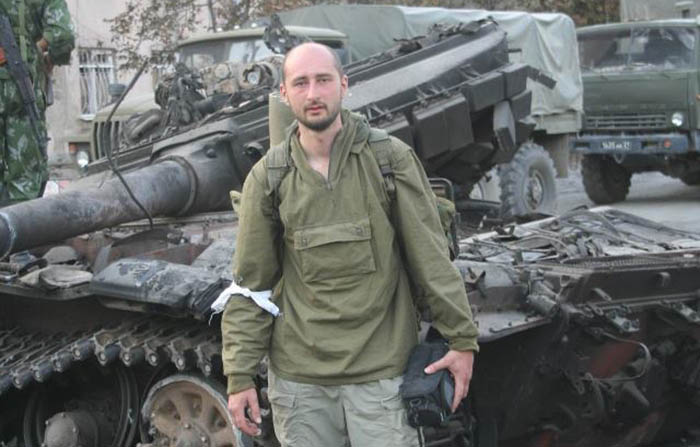
Updated statement: High profile Russian journalist and Kremlin critic Arkady Babchenko staged his own “murder”, it was revealed in a press conference where the journalist appeared on Wednesday 30 May. Earlier news reports have said he was shot and killed in Kiev, Ukraine, at his home, where he lived with his wife. However, that has since been revealed to be untrue.
Babchenko claimed it was necessary to do this in order to catch people who were trying to kill him.
Babchenko left Russia in February 2017, writing that it was “a country I no longer feel safe in”. Babchenko, a former war correspondent for Novaya Gazeta, was known for his fierce criticism of Russia’s annexation of Crimea, its support for separatists in eastern Ukraine and its military intervention in Syria.
Index calls on the Ukrainian police to continue their investigations into the 2016 murder of journalist Pavlo Sheremet, which has yet to be solved.[/vc_column_text][/vc_column][/vc_row][vc_row][vc_column][vc_basic_grid post_type=”post” max_items=”4″ element_width=”6″ grid_id=”vc_gid:1527698401910-293e4fff-01bc-10″ taxonomies=”15″][/vc_column][/vc_row]
1 May 2018 | Europe and Central Asia, Mapping Media Freedom, News, Russia, Ukraine
[vc_row][vc_column][vc_single_image image=”100124″ img_size=”full”][vc_column_text]Flying from Moscow to Simferopol is quick and relatively affordable if you’re travelling out of season, but according to Ukrainian law it’s also illegal. After the 2014 Russian annexation of the peninsula, Ukraine passed a law that prohibits travelling to Crimea via Russia. Violating it can lead to a fine and a ban on entering Ukraine.
Journalists who travel to Crimea via Ukraine need the necessary documentation to work in a territory that is de facto controlled by Russia. In addition to a Russian accreditation and work visas — obtained at the end of a long and demanding process that can prove particularly difficult for freelancers — journalists also need to make their way to Kyiv and present a series of documents to Ukraine’s ministry of information and immigration service, to obtain a permit to enter Crimea, which takes a minimum of one or two days. Then they can head south and make their way to what has become the border with Crimea, 668 kilometres away. Once on the peninsula, they are usually interviewed by FSB officers.
Anton Naumliuk, a Russian journalist who covers Crimea for Radio Liberty, has been travelling to the peninsula about six times a year recently, always via Ukraine. He says he’s noticed that the procedure on the Ukrainian side is becoming simpler and faster. He’s also seen the border gradually built up. “Two years ago there was nothing, just the ground,” he said. Now there’s portacabins and fences. In the summer, there can be long queues.
Journalists often encounter difficulties on the Russian side, he explained. “[FSB officers] ask you who you’ll meet. This interrogation can take hours. If the journalist is quite well-known they try not to do it. If you’re young, if you’re Ukrainian, or carry equipment, you’re more likely to be interrogated. It can be quite nerve-wracking.”
Journalists can be asked to display the content of their phones or computers, although, according to Russian law, they cannot be forced to provide passwords to law enforcement. Officers can search hard drives or flashcards. This means journalists are advised to wipe any sensitive information which could compromise their sources before crossing the border. FSB agents have also been known to ask journalists for their phones’ IMEI number, which could allow them to track the person’s movements when they are reporting in the peninsula.
On my way back from a recent reporting trip to Crimea I met Tetiana Pechonchyk, who monitors human rights violations in Crimea at the Human Rights Information Centre in Kyiv. Her organisation has been campaigning for an easier access for journalists to the peninsula, in a context where coverage by Ukrainian journalists has gradually become near to impossible. “Almost no Ukrainian journalist is able to work in Crimea. A lot of Ukrainian journalists who covered the occupation and persecutions connected to it left Crimea. Ten Crimean media outlets moved to mainland Ukraine with their staff. They continue to cover Crimea but a majority of the websites are blocked on the peninsula, while not being blocked in Russia,” she said.
According to the Human Rights Information Centre’s monitoring, the number of assaults against journalists in Crimea has gone down, but for Pechonchyk, this does not mean much: “They pushed most of independent journalists out. Once you’ve emptied the field then you have no one to repress. They were lots of physical attacks in 2014. In 2015 Russia used legal tools against media outlets. They wouldn’t give a Russian license to outlets. Then they picked journalists who work for the Ukrainian media and terrified them one by one. Small media and bloggers have started appearing in Crimea. The role of professional journalists has been taken over by average citizens who film videos of searches in Tatar houses, go to politically motivated trials to cover them. Now authorities have started persecuting citizen journalists as well.”
Naumliuk began reporting from Crimea because he saw what was taking place there as a continuation of the war in Donbass. “It’s a lot more important than it seems at first glance and offers some understanding into what happened after the breakup of the Soviet Union and what will happen to such a big territory, in places like Belarus and Kazakhstan,” he said. He mostly covers court cases, with a focus on persecutions against Tatars. He says very few foreign outlets work with him regularly, they’ll only ask for his help if something happens.
“[Without constant coverage] it’s super difficult to understand the situation. There’s no human rights organisations working on the ground and very few independent journalists. Very little information on repression against political prisoners goes out. For this reason, it seems nothing is happening in Crimea. It’s all very quiet. But if you speak with Tatars the picture changes. A majority of kids live without their father because of what has been happening,”Naumliuk said.
“I think that not enough journalists go, and that’s there’s not enough stories coming from Crimea, because of the travel,” Ola Cichowlas, who recently travelled via Ukraine to spend two days reporting in Crimea for the Agence France Presse, said in an interview.
“Meanwhile, the world has gotten tired of the story,” Pechonchyk said. Foreign journalists often come for the anniversary of the annexation, do a quick story and then leave.
According to the State Migration Service of Ukraine, 106 foreign journalists have travelled to Crimea via Ukraine between 2015 and March 2018.
In this context, the Human Rights Information Centre and other organisations have tried to push for a facilitated access for foreign journalists who travel to Crimea, but also for aid workers and lawyers for whom it can take much longer to obtain a permit. “The first issue in terms of access is security,” says Pechonchyk. “For a foreign journalist it’s safer to come to Crimea via the Russian Federation than enter via mainland Ukraine. You’re almost always interrogated by the FSB when you go via Ukraine, with a higher risk of being put under surveillance. If you fly to Crimea from Moscow you violate Ukrainian law but it’s safer.”
Pechonchyk believes the process enabling foreign journalists to travel to Crimea should be made simpler: “It shouldn’t be a permission, but a notification. People should be allowed to do it from abroad, via a consulate or an embassy through an online form, and they should be able to apply in English – it’s all in Ukrainian at the moment. This should be a multi-entry permit and the number of categories able to get it should be extended.” At the moment, the list only includes journalists, human rights defenders, people working for international organisations, travelling for religious purposes, to visit relatives or people who have relatives buried in Crimea. Researchers and filmmakers, for instance, are not included and struggle to go to Crimea legally.
Pechonchyk also believes there should be exceptional cases – emergencies – where journalists and lawyers are allowed to travel from Russia, to attend a trial, or report on an arrest, for instance. The existing legislation offers little clarity and seems to be mostly applied when Ukraine wants to punish individuals who supported the annexation, as happened in 2017 when they banned a Russian singer who was to take part in the Eurovision and had performed in Crimea.
But there seems to be little room for a debate on this in Ukrainian society at the moment. Difficulties of access also apply to journalists who visit the self-proclaimed separatist republics of Donetsk or Luhansk, who need a series of accreditations from the Ukrainian and the separatist side, are not supposed to enter the separatist republics from Russia, and can face backlash once they have travelled to the republic. This is what happened when in May 2016, personal information of journalists having visited DNR and LNR was leaked to Myrotvorets, a Ukrainian website known to be supported by Ukrainian police and secret services. The leak included journalists from more than 30 media outlets, who had been merely covering the war on the rebel side but were depicted by nationalists as “collaborating with terrorists”. No one was prosecuted for the leak.
Johann Bihr, who covers Eastern Europe for Reporters Without Borders, told Index: “It’s important that foreign journalists keep heading to Crimea and going back there. And we encourage Russia and Ukraine to facilitate access for journalists. If they fail to do so we face some kind of double penalty, where Crimea is abandoned by the international community because it has not been recognised and turns into an information black hole.”[/vc_column_text][/vc_column][/vc_row][vc_row][vc_column][vc_basic_grid post_type=”post” max_items=”12″ style=”load-more” items_per_page=”4″ element_width=”6″ grid_id=”vc_gid:1525192972009-6f6057be-6973-0″ taxonomies=”6564″][/vc_column][/vc_row]
4 Apr 2018 | Magazine, Magazine Contents, Volume 47.01 Spring 2018
[vc_row][vc_column][vc_custom_heading text=”With contributions from Omar Mohammed, Mahvash Sabet, Simon Callow and Lucy Worsley, as well as interviews with Neil Oliver, Barry Humphries and Abbad Yahya”][/vc_column][/vc_row][vc_row][vc_column][vc_column_text]
The spring 2018 issue of Index on Censorship magazine takes a special look at how governments and other powers across the globe are manipulating history for their own ends.
In this issue, we examine the various ways and areas where historical narratives are being changed, including a Q&A with Chinese and Japanese people on what they were taught about the Nanjing massacre at school; the historian known as Mosul Eye gives a special insight into his struggle documenting what Isis were trying to destroy; and Raymond Joseph takes a look at how South Africa’s government is erasing those who fought against apartheid.
The issue features interviews with historians Margaret MacMillan and Neil Oliver, and a piece addressing who really had free speech in the Tudor Court from Lucy Worsley.
[/vc_column_text][/vc_column][/vc_row][vc_row][vc_column][vc_single_image image=”99222″ img_size=”full”][/vc_column][/vc_row][vc_row][vc_column][vc_column_text]
We also take a look at how victims of the Franco regime in Spain may finally be put to rest in Silvia Nortes’ article; Irene Caselli explores how a new law in Colombia making history compulsory in school will be implemented after decades of conflict; and Andrei Aliaksandrau explains how Ukraine and Belarus approach their Soviet past.
The special report includes articles discussing how Turkey is discussing – or not – the Armenian genocide, while Poland passes a law to make talking about the Holocaust in certain ways illegal.
Outside the special report, Barry Humphries aka Dame Edna talks about his new show featuring banned music from the Weimar Republic and comedian Mark Thomas discusses breaking taboos with theatre in a Palestinian refugee camp.
Finally, we have an exclusive short story by author Christie Watson; an extract from Palestinian author Abbad Yahya’s latest book; and a poem from award-winning poet Mahvash Sabet.
[/vc_column_text][/vc_column][vc_column][/vc_column][/vc_row][vc_row][vc_column][vc_custom_heading text=”Special report: The abuse of history “][vc_column_text]
A date (not) to forget, by Louisa Lim: The author on why her book about Tiananmen would be well-nigh impossible to research today
Who controls the past controls the future…, by Sally Gimson: Fall in line or be in the firing line is the message historian are receiving from governments around the world
Another country, by Luka Ostojić: One hundred years after the creation of Yugoslavia, there are few signs it ever existed in Croatia. Why?
No comfort in the truth, by Annemarie Luck: It’s the episode of history Japan would rather forget. Instead comfort women are back in the news
Unleashing the past, by Kaya Genç: Freedom to publish on the World War I massacre of Turkish Armenians is fragile and threatened
Stripsearch, by Martin Rowson: Mister History is here to teach you what really happened
Tracing a not too dissident past, by Irene Caselli: As Cubans prepare for a post-Castro era, a digital museum explores the nation’s rebellious history
Lessons in bias, by Margaret MacMillan, Neil Oliver, Lucy Worsley, Charles van Onselen, Ed Keazor: Leading historians and presenters discuss the black holes of the historical universe
Projecting Poland and its past, by Konstanty Gebert: Poland wants you to talk about the “Polocaust”
Battle lines, by Hannah Leung and Matthew Hernon: One battle, two countries and a whole lot of opinions. We talk to people in China and Japan about what they learnt at school about the Nanjing massacre
The empire strikes back, by Andrei Aliaksandrau: Ukraine and Belarus approach their former Soviet status in opposite ways. Plus Stephen Komarnyckyj on why Ukraine needs to not cherry-pick its past
Staging dissent, by Simon Callow: When a British prime minister was not amused by satire, theatre censorship followed. We revisit plays that riled him, 50 years after the abolition of the state censor
Eye of the storm, by Omar Mohammed: The historian known as Mosul Eye on documenting what Isis were trying to destroy
Desert defenders, by Lucia He: An 1870s battle in Argentina saw the murder of thousands of its indigenous people. But that history is being glossed over by the current government
Buried treasures, by David Anderson: Britain’s historians are struggling to access essential archives. Is this down to government inefficiency or something more sinister?
Masters of none, by Bernt Hagtvet: Post-war Germany sets an example of how history can be “mastered”. Poland and Hungary could learn from it
Naming history’s forgotten fighters, by Raymond Joseph: South Africa’s government is setting out to forget some of the alliance who fought against apartheid. Some of them remain in prison
Colombia’s new history test, by Irene Caselli: A new law is making history compulsory in Colombia’s schools. But with most people affected by decades of conflict, will this topic be too hot to handle?
Breaking from the chains of the past, by Audra Diptee: Recounting Caribbean history accurately is hard when many of the documents have been destroyed
Rebels show royal streak, by Layli Foroudi: Some of the Iranian protesters at recent demonstrations held up photos of the former shah. Why?
Checking the history bubble, by Mark Frary: Historians will have to use social media as an essential tool in future research. How will they decide if its information is unreliable or wrong?
Franco’s ghosts, by Silvia Nortes: Many bodies of those killed under Franco’s regime have yet to be recovered and buried. A new movement is making more information public about the period
[/vc_column_text][/vc_column][/vc_row][vc_row][vc_column][vc_custom_heading text=”Column”][vc_column_text]
Global view, by Jodie Ginsberg: If we don’t support those whose views we dislike as much as those whose views we do, we risk losing free speech for all
[/vc_column_text][/vc_column][/vc_row][vc_row][vc_column][vc_custom_heading text=”In focus”][vc_column_text]
How gags can remove gags, by Tracey Bagshaw: Comedian Mark Thomas discusses the taboos about stand-up he encountered in a refugee camp in Palestine
Behind our silence, by Laura Silvia Battaglia: Refugees feel that they are not allowed to give their views in public in case they upset their new nation, they tell our interviewer
Something wicked this way comes, by Abigail Frymann Rouch: They were banned by the Nazis and now they’re back. An interview with Barry Humphries on his forthcoming Weimar Republic cabaret
Fake news: the global silencer, by Caroline Lees: The term has become a useful weapon in the dictator’s toolkit against the media. Just look at the Philippines
The muzzled truth, by Michael Vatikiotis: The media in south-east Asia face threats from many different angles. It’s hard to report openly, though some try against the odds
Carving out a space for free speech, by Kirsten Han: As journalists in Singapore avoid controversial topics, a new site launches to tackle these
[/vc_column_text][/vc_column][/vc_row][vc_row][vc_column][vc_custom_heading text=”Culture”][vc_column_text]
Just hurting, not speaking, by Christie Watson: Rachael Jolley interviews the author about her forthcoming book, why old people are today’s silent community and introduces a short story written exclusively for the magazine
Ban and backlash create a bestseller, by Abbad Yahya: The bestselling Palestinian author talks to Jemimah Steinfeld about why a joke on Yasser Arafat put his life at risk. Also an extract from his latest book, translated into English for the first time
Ultimate escapism, by Mahvesh Sabet: The award-winning poet speaks to Layli Foroudi about fighting adversity in prison. Plus, a poem of Sabet’s published in English for the first time
[/vc_column_text][/vc_column][/vc_row][vc_row][vc_column][vc_custom_heading text=”Column”][vc_column_text]
Index around the world, by Danyaal Yasin: Research from Mapping Media Freedom details threats against journalists across Europe
[/vc_column_text][/vc_column][/vc_row][vc_row][vc_column][vc_custom_heading text=”Endnote”][vc_column_text]
Frightening state, by Jemimah Steinfeld: States are increasing the use of kidnapping to frighten journalists into not reporting stories
[/vc_column_text][/vc_column][/vc_row][vc_row content_placement=”top”][vc_column width=”1/3″][vc_custom_heading text=”The Abuse of History” font_container=”tag:p|font_size:24|text_align:left” link=”url:https%3A%2F%2Fwww.indexoncensorship.org%2F2017%2F12%2Fwhat-price-protest%2F%20|||”][vc_column_text]The spring 2018 issue of Index on Censorship magazine takes a special look at how governments and other powers across the globe are manipulating history for their own ends
With: Simon Callow, Louisa Lim, Omar Mohammed [/vc_column_text][/vc_column][vc_column width=”1/3″][vc_single_image image=”99222″ img_size=”medium” alignment=”center” onclick=”custom_link” link=”https://www.indexoncensorship.org/2017/12/what-price-protest/”][/vc_column][vc_column width=”1/3″ css=”.vc_custom_1481888488328{padding-bottom: 50px !important;}”][vc_custom_heading text=”Subscribe” font_container=”tag:p|font_size:24|text_align:left” link=”url:https%3A%2F%2Fwww.indexoncensorship.org%2Fsubscribe%2F|||”][vc_column_text]In print, online. In your mailbox, on your iPad.
Subscription options from £18 or just £1.49 in the App Store for a digital issue.
Every subscriber helps support Index on Censorship’s projects around the world.
 SUBSCRIBE NOW[/vc_column_text][/vc_column][/vc_row]
