[vc_row][vc_column][vc_column_text]Each week, Index on Censorship’s Mapping Media Freedom project verifies threats, violations and limitations faced by the media throughout the European Union and neighbouring countries. Here are five recent reports that give us cause for concern.
Turkey’s main internet regulator, Information and Communication Technologies, sent instructions to operators to close VPN services, according to technology news site Webtekno.
The ICT said it was acting within the scope of Article 6, paragraph 2 of law no 5651 in adopting a decision requesting Turkish operators to shut down VPN services.
The decision covers popular encryption services as Tor Project, VPN Master, Hotspot Shield VPN, Psiphon, Zenmate VPN, TunnelBear, Zero VPN, VyprVPN, Private Internet Access VPN, Espress VPN, IPVanish VPN.
According to Webtekno some VPN services are still available such as Open VPN.
“This is clearly detrimental to journalists and the protection of their sources,” Hannah Machlin, project officer for Mapping Media Freedom, said.
Turkey’s internet censorship did not stop with VPNs as the country faced a shutdown of the popular social media sites Facebook, YouTube, Twitter and more. This was the first time in recent years that the Turkish government targeted popular messaging apps such as WhatsApp, Skype and Instagram, according to Turkey Blocks.
The Independent states that it’s unclear whether the social media outage came from an intentional ban, an accident or a cyber attack. Turkey Blocks believes the outage was related to the arrest of political activists for the opposition party the previous night.
Turkey has increasingly utilised internet restrictions to limit media coverage in times of political unrest.
Spanish group Morera and Vallejo, has decided to slash contracts with photographers working for their newspaper, El Correo de Andalucía, according to the Sevilla Press Association (APS).
The three photographers working as “fake” freelancers for the newspaper were on a permanent contract without the benefits of being an employee. New contracts for the photographers worsened their conditions, lowering their pay and lessening the work photographers can put in daily.
APS additionally states that journalists working for El Correo de Andalucía are expected to act as photographers as well, doubling the amount of work they must put in. The newspaper pushed for the merging journalism and photography but journalists are unwilling to steal their coworkers’ jobs.
Four journalists from the Center for Investigative Reporting in Serbia (CINS) have noted that they have been followed and photographed on mobile phones by unknown individuals, NUNs Press reported.
CINS, which is known for reporting on corruption and organised crime in Serbia, believes the stalkers are an attempt to intimidate their journalists. Editor-in-chief Dino Jahic stated that they’re unsure who is behind the harassment, “We are working on dozens of investigations all the time, and each of them could trigger somebody’s anger.”
On its website, CINS wrote that they were determined to continue their investigations despite the intimidation. Their case has been reported to the Ministry of Interior and the public prosecutor’s office in Belgrade.
The online investigative news site Ukrayinska Pravda has reported that Ukrainian authorities wiretapped the outlet’s offices during the summer of 2015.
Editor-in-chief Sevgil Musayeva-Borovyk said in March of 2016, an unidentified person handed in an envelope with operational reports, activities and topics recently discussed by UP. The site has no evidence that wiretapping has continued since then.
According to Ukrayinska Pravda, the security service of Ukraine was carrying out orders from the president’s administration. Ukrayinska Pravda reported that it was not only its journalists that were targeted, claiming the staff of several other media sites have been tapped. Mapping Media Freedom does not yet know which other organisations.
Journalists have asked the security service of Ukraine, interior minister and chairman of the national police to respond to the information UP has gathered.[/vc_column_text][/vc_column][/vc_row][vc_row][vc_column][vc_column_text]
Today is the International Day to End Impunity for Crimes Against Journalists. Since 2006, 827 journalists have been killed for their reporting. Nine out of 10 of these cases go unpunished.
Index on Censorship’s Mapping Media Freedom platform verified a number of reports of impunity since it began monitoring threats to press freedom across Europe in May 2014. Here are just five reports from three countries of concern: Russia, Belarus and Ukraine.
“Impunity empowers those who orchestrate crimes and leaves victims feeling vulnerable and abandoned,” said Hannah Machlin, Index’s project officer for MMF. “What we are witnessing is a vicious cycle of unresolved crimes against journalists.”
Most recently, MMF reported that Sergey Dorovskoy, who the Lyublinski district court in Moscow recognised as orchestrating the murder of Novaya Gazeta journalist Igor Domnikov, received a 200,000 rubles (€2,860) fine but no jail time because the statute of limitations had passed. This small punishment was in compensation for “moral damages” to Domnikov’s wife.
From 1998-2000, Igor Domnikov headed Novaya Gazeta’s special projects department which ran investigations. He had published a series of articles about Dorovskoy’s alleged criminal activities and corruption.
On 19 February 2014, Vyacheslav Veremiy, a Ukrainian journalist for the newspaper, Vesti, died from injuries he sustained from a gunshot and a brutal beating. Veremiy was targeted while covering the anti-government Euromaidan protests in the country’s capital Kyiv. The two-year-old case has produced suspects but no prosecutions. The investigation remains open.
In Belarus, officials did not file a criminal case in the assault of TUT.by journalist Pavel Dabravolski, who said he was beaten on 25 January 2016 by police while filming another incident at a court facility. The officers involved testified that Dabravolski did not present a press card when requested and grabbed at them while shouting insults. Additionally, police claimed that Dabravolski was interfering with their duties.
Dabravolski captured the incident on his mobile phone, though the recording was not considered as part of the three-month investigation into the incident. According to the journalist, he was thrown to the ground and kicked by police. He was fined for charges of contempt of court and disobeying legal demands.
Index on Censorship calls for more to be done to ensure justice is served for crimes against journalists.
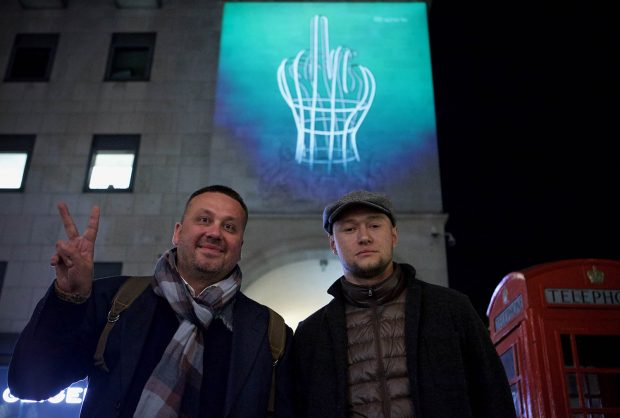
Andriy Klyvynyuk (right) and fellow activist Eugene Stepanenko in front of a projection of Ai Weiwei’s freedom of expression symbol in London. Photo: Nicolai Khalezin
Ukrainian rock musician and activist Andriy Klyvynyuk spoke to Index on Censorship about his support for popular film director and pro-Ukrainian activist Oleg Sentsov and the other Ukrainian political prisoners held by Russia.
Klyvynyuk, the frontman of the pop group Boombox, was a speaker at Belarus Free Theatre’s Freedom of Expression in Ukraine event at the House of Commons in London, where he called on the British government to demand Sentsov’s release. Sentsov is serving a 20-year prison sentence on charges of being part of a terrorist conspiracy. He has stated that he was tortured by investigators and that a key witness recanted in the courtroom on the grounds that evidence had been extorted under torture. His lawyers describe the case against him as “absurd and fictitious”.
Sentsov faces another 18 years in jail but Klyvynyuk, who drove an ambulance during the pro-EU Euromaidan protests in 2014, is determined that Ukraine will continue to work towards a future free of Russian interference.
“We used to cry but now we are laughing because we are not afraid,” he told Index. “We are only 25 years old as a country, and we are at the very beginning of a road. We want to be open and don’t want to see a great wall. I don’t want to be a big star somewhere, having everything but not being able to travel, speak with you, and that was the point of Euromaidan. We are not for the money, the wealth, houses and cars – it’s not what we want, it’s not the point of life at all.”
According to Klyvynyuk, it is Russia that is afraid. “They are very frightened to lose their dominance, to lose their money, to lose their superpower, in such a way as our mafia lost their power,” he said. “The officials are so much afraid that they invaded an independent state.”
Other speakers at the House of Commons event included journalist and author Peter Pomerantsev, and film and theatre director turned soldier Eugene Stepanenko. A video was shown including messages of solidarity from artists including fashion designer Vivienne Westwood and actor Will Attenborough.
Klyvynyuk welcomed these contributions. Although he does not mix his art with his activism, he feels strongly that those with a public position have a responsibility to speak out on human rights abuses. Those who shut their eyes to it, he says, are “clowns dancing on the tables of dictators”.
“I’m a patriot of course but I don’t think Ukraine is bigger or better than any other country in the world,” he said, calling on the world’s media to refocus on Russia’s behaviour towards its neighbour. “This is why we talk about political prisoners all over the world and wars all over the world. But to forget about situations like that, then everybody says ‘Oh, how are you? Are you okay?’ three years later. I say ‘Hey, stop, you know nothing’, and if you are a media person, if you’ve got followers on your social media, if thousands of people are waiting to hear from you, you should find some time to tell these important things.”
As for Oleg Sentsov, Klyvynyuk’s message was one of hope. “I hope that he won’t be broken inside, I hope that he, all of them, will find strength to live through, and then after we win, go out and not just sit and do nothing but continue their work, what they are here for.”
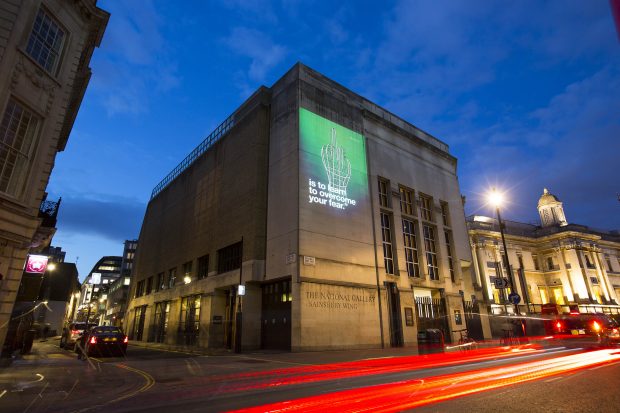
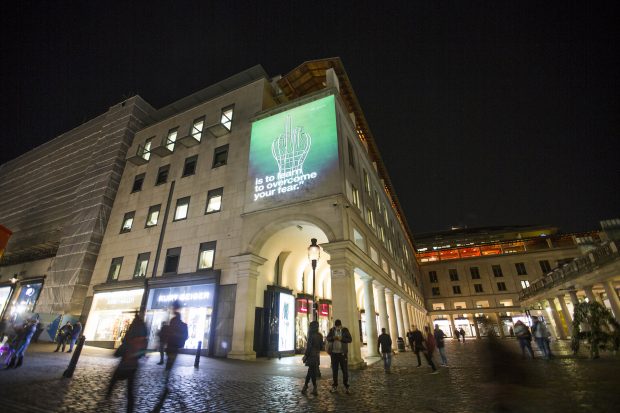
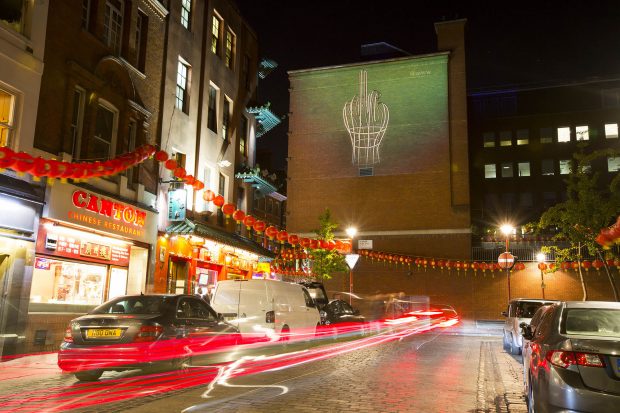
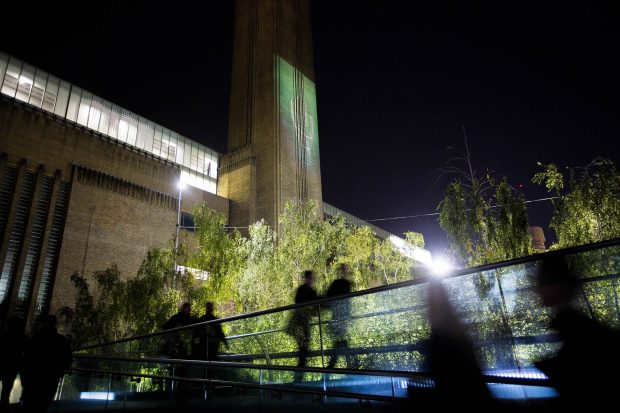
10 October 2016: Belarus Free Theatre project Ai Weiwei’s symbol of freedom of expression onto five iconic buildings across London to highlight the case of Oleg Sentsov. Credit: Graeme Robertson
“We urgently call upon British politicians to put justice, human rights and international law ahead of business interests and to look afresh at the cases of the Kremlin hostages, [and] all political prisoners held by Russia, including our friend Oleg Sentsov,” co-founding artistic director of Belarus Free Theatre, Natalia Kaliada said.
On Monday 10 October, the theatre company hosted Freedom of Expression in Ukraine, an event at the House of Commons, in solidarity with Oleg Sentsov, a popular film director and pro-Ukrainian activist serving a 20-year prison sentence as well as all other Ukrainian political prisoners currently detained in Russian jails.
Sentsov is currently imprisoned in Siberia and is facing 18 more years in jail on charges of being part of a terrorist conspiracy. Sentsov has stated that he was tortured by investigators, and that a key witness recanted in the courtroom on the grounds that evidence had been extorted under torture. His lawyers describe the case against him as “absurd and fictitious”.
The night included a film calling for Sentsov’s release featuring actor Simon Callow, Belarusian Nobel Laureate for Literature Svetlana Alexievich, Polish film director and chair of European Film Academy Agnieszka Holland, actor Will Attenborough, film director Yuri Khaschevatsky and fashion designer and activist, Vivienne Westwood.
Natalia Kaplan, a cousin of Sentsov, could not be in London for the event but recorded a special video appeal for his release.
Pussy Riot’s Maria Alyokhina and members of Belarus Free Theatre read extracts of letters from Sentsov and short scenes from Belarus Free Theatre’s latest production, Burning Doors. Other speakers included Andrei Khliyvynuk, activist and frontman of Ukrainian supergroup Boombox, and film and theatre-director-turned-soldier Eugene Stepanenko.
Nobel Laureate for Literature Svetlana Alexievich and British filmmaker Lord Puttnam both recorded a special message for the event.
Sentsov first came to the attention of the international film world with Gamer, a debut feature inspired by the computer and video-gaming club for young people that he had founded. It opened to great acclaim at the Rotterdam International Film Festival in 2012.
The European Film Academy together with leading international film directors, including Pedro Almodóvar, Wim Wenders, Stephen Daldry, Mike Leigh and Ken Loach, have campaigned for Sentsov’s release, echoing the grave concerns of Amnesty International that his trial was a “total fiasco” and that the “entire case for the prosecution is built on a house of cards”.
Fernando Bovaira named Sentsov an honorary member of the 62nd San Sebastian Film Festival’s main competition jury, and a chair was reserved for him in solidarity.
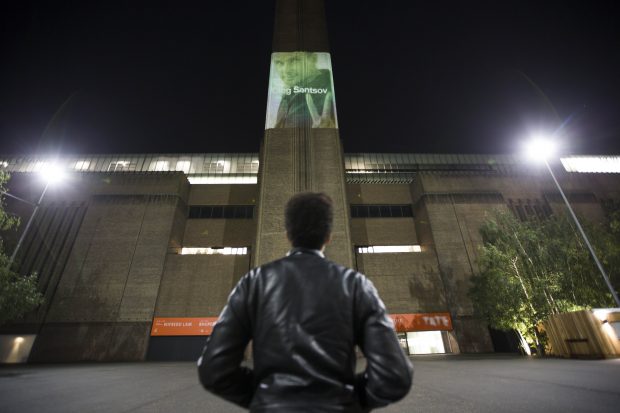
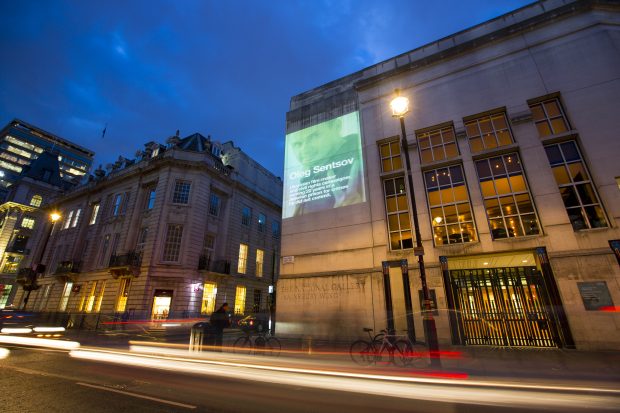
During the evening, an image of Ai Weiwei’s middle finger was projected onto five iconic buildings in London: The National Gallery’s Sainsbury Wing, The Forth Plinth in Trafalgar Square, Royal Opera House, Soho’s Gerrard Street and Tate Modern, together with a short film of Sentsov’s “sham trial” to garner UK public support and attention to his plight.
Ai’s finger, is used as a symbol of freedom “a powerful reminder of the need to strive for justice and freedom of expression,” explained Kaliada.
Credit: Graeme Robertson.
Credit: Graeme Robertson
Credit: Graeme Robertson
Credit: Graeme Robertson
Credit: Graeme Robertson
The demonstration was part of Belarus Free Theatre’s I’m with the Banned campaign which is an artist-led effort to bring together those who live in political freedom in solidarity with artists and activists who are censored or imprisoned in Belarus, Russia, Ukraine and anywhere else in the world where justice and freedom are denied.
Kaliada said: “In recent months, Ukraine has disappeared off the public radar even though the war rages on and Russia continues to drag the world into a new Cold War at a highly sophisticated level that endangers people living in the geopolitical knot known as Ukraine, Belarus and Russia, as well as threatening the global security of people further across the world.”
She said that London is where the founding members of Belarus Free Theatre sought shelter five years ago when they arrived in the UK as political refugees from Belarus.”For one night, the walls of the city will speak on behalf of those who are silenced, and one of the greatest capitals of the world will stand with us in solidarity with Oleg Sentsov,” she said. “As contemporary artists and human beings we have only one tool: creativity.”

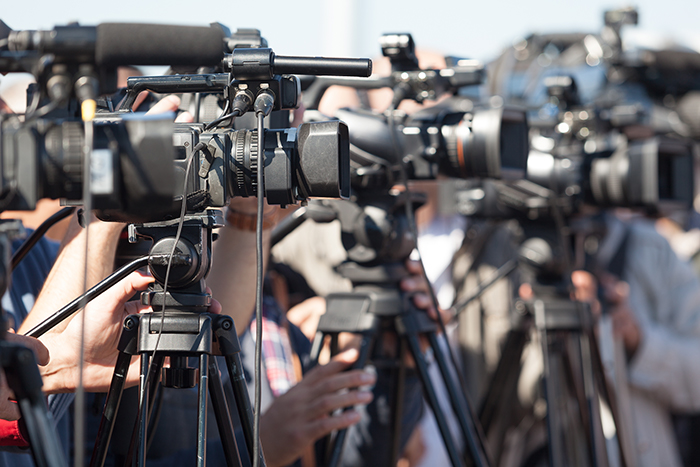 Each week, Index on Censorship’s Mapping Media Freedom project verifies threats, violations and limitations faced by the media throughout the European Union and neighbouring countries. Here are five recent reports that give us cause for concern.