25 Feb 2016 | Africa, Campaigns, Digital Freedom, Digital Freedom Statements, Statements, Uganda
Mr. Zeid Ra’ad Al Hussein, Mr. David Kaye, Mr. Joseph Cannataci, Mr. Maina Kiai, Mr. Michel Forst, Ms. Faith Pansy Tlakula, and Ms. Reine Alapini-Gansou
cc: African Union
African Peer Review Mechanism (APRM) Secretariat
Common Market for Eastern and Southern Africa Secretariat
Domestic & International Election Observer Missions to the Republic of Uganda
East African Community Secretariat
International Conference on the Great Lakes Region Secretariat
New Partnership for Africa’s Development (NEPAD) Secretariat
Uganda Communications Commission
Uganda Electoral Commission
Uganda Ministry of Information and Communications Technology
23 February 2016
Re: Internet shutdown in Uganda and elections
Your Excellencies,
We are writing to urgently request your immediate action to condemn the internet shutdown in Uganda, and to prevent any systematic or targeted attacks on democracy and freedom of expression in other African nations during forthcoming elections in 2016. [1]
On February 18, Ugandan internet users detected an internet outage affecting Twitter, Facebook, and other communications platforms. [2] According to the Uganda Communications Commission (UCC), blocking was carried out on orders of the Electoral Commission, for security reasons. [3] The shutdown coincided with voting for the presidential election, and remained in place until the afternoon of Sunday, February 21. During this period, two presidential candidates were detained under house arrest. [4] The telco MTN Uganda confirmed the UCC directed it to block “Social Media and Mobile Money services due to a threat to Public Order & Safety.” [5] The blocking order also affected the telcos Airtel, Smile, Vodafone, and Africel. President Museveni admitted to journalists on February 18 that he had ordered the block because “steps must be taken for security to stop so many (social media users from) getting in trouble; it is temporary because some people use those pathways for telling lies.” [6]
Research shows that internet shutdowns and state violence go hand in hand. [7] Shutdowns disrupt the free flow of information and create a cover of darkness that allows state repression to occur without scrutiny. Worryingly, Uganda has joined an alarming global trend of government-mandated shutdowns during elections, a practice that many African Union member governments have recently adopted, including: Burundi, Congo-Brazzaville, Egypt, Sudan, the Central African Republic, Niger, Democratic Republic of Congo. [8], [9], [10], [11], [12], [13], [14]
Internet shutdowns — with governments ordering the suspension or throttling of entire networks, often during elections or public protests — must never be allowed to become the new normal. Justified for public safety purposes, shutdowns instead cut off access to vital information, e-financing, and emergency services, plunging whole societies into fear and destabilizing the internet’s power to support small business livelihoods and drive economic development.
Uganda’s shutdown occurred as more than 25 African Union member countries are preparing to conduct presidential, local, general or parliamentary elections. [15]
A growing body of jurisprudence declares shutdowns to violate international law. In 2015, various experts from the United Nations (UN) Organization for Security and Co-operation in Europe (OSCE), Organization of American States (OAS), and the African Commission on Human and Peoples’ Rights (ACHPR), issued an historic statement declaring that internet “kill switches” can never be justified under international human rights law, even in times of conflict. [16] General Comment 34 of the UN Human Rights Committee, the official interpreter of the International Covenant on Civil and Political Rights, emphasizes that restrictions on speech online must be strictly necessary and proportionate to achieve a legitimate purpose. Shutdowns disproportionately impact all users, and unnecessarily restrict access to information and emergency services communications during crucial moments.
The internet has enabled significant advances in health, education, and creativity, and it is now essential to fully realize human rights including participation in elections and access to information.
We humbly request that you use the vital positions of your good offices to:
- call upon the Ugandan government to provide redress to victims of the internet shutdown, and pledge not to issue similar orders in the future;
- call on African states to uphold their human rights obligations, and not to take disproportionate responses like issuing shutdown orders, especially during sensitive moments like elections;
- investigate shutdowns, in their various forms, in order to produce public reports that examine this alarming trend and its impact on human rights, and make recommendations to governments and companies on how to prevent future disruptions;
- encourage telecommunications and internet services providers to respect human rights and resist unlawful orders to violate user rights, including through public disclosures and transparency reports;
- encourage the African Commission on People’s and Human Rights, the United Nations Human Rights Council, and the UN General Assembly to resolve that Internet Shutdowns violate freedom of expression per se and without legal justification.
We are happy to assist you in any of these matters.
Sincerely,
Access Now
African Centre for Democracy and Human Rights Studies (ACDHRS)
Association for Progressive Communications (APC)
Article 19 East Africa
Chapter Four Uganda
CIPESA
CIVICUS
Committee to Protect Journalists
DefendDefenders (The East and Horn of Africa Human Rights Defenders Project)
Electronic Frontier Foundation (EFF)
Global Partners Digital
Hivos East Africa
ifreedom Uganda
Index on Censorship
Integrating Livelihoods thru Communication Information Technology (ILICIT Africa)
International Commission of Jurists Kenya
ISOC Uganda
KICTANet (Kenya ICT Action Network)
Media Rights Agenda
Paradigm Initiative Nigeria
The African Media Initiative (AMI)
Unwanted Witness
Web We Want Foundation
Women of Uganda Network (WOUGNET)
Zimbabwe Human Rights NGO Forum
Endnotes
[1] Uganda election: Facebook and Whatsapp blocked’ (BBC, 18 February 2016) <http://www.bbc.co.uk/news/world-africa-35601220> accessed 18 February 2016.
[2] Omar Mohammed, ‘Twitter and Facebook are blocked in Uganda as the country goes to the polls’ (Quartz Africa, 18 February 2016) <http://qz.com/619188/ugandan-citizens-say-twitter-and-facebook-have-been-blocked-as-the-election-gets-underway/> accessed 18 February 2016.
[3] Uganda blocks social media for ‘security reasons’, polls delayed over late voting material delivery (The Star, 18 February 2016) <http://www.the-star.co.ke/news/2016/02/18/uganda-blocks-social-media-for-security-reasons-polls-delayed-over_c1297431> accessed 18 February 2016.
[4] Brian Duggan, “Uganda shuts down social media; candidates arrested on election day” (CNN, 18 February 2016) <http://www.cnn.com/2016/02/18/world/uganda-election-social-media-shutdown/> accessed 22 February 2016.
[5] MTN Uganda <https://twitter.com/mtnug/status/700286134262353920> accessed 22 February 2016.
[6] Tabu Batugira, “Yoweri Museveni explains social media, mobile money shutdown” (Daily Nation, February 18, 2016) <http://www.nation.co.ke/news/Yoweri-Museveni-explains-social-media-mobile-money-shutdown/-/1056/3083032/-/8h5ykhz/-/index.html> accessed 22 February 2016.
[7] Sarah Myers West, ‘Research Shows Internet Shutdowns and State Violence Go Hand in Hand in Syria’ (Electronic Frontier Foundation, 1 July 2015)
<https://www.eff.org/deeplinks/2015/06/research-shows-internet-shutdowns-and-state-violence-go-hand-hand-syria> accessed 18 February 2016.
[8] ‘Access urges UN and African Union experts to take action on Burundi internet shutdown’ (Access Now 29 April 2015) <https://www.accessnow.org/access-urges-un-and-african-union-experts-to-take-action-on-burundi-interne/> accessed 18 February 2016.
[9] Deji Olukotun, ‘Government may have ordered internet shutdown in Congo-Brazzaville’ (Access Now 20 October 2015) <https://www.accessnow.org/government-may-have-ordered-internet-shutdown-in-congo-brazzaville/> accessed 18 February 2016.
[10] Deji Olukotun and Peter Micek, ‘Five years later: the internet shutdown that rocked Egypt’ (Access Now 21 January 2016) <https://www.accessnow.org/five-years-later-the-internet-shutdown-that-rocked-egypt/> accessed 18 February 2016.
[11] Peter Micek, ‘Update: Mass internet shutdown in Sudan follows days of protest’ (Access Now, 15 October 2013) <https://www.accessnow.org/mass-internet-shutdown-in-sudan-follows-days-of-protest/> accessed 18 February 2016.
[12] Peter Micek, ‘Access submits evidence to International Criminal Court on net shutdown in Central African Republic’(Access Now 17 February 2015) <https://www.accessnow.org/evidence-international-criminal-court-net-shutdown-in-central-african-repub/> accessed 18 February 2016.
[13] ‘Niger resorts to blocking in wake of violent protests against Charlie Hebdo cartoons.’ (Access Now Facebook page 26 January 2015) <https://www.facebook.com/accessnow/posts/10153030213288480> accessed 18 February 2016.
[14] Peter Micek, (Access Now 23 January 2015) ‘Violating International Law, DRC Orders Telcos to Cease Communications Services’ <https://www.accessnow.org/violating-international-law-drc-orders-telcos-vodafone-millicon-airtel/> accessed 18 February 2016.
[15] Confirmed elections in Africa in 2016 include: Central African Republic (14th February), Uganda (18th February), Comoros and Niger (21st February), Rwanda (22nd -27th February), Cape Verde (TBC February), Benin (6th-13th March), Niger, Tanzania and Congo (20th March), Rwanda (22nd March), Chad (10th April), Sudan (11th April), Djibouti (TBC April), Niger (9th May), Burkina Faso (22nd May), Senegal (TBC May), Sao Tome and Principe (TBC July), Zambia (11th July), Cape Verde (TBC August), Tunisia (30th October), Ghana (7th November), Democratic Republic of Congo (27th November), Equatorial Guinea (TBC November), Gambia (1st December), Sudan, and Cote d’Ivoire (TBC December). Other elections without confirmed dates are scheduled to occur in Sierra Leone, Mauritania, Libya, Mali, Guinea, Rwanda, Somalia, and Gabon.
[16] Peter Micek, (Access Now 4 May 2015) ‘Internet kill switches are a violation of human rights law, declare major UN and rights experts’ <https://www.accessnow.org/blog/2015/05/04/internet-kill-switches-are-a-violation-of-human-rights-law-declare-major-un> accessed 18 February 2016.
9 Feb 2016 | About Index, Awards, Events, mobile, Press Releases
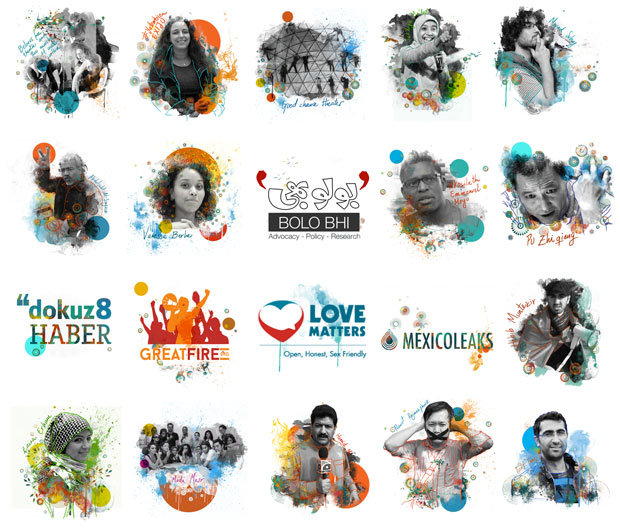
An Aleppo-based journalist training women to report on the crisis in war-torn Syria, an Indonesian comic who jokes about Islamic extremism and a 19-year-old campaigner against repression in Eritrea are among those shortlisted for the 2016 Index on Censorship Freedom of Expression Awards.
Drawn from more than 400 crowdsourced nominations, the Index awards shortlist celebrates artists, writers, journalists and campaigners tackling censorship and fighting for freedom of expression. Many of the 20 shortlisted nominees are regularly targeted by authorities or by criminal and extremist groups for their work: some face regular death threats, others criminal prosecution.
Judges for this year’s awards are Nobel Prize-winning author Wole Soyinka, pianist James Rhodes, tech entrepreneur Bindi Karia, Colombian journalist Maria Teresa Ronderos, human rights lawyer Kirsty Brimelow QC and Bahraini campaigner Nabeel Rajab.
“Censorship is not something that happens ‘somewhere else’,” said Jodie Ginsberg, CEO of Index on Censorship. “It occurs on a daily basis in every country, in every part of the world. The shortlist honours those who are among the bravest and most creative in tackling such threats.”
Awards are offered in four categories: journalism; arts; campaigning; and digital activism.
Nominees include Good Chance Theatre who work in the infamous “Jungle” refugee camp in Calais, France; imprisoned Bahraini academic and blogger Dr Abduljalil Al-Singace, who has continued to protest in prison despite being subjected to torture and abuse for daring to speak out on human rights abuses in his country; GreatFire, an anonymous group that battles China’s severe web censorship; and Pravit Rojanaphruk, a veteran reporter who was arrested, interrogated and forced out of his job for criticising Thailand’s military government.
Other nominees include Zaina Erhaim, who returned to her native Syria to report on the conflict and train women to tell unreported stories; Sakdiyah Ma’ruf, a female Muslim stand-up comedian from Indonesia; and campaigner Nkosilathi Emmanuel Moyo, a Zimbabwean who fights corruption in his country, currently in hiding after sending Robert Mugabe a prison uniform for his 92nd birthday this month.
Winners, who will be announced at a gala ceremony in London on 13 April, become Index on Censorship Freedom of Expression Awards Fellows and are given support for their work.
“How do you fight for free expression beyond a moment? How do you keep it alive? You must remember how stressful it is for people on the ground. This fellowship, following us for a year, it is a good idea,” said Rafael Marques de Morais, Freedom of Expression Award winner for Journalism in 2015.
Notes for editors:
- Index on Censorship is a UK-based non-profit organisation that publishes work by censored writers and artists and campaigns against censorship worldwide.
- More detail about each of the nominees is included below.
- The winners will be announced at a ceremony at The Unicorn Theatre, London, on 13 April.
For more information, or to arrange interviews with any of those shortlisted, please contact: David Heinemann on 0207 260 2660. More biographical information and photos of the nominees are available at awards.indexoncensorship.org
Index on Censorship Freedom of Expression Awards nominees 2016
Arts
Belarus Free Theatre and The Ministry of Counterculture (UK/Belarus)
Ten-year-old Belarus Free Theatre has been using their creative and subversive art to protest the dictatorial rule of Aleksandr Lukashenko for a decade
Tania Bruguera (Cuba)
American-Cuban artist Tania Bruguera, who uses art to campaign for greater openness in Cuban society, was arrested after attempting to stage her play #YoTambienExijo at a festival in Havana. It is now a global movement
Good Chance Theatre (UK)
Good Chance works in the infamous Jungle refugee camp in Calais, France, to provide a space for refugees to express themselves
Sakdiyah Ma’ruf (Indonesia)
Sakdiyah Ma’ruf is a female Muslim stand-up comedian from Indonesia who challenges Islamic fundamentalism and advocates for women’s rights
Murad Subay (Yemen)
Artist Murad Subay uses his country’s streets as a canvas to protest Yemen’s war, institutionalised corruption and forced “disappearings”
Campaigning
Abduljalil Al-Singace (Bahrain)
Dr. Abduljalil Al- Singace is an imprisoned Bahraini human rights activist, academic and blogger who has not let prison stop him from calling attention to his country’s human rights practices
Vanessa Berhe (US)
University student Vanessa Berhe is fighting for the release of her uncle, Eritrean journalist Seyoum Tsehaye, and for freedom of expression in Eritrea, one of the world’s worst most censored countries
Bolo Bhi (Pakistan)
A women-lead digital rights campaigning group who have orchestrated an impressive effort to turn back the Pakistani government’s draconian attempt to censor the internet
Nkosilathi Emmanuel Moyo (Zimbabwe)
Prolific author and activist Nkosilathi Emmanuel Moyo campaigned against political corruption and worked with young people to foster human rights
Pu Zhiqiang (China)
A human rights lawyer who represented Ai Weiwei, Pu Zhiqiang has been targeted by China’s authorities for his unwavering support of free speech
Digital Advocacy
Dokuz8 Haber and Gökhan Biçici (Turkey)
Journalist Gökhan Biçici launched citizen news agency Dokuz8Haber to foster uncensored information and strengthen Turkish democracy, circumventing intense press censorship
GreatFire (China)
GreatFire campaigns for transparency of Chinese censorship by providing numerous effective circumvention tools to the “Great Firewall”
Love Matters (international)
An international platform dedicated to opening up conversation about sexual health in countries where such subjects are censored or taboo
Mexicoleaks (Mexico)
An anonymous news-sharing platform seeking to bring more transparency to Mexico’s society by uncovering corruption
Hebib Muntezir (Azerbaijan)
An exiled Azerbaijani activist and blogger, who works with Meydan TV, mobilising social media to get uncensored news to a surprising number of his fellow citizens
Journalism
Zaina Erhaim (Syria)
One of the few female journalists still reporting from Syria, Zaina Erhaim of Aleppo works to train women to tell the story of the war-ravaged country
Mada Masr (Egypt)
Mada Masr is an independent news cooperative launched to offer an alternative narrative to government-controlled media
Hamid Mir (Pakistan)
Hamid Mir, a television journalist whose 30-year-career has been punctuated by threats, physical assaults, abductions and assassination attempts for taking on unchallenged powers in Pakistan
Pravit Rojanaphruk (Thailand)
Pravit Rojanaphruk is a veteran reporter who was arrested, interrogated and forced to resign for speaking out against Thailand’s lèse majesté law and military government
Ferit Tunç (Turkey)
Ferit Tunç is a Kurdish journalist who set up an independent newspaper in eastern Turkey and used inventive methods including publishing recipes with hidden messages to challenge censorship of his reporting on corruption
6 Sep 2015 | Magazine, Volume 44.02 Summer 2015
[vc_row disable_element=”yes” css=”.vc_custom_1495013730355{margin-right: 0px !important;margin-left: 0px !important;border-bottom-width: 1px !important;padding-top: 15px !important;padding-bottom: 15px !important;border-bottom-color: #455560 !important;border-bottom-style: solid !important;}”][vc_column css=”.vc_custom_1474781640064{margin: 0px !important;padding: 0px !important;}”][vc_column_text css=”.vc_custom_1477669802842{margin-top: 0px !important;margin-right: 0px !important;margin-bottom: 0px !important;margin-left: 0px !important;padding-top: 0px !important;padding-right: 0px !important;padding-bottom: 0px !important;padding-left: 0px !important;}”]CONTRIBUTORS[/vc_column_text][/vc_column][/vc_row][vc_row disable_element=”yes” css=”.vc_custom_1495013737805{margin-top: 0px !important;padding-top: 0px !important;}”][vc_column width=”1/3″ css=”.vc_custom_1474781919494{padding-top: 0px !important;padding-bottom: 0px !important;}”][staff name=”Karim Miské” title=”Novelist” color=”#ee3424″ profile_image=”89017″]Karim Miské is a documentary maker and novelist who lives in Paris. His debut novel is Arab Jazz, which won Grand Prix de Littérature Policière in 2015, a prestigious award for crime fiction in French, and the Prix du Goéland Masqué. He previously directed a three-part historical series for Al-Jazeera entitled Muslims of France. He tweets @karimmiske[/staff][/vc_column][vc_column width=”1/3″ css=”.vc_custom_1474781952845{padding-top: 0px !important;padding-bottom: 0px !important;}”][staff name=”Roger Law” title=”Caricaturist ” color=”#ee3424″ profile_image=”89217″]Roger Law is a caricaturist from the UK, who is most famous for creating the hit TV show Spitting Image, which ran from 1984 until 1996. His work has also appeared in The New York Times, The Observer, The Sunday Times and Der Spiegel. Photo credit: Steve Pyke[/staff][/vc_column][vc_column width=”1/3″ css=”.vc_custom_1474781958364{padding-top: 0px !important;padding-bottom: 0px !important;}”][staff name=”Canan Coşkun” title=”Journalist” color=”#ee3424″ profile_image=”89018″]Canan Coşkun is a legal reporter at Cumhuriyet, one of the main national newspapers in Turkey, which has been repeatedly raided by police and attacked by opponents. She currently faces more than 23 years in prison, charged with defaming Turkishness, the Republic of Turkey and the state’s bodies and institutions in her articles.[/staff][/vc_column][/vc_row][vc_row equal_height=”yes” content_placement=”top” css=”.vc_custom_1474815243644{margin-top: 30px !important;margin-right: 0px !important;margin-bottom: 30px !important;margin-left: 0px !important;}”][vc_column width=”1/2″ css=”.vc_custom_1474619182234{background-color: #455560 !important;}”][vc_column_text el_class=”text_white”]Editorial
Editor Rachael Jolley explains why the latest Index on Censorship magazine is focusing on academic freedom, with a look at current threats from around the worldwide, from Ukraine to the US.[/vc_column_text][/vc_column][vc_column width=”1/4″ css=”.vc_custom_1474720631074{margin-top: 0px !important;margin-bottom: 0px !important;padding-top: 0px !important;padding-right: 0px !important;padding-bottom: 0px !important;padding-left: 0px !important;background-color: #78858d !important;}” el_class=”image-content-grid”][vc_row_inner css=”.vc_custom_1495014070302{margin-top: 0px !important;margin-right: 0px !important;margin-bottom: 0px !important;margin-left: 0px !important;border-top-width: 0px !important;border-right-width: 0px !important;border-bottom-width: 0px !important;border-left-width: 0px !important;padding-top: 65px !important;padding-right: 0px !important;padding-bottom: 65px !important;padding-left: 0px !important;background-image: url(https://www.indexoncensorship.org/wp-content/uploads/2015/06/CoverSummer2015-395.jpg?id=66714) !important;background-position: center !important;background-repeat: no-repeat !important;background-size: cover !important;}”][vc_column_inner css=”.vc_custom_1474716958003{margin: 0px !important;border-width: 0px !important;padding: 0px !important;}”][/vc_column_inner][/vc_row_inner][vc_column_text css=”.vc_custom_1495014100679{margin-top: 0px !important;margin-right: 0px !important;margin-bottom: 0px !important;margin-left: 0px !important;padding-top: 20px !important;padding-right: 20px !important;padding-bottom: 20px !important;padding-left: 20px !important;background-color: #78858d !important;}” el_class=”text_white”]Contents
A look at what’s inside the summer 2015 issue[/vc_column_text][/vc_column][vc_column width=”1/4″ css=”.vc_custom_1474720637924{margin-top: 0px !important;margin-bottom: 0px !important;padding-top: 0px !important;padding-right: 0px !important;padding-bottom: 0px !important;padding-left: 0px !important;background-color: #78858d !important;}” el_class=”image-content-grid”][vc_row_inner css=”.vc_custom_1495014924277{margin-top: 0px !important;margin-right: 0px !important;margin-bottom: 0px !important;margin-left: 0px !important;border-top-width: 0px !important;border-right-width: 0px !important;border-bottom-width: 0px !important;border-left-width: 0px !important;padding-top: 65px !important;padding-right: 0px !important;padding-bottom: 65px !important;padding-left: 0px !important;background-image: url(https://www.indexoncensorship.org/wp-content/uploads/2015/06/ED374B.jpg?id=66760) !important;background-position: center !important;background-repeat: no-repeat !important;background-size: cover !important;}”][vc_column_inner css=”.vc_custom_1474716958003{margin: 0px !important;border-width: 0px !important;padding: 0px !important;}”][/vc_column_inner][/vc_row_inner][vc_column_text css=”.vc_custom_1495014943674{margin-top: 0px !important;margin-right: 0px !important;margin-bottom: 0px !important;margin-left: 0px !important;padding-top: 20px !important;padding-right: 20px !important;padding-bottom: 20px !important;padding-left: 20px !important;background-color: #78858d !important;}” el_class=”text_white”]Open Letter
We the undersigned believe that academic freedom is under threat across the world. [/vc_column_text][/vc_column][/vc_row][vc_row equal_height=”yes” css=”.vc_custom_1491994247427{margin-top: 0px !important;margin-right: 0px !important;margin-bottom: 0px !important;margin-left: 0px !important;}”][vc_column width=”1/3″ css=”.vc_custom_1493814833226{margin-top: 0px !important;margin-right: 0px !important;margin-bottom: 0px !important;margin-left: 0px !important;border-top-width: 0px !important;border-right-width: 0px !important;border-bottom-width: 0px !important;border-left-width: 0px !important;padding-top: 0px !important;padding-right: 0px !important;padding-bottom: 0px !important;padding-left: 0px !important;background-color: #78858d !important;}”][vc_row_inner css=”.vc_custom_1495015219307{margin-top: 0px !important;margin-right: 0px !important;margin-bottom: 0px !important;margin-left: 0px !important;border-top-width: 0px !important;border-right-width: 0px !important;border-bottom-width: 0px !important;border-left-width: 0px !important;padding-top: 65px !important;padding-right: 0px !important;padding-bottom: 65px !important;padding-left: 0px !important;background-image: url(https://www.indexoncensorship.org/wp-content/uploads/2015/06/AD463W.jpg?id=67090) !important;background-position: center !important;background-repeat: no-repeat !important;background-size: cover !important;}”][vc_column_inner 0=””][/vc_column_inner][/vc_row_inner][vc_column_text css=”.vc_custom_1495015028084{margin-top: 0px !important;margin-right: 0px !important;margin-bottom: 0px !important;margin-left: 0px !important;padding-top: 20px !important;padding-right: 20px !important;padding-bottom: 20px !important;padding-left: 20px !important;background-color: #78858d !important;}” el_class=”text_white”]Fear of terror and offence
From a government crackdown on extremism to marketing departments’ concerns over branding, lecturer Thomas Docherty looks at the threats to the tradition of free discussion on campus.[/vc_column_text][/vc_column][vc_column width=”1/3″ css=”.vc_custom_1493815095611{padding-top: 0px !important;padding-right: 0px !important;padding-bottom: 0px !important;padding-left: 0px !important;background-color: #78858d !important;}” el_class=”image-content-grid”][vc_row_inner css=”.vc_custom_1495015200298{margin-top: 0px !important;margin-right: 0px !important;margin-bottom: 0px !important;margin-left: 0px !important;border-top-width: 0px !important;border-right-width: 0px !important;border-bottom-width: 0px !important;border-left-width: 0px !important;padding-top: 65px !important;padding-right: 0px !important;padding-bottom: 65px !important;padding-left: 0px !important;background-image: url(https://www.indexoncensorship.org/wp-content/uploads/2015/07/Zambezi-News-Season-2-Cast.jpg?id=67451) !important;background-position: center !important;background-repeat: no-repeat !important;background-size: cover !important;}”][vc_column_inner 0=””][/vc_column_inner][/vc_row_inner][vc_column_text css=”.vc_custom_1495015141985{margin-top: 0px !important;margin-right: 0px !important;margin-bottom: 0px !important;margin-left: 0px !important;padding-top: 20px !important;padding-right: 20px !important;padding-bottom: 20px !important;padding-left: 20px !important;background-color: #78858d !important;}” el_class=”text_white”]Power of satirical comedy in Zimbabwe
Zimbabwean artist and satirist Samm Farai Monro aka Comrade Fatso outlines the growing satire scene in Zimbabwe and the dangers he and fellow comedians face from government crackdowns.[/vc_column_text][/vc_column][vc_column width=”1/3″ css=”.vc_custom_1493815155369{padding-top: 0px !important;padding-right: 0px !important;padding-bottom: 0px !important;padding-left: 0px !important;background-color: #78858d !important;}” el_class=”image-content-grid”][vc_row_inner css=”.vc_custom_1495015289971{margin-top: 0px !important;margin-right: 0px !important;margin-bottom: 0px !important;margin-left: 0px !important;border-top-width: 0px !important;border-right-width: 0px !important;border-bottom-width: 0px !important;border-left-width: 0px !important;padding-top: 65px !important;padding-right: 0px !important;padding-bottom: 65px !important;padding-left: 0px !important;background-image: url(https://www.indexoncensorship.org/wp-content/uploads/2015/06/Morgan-pic-1.jpg?id=67255) !important;background-position: center !important;background-repeat: no-repeat !important;background-size: cover !important;}”][vc_column_inner 0=””][/vc_column_inner][/vc_row_inner][vc_column_text css=”.vc_custom_1495015352306{margin-top: 0px !important;margin-right: 0px !important;margin-bottom: 0px !important;margin-left: 0px !important;padding-top: 20px !important;padding-right: 20px !important;padding-bottom: 20px !important;padding-left: 20px !important;background-color: #78858d !important;}” el_class=”text_white”]Round-the-world tour of censorship
Ann Morgan’s challenge to read a book from every country in the world led her to discover a host of censored writers.
3 May 2017[/vc_column_text][/vc_column][/vc_row][vc_row][vc_column width=”1/2″][vc_single_image image=”90659″ img_size=”full” onclick=”custom_link” link=”https://shop.exacteditions.com/gb/index-on-censorship”][/vc_column][vc_column width=”1/2″][vc_column_text]
Subscribe to Index on Censorship magazine on your Apple, Android or desktop device for just £17.99 a year. You’ll get access to the latest thought-provoking and award-winning issues of the magazine PLUS ten years of archived issues, including Fired, threatened, imprisoned…
Subscribe now.
[/vc_column_text][/vc_column][/vc_row]
14 Aug 2015 | Events, mobile, Zimbabwe
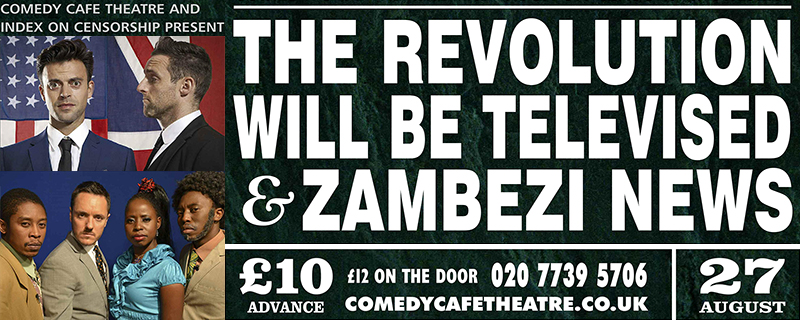
The Bafta-winning duo Heydon Prowse and Jolyon Rubinstein, of BBC Three’s comedy series The Revolution Will Be Televised are joining their award-winning Zimbabwean counterparts Zambezi News for a very special one-off show at The Comedy Café Theatre, London.
Featuring Zambezi News Live – a 30 minute satirical sketch performance from Comrade Fatso, Outspoken and Michael K that hilariously tackles issues from race to sex, politics to sport and hip-hop to land reform. The story of Zambezi News, the comedians poking fun at power in Zimbabwe, was covered in the latest issue of Index on Censorship magazine.
The Zimbabweans will then be joined onstage by Heydon and Jolyon to share stories, swap jokes and explore experiences of censorship and free speech on both sides of the Sahara.
When: Thursday 27th August, 8.00pm
Where: The Comedy Cafe, 68 Rivington St, Shoreditch, London, SE2 (Map/directions)
Tickets: Sold out

Presented in partnership with The Comedy Cafe Theatre
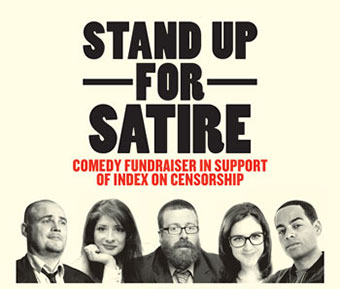 Index on Censorship has been publishing articles on satire by writers across the globe throughout its 43-year history. Ahead of our event, Stand Up for Satire, we published a series of archival posts from the magazine on satire and its connection with freedom of expression.
14 July: The power of satirical comedy in Zimbabwe by Samm Farai Monro | 17 July: How to Win Friends and Influence an Election by Rowan Atkinson | 21 July: Comfort Zones by Scott Capurro | 24 July: They shoot comedians by Jamie Garzon | 28 July: Comedy is everywhere by Milan Kundera | Student reading lists: Comedy and censorship