24 Aug 2016 | mobile, News, Youth Board
Index recently appointed a new youth advisory board cohort. The eight young students and professionals, from countries including Hungary, Germany, India and the US, will hold their seats on the board until December.
Each month, board members meet online to discuss freedom of expression issues occurring around the world and complete an assignment that grows from that discussion. For their first task the board were asked to write a short bio and take a photo of themselves holding a quote that reflects their belief in free speech.
Sophia Smith-Galer 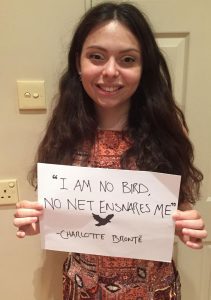
I’m half English, half Italian, and was born and raised in London. I have just graduated from Durham University with a degree in Spanish and Arabic and will be studying for a Master’s in broadcast journalism at City University next year.
I have just returned from a trip to New York after winning a multilingual world essay prize which included speaking at the United Nations’ General Assembly. I was in the group of Arabic language winners and our speeches were about tackling climate change, which is one of the UN’s sustainable development goals for 2030. Now that I am embarking on a career in journalism I’m looking forward to continue supporting these goals in my work.
Freedom of expression is particularly important to me as several countries that speak both of the languages I have dedicated years of study to continue to be plagued by tyrants and censors. I’m particularly interested addressing censorship in Latin America and the Middle East, especially with regard to the arts, as I’m also a classical singer and keen art historian.
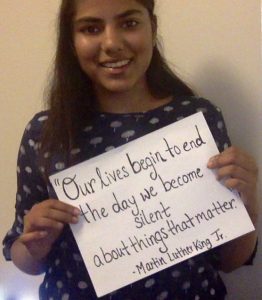
Shruti Venkatraman
Originally from Mumbai, I am currently a first year undergraduate studying law at the University of Edinburgh. As a law student, I am interested in advocacy in general, but I am particularly interested in advocating for fundamental human rights.
In today’s socio-political context, the phrase “freedom of expression” has gained importance and expanded in its meaning from it’s original intent to prevent minority persecution. Having lived in India and South Africa, I was able to grasp the importance of free speech in the context of regional history, and I learnt how human rights appeals have had local and global impacts and are inherently tied with social development. Index on Censorship’s admirable work to promote and defend freedom of expression highlights how important this cause is in our quest for social progress, justice and equality and how repression of these rights result in societal backwardness.
Niharika Pandit 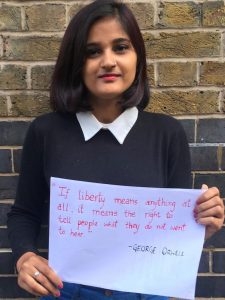
I am currently a master’s candidate at the Centre for Gender Studies at SOAS, University of London with South Asia as my focus area of gender research. I became interested in issues of censorship during my undergraduate studies in mass media with a specialisation in journalism from Bombay.
As a journalist and an active social media user in India, I was witness to numerous instances of online abuse, trolling and silencing of women politicians, journalists and activists who voiced opinions on political and social issues. As a response to the barrage of abuse in the online space, otherwise a liberating space to hear diversified opinions, I wrote a piece on Twitter trolls in India and the use of sexist abuse as a tool to muzzle women for Index on Censorship’s Young Writers’ Programme.
Within censorship, I am particularly interested in working on the intersections of social media, gender along with looking at censorship in militarised zones and its growing legitimacy in contemporary political ethos as part of my research.
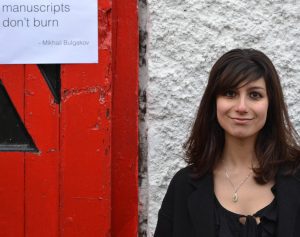
Layli Foroudi
It was studying literary works from the Soviet period during my undergraduate degree that highlighted the issue of censorship for me initially. Clearly this issue has outlived (and predates) the Soviet Union and is still of pressing concern in Russia today and globally. After graduating, I worked as a journalist on issues of freedom of expression and belief in Iran, and then in Russia at the Moscow Times. By pushing a state-sponsored version of the truth and punishing those at variance with it, these countries and others marginalise people and stifle innovation and creativity.
Freedom of expression and public debate underpin what society consists of and being denied this freedom is being denied the right to participation in society, as Hannah Arendt wrote: the polis is “the organisation of people as it arises out of acting and speaking together”. Historically, many have been denied the right to “act and speak”, based on ethnicity, gender, belief, immigration status, etc, and continue to be. I am interested in encouraging a diversity voices in the public sphere, something I have enjoyed exploring more this past year while undertaking an MPhil in race, ethnicity, and conflict at Trinity College Dublin and as a member of the youth advisory board since January.
Ian Morse 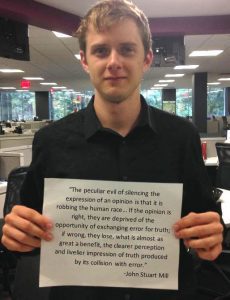
I’m a student and journalist at Lafayette College in the US, but I have studied in Germany, Turkey and the UK. I really started studying news media when I lived in Turkey 18 months ago, because even then (much more so now) journalists and bloggers had a very tough time gathering and publishing good information. Since then, I’ve been a journalist in Turkey, the UK and Greece. I study history and mathematics-economics, but almost every project I do is focused on news media.
I’ve encountered freedom of expression violations in many fashions, from student pressures against speakers to petty government retaliation to Twitter blocking. There is quite a bit of nuance that is overlooked in many cases, but that nuance is needed to understand where the line needs to be drawn. Words have a lot of power in society – but it is often difficult to get the truth out when lies are louder or gags are stronger. I hope with Index that we can find ways to fix this.
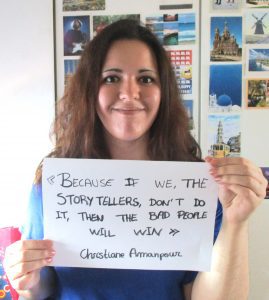
Anna Gumbau
I am a journalist living between Barcelona and Brussels. I am passionate about youth work, having volunteered for five years as member of AEGEE-Europe / European Students’ Forum, including a year as member of its international board. I have taken part in, and often led projects, run by students for other students all over Europe, on topics such as pluralism of media, election observation and media literacy. I am also involved in the field of internet governance, participating in the last two editions of the EuroDIG and joining the Youth Observatory of the Internet Society.
As a young media-maker who grew up listening to the stories of censorship in the times of the Spanish dictatorship, I believe strongly in free speech, a free press and media pluralism as essential pillars for democracy. I am fascinated by the power of words and freedom of expression to empower citizens and stand up to what they believe in. I also envision free media as a crucial element for better informed societies and, in extension, for more responsible individual citizens to participate in the public space.
Constantin Eckner 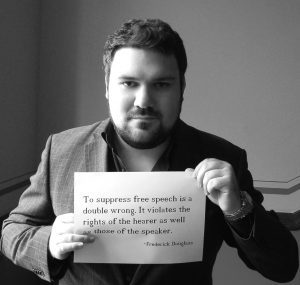
I am originally from Germany. I graduated from University of St Andrews with a master’s degree in modern history. Currently, I am a Ph.D. candidate specialising in human rights, asylum policy and the history of migration. Moreover, I have worked as a writer and journalist since I was 17 years old, covering a variety of topics over the years. Longer stays in cities like Budapest and Istanbul have raised my awareness for pressures exerted upon freedom of expression.
In a perfect world journalists, as well as every citizen, would live without fear of state censorship and potentially facing repercussions for the words they write or speak, for the pictures they draw, for the photos they shoot or for music they play.
Freedom of expression and access to information are cornerstones of an enlightened society. Unfortunately, in 2016 the world is still challenged by undemocratic regimes and powers that intend to quash people, which is an oppressive situation that has to change. It is up to us to help those who cannot raise their voice fearlessly.
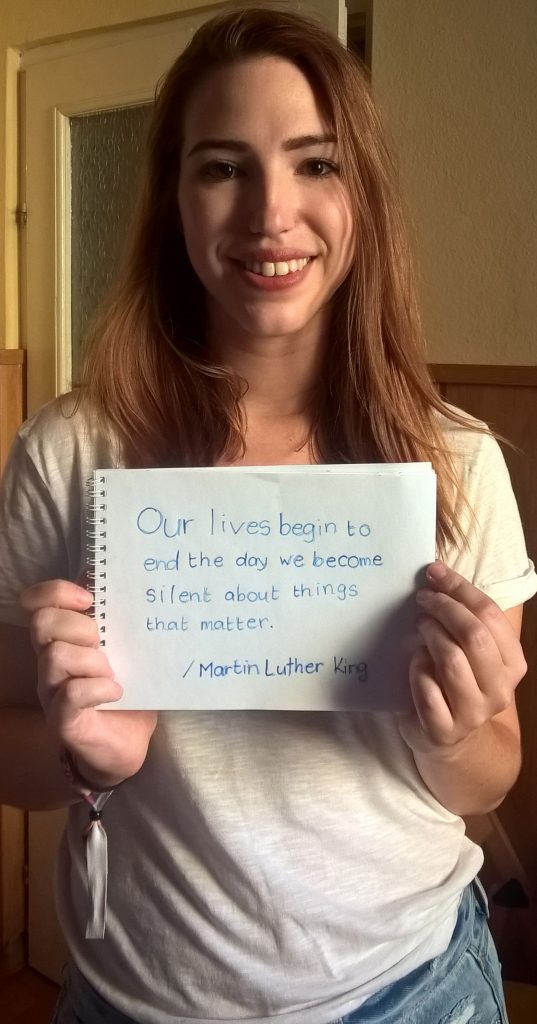 Fruzsina Katona
I was born and raised in Hungary, although I spent my pre-university years in a small town in eastern Hungary. Today I am a freelance journalist.
I always knew I wanted to be a journalist, since I was always interested in literally everything that surrounded me. The urge to publish became stronger at the age of 17, after I returned from Japan, where I spent a school year. That one year made me realise, that my home country is really far from the image I had of it. And the only way I can fight against corruption, abuses and narrow-mindedness – apart from voting – is to educate and inform the public. I took an internship at Hungary’s leading investigative journalism center, and 2015 Index on Censorship Freedom of Expression award-winner, Atlatszo.hu. I have worked for them as a freelancer ever since, and I enjoy my work pretty much.
I recently received a graduate degree in communication and media studies, and supplemented my “official” studies with training, workshops and conferences across Europe.
In the future I would like to be a post-conflict reporter or a human rights journalist, specialising in freedom of expression and the press.
22 Jul 2016 | Academic Freedom, Academic Freedom Letters, Campaigns, Campaigns -- Featured, mobile
The University of Cape Town rescinded an invitation to journalist and editor Flemming Rose, who had been scheduled to deliver the annual TB Davie lecture on academic freedom in August. In 2005 Rose commissioned the cartoons of the prophet Mohammed that sparked protests and riots across the world.
Regarding my thoughts on the matter and the arguments put forward as motivation for taking back the invitation I find three things important:
1. I find it disgraceful that the Vice-Chancellor Mr. Max Price puts the blame on me instead of taking responsibility for his decision. He is afraid that some people might react in certain ways to my presence. That’s not my responsibility. If they choose to act in a way that concerns the VC, it’s their decision, not mine. The VC has to hold them responsible for their actions, not me. It’s the heckler’s veto. Mr. Price talks about “the harm that unlimited freedom of expression could cause.” I don’t know any person including myself who is in favor of unlimited free speech, that’s a caricature of free speech activists. What I oppose is the kind of “I am in favor of free speech, but”-position that Mr. Price provides a classic example of. His approach to free speech would make it possible to ban any speech.
2. Mr. Price is misrepresenting my position. He writes: “Mr. Rose is regarded by many around the world as right wing, Islamophobic, someone whose statements have been deliberatively provocative, insulting and possibly amount to hate speech, and an editor of a publication that many believe took a bigoted view of freedom of expression.” He adds that I am defender of “selective blasphemy”. What are the sources for these accusations? An article from 2006 at the height of the cartoon crisis, when a lot of unchecked information and rumors were making the rounds, among them that I was working for Mossad, the KGB’s successor in Russia and the CIA. My guilt seems to be that I have met and interviewed Daniel Pipes. The other source is a review of my book The Tyranny of Silence: How One Cartoon Ignited a Global Debate on the Future of Free Speech by a Danish professor who has been biased against me and Jyllands-Posten from the outset.
I find it strange that the VC uses Peter Hervik’s review as a source of authority. Hervik labels me a “radical rightwing activist” without defining what he means by that and even worse without quoting anything from what I have said and written. I am a classical liberal. I do not defend selective blasphemy, I defend the right to blasphemy as such. To provide you with an impression of his approach let me quote from the review. He writes about me:
“Not least his enormous urge to gather any news coverage from around the world in order to show that ‘I was right and that others were wrong’.”
Sounds a bit like a fanatic, or at least that’s the impression he wants to convey.
This is what I actually wrote:
“At first I wanted to document that I was right and others were wrong. But along the way, I found out that I needed to look inward, to reflect on my own story and background. Why was this debate so important to me? Why was I from the outset, almost, instinctively, able to identify the core issue… I am fully aware that other versions exist that are no less true than my own; in some cases they may be even more complete.”
“I do have strong opinions when it comes to certain things. But I am not a person who takes an instant stand on just anything. I am a natural skeptic. I ponder at length and lose myself in layers of meaning and the many sides of an issue, I don’t see that trait as a flaw: It is the condition of modern man and indeed the core strength of secular democracies, which are founded on the idea that there is no monopoly on truth. Doubt is the germ of curiosity and critical questioning, and its prerequisite is a strong sense of self, a courage that leaves room for debate.”
A bit different than Hervik’s version, right?
To me this looks like a deliberate distortion of I was trying to say in that paragraph. Disagreement is necessary and fine but we have to present the point of view of our opponents in a more or less fair way. Anyone who needs to misrepresent the point of view of his opponent usually has a bad case.
It’s really a sign of poor judgement and bad academic standards to disinvite me on the basis of what other people say about me, when I have published a book that covers my own story, which tells how my views on politics were formed and analyses the history of tolerance and free speech. The book is not only focusing on Islam. I write about the Russian Orthodox’ Church silencing of criticism, Hindu-nationalists attacks on an Indian Muslim artist and so on and so forth. Why use second-hand sources when you can read the primary source in English and make up your mind?
This doesn’t mean that I would favour banning a “radical right wing” speaker, whatever that means. I would defend such a speaker’s right to make his case. After all, that’s the way we learn to argue against points of views that we don’t like.
3. Mr. Price is also getting the facts wrong about Jyllands-Posten and its position. The newspaper published several cartoons ridiculing Jesus, even by Kurt Westergaard, the artist that did the cartoon of the Mohammad with a bomb in his turban. The Jesus cartoons that were refused were submitted by a freelancer not a staffer, so it was like refusing any other article or cartoon by a freelancer.
In my book (the Danish version) I have included some of those and other images. Apart from Westergaard’s I have added Serrano’s Piss Christ and an image by Jens Jørgen Thorsen, a Danish artist who in 1984 painted Jesus with an erection on a public building and cartoons from the Nazi Magazine Der Stürmer, George Grosz’ drawings of a Christ-like figure equipped with a gas mask on the cross next to a canon (World War I) and Manet’s Lunch on the Green Grass. All this to show examples of images that throughout history have caused controversy.
Contrary to what Mr. Price writes, Jyllands-Posten published antisemitic cartoons and cartoons mocking the Holocaust (a full page on 4 February, 2006 at the height of the cartoon crisis) that previously had been published in Arab newspapers. We, like most other Danish newspapers, published submissions to the Iranian Holocaust cartoon contest as well. We did it, not because we support the views expressed in the cartoons (the same point goes for the Mohammed-cartoons) – publication does not mean endorsement. We did it in order for our readers to see what makes people laugh in the countries where many were so upset by the Mohammed cartoons.
Recently I have defended radical imams’ right to hate speech, and I have (in Danish) written favorably about a book by a socially conservative Norwegian Muslim (title: Is it possible to love the Koran and Norway at the same time?).
Also read:
Index on Censorship condemns decision to axe Flemming Rose as speaker on academic freedom
Dr Max Price, Vice-Chancellor of UCT, letter to the academic freedom committee
UCT Academic freedom committee response to Dr. Max Price
UCT statement: Withdrawal of invitation to speaker of TB Davie Academic Freedom Lecture
Kenan Malik: Academic freedom and academic cowardice
22 Jul 2016 | Americas, mobile, News, United States
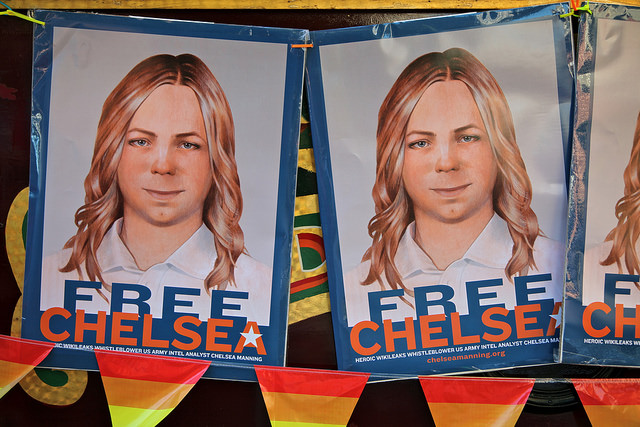
Although the USA is considered to have relatively generous freedoms of speech and the press protected under the First Amendment to the US Constitution, these freedoms have their limits. Many whistleblowers are not afforded protection in the USA and are subjected to lengthy prison terms after disclosing classified information to the public.
Chelsea Manning’s suicide attempt on 5 July, six years into her 35-year sentence, highlights the severity the USA practices when sentencing whistleblowers. Manning was responsible for the leaks of classified US military information to Wikileaks including videos, incident reports from the Afghanistan and Iraq wars, information on detainees at Guantanamo and thousands of Department of State cables. She was sentenced on 21 August 2013 to 35 years at the maximum-security US Disciplinary Barracks at Fort Leavenworth.
Manning’s case appears to be the rule, not the exception, in the USA.
Jeffrey Sterling
Considered to be a whistleblower by some, Jeffrey Sterling, who worked for the CIA from 1993 to 2002, was charged under the Espionage Act with mishandling national defense information in 2010. Sterling was sentenced to three and a half years in prison for his contributions to New York Times journalist James Risen’s book, State of War: The Secret History of the CIA and the Bush Administration, which detailed the failed CIA Operation Merlin that may have inadvertently aided the Iranian nuclear weapons program. Risen was subpoenaed twice to testify in the case United States v Sterling but refused, resulting in a seven-year legal battle.
On 11 May 2015, at Sterling’s sentencing, judge Leonie Brinkema stated that although she was moved by his professional history, she wanted to send a message to other whistleblowers of the “price to be paid” when revealing government secrets.
Stephen Jin-Woo Kim
Stephen Kim is a former US Department of State contractor who, on 11 June 2009, spoke to Fox News reporter James Rosen about North Korean plans for a nuclear bomb test. Kim allegedly sought Rosen out after becoming frustrated that there was little being done in the Department of State in response to the threats of nuclear tests in North Korea, tests that were ultimately carried out. Fox News published Rosen’s article, North Korea Intends to Match U.N. Resolution With New Nuclear Test, which resulted in an FBI investigation. Kim subsequently pleaded guilty to a single felony count of unauthorised disclosure of national defense information and was sentenced to 13 months in prison on 7 February 2014.
John Kiriakou
John Kiriakou, a former CIA officer, was charged with disclosing information to journalists on several occasions, including revealing the use of torture on Abu Zubaydah and connecting a covert operative to a specific undercover operation. Kiriakou accepted a plea bargain that spared the journalists he had spoken with from having to testify by pleading guilty to one count of violating the Intelligence Identities Protection Act.
On 28 February 2013, Kiriakou began serving his 30-month sentence. He has stated that his case was more about punishment for exposing torture than leaking information and that he would “do it all over again”.
Edward Snowden
Although the most famous whistleblower on this list has not been tried and sentenced, Edward Snowden could face up to 30 years in prison for his multiple felony charges under the World War I-era Espionage Act. Snowden was charged on 14 June 2013 for his role in leaking classified information from the National Security Agency, notably a global surveillance initiative.
Snowden has expressed a willingness to go to prison for his actions but refuses to be used as a “deterrent to people trying to do the right thing in difficult situations” as so many whistleblowers often are.
Barrett Brown
The political climate in the US has become so hostile towards leaks that even journalists can face repercussions for their involvement with whistleblowers. American journalist and essayist Barrett Brown’s case became well-known after he was arrested for copying and pasting a hyperlink to millions of leaked emails from Stratfor, an American private intelligence company, from one chat room to another. The leak itself had been orchestrated by Jeremy Hammond, who is serving 10 years in prison for his participation, and did not involve Brown. Brown faced a sentence of up to 102 years in prison, once again for sharing a hyperlink, before the 12 counts of aggravated identity theft and trafficking in stolen data charges were dropped in 2013.
Although the dismissal of these charges was heralded as a victory for press freedom, Brown was still convicted of two counts of being an accessory after the fact and obstructing the execution of a search warrant. On 22 January 2015, Brown was sentenced to 63 months in prison and ordered to pay $890,250 in fines and restitution to Stratfor.
5 Jul 2016 | Europe and Central Asia, Events
How can we protect a free media and space for civil society? What are the growing restrictions facing journalists? How can investigative journalism fight corruption?
As the space for free media in Europe is threatened, the importance of an independent media must be emphasised. A free and independent media plays a vital role in exposing corruption and holding governments and the corporate world accountable.
Join Transparency International EU for a conference on “The Role of Investigative Journalism and a Free Media in Fighting Corruption” including:
Restrictions on Media and the Press in the European Union, 3.45pm-4.45pm
- Jodie Ginsberg, chief executive, Index on Censorship
- Andras Peltho, founder/editor, Direckt 36 Hungary
- Dirk Voorhoof, board member, European Centre for Press and Media Freedom
Investigating Corruption, 4.45pm-5.45pm
- Miranda Patrucic, editor, Organised Crime and Corruption Reporting Project
- Kristoff Clerix, Knack Magazine (ICIJ member who has worked on LuxLeaks, SwissLeaks and Panama Papers)
When: 2-6pm, 14 July
Where: Residence Palace, Rue de la Loi 155, Brussels
Tickets: To attend this event, register here. To apply for a travel grant contact [email protected]
