21 Feb 2014 | Americas, Brazil, News, Politics and Society
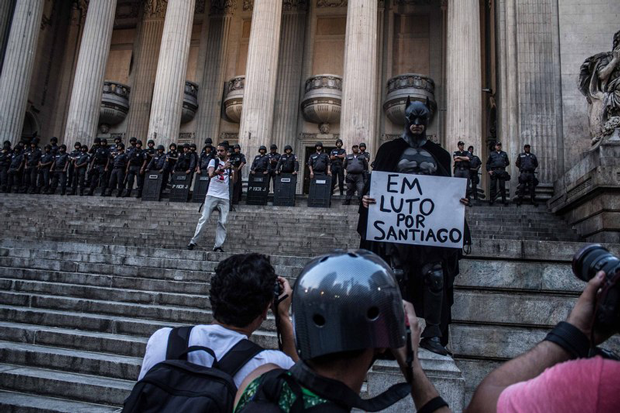
Rio’s Batman honours the recently deceased network cameraman Santiago Andrade, who died after being hit in the head with fireworks released by black bloc activists during a protest on February 6. (Photo: Leonardo Coelho / Demotix)
The death of Santiago Andrade on 10 February, a cameraman for Brazil’s Bandeirantes Network, from injuries he suffered while filming a Rio de Janeiro transport price protest has shocked the country.
In the uproar that followed, two protesters — Caio Silva de Souza and Fabio Barbosa Raposo – were arrested for targeting Andrade with fireworks. The media quickly filled with editorials and coverage that declared democracy was at risk. Journalists described the attack as a grave threat to freedom of expression and criticism of police handling of the protests. One op-ed even accused a leftist party deputy of links with the attack without presenting evidence.
However, there is a lack of preparation from the Brazilian press itself, when covering the demonstrations. This deficiency was highlighted by a BBC reporter who provided first aid to Andrade. Brazilian journalists usually cover protests without identification vests, protection or training.
Violence against the press is not a new problem in Brazil. There have been 126 attacks on journalists by police or demonstrators since the mass protest movement began in June 2013. It is common for journalists’ cars to be targeted by protesters. At the same time, it has been reported that journalists have been murdered for political reasons.
Brazil is the 11th most dangerous country for the journalistic profession, according to the Committee to Protect Journalists (CPJ). “The number of journalists killed has grown in recent years and the official government response has been insufficient. Brazil has become a dangerous country for the practice of journalism,” CPJ coordinator Carlos Lauría told UN Radio.
The attack on Andrade was the fourth episode of violence against journalists during protests in 2014. On 25 January, two reporters were injured in São Paulo — EFE reporter Sebastião Moreira and freelancer Paul Alexander were attacked by the police. UOL News reporter Gustavo Maia was assaulted by police on 6 February — the same day Andrade was injured.
The death of the cameraman happened at the same time the Brazilian Congress — with the backing of the federal government — was attempting to quickly pass two controversial bills against terrorism. The public reaction was overwhelmingly negative. The justice department is likely to present a new bill to congress. While the bill has not yet been published, it is said to provide stricter punishment for violent infiltrators in demonstrations, in addition to standardizing police responses throughout Brazil. The Minister of Justice, José Eduardo Cardozo, also met with representatives of the media and promised action to protect reporters.
Several national and international organizations expressed concern over the Andrade attack. The International Federation of Journalists (IFJ) and Reporters Without Borders called on the Brazilian authorities to guarantee the safety of journalists covering demonstrations. The UN expressed concern about violent protests and the “excessive use of force and arbitrary arrests of demonstrators and journalists by police forces”. UNESCO pleaded with Brazilian media groups to train their employees working in hazardous environments. The Brazilian Association of Investigative Journalism (Abraji) released a statement condemning the the attack and urged the Brazilian government to protect journalists and freedom of expression. The International Press Institute (IPI) recalled various crimes against Brazilian journalists and insisted that investigation of crimes against journalists be a priority for the government.
Brazil’s president Dilma Rousseff expressed her grief on Twitter. She said the death of Andrade “revolts and saddens” and stressed that “freedom of expression cannot be used to threaten life”. In an official statement, the Secretary of Human Rights of the Presidency said that “this case unfortunately tragically symbolizes the systematic violence against communication professionals engaged in covering demonstrations”.
From the standpoint of the investigations, this is a confusing story, full of questions, with different versions of events coming from the media and the police.
The lawyer for the men arrested for detonating the rocket said the two were recruited by, and received money from ,“activists”. The Civil Police claims there are infiltrators in protests that are paid by political parties of the extreme left.
The governor of Rio de Janeiro, Sergio Cabral, also said that “there are political parties and organisations embedded in these violent actions”.
Is there cooptation of popular movements? There is no evidence of it. Is Brazilian democracy facing a crisis? It seems that nobody wants to be responsible for the answers.
While the press is mourning the loss of yet another one of its own, there needs to be time to ascertain the facts rather than lob accusations when tensions are high. The press needs to investigate and confirm or deny the official line directed against the left or nothing will come from the death of a colleague symbolised by the cameras placed in front of the congress.
This article was posted on 21 February 2014 at indexoncensorship.org
20 Feb 2014 | Europe and Central Asia, News, United Kingdom
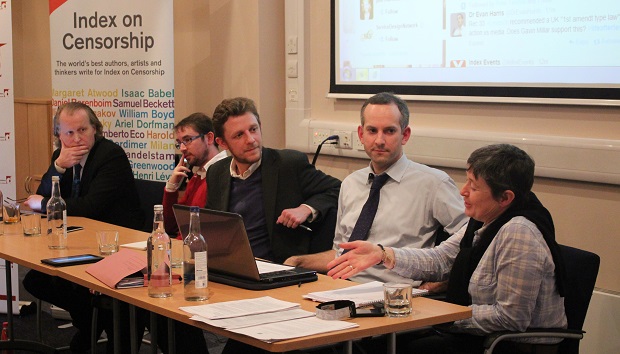
The panel from left to right: Gavin Millar QC, Tom Phillips, Padraig Reidy, Jonathan Heawood and Gill Phillips (Image: Georgia Hussey)
A new press regulator, with or without statutory underpinnings, would not stop another scandal like phone hacking from happening, an Index on Censorship panel said yesterday. The panel, consisting of Gill Phillips (Legal Director, Guardian Media Group), Gavin Millar QC (Doughty Street Chambers), Jonathan Heawood (Director of the Impress Project), and Tom Phillips (Senior Writer, Buzzfeed UK), chaired by Padraig Reidy, spoke at a Doughty Street Chambers and Index on Censorship debate on press freedom in the UK after the Leveson inquiry.
“In terms of the institutions that failed over phone hacking, the Press Complaints Commission doesn’t even make it onto the podium,” said Tom Phillips. “So the idea that any kind of regulation was ever intended to be the solution to this is missing a whole bigger picture.”
If you set up a system to stop something “human ingenuity and imagination” will find a way to get around it, said Gavin Millar QC. He added that the best regulation “has to come from the heart”, and was worried about the complicated rules surrounding regulation taking the responsibility away from those “who are putting the stuff out.”
Jonathan Heawood argued that we can make press abuses “less likely” though a “good, intelligent, intelligently applied regulator” and “sufficiently enforced, sufficiently clear sanctions”. He added that regulation is “part of the solution” to improve conditions allowing public interest journalism to flourish.
Press regulation took centre stage at the event, but wider issues of press freedom were also discussed. Gavin Millar pointed out how the UK’s debate on press freedom and press regulation may be perceived in authoritarian countries, while Tom Phillips warned that ignoring the evolving social norms of the internet age bad is for press freedom. Gill Phillips argued that while the UK isn’t as bad on press freedom as some other countries, “where we’re going” and “the threat of criminalisation that effects every day journalism” is worrying.
The event took place ahead of the release of Index on Censorship’s policy paper Life after Leveson: British media freedom in 2014. The paper acknowledges that the recent change in libel law was good for this country’s press freedom, “the record of successive governments have been far from perfect” and “there are still several areas where this government can act to safeguard the free press and free speech more broadly in the coming year.”
It was a timely discussion, as yesterday the High Court dismissed David Miranda’s challenge to his detention at Heathrow under the Terrorism Act in August. It was also the day former News of the World editor Rebekah Brooks took the stand in the ongoing hacking trial.
“The [Miranda] judgement has some wide ranging views downgrading journalism in the 20th century that I find personally bizarre,” said Philips. Millar said the judgement shows how the “remaining tendency of government using the possibility of court proceedings against newspapers to stifle the publication of state secrets” has a “chilling effect” on press freedom.
The sold-out event encouraged audience interaction, which made for a lively and at times heated, debate. One comment from the floor argued the panel had missed the point — that the debate was about press abuses, and a regulator was the minimum step that had to be taken. Another audience member questioned the press calling for regulation of other industries, but not wanting to be regulated themselves. The Guardian’s Roy Greenslade argued that we need to separate those issues of press abuse that can be tackled through the law and those that must be tackled by self-restraint on the part of the media. Observer columnist Peter Preston said the Royal Charter regulator would be part of a “conspiracy of chaps”.
The discussion also took place on Twitter, under the hashtag #LifeAfterLeveson
This article was published on 20 February 2014 at indexoncensorship.org
19 Feb 2014 | Uncategorized
David Miranda Media Coalition Submissions Final
17 Feb 2014 | Americas, Brazil, News
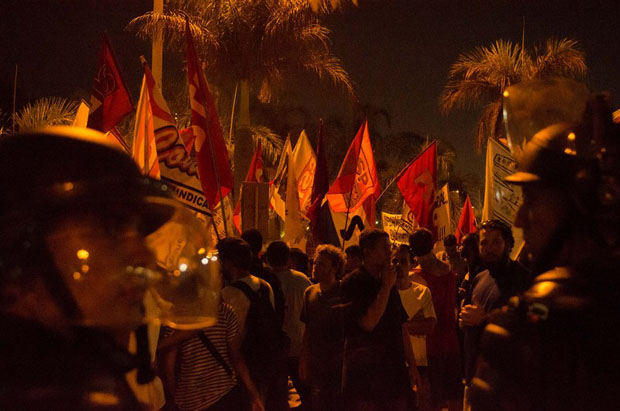
Protests against increase in public transportation costs in Rio de Janeiro on 13 February (Image: Mauricio Fidalgo/Demotix)
On Friday 14 February, Brazil’s Minister of Justice, José Eduardo Cardozo, announced a bill to regulate safety measures during protests. The bill allows for use of force by the military police and punishment for violent actions during demonstrations, and will be sent to congress for consideration in the coming days. The move comes after the death of Bandeirantes Network cameraman Santiago Andrade on 10 February, from injuries sustained covering a protest. This is the latest move by Brazil’s government to control popular discontent ahead of this summer’s FIFA World Cup.
The government is rushing vaguely worded, extraordinary bills defining “terrorism” to the floor of congress. Currently, there are no specific laws for the crime of terrorism in Brazilian legislation. Crimes are classified in the National Security Act, created during the military dictatorship. A number of bills tackling this issue, which could potentially penalise protest actions, are now being debated in congress, without input from the population.
A street protest against rising bus fares in Rio de Janeiro on 6 February erupted in violence, when gas bombs and fireworks thrown by some demonstrators injured seven people, including Santiago Andrade. The cameraman was hit by a rocket firework launched by two protesters, which burst over his head. He later died from the injuries, and the two protesters were arrested in controversial circumstances.
The incident generated national uproar. Congressmen called the protest an act of terrorism and promised action. A number of figures within the Brazilian government, including President Dilma Rousseff, condemned the “escalating violence in protests”. Citing public security, congress moved quickly to table bills aimed at defining actions in public places — both violent and non-violent — as terrorism. Bill 499/2013, which has been fast tracked for consideration, defines terrorism as “causing terror or widespread panic” and threatens penalties of up to 30 years. The bill further stipulates that acts of terror committed with explosives increases the penalty by one third. It also criminalises “Black Bloc” protest groups, and wearing masks. Legal experts have criticised the bill for its vague language which leaves room for wide interpretations. Further, critics contend that it shows the government’s intent to use the bill as a tool to suppress popular protests during the World Cup.
The controversial Bill 728/2011 was created to punish “infractions” committed during the World Cup. In its text, acts of terrorism are associated with religious or ideological positions, and it also limits Brazilians’ ability to strike. The bill was nicknamed the AI-5 Cup, after the 1968 AI-5 act, which in gave extraordinary powers to the then-president and suspended key civil and constitutional guarantees for over 20 years. Under pressure from Brazil’s civil society, 728 was shelved.
Still under consideration in congress, however, is Bill 236/2012 — an anti-terror project that promises to modernise Brazil’s penal code, which dates from 1940. While it categorises terrorism, 236 does not define it. Among its most dangerous threats to freedom of expression is the criminalisation of disturbing the peace, and damage to public property by “vandals” and “vagrants”. The bill does not further define or clarify these terms.
Former justice minister Miguel Reale Jr, a renowned jurist and professor of law at the University of Sao Paulo, criticised the law’s “legal nonsense” and labelled it a setback for journalism. The bill would criminalise defamation and impose four year sentences without adequately defining this offence. He has launched a campaign against it, which has gained support from the legal community.
Bill 236 also contains “crimes against sporting and cultural events”. Any person who promotes “tumult” within 5 km of a sporting event would be imprisoned for up to two years, and the bill would also block protest access to the sport or cultural venue for up to three years. If applied, any popular protest on game days could be banned.
But whether or not some or all of the bills are passed, President Rousseff looks set to be able to curtail protests. On 20 December, a manual on the enforcement of law and public order, put together by the Ministry of Defence, entered into force. The manual defines “opponent forces” as persons, groups or organisations that provoke radical and violent actions, and cites the blocking of public streets as a major threat. Under certain conditions, the manual allows the president to give police powers to the armed forces.
Brazilians who wish to take to the streets, could have an interesting spring.
This article was posted on February 17, 2014 at indexoncensorship.org
