31 Jan 2019 | Bahrain, Bahrain Statements, Campaigns -- Featured, Middle East and North Africa
[vc_row][vc_column][vc_column_text]
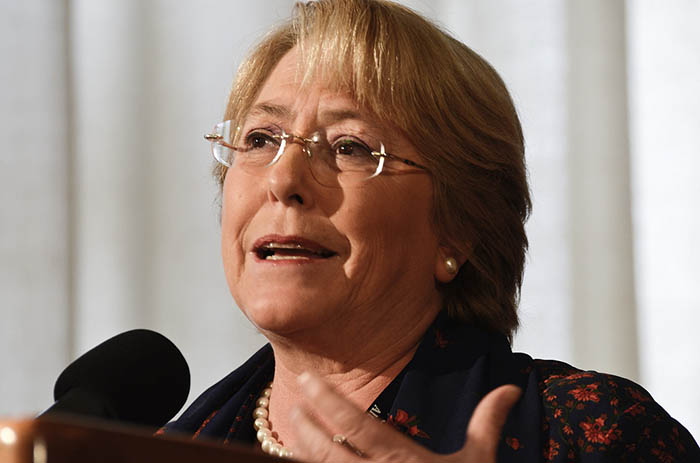
Michelle Bachelet, United Nations High Commissioner for Human Rights. Credit: UN Women / Flickr
H.E. Michelle Bachelet
United Nations High Commissioner for Human Rights
Office of the High Commissioner for Human Rights (OHCHR)
United Nations
52 Rue des Paquis
1201 Geneva, Switzerland
Your Excellency,
We, the undersigned organisations, write to you to express our concern regarding the worsening situation for civil society in Bahrain. We believe co-ordinated international action coupled with public scrutiny are imperative to address the government of Bahrain’s ongoing attacks on civil society and to hold the kingdom accountable to its commitments to international human rights laws and standards. To this end, we call upon your Office to continue to monitor the situation in Bahrain and to continue to raise concerns at the highest level, both publicly and privately, with the government, as was done by your predecessor, Zeid Ra’ad Al Hussein. We believe heightened scrutiny of Bahrain’s human rights record and its ongoing human rights violations is particularly important now that the kingdom is a Member State of the Human Rights Council.
In the past two years, the Bahraini government increased its repression of the kingdom’s remaining civil society organisations, political opposition groups, and human rights defenders. In June 2016, Bahrain’s Administrative Court forcibly dissolved al-Wefaq, Bahrain’s largest political opposition society, a ruling that was upheld in February 2018. In May 2017, a court approved the forcible dissolution of the National Democratic Action Society, also known as Wa’ad. Only a month later, the government indefinitely suspended the kingdom’s last remaining independent newspaper, Al-Wasat, continuing its repression of free expression and press freedom.
While there were hopes that the government might ease repression in the run-up to elections for the lower house of parliament on 24 November 2018, these were dashed with a series of actions and policies that effectively precluded the elections from being free or fair, and that continued the broader assault on civil society. Only weeks ahead of ahead of the elections, the country’s highest appeals court sentenced Sheikh Ali Salman, the Secretary-General of Al-Wefaq, to life in prison on spurious charges of espionage dating from 2011. The government also enacted new legislation banning all individuals who had ever belonged to a dissolved political society from seeking or holding elected office, as well as anyone who has ever served six months or more in prison. This affects a large portion of Bahrain’s population, as the kingdom currently has around 4,000 political prisoners.
Beyond rigging the election process at the expense of political opposition societies and free and fair participation, over this past year Bahrain has continued to target, harass, and imprison activists and human rights defenders for exercising their right to free expression. The government criminalised calls to boycott the elections, and, on 13 November 2018, arrested former Member of Parliament Ali Rasheed al-Asheeri for tweeting about boycotting the November elections. On 31 December 2018, Bahrain’s Court of Cassation – its court of last resort – upheld prominent human rights defender Nabeel Rajab’s five-year prison sentence on spurious charges of tweeting and re-tweeting criticism of torture in Jau Prison and the war in Yemen, drawing criticism from the Office of the High Commissioner for Human Rights. With this decision, Rajab has exhausted all legal remedies to reverse the charges and will remain in prison until 2023. He has already served a two-year prison sentence on charges related to television interviews in which he discussed the human rights situation in the kingdom.
While Bahrain has several institutions tasked with oversight responsibilities and enforcing accountability for human rights abuses, we have grave concerns over their effectiveness, their independence, and their commitment to fulfilling their mandates. Similar concerns have been raised about other Bahraini institutions – the National Institution for Human Rights (NIHR) and the Ministry of Interior Ombudsman – by the UN Human Rights Committee. In the Committee’s first evaluation of Bahrain under the International Covenant on Civil and Political Rights (ICCPR) in July 2018, it found the NIHR largely lacked sufficient independence from the government. The European Parliament has also criticised the NIHR, including in a June 2018 resolution where the body expressed “regret” for the honours it has bestowed upon the NIHR. In the resolution, the European Parliament cited the institution’s lack of independence to fulfil its duties. The Ministry of Interior (MoI) Ombudsman has received sharp criticism, including from the UN Committee Against Torture (CAT). The CAT cited the Ombudsman’s lack of independence, impartiality, and efficacy in addressing complaints submitted to the institution.
Bahrain’s national institutions not only fail to implement human rights reforms, they help perpetuate and whitewash abuses. Both the Ombudsman and NIHR have released reports that sanitise violations like police brutality, while neglecting to address or condemn violent police raids on peaceful protests.
The failure of Bahrain’s human rights institutions to address serious abuses both reflects and promotes a broader culture of impunity in the country, where the government can continue to suppress free expression and civil society.
Despite these abuses and despite concerns from UN bodies, Bahrain has not been the subject of collective action in the United Nations Human Rights Council (HRC) since a joint statement in September 2015 at HRC 30. Since then, the government has taken increased steps to limit fundamental freedoms, including restricting the rights to free expression, free assembly, free association, and free press, dissolving political opposition societies and jailing human rights defenders, religious leaders, and political figures. However, even as Bahrain has embarked on this campaign to suppress opposition and dissent, state action on Bahrain in the HRC has been limited to individual condemnations by various governments under Agenda Items 2 and 4.
Despite this lack of joint action, the Office of the High Commissioner has been consistently vocal about Bahrain’s rights abuses, and we are very appreciative of the Office’s attention over the past several years. Your predecessor raised concerns about Bahrain in his opening statements at the HRC, including at the 36th Council session, where he highlighted restrictions on civil society and the kingdom’s lack of engagement with international human rights mechanisms, and at 38th Council session, in which he reiterated past concerns and sharply criticised Bahrain for its continued refusal to co-operate with the Office of the High Commissioner and the mandates of the Special Procedures.
We believe that this UN scrutiny is now even more necessary as Bahrain assumes a seat on the Council as a Member State.
We strongly urge you to continue to monitor the situation, to publicly express your concerns to Bahraini officials, and to call on the Bahraini government to meet its international obligations, including those concerning protecting and promoting civil society. Without an independent, viable civil society in the country there can be no serious domestic pressure on the government to relax restrictions and ease repression.
We call on you to highlight Bahrain’s restrictions on civil society, targeting of human rights defenders, dissolution of political opposition, and unrelenting attacks on free expression in your opening statement at the 40th Human Rights Council session, the first session of which Bahrain is a member of the Council.
Sincerely,
Americans for Democracy & Human Rights in Bahrain (ADHRB)
Adil Soz – International Foundation for Protection of Freedom of Speech
ARTICLE 19
Bahrain Center for Human Rights
Cairo Institute for Human Rights Studies (CIHRS)
Cartoonists Rights Network International (CRNI)
Center for Media Studies & Peace Building (CEMESP)
Centre for Independent Journalism (CIJ)
Foro de Periodismo Argentino
Freedom Forum
Independent Journalism Center (IJC)
Index on Censorship
Initiative for Freedom of Expression – Turkey
Maharat Foundation
Mediacentar Sarajevo
Media Foundation for West Africa (MFWA)
Norwegian PEN
OpenMedia
Pacific Islands News Association (PINA)
PEN America
Southeast Asian Press Alliance (SEAPA)
South East Europe Media Organisation
Syrian Center for Media and Freedom of Expression (SCM)
Vigilance for Democracy and the Civic State
Asian Human Rights Commission (AHRC)
Association for Human Rights in Ethiopia (AHRE)
Bahrain Institute for Rights and Democracy
Cairo Institute to Human Rights Studies (CIHRS)
CIVICUS
European Centre for Democracy and Human Rights
Odhikar (Bangladesh)
Center for Civil Liberties (Ukraine)
Sudanese Development Initiative (Sudan)
JOINT Liga de ONGs em Mocambique
West African Human Rights Defenders Network
Latin American Network for Democracy (REDLAD)
Ligue Burundaise des Droits de l’homme ITEKA
Organisation Tchadienne Anti-Corruption (OTAC)[/vc_column_text][/vc_column][/vc_row][vc_row][vc_column][vc_basic_grid post_type=”post” max_items=”4″ element_width=”6″ grid_id=”vc_gid:1549278314945-d1d5bcda-455e-2″ taxonomies=”716″][/vc_column][/vc_row]
10 Apr 2018 | Bahrain, Bahrain News, Uncategorized
[vc_row][vc_column][vc_column_text]
In 2011 Bahraini human rights defenders were arrested for pro-democratic activism. Seven years on, monthly protests are reminders of ongoing injustice.
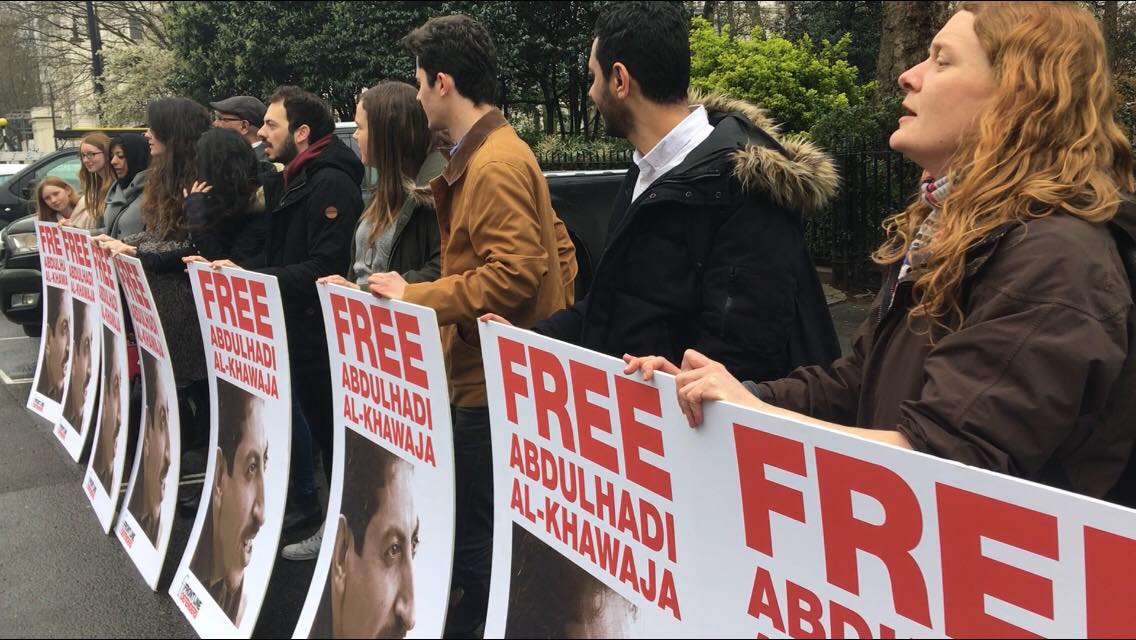
Protesters gathered outside the Bahrain Embassy shouting “free free Abdulhadi” as activists continue to be targeted
NGO’s gathered yesterday at the Bahrain embassy in London to call for the release of Abdulhadi al-Khawaja, a human rights defender imprisoned for life seven years ago for organising peaceful protests against Bahrain’s government during the country’s Arab Spring uprising.
Al-Khawaja founded the Bahrain Centre for Human Rights in 2002 and is a founding director of the Gulf Centre for Human Rights, established in 2011. He was one of 13 human rights defenders to be arrested during the 2011 demonstrations.
Index on Censorship and other human rights organisations have called for his immediate release and for all human rights defenders jailed in Bahrain to be freed.
Monday’s protest not only signalled the ongoing persecution of al-Khawaja, but with repeated calls for his release, highlight Bahrain’s systematic imprisonment and targeting of human rights activists since the Arab Spring.
Front Line Defenders recently reported that all human rights defenders in Bahrain have been exiled, imprisoned or prevented from freely working or travelling. Here, we profile some of those targeted:
Nabeel Rajab
This human rights defender was imprisoned for five years in February 2018 for tweets and retweets perceived as inflammatory by the Bahraini authorities. The posts, from 2015, relate to torture in Bahrain’s Jau prison and the killing of civilians. He has been in and out of prison for peaceful human rights activism since 2012, with charges ranging from “incitement to non-compliance with the law” and “spreading false news” to “incitement to hatred against the regime”.
Nedal Al-Salman
Head of women and children’s rights advocacy for the Bahrain Centre for Human Rights, Al-Salman was stopped at Bahrain International Airport in December 2017. She was prevented from travelling and has since been banned from leaving the country. The same happened in 2016 when she was barred from exiting on her way to attend the United Nations Human Rights Council in Geneva. In April 2017 Sharaf Al-Mousawi was also stopped on her way to a development meeting in Lebanon.
Ebtisam Al-Saegh
Al-Saegh, who works for Salam for Human Rights and Democracy, was one of 22 human rights defenders who were interrogated by the Bahraini authorities in April 2017. They had all supposedly attended an illegal meeting. Most were informed they were banned from travelling. Al-Saegh has been repeatedly targeted by the authorities, sexually assaulted and threatened with rape for her human rights advocacy.
Saeed Al-Samahiji
Saeed Al-Samahiji, an opthamologist, used his medical expertise to help protesters injured in the 2011 Bahraini Arab Spring. In 2012 he was sentenced to 10 years in prison for his involvement but was released in 2013 following an appeal. He has since been repeatedly targeted, serving a year in prison in 2014 for insulting the king and being charged for tweets written in 2016. Charges included “threatening a neighbouring country (Saudi Arabia) for the purpose of threatening national security” and “publicly calling for participation in unlicensed demonstrations and marches”.
Duaa Alwadaei
In March 2018 London-based Duaa Alwadaei was sentenced to two months in jail for insulting a police officer. Her trial was conducted without her present. The charge came after Alwadaei told of her mistreatment by security at Bahrain International airport in 2016. Her husband is Sayed Ahmed Alwadaei, Director of the UK-based Bahrain Institute for Rights and Democracy. He attended Monday’s protests at the Bahraini Embassy in London, calling for an end to the persecution of the country’s human rights defenders. [/vc_column_text][vc_video link=”https://www.youtube.com/watch?v=8lkS7Fsyqso&feature=youtu.be” align=”center”][/vc_column][/vc_row][vc_row][vc_column][vc_basic_grid post_type=”post” max_items=”12″ style=”load-more” items_per_page=”4″ element_width=”6″ grid_id=”vc_gid:1523361407755-9197b56c-e77e-6″ taxonomies=”716″][/vc_column][/vc_row]
11 Sep 2017 | Bahrain, Bahrain Statements, Campaigns -- Featured, Statements
Leading Bahraini human rights campaigner Nabeel Rajab appeared in the Higher Criminal Court on 11 September to be told by a new judge that the case had been continued to 27 September.
“Nabeel has been subjected to a completely ridiculous campaign of judicial harassment for expressing his opinions about the country he loves. Nabeel Rajab has committed no crime and should be set free immediately and unconditionally,” said Jodie Ginsberg, CEO of Index on Censorship.
Rajab faces up to 15 years in prison for “insulting a statutory body”, “spreading rumours in war time” and “insulting a neighbouring country.” Rajab, president of the 2012 Index on Censorship Freedom of Expression Award-winning Bahrain Center for Human Rights, was sentenced in July to two years in prison for speaking to journalists.
Index on Censorship marked the 11 September trial date by joining the Amnesty International Bahrain team, the Bahrain Institute for Rights and Democracy (BIRD), English PEN and Reporters Without Borders by holding a vigil outside the Bahraini embassy in London.
17 Aug 2017 | Bahrain, Bahrain News, Middle East and North Africa, News
[vc_row][vc_column][vc_column_text]
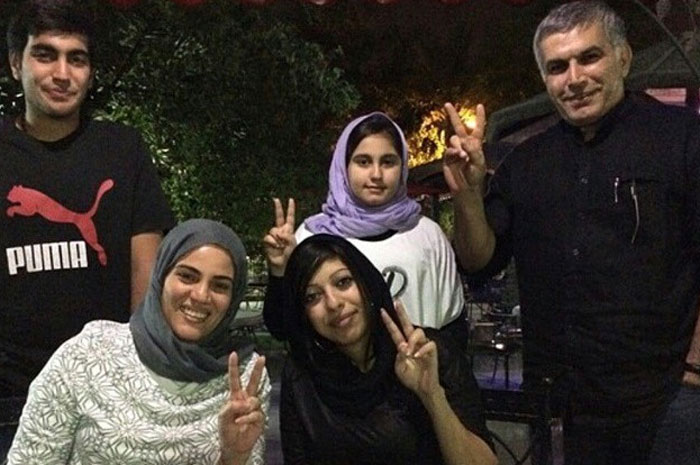
Back Row from left: Adam Rajab, Malak Rajab and Nabeel Rajab. Front Row from left: Sumaya Rajab and Zainab Alkhawaja. (Photo: Adam Rajab)
Human rights defenders often confront obstacles that make their work difficult. This is especially true in Bahrain, where the Sunni monarchy and government have been bent on silencing all opposition ever since the Arab Spring when tens of thousands of Bahraini citizens protested for democratic reform.
In recent months, the nation’s only independent news outlet, Al Wasat, was shuttered and prominent human rights activist Nabeel Rajab was sentenced to two years in prison for “spreading fake news”.
The families of activists suffer along with their loved ones and are often targeted with official harassment: detention, loss of employment, beatings and harassment. Each case is an individual story of a struggle for freedom.
A result of actions
Members of Sayed Ahmed Alwadaei’s family have been harassed and detained due to his ongoing campaigning for democracy and human rights in Bahrain. Most recently his mother-in-law and brother-in-law were detained while Alwadaei attended the United Nations Human Rights Council in March.
Alwadaei, director of advocacy at the Bahrain Institute for Rights and Democracy, is no stranger to detention: he was arrested twice in 2011 and served a six-month sentence in a Bahraini jail. He found asylum in the UK in July 2012. In February 2015, Alwadaei was among 72 Bahraini citizens to be stripped of their citizenship.
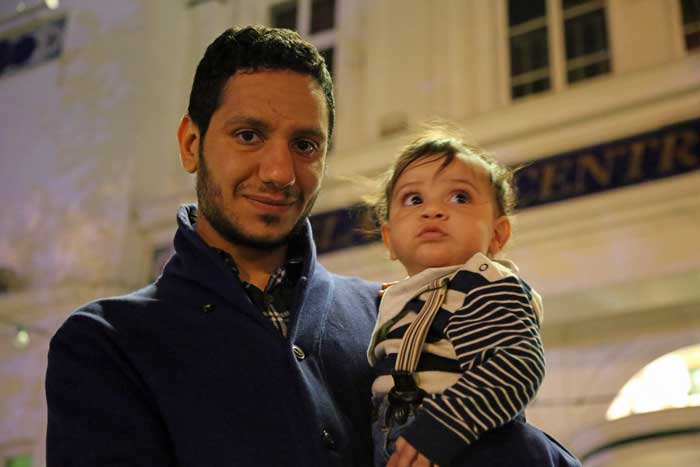
Sayed Ahmed Alwadaei with his son Yousif (Photo: Moosa Satrawi)
In October 2016, Alwadaei’s wife and infant son Yousif also faced official harassment as they tried to leave Bahrain to join Alwadaei in the UK. His wife was arrested at the airport and held overnight, during which time she was ill-treated. It was not until a few months later that she and her son were able to leave the country.
Other members Alwadaei’s family, including his sister, have also faced interrogations.
When asked how he continues campaigning under these circumstances, Alwadaei told index: “We can only get through this by sticking together and staying strong. It’s important to have a supportive family. The potential for arrest and torture is something they know and have to be willing to sacrifice.”
He added that he is balancing his efforts to get his mother-in-law out of prison while continuing his work in activism. “It’s hard but this is the right thing to do.”
“The oppression or torture aims to do one thing: to break your will because you’re not ready for the consequences,” Alwadaei said. “This is the state they want to leave you in. They want you to be broken and this is why we keep going.”
A life-long struggle
Maryam Al-Khawaja has been preparing for and participating in the struggle for human rights her entire life.
As a young child growing up in Denmark, she and her three sisters attended an English-speaking school, but the Al-Khawaja family knew they were only in the country temporarily. Her mother and father had been exiled for speaking out in Bahrain.
At a very young age, she remembers her parents asking her and her siblings before bed: “What have you done today to make the world a better place?” She told Index that her father wouldn’t help them answer the question because he wanted them to think about how the world could be. She remembers dinner conversations alive with politics and philosophical discussion about whether having false hope or no hope was better.
Around the 7th or 8th grade, Al-Khawaja knew wanted to be like her father when she grew up; she wanted to be an activist.
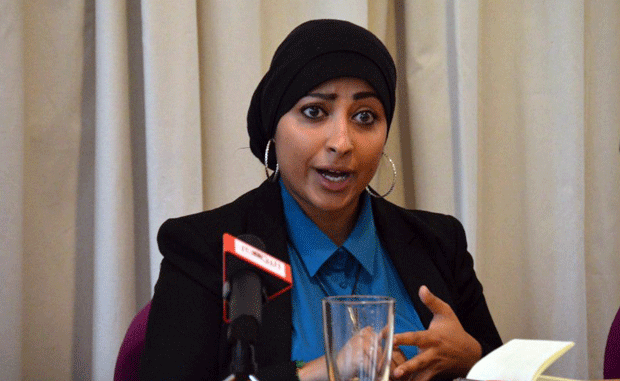
Maryam Al-Khawaja (Photo: David Coscia for Index on Censorship)
Al-Khawaja was 14 when her family returned to Bahrain in 2001. She recalls thinking her family was ready to take on the challenges and that the people of Bahrain would be ready to fight with them. But that was not the case. The country was tired of conflict and believed that the king’s promised reforms would be implemented. At the same time, activists were not popular among ordinary Bahrainis.
At college she said she was criticised by her classmates for speaking her mind about the state of their country, which caused her to lose interest in her father’s reform work. At the time, she asked him: “Why are you trying to change a situation for people who don’t want to change it for themselves?” His response was simple: “Someday you will understand.”
It wasn’t until 2011 during the Arab Spring protests that she developed a newfound respect for her father and was ashamed of herself for ever doubting him. She admits growing up in Denmark made her think fighting for human rights would be easy. When her father, along with 12 other leaders of the uprising, was arrested and sentenced to life imprisonment, she found that a life of campaigning isn’t so effortless.
During our conversation, Al-Khawaja jumped off the phone for a few minutes to take a call from her father. She had not heard from him in over three weeks and said their phone calls are always random and typically short as it is normal for the line to be cut if anything about the Bahrain government or any activist’s work is mentioned.
Until recently, her mother and sisters in Bahrain had not seen her father since February as their requests to visit have continually been denied. Al-Khawaja has not seen her father since 2014 as there are multiple fabricated charges against her that would mean imprisonment if she returned to the country.
Since her father’s imprisonment, Al-Khawaja and her older sister Zainab have been active in the push for human rights and freedom of speech in Bahrain. She says her father has two main characteristics as an activist: a fierce advocate and a fiery speaker. She explained that she and Zainab are the two parts to that whole: Al-Khawaja as the advocate and Zainab as the speaker.
Al-Khawaja said the work of her father and her sister Zainab has been tough for her two younger sisters. One sister had the highest scores in nursing school in Bahrain and graduation seemed to promise a job. But the paperwork from the government granting her access to work never came. She’s been waiting nearly eight years without a job. Al-Khawaja said it’s difficult for her family members when they’re in jail as they have to “take care of us when we cannot take care of ourselves”.
Her mother also felt the effects of the family member’s work when she was fired from her private school teaching job where she was the head of guidance.
A cause for celebrity status never wanted
Adam Rajab realised when he was young that his father Nabeel wasn’t like other dads. “I was so confused ‘why does my father work all day, while other fathers have certain working hours?,’” he told Index.
During a holiday he asked his father to take a break for a day. His father answered: “My colleagues are in prison. I can’t stop my work because they are suffering behind bars.”
In 2006, when Rajab was nine years old, he vividly recalls seeing his father come home bleeding from his head with a swollen and bruised back. “I was shocked and terrified but my father continued protesting like nothing had happened,” he said. “This was terrifying to me but the determination and fearlessness I saw in him really inspired me.”
In 2011 Nabeel Rajab’s work became well known. He appeared on TV and was the first activist to use social media to support the revolution then sweeping Bahrain. “Wherever we went, people would stop him and start taking pictures,” Adam said, adding that the strange situation was a shock to the family. “It started to become difficult because we couldn’t enjoy a private life like we used to.”
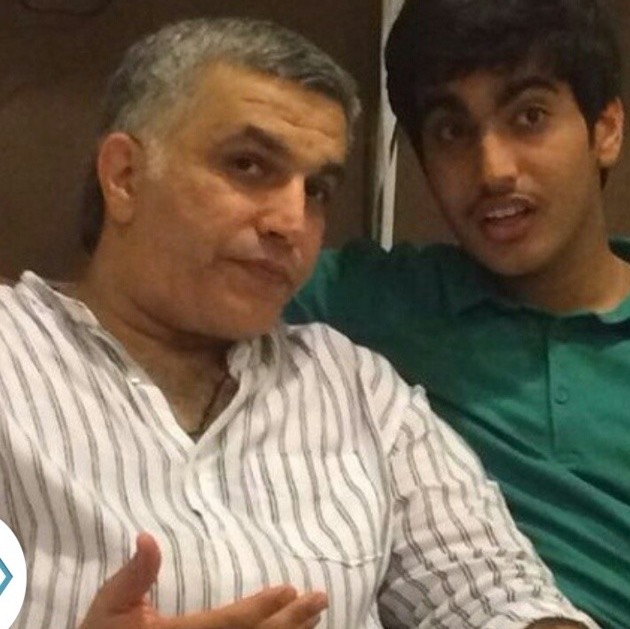
Nabeel Rajab with his son Adam Rajab
As a leader of the movement, Rajab’s father has become a face leaders around the world recognise but do little about. For years he has been in and out of jail. On 10 July 2017 he was sentenced to two years in prison for “broadcasting fake news”.
Although no one in the family has been arrested, his mother was harassed at her government job and then fired. Rajab and his sister have also faced harassment in school.
Rajab and his father have a very close relationship so the imprisonment has not been easy. “I haven’t seen him for more than a year now and he faces more charges which probably means more prison sentences,” Rajab said. “I find it difficult to enjoy anything while he is locked up in a cell and deprived of life, but as he taught me, the spirit is always up.”
Rajab wants his father to free and for them to live like any other ordinary family, but this does not take away from how proud he is or the strength of his belief in his father’s cause.
An open ended sentence
It’s difficult to imagine the emotions these activists and their families go through on a daily basis. A psychologist from the Refer Self Counselling Psychology Practice explained to Index that having a family member with a sentence with a sure release date is one case but when trials or release dates are postponed time and time again as they are in Bahrain, it is much more difficult. “We are rational problem solvers but not good with the unpredictable.”
The psychologist explained the situation in Bahrain is unlike what most with family members behind bars will ever experience. False hope puts an even greater emotional strain on loved ones.[/vc_column_text][/vc_column][/vc_row][vc_row][vc_column][vc_row_inner][vc_column_inner][vc_basic_grid post_type=”post” max_items=”4″ element_width=”6″ grid_id=”vc_gid:1503052292764-bb1a6c59-5e91-2″][/vc_column_inner][/vc_row_inner][/vc_column][/vc_row]
