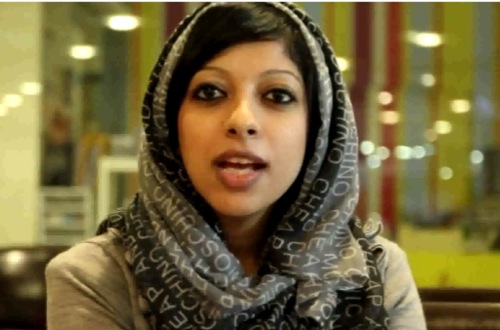
Bahraini human rights activist Zainab Al-Khawaja will appear before the Bahraini court of appeals on 21 October to hear its verdict on charges including ripping a picture of and insulting the king, for which she has been on bail since 2014.
Al-Khawaja, the daughter of Abdulhadi Al-khawaja, former president of the Index award-winning Bahrain Centre for Human Rights, faces nearly five years in prison if her appeal is rejected. Al-Khawaja was sentenced on 4 December 2014 — just days after giving birth to her second child — on four charges which include two months for ripping the picture of the king, one year for insulting a police officer, three years for insulting the king and nine months for entering a restricted area.
The Al-Khawaja family have been involved in Bahrain’s pro-democracy movement, making them targets for authorities in the monarchy. Zainab Al-Khawaja’s father, Abdulhadi, was sentenced to life imprisonment on 22 June 2011 for his peaceful human rights activities. Zainab’s sister Maryam Al-Khawaja has been acting president of the Bahrain Centre for Human Rights since the arrest of Nabeel Rajab, another high-profile activist who has been subjected to judicial harassment for expressing opinions.
A Thunderclap campaign has been launched urging people to wish her a happy birthday and call for her conviction to be quashed so that she and her year-old son don’t go to prison.
Al-Khawaja has thanked supporters on Twitter, saying “My love and respect to all the people of Bahrain who continue to sacrifice every day so that someday our children can be free. And thank you to all those who stand up and speak out on behalf of the people of Bahrain. You restore our faith in humanity.”
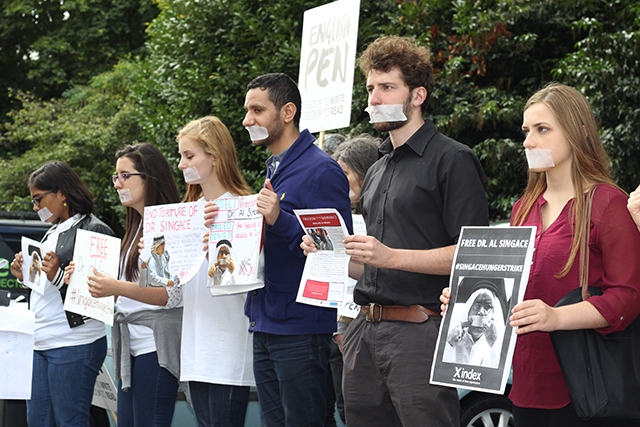
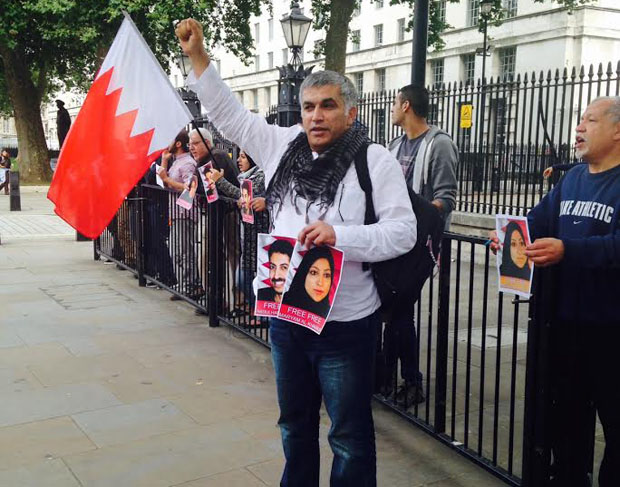
The Bahrain Institute for Rights and Democracy (BIRD), English PEN and Index on Censorship gathered outside the Bahrain Embassy in London on Wednesday 29 July 2015 to protest the ongoing detention of Dr Abduljalil Al-Singace.
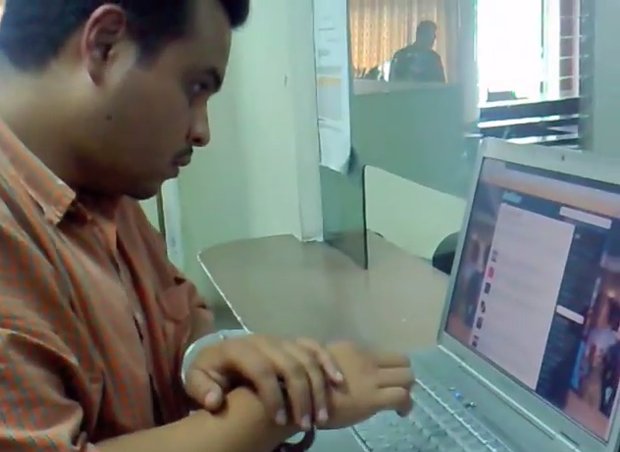
Al-Singace is a prominent academic and blogger who promoted human rights in Bahrain since 2000. Police arrested Al-Singace for his participation in peaceful protests in 2011. During his initial detention, security officials subjected Al-Singace to torture and ill-treatment, including forced standing, verbal and sexual assault, beatings, and prolonged solitary confinement. He was tried by a military court in June 2011 and sentenced to life in prison for allegedly plotting to overthrow the government.
Al-Singace’s health has rapidly deteriorated since he was imprisoned, and he is kept from receiving desperately needed medical supplies. On 21 March 2015 Al-Singace began a hunger strike in protest of the ill-treatment of inmates and the poor, unsanitary conditions at Jau Prison. He has now completed 132 days of hunger strike.
(Photo: Moosa Mohammed)
Rights groups gathered at the solidarity protest unanimously called for the release of Al-Singace and denounced restrictions on freedom of expression in Bahrain. The organisations also called on Bahrain to investigate allegations of torture in Bahrain’s prisons and called for urgent medical attention for Al-Singace.
Freedom of expression in Bahrain has continued to be restricted since 2011, when Saudi Arabian troops helped crush pro-democracy protests during the Arab Spring. The government regularly censors its citizens’ opinions, especially criticisms of the government, and imprisonment is a common punishment for simply expressing one’s opinion. Al-Singace is only one of many who have been jailed for expressing their beliefs. His continued strength and activism remains an inspiration to those still fighting within Bahrain and around the world for the fundamental right to freedom of expression.
Take action
Al-Singace suffers from post-polio syndrome, heart, eye, and sinus problems, and requires urgent nasal and ear surgery. Prison authorities have denied Al-Singace the specialist medical treatment that he urgently needs. He is currently being detained at the Al-Qalaa Hospital and is not permitted to go outdoors. He is also being denied access to novels, religious texts, television, radio, and pen and paper for writing.
Governments don’t really like coming across as authoritarian. They may do very authoritarian things, like lock up journalists and activists and human rights lawyers and pro democracy campaigners, but they’d rather these people didn’t talk about it. They like to present themselves as nice and human rights-respecting; like free speech and rule of law is something their countries have plenty of. That’s why they’re so keen to stress that when they do lock up journalists and activists and human rights lawyers and pro-democracy campaigners, it’s not because they’re journalists and activists and human rights lawyers and pro-democracy campaigners. No, no: they’re criminals you see, who, by some strange coincidence, all just happen to be journalists and activists and human rights lawyers and pro-democracy campaigners. Just look at the definitely-not-free-speech-related charges they face.
1) Azerbaijan: “incitement to suicide”
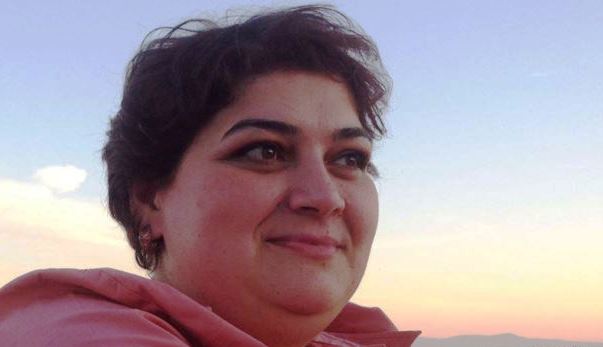
Khadija Ismayilova is one of the government critics jailed ahead of the European Games.
Azerbaijani investigative journalist Khadija Ismayilova was arrested in December for inciting suicide in a former colleague — who has since told media he was pressured by authorities into making the accusation. She is now awaiting trial for “tax evasion” and “abuse of power” among other things. These new charges have, incidentally, also been slapped on a number of other Azerbaijani human rights activists in recent months.
2) Belarus: participation in “mass disturbance”
Belorussian journalist Irina Khalip was in 2011 given a two-year suspended sentence for participating in “mass disturbance” in the aftermath of disputed presidential elections that saw Alexander Lukashenko win a fourth term in office.
3) China: “inciting subversion of state power”
Chinese dissident Zhu Yufu in 2012 faced charges of “inciting subversion of state power” over his poem “It’s time” which urged people to defend their freedoms.
4) Angola: “malicious prosecution”
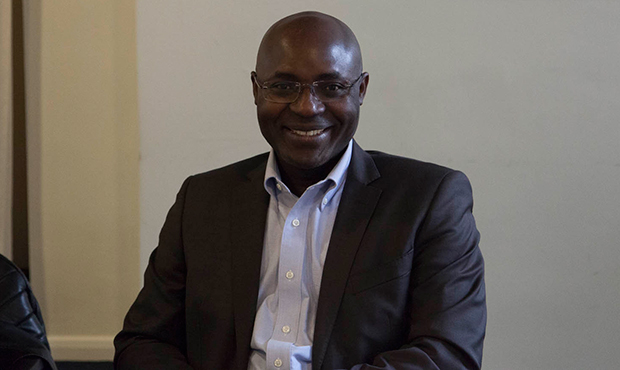
Journalist and human rights activist Rafael Marques de Morais (Photo: Sean Gallagher/Index on Censorship)
Rafael Marques de Morais, an Angolan investigative journalist and campaigner, has for months been locked in a legal battle with a group of generals who he holds the generals morally responsible for human rights abuses he uncovered within the country’s diamond trade. For this they filed a series of libel suits against him. In May, it looked like the parties had come to an agreement whereby the charges would be dismissed, only for the case against Marques to unexpectedly continue — with charges including “malicious prosecution”.
5) Kuwait: “insulting the prince and his powers”
Kuwaiti blogger Lawrence al-Rashidi was in 2012 sentenced to ten years in prison and fined for “insulting the prince and his powers” in poems posted to YouTube. The year before he had been accused of “spreading false news and rumours about the situation in the country” and “calling on tribes to confront the ruling regime, and bring down its transgressions”.
6) Bahrain: “misusing social media
Nabeel Rajab during a protest in London in September (Photo: Milana Knezevic)
In January nine people in Bahrain were arrested for “misusing social media”, a charge punishable by a fine or up to two years in prison. This comes in addition to the imprisonment of Nabeel Rajab, one of country’s leading human rights defenders, in connection to a tweet.
7) Saudi Arabia: “calling upon society to disobey by describing society as masculine” and “using sarcasm while mentioning religious texts and religious scholars”
In late 2014, Saudi women’s rights activist Souad Al-Shammari was arrested during an interrogation over some of her tweets, on charges including “calling upon society to disobey by describing society as masculine” and “using sarcasm while mentioning religious texts and religious scholars”.
Jean Anleau was arrested in 2009 for causing “financial panic” by tweeting that Guatemalans should fight corruption by withdrawing their money from banks.
9) Swaziland: “scandalising the judiciary”
Swazi Human rights lawyer Thulani Maseko and journalist and editor Bheki Makhubu in 2014 faced charges of “scandalising the judiciary”. This was based on two articles by Maseko and Makhubu criticising corruption and the lack of impartiality in the country’s judicial system.
10) Uzbekistan: “damaging the country’s image”
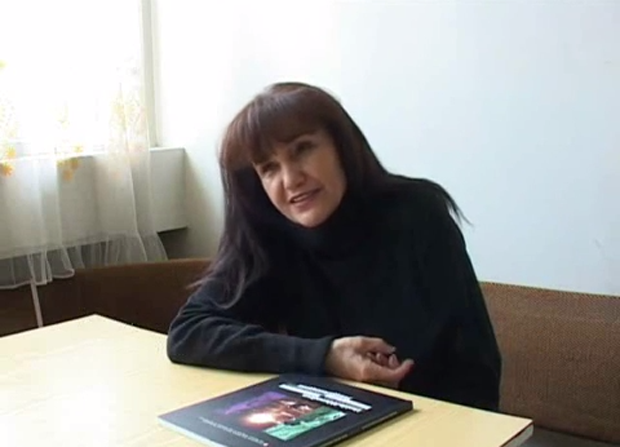
Umida Akhmedova (Image: Uznewsnet/YouTube)
Uzbek photographer Umida Akhmedova, whose work has been published in The New York Times and Wall Street Journal, was in 2009 charged with “damaging the country’s image” over photographs depicting life in rural Uzbekistan.
11) Sudan: “waging war against the state”
Al-Haj Ali Warrag, a leading Sudanese journalist and opposition party member, was in 2010 charged with “waging war against the state”. This came after an opinion piece where he advocated an election boycott.
12) Hong Kong: “nuisance crimes committed in a public place”
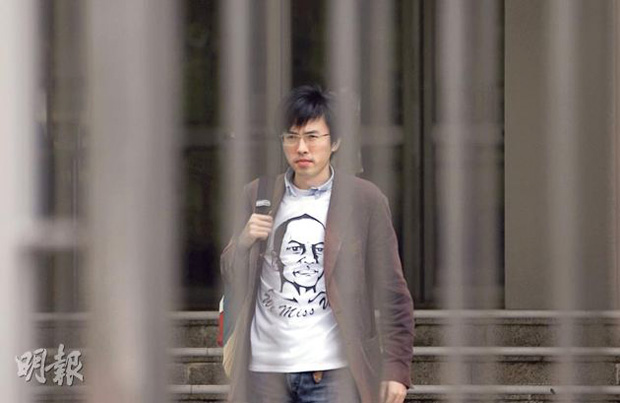
Avery Ng wearing the t-shirt he threw at Hu Jintao. Image from his Facebook page.
Avery Ng, an activist from Hong Kong, was in 2012 charged “with nuisance crimes committed in a public place” after throwing a t-shirt featuring a drawing of the late Chinese dissident Li Wangyang at former Chinese president Hu Jintao during an official visit.
13) Morocco: compromising “the security and integrity of the nation and citizens”
Rachid Nini, a Moroccan newspaper editor, was in 2011 sentenced to a year in prison and a fine for compromising “the security and integrity of the nation and citizens”. A number of his editorials had attempted to expose corruption in the Moroccan government.
By Thatcher Hullerman Cook (https://www.flickr.com/photos/poptech/5107260975) [CC BY-SA 2.0 (http://creativecommons.org/licenses/by-sa/2.0)], via Wikimedia Commons
Grammy and Oscar-award winning American singer John Legend is set to perform in Bahrain on Monday 2 March, according to the organisers of Bahraini festival Spring Of Culture 2015.
“While sitting at his gleaming grand piano, accompanied by the subtle brilliance of four string instrumentalists and a guitarist, the 35-year-old crooner captivates his audience at the simply wonderfull (sic) intimate venue,” reads the promotional blurb on the festival’s website. And it looks to have been a popular booking, as tickets reportedly sold out in hours.
But many are unhappy with the concert going ahead, due to Bahrain’s poor human rights record. The Gulf monarchy has seen significant protests since 2011 calling for democracy and human rights, which have been cracked down on by authorities. “The government continued to stifle and punish dissent and to curtail freedoms of expression, association and assembly,” Amnesty International said of Bahrain in their recently released annual report.
Among those speaking out against the show, was prominent human rights defender Maryam Alkhawaja. Her father and sister are currently imprisoned in Bahrain on charges related to their campaigning work.
.@johnlegend ur performance in #Bahrain will b used 2 whitewash regime violations which include: systematic #torture, extrajudicial killings
.@johnlegend 10 mins frm where ull b prforming, protests will b attackd, ppl teargassd. Dont allow ur music 2 drown out their cries #Bahrain — Maryam Alkhawaja (@MARYAMALKHAWAJA) February 26, 2015
.@johnlegend song #Glory is an inspiration to everyone fighting for rights. Your integrity is at stake if you perform it in #Bahrain — BIRD (@BirdBahrain_) February 26, 2015
People should pressure signer @johnlegend who claim to love civil rights so he would cancel his trip to support AlKahlifa Moanrchy #Bahrain — Ali AlAhmed (@AliAlAhmed_en) February 26, 2015
Nabeel Rajab, another famous human rights campaigner, also reached out to Legend on Twitter. Rajab was in January sentenced over a tweet where he allegedly “denigrated government institutions”. He was today again summoned by Bahraini police, and fears he can be arrested “at any time“.
Many expressed disappointment that Legend, who on numerous occasions in recent times has spoken out on racism and injustice in his native US, would perform in Bahrain given the country’s current political situation.
As someone speaking out against incarceration in the US, shocking that @johnlegend is going to sing in Bahrain with 3000 political prisoners — Ala’a Shehabi (@alaashehabi) February 25, 2015
.@johnlegend Please don’t perform in Bahrain, John. After your Selma track, you cannot support a repressive segregationist regime like that. — AHMED HUSSAIN ☪ (@iA7med80_) February 26, 2015
It would be a fantastic statement of solidarity against oppression for @johnlegend to refuse to perform in #Bahrain. Please consider it. — Daniel Wickham (@DanielWickham93) February 25, 2015
.@johnlegend how can one of today’s most politically thoughtful artists play Bahrain with 1000s of political prisoners? Via @alaashehabi — Marc Lynch (@abuaardvark) February 25, 2015
You have emerged as a voice of conscience in today’s America. In your writing, performances and speeches you have proven yourself to be a principled champion of equality who is unafraid to speak out for what is right. Last year, you wrote that “As I watched the final version of Selma, I did so with the backdrop of the streets of many of our major cities filled with protesters, crying out for justice after yet another unarmed black person’s life was taken by the police with impunity.”Bahraini lives have been taken by the police with impunity as well, and Bahraini lives do matter. I hope that you will think deeply about the implications of performing in a country like today’s Bahrain, where the violence of an unaccountable police against peaceful protestors mirrors everything against which you have spoken out at home.
While some called for a cancellation of the show, others urged Legend to use his platform to speak out about human right abuses in Bahrain, as he has done in the US.
If @johnlegend decides 2 go thru with #Bahrain shows, he must bring the msg of “Glory” to a country with extreme human rights violations. — Kelsey Waxman (@kkwaxman) February 25, 2015
But not everybody agreed with the criticism.
The stupidity of some people is unreal. Asking John Legend not to come to Bahrain due to protests (that aren’t even important anymore) is… — Moh’d (@MohamedK62) February 26, 2015
…is just stupid. John Legend coming to Bahrain would give our economy a boost (no matter how small or big it is). — Moh’d (@MohamedK62) February 26, 2015
This isn’t the first controversial celebrity visit to Bahrain. In 2012, reality star Kim Kardashian visited the country to launch a Millions of Milkshakes store. As Index’s Sara Yasin wrote at the time: “Bahrain is no stranger to using flashy events to attempt to whitewash its tarnished international reputation.”
Update 2 March 2015, 16:28pm
John Legend has responded to the criticism, saying that “the solution to every human rights concern is not always to boycott” and that he hopes “to meet the many people who are peacefully struggling for freedom, justice and accountability, regardless of what country they live in”. Full statement below, via The Independent:
Some have recently suggested that, due to documented human rights abuses by the government of Bahrain, I should cancel my upcoming concert there. After consulting with human rights experts, I decided to keep my commitment to perform for the people of Bahrain, many of whom I am proud to call my fans, during their annual festival. I have spent quite a bit of time thinking about human rights, civil rights and other issues of justice, both in the United States and abroad. The solution to every human rights concern is not always to boycott. Most of the time I will choose to engage with the people of the country rather than ignore or abandon my commitments to perform for them. Often, the best way to drive progress is to show up and participate in the conversation. As we move this work forward, I hope to meet the many people who are peacefully struggling for freedom, justice and accountability, regardless of what country they live in, and tell them directly that I stand with them. Part of my mission in life is to spread love and joy to people all over the world. I intend to do just that in Bahrain, regardless of my disagreements with some of their governments’ policies and actions.

![By Thatcher Hullerman Cook (https://www.flickr.com/photos/poptech/5107260975) [CC BY-SA 2.0 (http://creativecommons.org/licenses/by-sa/2.0)], via Wikimedia Commons](https://www.indexoncensorship.org/wp-content/uploads/2015/02/John_Legend_NEW-SIZE.jpg)