20 Jun 2014 | China, News, Politics and Society, Religion and Culture
(Photo: Macmillan)
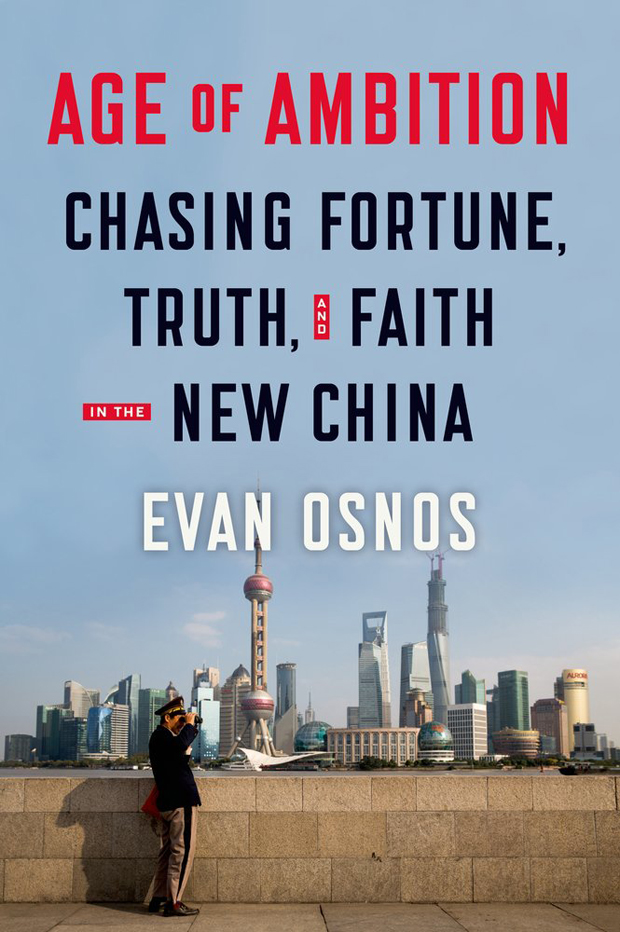
In a recent op-ed for The New York Times, American journalist Evan Osnos said that he turned down the opportunity to publish a copy of his new book Age of Ambition: Chasing Fortune, Truth, and Faith in the New China because an initial report from the censors came back asking for almost a quarter to be struck out.
The only surprising thing about this is that they were only planning to cut about 25%. Osnos’ book follows the lives of a cast of characters as they pursue their dreams – whether that be for money, for love, for dignity for freedom or justice. He does not hold back listing the faults of China’s authoritarian system – the corruption, the hypocrisy, the lies, the control, and the censorship itself. Among the cast of characters that Osnos follows a fair few are clearly a no-go – among them imprisoned dissident writer Liu Xiaobo, blind activist lawyer Chen Guangcheng and outspoken artist Ai Weiwei among them.
Osnos declined to publish because: “to produce a ‘special version’ that plays down dissent, trims the Great Leap Forward, and recites the official history of [former official] Bo Xilai’s corruption would not help Chinese readers. On the contrary, it would endorse a false image of the past and present. As a writer, my side of the bargain is to give the truest story I can.”
For Osnos it wasn’t just a matter of how much of the book would have to go — a lie is a lie whether it is a big one or a small one. He told Index on Censorship: “It’s a slippery slope. If you agree to cut five paragraphs or 10% of the text or 25%, where do you stop?”
Osnos’ op-ed has highlighted the dilemma writers face publishing in China. The mainland is now hungry for western works. A publisher approached Osnos and not the other way around. American journalist Peter Hessler, who was the Beijing correspondent for The New Yorker before Osnos, published two of his China books on the mainland, County Driving and River Town. He said that they both sold more than 150,000 copies in China. Country Driving actually sold more copies in China than they did in the US. In the first 10 months of last year, 650,000 censored copies of Deng Xiaoping and the Transformation of China by Ezra F. Vogel, professor emeritus at Harvard University, were bought in China. Around 10% of the book was excised.
Osnos wouldn’t compromise, but Hessler and Vogel did, for different reasons.
Hessler says he felt that he owed it to the people he was writing about to give them access to what he was saying about them. “The longer that I wrote about China, the less comfortable I was with the fact that readers in these places could not read what I was writing about them,” Hessler told Index on Censorship. “It’s an unhealthy dynamic that is common all over the developing world – the foreign correspondent often feels like he’s exporting stories. He doesn’t receive local feedback, and there’s a risk that he isn’t fully accountable to his subjects.”
Hessler’s books tend to follow communities and as such are less sensitive. “The general pattern is to cut references to national leaders or events, while leaving detailed descriptions of local events,” notes Hessler. Just a few pages were cut from both books out of more than 400 pages – changes, he thought, that did not “strike at the core of either book.” He did not try to publish another of his China books, Oracle Bones, because it was much more sensitive and would have faced significant cuts.
Vogel argued that his work opened the door to a more open discussion. “Many Chinese academics were appreciative that my book had expanded the range of freedom, allowing them to discuss more topics than had been possible before the book was published,” he wrote on The Harvard University Press website.
The danger is of course, even if the book does spark discussion, even if the censor does let some “sensitive” details slip through, readers are largely unaware of what was changed and thus the version they read ends up perpetuating the official line.
“If the censorship would change the point or substance of the book, then readers will come away with a, not just limited, but actually incorrect understanding of what the author was trying to say,” notes Eric Abrahamsen, an American publishing consultant and literary translator based in Beijing. “In the case of Evan Osnos’ book, losing 25% would mean that readers would believe that he thinks differently than he actually does. That would be incredibly pernicious, and isn’t remotely worth it.”
Vogel’s decision has earned him scathing criticism from Perry Link, Professor Emeritus of East Asian Studies at Princeton University. Link, who is famous for describing Chinese censorship as “the anaconda in the chandelier”, says that rather than opening the doors to discussion, Vogel’s censored book props up the Party’s line.
“The 10% that is omitted from Ezra’s book is not a random 10%,” he said. “It is a 10% that distorts the reader’s overall impression of the whole — i.e., the other 90% as well. Ezra’s book is very favourable to the regime. If 10% is omitted, it reads like a flat-out, all-out endorsement by a Harvard professor of Chinese Communist Party authoritarian rule.”
This article was published on June 20, 2014 at indexoncensorship.org
19 Jun 2014 | China
China’s censors have a hard time stamping out memes.
Memes are proving one of the most powerful weapons Chinese netizens can use to fight online censorship. In the weeks on either side of this year’s 25th anniversary of Tiananmen Square, Chinese censors blocked a variety of terms on social media, including “blood”, “May 35” and even “today”, but references to the event kept on emerging in memes. Images alluding to the infamous “Tank Man” took on a variety of forms, using heads of Mao, tractors, lego and the iconic Hong Kong rubber duck in lieu of circulating the actual iconic photo.
The concept of the meme was coined by Richard Dawkins in 1976 to explain certain ideas, catchphrases, trends and other pieces of cultural information that replicate through a population. In its current usage, memes are defined as cultural items in the form of an image, video or phrase that spreads via the internet and are often altered in a creative or humorous way.
They’ve been part of the Chinese blogosphere for years and in many ways are ideally suited to the Chinese context. In part this is because Mandarin as a language allows for a playful form of double entrendre. Due to its many tones even the slightest shift in pronunciation can change a word’s meaning, while still sounding similar enough to invoke comparisons. The most famous Chinese meme, which parodies censorship itself, is that of the grass mud horse — caonima. In certain tones caonima means an alpaca; in other tones it’s a famous Chinese profanity. A few years back a video depicting a grass mud horse defeating a river crab, hexie, which is a homonym for the propaganda catchword “harmony”, went viral. To this day memes relating to this still emerge to poke fun at Chinese authorities.
Herein lies the strength of memes; their ability to evolve quickly and to imply rather than state makes them very difficult to detect and delete. After all, it’s hard enough for Chinese censors to keep track of and block all search terms directly referencing taboo topics. It’s harder still to block the infinite variations of words and images that might allude to controversy.
“Due to advanced and pervasive censorship, Chinese netizens are often forced to use coded language and images to talk about the social and political issues they find important,” says Ben Valentine, strategist and contributing writer for The Civic Beat, which examines social change memes and viral media.
“Images are much harder to algorithmically block because machines have trouble understanding visual content. While online writing directly talking about anything to do with Tiananmen Square in 1989 is extremely difficult, some of these memes make it past the censors. This is partially why, despite pervasive censorship, the Chinese web still remains a quite lively and active online space,” he adds.
For David Bandhurs, a researcher at the University of Hong Kong’s China Media Project, anyone who engages on a regular basis with others in the Chinese internet space “understands that irony, parody and other forms of expressive subterfuge are absolutely essential”. Memes “are the very substance of self-expression, of which social and political expression are a part, in a repressive space”.
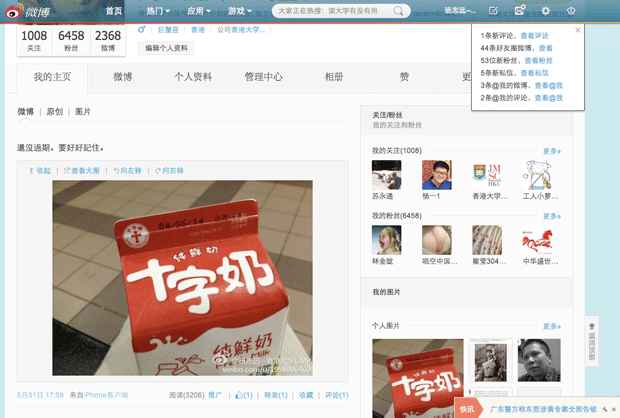
Ahead of the 4th June anniversary, Bandhurs posted a photo of his milk carton to Weibo (China’s Twitter). The expiration date was “04/06/14” and he wrote: “It’s not yet expired. We have to remember.”
“This was a very casual post, its point being to share a momentary thought with my community, a thought which for some might prompt a moment of esprit de corps, or a moment of reflection,” he tells Index.
“A lot of memes emerge, and they emerge constantly, in exactly this way. They encapsulate a thought or a feeling — often with a strong social or political dimension — that cannot be openly expressed. For example, the meme ‘My father is Li Gang’ quickly became emblematic of the injustice and inequality resulting from unchecked power. It was like a key that could open a box of thoughts no one could make very explicit.”
Just how effective are these memes? When shared instantly and abundantly across platforms like Weibo, they can be very powerful. In some instances Chinese memes have spurred a call to action, as was the case with those that knocked Beijing’s poor air quality. Until recently, the government denied the extent of the pollution. Conversation on the topic was silenced. Then photos of blue sky days and other related memes emerged. Now the government is approaching the topic with more transparency.
As for those topics which still remain off limits, memes provide an alternative form of political discourse. The China Digital Times sees caonima specifically as the “the icon of online resistance to censorship”.
Memes represent a way in which Chinese people momentarily seize control of conversations. For example, when blind activist and lawyer Chen Guangcheng was arrested, thousands of people posted photos of themselves wearing sunglasses in protest. While it might not seem like the biggest act of defiance, it’s still something in a nation where free speech and collective action are strictly controlled.
“These memes allow for more expression, a political conversation to start, for humor around a taboo subject; this is an incredibly empowering feeling. The ability to connect, talk, laugh, and touch on politics feels good,” explains Valentine.
Speaking of memes more generally, Cole Stryker, author of Epic Win for Anonymous: How 4chan’s Army Conquered the Web, tells Index:
“The power of politically-oriented memes is that they can be used in a playful way that isn’t necessarily directly confrontational to a regime. In some cases, the regime doesn’t even realize they’re being undermined. This allows activists to openly protest with impunity or even anonymity.”
At the same time, it’s important not to overstate the power of memes in China. Most vanish in the cyberspace vortex. Bandhurs’ milk carton post, for example, had more than 3,000 views, but could not be shared or commented upon, taking the sting out of it.
Memes are also predominantly harmless and politically apathetic. An office worker in Beijing, Wang Meimei, 28, said she and her friends constantly share memes. These solely relate to entertainment, not politics, because “we’re not interested in that”.
Meanwhile, 35-year-old Huang Yeping, who works in news media in Beijing, says none of the recent memes he has seen capture any form of zeitgeist.
“Is it me or have Chinese become even more subdued in terms of political expression, so much so that they haven’t been able to create anything as infectious as grass mud horse or a derivative of the tankman?” he asks, then adds:
“There has been this chill spreading across the cyber world.”
And as this indicates, taken alone memes cannot supersede collective action, nor do most have that in mind. They can spark a discussion, yes, yet remain as entertainment without the other key elements that bring about concrete action. What memes can do is allow for everyday Chinese to seize control of conversations — whether they be of a social, political or cultural nature — even if only for a few hours or days before the army of censors step in. And as Valentine says, that “feels good”.
This article was published on June 19, 2014 at indexoncensorship.org
23 May 2014 | China, News
(Photo: Yo Hibino/Wikimedia Commons)
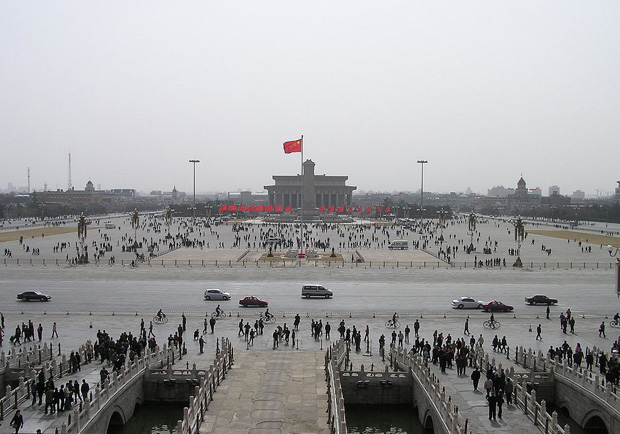
“Keep quiet and carry on” is the slogan that can best describe China’s take on the approaching 25th anniversary of the 1989 Tiananmen Square massacre.
This is the yearly Tiananmen anniversary crackdown, and people within China know what to expect; slower internet, blocked search terms, more military personnel in public and the arrest of high profile individuals. But this year’s crackdown appears particularly thorough, either a reaction to dissent being higher than usual or a perception that it is in light of the milestone anniversary.
The Chinese government has already jailed scores of lawyers, activists and intellectuals, sending a chilling message to any other would-be agitators. Of the most widely reported was the arrest of Pu Zhiqiang, a prominent human rights lawyer who helped organise the 1989 protests. His detention came three days after he joined a private panel discussion on the massacre. Around 15 people were at the event, five of whom have since been detained. Then there was the airing of confessions on state media by journalist Gao Yu and citizen journalist Xiang Nanfu this May, which echoes Maoist propaganda tactics.
As we get closer to 4 June actions against freedom of expression will grow. Yvonne Shen, who is Asia News Digest Editor at Freedom House, an NGO committed to tracking violations to free expression, says the Chinese government “step up their censorship efforts in the days surrounding that date”. Within a week the organisation anticipate spikes in suspicious activity online. They are keeping a close eye on social platform WeChat in particular, given its current popularity.
“There was a leaked document dated 31 May, 2011, from the Beijing Municipal Government, that suggested the authorities had launched a ‘wartime coordination mechanism’ that required all units to report suspicious information during the “sensitive period,” Shen tells Index of the government’s usual tactic.
China forbids open discussion of the Tiananmen Square crackdown, in which soldiers fired on crowds of unarmed pro-democracy protesters, killing hundreds if not thousands (no official death toll has ever been released). On top of arrests, an army of censors work overtime to ensure mentions of the event are quickly removed. Sites are blocked and words that allude to or directly reference it vanish.
The private realms of emails and direct messages are also monitored, as Louisa Lim, author of upcoming book The People’s Republic of Amnesia, Tiananmen Revisited, describes: “I wrote my book on a brand-new laptop that had never been online. Every night I locked it in a safe in my apartment. I never mentioned the book on the phone or in e-mail, at home or in the office — both located in the same Beijing diplomatic compound, which I assumed was bugged.”
Chinese journalists are trained “not to ever touch Tiananmen with a 10 foot pole,” Beijing-based journalist Eric Fish tells Index. He too perceives a recent shift: “The atmosphere for Chinese journalists has tightened quite a bit in general since Xi Jinping came to power. It feels like they’ve clamped down a lot more than normal in the lead-up to this anniversary.”
As Fish says, the detentions form part of a broader crackdown on free speech. When Xi Jinping came to power in 2012, there were hopes he would relax censorship. These hopes were quickly dashed. Index recently reported on a ban of seemingly innocent US TV shows, which shows just how pervasive the attack has been.
Even foreign journalists, who are usually granted more leeway, have experienced “a big uptick in pressure over the past two years,” says Fish, a reference to several prominent cases of journalist visas being revoked.
This is a fact Steven Levine has had to accept. “I anticipate being refused a Chinese visa the next time I apply to visit China as this is one way in which the Chinese authorities punish foreigners who criticise their human rights practices,” explains the retired professor of Chinese history and politics, who coordinates the Tiananmen Initiative Project — an individual effort aimed at focussing attention on the Tiananmen Movement and government crackdown.
Levine’s project has already been banned from the Chinese online world; within days of launching last November, the site had been blocked. Levine will not be deterred and continues to correspond with Chinese individuals inside the country, as well as with exiled Chinese who were either leaders or active in the 1989 movement. For him, being refused a visa is a price worth paying. It’s a different story for those inside of China, who take a much bigger gamble.
That said many have come up with creative ways to circumvent censorship. For example, prominent writer Murong Xuecun avoided the censors by using the politically neutral word “tractors” instead of the highly provocative “tanks”. And while “4th June” is blocked, the new code of “May 35th” has filled its place — a count of that month’s 31 days plus four in June.
It’s a game of cat and mouse. Ultimately, the cat is winning, but the mice aren’t going down without a fight.
This article was posted on May 23, 2014 at indexoncensorship.org
13 May 2014 | Asia and Pacific, News, North Korea
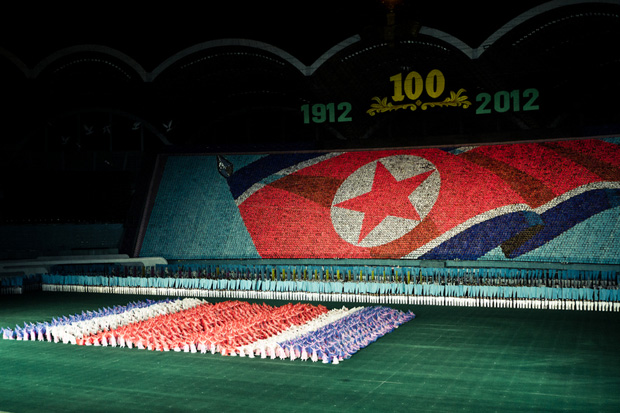
Gymnasts at Arirang festival in Pyongyang, North Korea (Image: Roman Kalyakin/Demotix)
Jang Jin-sung, formerly poet laureate for North Korea, is one of its highest-ranking defectors and most vocal critics. A meteoric career that saw him also become chief propagandist in the United Front Department, engaging in counter-intelligence and psychological warfare against South Korea, he was also one of Kim Jong Il’s inner circle — a dreamlike life of privilege shattered when he found the bodies of famine victims lying in the streets of his home town. Facing almost certain death for the crime of mislaying a prohibited text, he dramatically escaped to China in 2004 and defected to South Korea. Based on his insights from working in the elite, he argues that the official narrative of North Korea being run under the absolutist genius of the Kim dynasty and the Korean Workers Party, is a lie. Power was not harmoniously transferred upon Kim Il Sung’s death in 1994 to his son, Kim Jong Il — instead Kim Jong Il had long before usurped his father with the support of the clandestine Organisation and Guidance Department (OGD), while Kim Il Sung spent his last years under virtual house arrest, bamboozled by his own cult, created by his son. Kim Jong Il directed the OGD under his reign and he legitimised “every single policy and proposal, surveillance purge, execution, song and poem”, but upon his death in 2011, however, the bequest of leadership upon his son Kim Jong Un was solely symbolic; the OGD took charge. That year, Jang set up New Focus International to give insight and analysis to North Korea. This week he talked about the OGD as “the single most powerful entity in North Korea” to the All-Party Parliamentary Group on North Korea. His words were translated by NFI’s international editor, Shirley Lee, and the talk was chaired by Lord David Alton.
The OGD is “the entity that controls everything. This is where all roads end, all chains of command, and all power structures go,” Jang said. “The real power structure, nothing has changed since Kim Jong Il’s time. The OGD is still just as it is, the same men are in the same positions of power.” Yet the OGD is so secret and compartmentalised a structure, it’s only fully comprehended by the most senior leaders, and known to “less than a dozen” of the approximate 26,000 refugees out of North Korea. That lack of knowledge has meant that traditionally, outside observers omitted the OGD’s existence, basing their views on diplomatic notes, refugee testimonies and political theories which Pyongyang has successfully fed into with propaganda about the Kims’ omnipotence, to obscure its power structures. Hence, many observers interpreted the purge of Kim Jong Un’s uncle Jang Song Thaek as the new leader getting rid of his old guard to make his own power network, whereas it was really the OGD liquidating a rival. South Korea has also connived to keep a lid on knowledge of the OGD. When Hwang Jong Op, the international secretary of the Korean Workers’ Party and principal author of the state philosophy of Juche, defected and sought to tell of the OGD, the South’s then Sunshine Policy “was based on a policy of engagement that sought not to provoke the North Korean regime, [so] they actually silenced his testimony from appearing,” said Jang.
Whereupon while “every single person seen as the second, third, fourth most powerful man, has been purged or destroyed … every single powerful member of the OGD has remained”. They will stay in power as the OGD is in effect North Korea’s “human resources department, it appoints everyone”. The vetting of appointees is based on trust, and loyalty secured by cadres knowing any perception of disloyalty will imprison them, their parents and their children. “No-one is exempt from this… because no matter how big you are, if you do something wrong, you are sending your family to prison camp to rot away for the rest of their lives, never to be seen again.” As Lee put it, “you’re not going to kill your own family to change that”. Jang himself has tried many times to contact his parents in North Korea, but has never succeeded. “You can’t begin to think about what his parents may be suffering but that just makes him stronger,” said Lee.
The OGD appoints all generals and makes all military orders, with the military’s autonomy compromised like everything else by the OGD’s all-pervasive surveillance structure. Party committees of spies are installed across all sectors from diplomacy to tourism, down to each and every apartment block — “the OGD has eyes and ears everywhere”. It is backed by the OGD’s secret police and system of prison camps that the group developed into a weapon of mass terror while it usurped Kim Il Sung. He was prevented from seeing friends or family by his OGD-appointed bodyguards, a corps now numbering 100,000. He “died as a scarecrow, he was nothing,” said Lee.
As well as these physical means of control, the state seeks to monopolise all information flows and uses incredible psychological and emotional force to ensure its citizens’ loyalty. “In North Korea the only politically correct faith to have is in the cult of the Kims,” said Jang, while religious organisations like the Chosun Association or Buddhist association are run by the UFD, and Christians end up in prison camps. “The only narrative that matters is of the righteous sovereignty of the state.”
Yet for all the surface illusion of power, the nuclear weapons, the police and prison system, “it is a country that’s ruined inside, it’s a collapsed state. They do not control the price of an egg, and that is a huge deal”. Black markets have almost entirely supplanted the government monopoly of provision of goods, ranging from clothing to food, which collapsed in the mid-1990s as millions perished in the famine. This has created two classes, those loyal to the party because of their stake in the status quo; and the market class of people who were abandoned by the state and survive on the black market. Critically, this means that for promotions, status, power or material wealth, “the currency has converted from loyalty to money,” said Jang, “and that has broken the cult of North Korea for everyone”.
Economic “reforms” are really state efforts to try control the black markets, which have at times suffered violent crackdowns, for having become “a black hole that sucked in the control mechanisms of the state”. Equally, however, the regime cannot survive without them, as “the market feeds the people”. The country is also suffering from criminal activities actually sanctioned by the regime, namely counterfeit dollar bills, meth amphetamine production and computer hacking. “It’s not the world that’s suffering, the country is being destroyed by the regime’s own creations,” as government computers are hacked and fake bills and drugs run through society. Refugee statements say meth amphetamine abuse has become “just part of the ordinary life”.
Meanwhile the markets live off information. “The price of rice, the price of your life rises and falls in terms of knowing outside world information…ordinary people know it’s an advantage to listen to the outside world [information],” and Jang endorses the set up of a BBC Korea service to broadcast into North Korea. “The only way to break the dictatorship of force is by breaking that emotional monopoly over the people… There is no more effective tool that the world can do than to acknowledge that the North Korean people have the right to another narrative than that the party supplies.”
“More important is that no one in the North today believes it will last for ever,” but “the one thing that is stopping them from acting is there is no other way. Everyone is trying to do it the regime’s way”. This extends from efforts to deal with Pyongyang’s nuclear bomb program, which fail because international frameworks don’t apply to North Korea — “the only way the world can resolve the nuclear problem is seeing the regime transform. You can’t do it within their demands” — to the country’s appalling human rights record. “Those who think putting human rights on the agenda would jeopardise engagement and dialogue are wrong. North Korea is more desperate for dialogue at the state level than the West is. They [the North Korean state] need that to sustain what is happening right now.” Putting human rights atop all agendas would mean “there is nowhere left for the North Korean leadership to stand”.
“Stop looking at the regime as the agent of positive transformation,” said Jang, and engage with those with no stake in the status quo. Meanwhile, China, as the North’s sole supporter, is key to its survival and to brook any change. “China supports North Korea because it’s more convenient to support it than not,” said Jang, adding that Kim Jong Il hated China more than anybody “because he was at their mercy”, while Beijing’s anger at Jang Song Thaek’s execution was because it was “like the nightmare of Kim Jong Il would continue”. On Wednesday China warned North Korea against carrying out another nuclear test. And while China has yet to host Kim Jong Un, it has already welcomed South Korea’s President Park with open arms. Repeatedly reaffirming North Korea’s human rights record, damningly detailed by the United Nations’ Commission of Inquiry Into Human Rights in the DPRK in March, to the Chinese government may pressure them into giving up the forceful repatriation of North Korea refugees, which leads to prison or death, according to Lord Alton. “The scariest thing for China is to start to get moral blame for what’s going on in North Korea. So it will want to be seen to be doing the right thing.” On that, Jang said any retribution befalling the regime for human rights abuses, “the OGD will blame will Kim Jong Un alone”.
Again it’s an issue of perception. “In North Korea, I thought change could not come because the regime was so powerful. When I came to South Korea I learned that North Korea was not transformed because the South Koreans didn’t know it could.” Indeed, “the only thing holding North Korea back from transforming is that the world isn’t ready for it.”
The talk was organised with help from the European Alliance for Human Rights in North Korea. Jang’s book Dear Leader (UK Random House, US, Simon & Schuster) is out now.
This article was posted on May 13, 2014 at indexoncensorship.org
