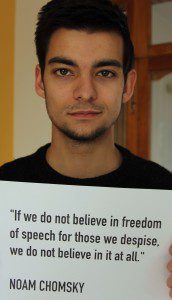
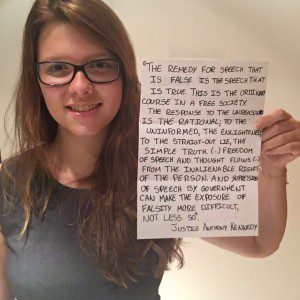
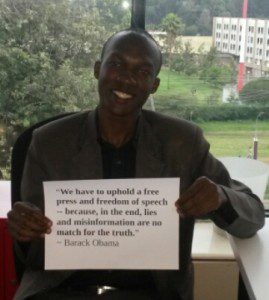
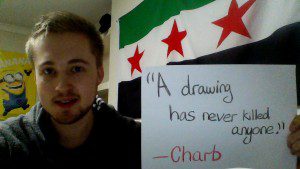
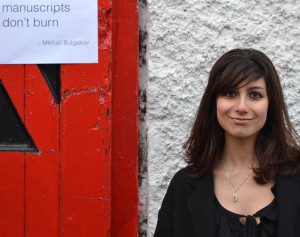
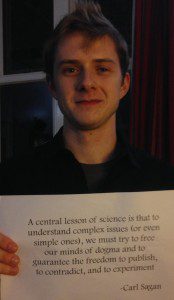
Index on Censorship recently appointed a new youth advisory board who attend monthly online meetings to discuss current freedom of expression issues and complete related tasks. As their first assignments they were asked to provide a short bio to introduce themselves, along with a photograph of them holding a quotation highlighting what free expression means to them.
Simon Engelkes
I am from Berlin, Germany, where I study political science at Free University Berlin. I have worked as an intern with Reporters Without Borders and RTL Television, which made me passionate about the importance of freedom of speech.
I believe that freedom of expression forms an important cornerstone of any effective democracy. Journalists and bloggers must live without fear and without interference from state or economic interests. Unfortunately, this is not the case. Journalists, authors and everyday citizens are imprisoned or killed by radicals, state agencies or drug cartels. Raif Badawi, James Foley, Khadija Ismayilova, Avijit Roy – the list is endless.
We need to remind ourselves and the powerful of today, that freedom of expression as well as freedom of information are basic human rights, which we have to defend at all costs.
Mariana Cunha e Melo
I am from Rio de Janeiro, Brazil. I graduated from law school in Rio and I have a degree from New York University School of Law. My family has taught me about the dangers of censorship and dictatorship, so I have always been interested in studying civil rights. This was the main reason I decided to study law.
I grew up listening to stories about the media censorship in Brazil during the military dictatorship. The fight against the ghost of state censorship has always sounded very natural to me – and, I believe, to all my generation. When I finished law school I found out that the new villain my generation has to face is the censorship based on constitutional values. The argument has changed, but the censorship is not all that different. So I decided to dedicate my academic and my professional life as a lawyer to fight all sorts of institutionalised censorship in Brazil.
Ephraim Kenyanito
I was born and raised in Kenya, and I am currently working as the sub-Saharan Africa policy analyst at Access Now, an international organisation that defends and extends the digital rights of users at risk around the world. My role involves working on the connection between internet policy and human rights in African Union member countries. I am an affiliate at the Internet Policy Observatory (IPO) at the Center for Global Communication Studies, University of Pennsylvania. I also currently serve as a member of the UN Secretary General’s Multi-stakeholder Advisory Group on internet governance.
The reason why I have always been passionate about protecting the open internet is that it is a cornerstone for advancing free speech in the post-millennium era and there is a great need to build common ground around a public interest-oriented approach to internet governance.
Emily Wright
I grew up in Portugal, and I am now based between London and Bogotá, Colombia. I am a freelance filmmaker and journalist. Working in documentary production and community-based, participatory journalism informed a growing interest in journalistic practices, freedom of expression and access to information.
I believe that one of the greatest threats to freedom of expression is the flagrant violation of civil liberties under the banner of national security. The war on terror, underscored by Bush’s declaration “You’re either for us or against us”, has collapsed the middle ground, suppressing any struggles that challenge that statement. Freedom of expression has become a pretext for silencing those who have the least access to it; those who do not fall in line with the global order’s supposed defence of freedom against barbarism and obscurantism.
Mark Crawford
I’m originally from Birmingham, and now a postgraduate student at University College London, specialising in Russian and post-Soviet politics. This has inevitably educated me on the pressures exerted upon freedom of expression in Russia, whose suffocated and disenfranchised opposition journalists I am currently investigating.
Hostility to free expression has become a staple of my university life. Rather than developing a coherent set of ideologies to challenge toxic values in the open, it has become mainstream for students of the most privileged universities in the world to veto them on behalf of everyone else, no-platforming and deriding free speech.
I am convinced that there is no point fighting for an egalitarian society if any monopolies over truth are permitted. Freedom of speech is, therefore, something I am keen to promote in whatever small way I can.
Madeleine Stone
My home is in south-east London but I spend most of my time in York, studying for my bachelor’s degree in English and related literature. I am currently the co-chair of York PEN, the University of York’s branch of English PEN, and a founding member of the Antione Collective, a human rights-focused theatre company.
Studying literature from across the globe has introduced me to issues of freedom and censorship, and the devastating effects censorship can have on national progress. Freedom of expression on campuses is hugely important to me as a student and it is currently under threat. Well-meaning individuals are shutting down the open debate that is vital to academic institutions. The only way to fight harmful ideas is to engage them head-on and destroy them through academic debate, not to ban them.
Layli Foroudi
I am a journalist and student currently studying for a MPhil in race, ethnicity and conflict at Trinity College Dublin. It was studying literary works from the Soviet period during my undergraduate degree in Russian and French at University College London that initially highlighted the issue of censorship for me. The quote I selected, “manuscripts don’t burn”, is from the book Master and Margarita by Russian author Mikhail Bulgakov. He wrote about the hardship that many writers faced as they had to adjust their own writing in accordance with the authority, as well as the fact that not all that is written can be taken to be true.
I think that these themes are very relevant today. Whether people are censored or self-censor out of fear of punishment or of being wrong, limiting freedom of expression results in loss of debate, of exchange and of creativity. Being denied freedom of expression is being denied the right to participation in society.
Ian Morse
I have been involved in journalism since I began studying at Lafayette College, Pennsylvania, USA, and have been engaged in press freedom and reporting in three countries since then. I studied in Turkey last spring, where I interviewed and wrote about journalists and press freedom. It motivated me to begin researching and writing on my own about these topics. Now, as I study for a semester in Cambridge in the UK, I continue to talk about and advocate for free speech and press.
I find it absolutely amazing the power words and information can have in a society. It becomes then extremely damaging to realise that some things cannot be published because they conflict with those in power. Free speech is now becoming a hot topic around the world, particularly among youth, and it makes it all the more important to be able to approach freedom of expression critically and objectively.
Freedom of the press has always been a pretty reliable litmus test for the state of any democracy. However, as Index on Censorship’s Mapping Media Freedom project shows, countries that are seen as traditionally open, with constitutions protecting freedom of expression, are currently rife with violations against the media.
“It is extremely troubling that media workers have been physically and sexually assaulted, arrested and denied access to key reporting areas in countries with strong democratic institutions,” Hannah Machlin, Index’s Mapping Media Freedom project officer, said. “We hope governments take action to prevent these types of violations from occurring at such a frightening rate.”
So far this year, Mapping Media Freedom has verified 61 media violations. Here are just five examples from the last fortnight that highlight some of the failures of these democracies to live up to their own standards.
1. Germany: Belgian TV reporter assaulted live on air
Just weeks after hundreds of women were sexually assaulted on the streets of Cologne, a journalist, Esmeralda Labye, was sexually assaulted while reporting from the Cologne carnival for Belgian TV station RTBF on 4 February. One man grabbed her breast and another kissed her neck while she was live on air.
“Two or three men gathered behind me and attempted to make themselves the centre of my attention,” Labye told The Guardian. “I was focusing on the broadcast, and then I felt a kiss on my neck.”
Writing for RTBF online, Labye condemned the “wretched and cowardly men” who assaulted her and complained of the increasing difficulty for female journalists to do their job without being harassed.
2. France: Proposed law will increase role of government’s media watchdog
On 4 February, plans to increase the role of the CSA — the French broadcast watchdog whose members are chosen by the government — as a guarantor of the independence of the media were discussed in the French National Assembly.
The French journalists’ union SNJ criticized the planned bill, written by a Parti Socialiste MP, stressing that the CSA is not independent from political influence. They wrote: “The CSA has no responsibility and legitimacy on matters related to the control of information or journalists. It should have none!”
3. Greece: Violent attack against journalist during anti-austerity demonstration
Protests against the Greek government’s plan to change its pension policy as part of the country’s third international bailout brought an estimated 40,000 people onto the streets of Athens and other cities, including journalists. On 4 February, Dimitris Perros, a journalist from the local radio station Athens 9,84, was violently attacked by unknown assailants while covering the demonstration. He was transported to the hospital with major injuries.
Newspapers reported that the attack was denounced in statements from across the political spectrum including Syriza,PASOK and the Greek Communist Party and the Journalist’s Union of the Athens Daily Newspapers. “The strangers who approached him asked him first if he is a journalist and when he answered affirmatively they started beating him with planks, while the police looked on,” the union stressed in an announcement.
4. The Netherlands: Journalists denied access to meeting on housing asylum seekers under “extremist” ban
On 28 January, several journalists were denied access to a citizens’ meeting about the possible creation of a new asylum seeker centre in the village of Luttelgeest, according to newspaper reports. An emergency regulation was issued to refuse journalists access to the meeting. The mayor also banned journalists from travelling within a radius of five kilometres of the village.
The Dutch Association of Journalists, the NVJ, condemned the measure saying that it was not the first time journalists have been banned. “It has happened many times now,” NVJ secretary Thomas Bruning said. “If journalists are denied access, they are obstructed from doing their job. This is alarming and should not happen in a democracy.”
5. Poland: Government uses defamation law to stop media critics
Even Europe’s youngest democracies are fighting off attacks on media freedom.
As Index on Censorship has previously reported, there is a growing trend in Poland of the government using defamation actions to stop criticism in the media. The most recent example, on 3 February, saw Poland’s ruling Law and Justice party, PiS, file a libel suit against the largest daily newspaper in the country, Gazeta Wyborcza about an opinion piece it disliked.
The article argued that PiS and Poland’s president Andrej Duda have behaved like a “mafia state” for pardoning former anti-corruption official Mariusz Kaminski, for abuse of power. Duda issued the pardon before Kaminski had exhausted the appeals process, a point that the author of the piece, Wojciech Czuchnowski, criticised in his opinion piece.
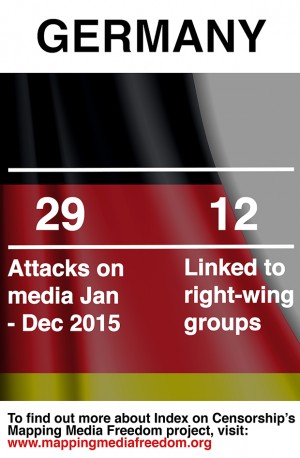
Pressure is mounting on journalists in Germany from right-wing groups that intimidate, insult and sometimes physically assault them, according to an analysis of reports filed to Index on Censorship’s project Mapping Media Freedom. In 2015 there were 29 attacks on media in Germany, 12 of those incidents were connected with the far right.
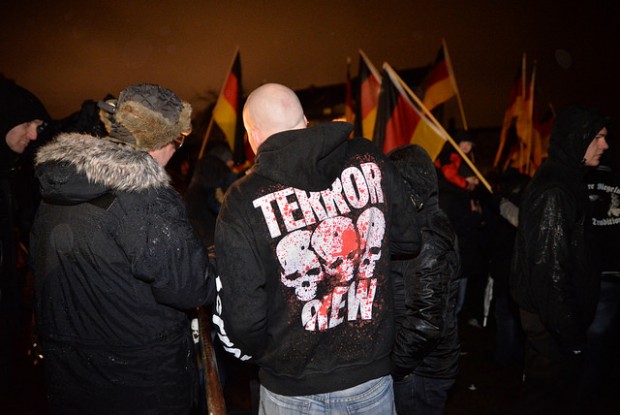
Starting in autumn 2014, the anti-immigrant, right-wing extremist group PEGIDA (Patriotic Europeans Against the Islamisation of the Occident) began as a protest movement that a year later still holds large demonstrations in cities around the country. PEGIDA, along with the populist right-wing political party Alternative für Deutschland (AfD) and similar extremist splinter groups frequently hold rallies that have become sites of aggression and violence against journalists reporting on them.
In 2014, Germany’s annual prize for Un-word of the Year for the most offensive new or recently popularised term went to “Lügenpresse” (lying press), a motto chanted at protests to smear journalists. Angry demonstrators call journalists part of a biased political elite. When journalists try to interview rally participants, they’re often turned away, yelled at or attacked.
“Index is extremely disturbed by the continuous attacks on journalists by right-wing protesters in Germany,” said Index on Censorship’s Mapping Media Freedom project officer, Hannah Machlin. “Media workers have been repeatedly assaulted and insulted in their line of work and these aggressions must be addressed by public officials in order to preserve press freedom in the country.”
Below are five recent stand-out cases of right-wing extremist intimidation of journalists.
On 30 October, Helmut Schümann, a columnist for the Berlin daily newspaper Tagesspiegel, was attacked by several assailants in front of his apartment building in the city’s Charlottenburg neighbourhood. An attacker asked “Are you Schümann for Tagesspiegel?” and then called him a “left-wing pig”.
On the day before the assault, Schümann had published an article about the rise in xenophobia coming out of right-wing extremist groups, headlined: Is that still our country?
Schümann filed a complaint of physical assault and insult with Berlin police. Following the attack, he said: “I’ll keep running my column, positioning myself and won’t let myself be intimidated.”
At a PEGIDA rally in Dresden on 19 October, several journalists were physically attacked. The demonstration was held to mark the one-year anniversary of the protest group and attracted thousands of people.
A reporter for German international broadcaster Deutsche Welle, Jaafar Abdul Karim, was surrounded by protestors while filming with his crew. He was prevented from filming and called a racial slur before being hit in the neck. His attacker ran away.
Jose Sequeira, a cameraman for the Russian TV channel Ruptly, had his gear thrown to the ground by protesters. He was then beaten in the back and head by a group of six or seven men.
At the same protest, an employee of German public radio station Deutschlandradio was attacked by a drunk protestor and mildly injured.
3. Belittling the “lying press”
Right-wing attacks against media workers include insults, intimidation and physical attacks
Police did not immediately identify a right-wing motive behind the assault while they looked for suspects.
4. Physical assault on cameraman
Aggressive protesters at another large PEGIDA rally on 23 November physically assaulted a cameraman who was filming the protest with a Russian TV crew. The 43-year-old suffered non-serious injuries and was brought to a nearby hospital.
Police arrested one 28-year-old suspect in connection to the attack.
Dresden, where PEGIDA began, was host to several shameful attacks against journalists in 2015. On 28 September, one reporter from state public broadcaster Mitteldeutscher Rundfunk (MDR) was kicked and another from the newspaper Dresdner Neueste Nachrichten was punched in the face while covering a large rally organised by the extremist group.
The MDR broadcast journalist reported after the assault that he was standing with colleagues adjusting his camera when he was approached from behind by a protester. When the journalists ignored the man’s questions, several other demonstrators joined in and began attacked the reporter.
Other protesters tried to grab the camera out of the hands of the Dresdner Neueste Nachrichten reporter and then punched him in the face.
As with many of the assault cases reported from protests this year, the assailants managed to escape into the crowd before police appeared at the scene.
Mapping Media Freedom
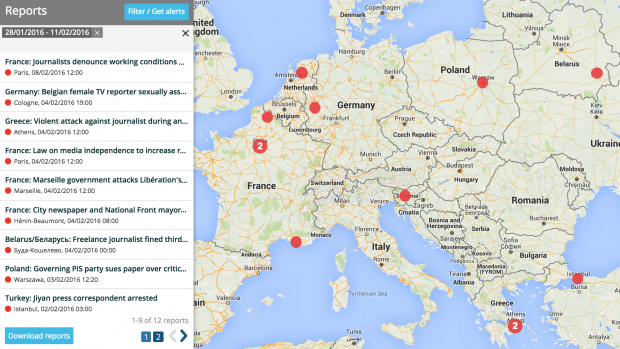
Click on the bubbles to view reports or double-click to zoom in on specific regions. The full site can be accessed at https://mappingmediafreedom.org/
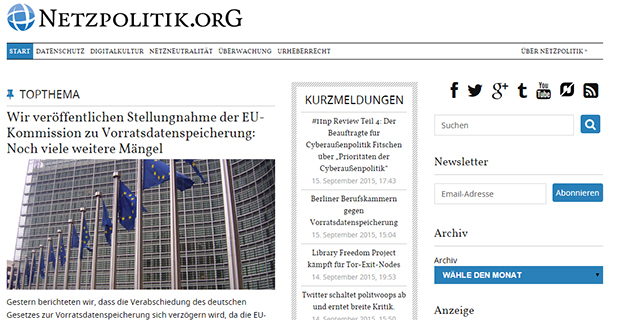
Over a month after the Berlin-based blog Netzpolitik.org was charged with treason for publishing leaked government documents, details are trickling out about the extent German authorities went to in order to build a case against the journalists running the website.
The German federal attorney general’s legal case turned out to be flimsy and ultimately collapsed on 10 August. Leading up to the decision to drop the case, public outrage soared over the treason accusation. Journalists associations jumped to the cause and a Berlin protest attracted thousands of supporters. Donations poured in to help the bloggers’ legal battle.
But before they gave up, authorities dug deep to try to scrape together evidence against Netzpolitik and its editors Markus Beckedahl and Andre Meister.
After weeks of delay the bloggers finally received partial information from their case files. The documents show that German state police obtained a nine-page file on the two Netzpolitik editors’ social security, private residence registrations and bank accounts.
Public broadcaster NDR wrote of the finance probe, “Obviously the authorities hoped by looking at the bank account documents they would be able to find a whistleblower who might have given the journalists documents from the Federal Office for the Protection of the Constitution [Verfassungsschutz].”
Netzpolitik was first informed about the treason investigation on 30 July 2015. The charge was raised after the blog published classified documents from the Verfassungsschutz, Germany’s domestic intelligence agency.
NDR reported this week that over a hundred of the agency’s employees had access to those documents.
Harald Range, the federal attorney general who launched the case, was forced into early retirement when the legal inquiry became a political scandal in August.
Since then, reports have come out suggesting top officials at the federal ministry of justice, the ministry of the interior, and even the chancellor’s office knew about the charges, as well as Verfassungsschutz chief Hans-Georg Maaßen. Government ministers have played dumb about the case in an attempt to shift blame onto the prosecutor’s shoddy execution.
“We want the responsible people to take responsibility,” Netzpolitik reporter Anna Biselli told Index on Censorship.
“For us it’s quite clear he [Range] would be fired because he was going to retire in half a year anyway,” she said.
The case against Netzpolitik marked a historic low for Germany, which ranked number 12 in Reporters without Borders’ 2015 World Press Freedom Index.
Hendrik Zörner, spokesperson for the German Journalists’ Association (DJV), said, “From the beginning we saw the risk that journalists would become intimidated by the investigation against Netzpolitik.org.” Zörner also acknowledged that its hard to determine whether there are now chilling effects for journalists in Germany.
Biselli told Index on Censorship that the website was propped up by a flow of support.
“We have a lot of offers for support even from some of the journalist unions, there are many people donating and others offering to look into legal things for us. So that is really positive,” Bisselli said.
The investigation of Netzpolitik is the first time German authorities have pursued a legal case against journalists since 1962, when the well known magazine Der Spiegel was charged with treason for publishing state secrets about the West German military. The magazine shut down temporarily while its founder Rudolf Augstein served 103 days in jail.
The case was dismissed by a federal court.
Spiegel later brought a complaint before Germany’s constitutional court in 1966. Even though the magazine’s complaint was rejected, the court issued a landmark decision that referred to the possible “healing” effects of journalism. Spiegel’s articles on the classified defence information, the court ruled, could “in the long term be more important for the welfare of the Federal Republic than confidentiality.”
“Scarily similar to the Netzpolitik.org case, the information leaked was actually not so new. Large parts of it had already been published before,” wrote Jeanette Hofmann, director of the Berlin-based Institut für Internet und Gesellschaft, in an op-ed last month for the website Internet Policy Review.
“A betrayal of state secrets requires by definition that there is a secret,” Hofmann wrote.
Considering the classified information at the heart of both the Spiegel and Netzpolitik investigations had already been reported, Hofmann argued, calling the documents “state secrets” was always a stretch.
Mapping Media Freedom
Click on the bubbles to view reports or double-click to zoom in on specific regions. The full site can be accessed at https://mappingmediafreedom.org/

 Mariana Cunha e Melo
  Ephraim Kenyanito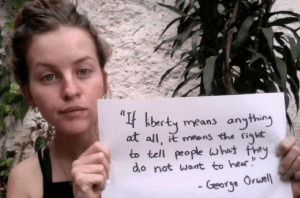
 Mark Crawford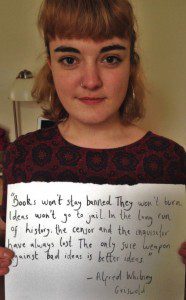
 Ian Morse