14 May 2014 | Middle East and North Africa, News, Yemen
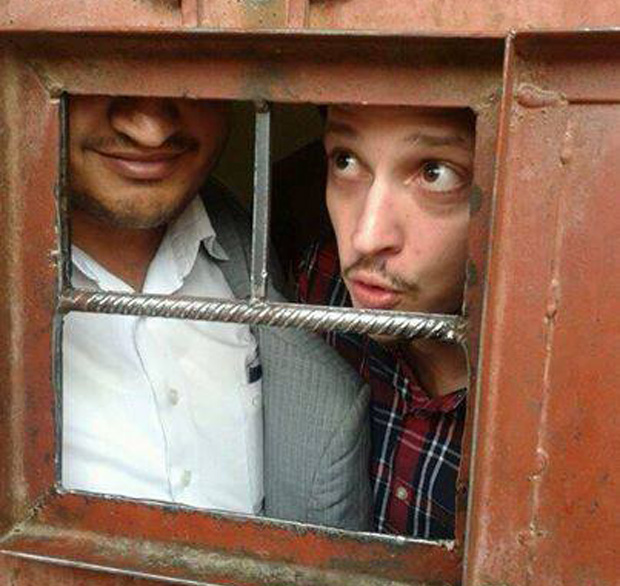
American journalist Adam Baron in jail. He was deported from Yemen last week. (Image: @almuslimi/Twitter)
Working in Yemen as a journalist can often feel like being an involuntary character in a clichéd Hollywood drama — a hybrid of a John le Carré novel and a Johnny English-style parody.
In over three and half years living in Yemen I’ve gone on the run from government agencies on four occasions. Looking back months later you either laugh or shake your head in despair at the surreal madness of it all.
One occasion involved a more than six-hour drive across part of rural Yemen popular for US drone strikes, with a local journalist alongside me. Exhausted and relieved, our successful getaway ended just before dawn.
Another was, in hindsight, rather more comical. As Yemen’s uprising intensified in April 2011, district security chief came knocking on the door in the middle of the night. He was looking for journalists and demanded copies of foreigners’ passports. It was a few weeks after soldiers had stormed the house of three foreign journalists who were then deported. The young, clandestine-revolutionary who guarded the apartment block where American journalist Jeb Boone and I were temporarily staying, managed to put the official off until the next day.
Under the cover of darkness we each packed a small rucksack of essentials: cameras, notebooks, and a change of clothes, while planning our escape to a friend’s house which had been left empty following the evacuation of the majority of the ex-pat community due to deteriorating security in Sana’a. As we made our furtive escape, creeping out of the gate in the early hours of the morning we walked straight into a truck full of soldiers parked outside the next-door neighbour’s gate. George Smiley wept.
The third almost ended in disaster. After writing a piece in January last year for The Times on Saudi Arabia’s involvement in America’s covert war in Yemen, on advice, I once again temporarily relocated in Sana’a amid fear of reprisals for my reporting. A couple of weeks after returning to my Old City home the taxi I was travelling in was ambushed outside the Ministry of Defence. A bullet smashed through the window next to my head, hissed through the hair of my driver but miraculously left both of us unharmed. Since then I have probably become the only woman in the world to convert their United Nude shoe bag into a gunshot trauma kit which I’ve since carried with me at all times.
But, as foreign journalists we have little if anything to fear. The worst that’s likely to happen to us, as American journalist Adam Baron found out during his deportation last week, is a 10-hour spell in jail wondering if we’re going to be given a few minutes to pack before being kicked out of the country we call home, without the possibility to return.
While we — the handful of foreign journalists based in Yemen — might have anxious moments once or twice a year, our Yemeni colleagues are constantly under threat. Yemen remains amongst the bottom 15 countries out of 180 in the world for press freedom. A Human Rights Watch report last September concluded that freedom of expression since President Abd-Rabbu Mansour Hadi took power in February 2012 has increased, but along with it, intimidation and violence against journalists has also risen. Yemen’s Freedom Foundation recorded 282 attacks and threats against journalists and media workers in 2013.
While Adam waited anxiously in jail last Tuesday, passport and phone confiscated, unease spread. Officials indicated that “other foreign journalists were next” my name was also mentioned. Not knowing if they’re coming to get you today, tomorrow, or at all, means that despite the relatively benign consequences, you are gripped with an almost unbearable sense of apprehension. Preparing for the worst I informed my editor at The Times in London and started to pack.
Three days later, still waiting, the madness felt like it was closing in. As the sunset over Sana’a on Friday evening one friend called to tell of gunfire and explosions next to his house. Meanwhile I sat in the protective darkness of my stairwell whispering into my phone as I heard the distant voices of two men banging on my front gate. Was this it? Was this the moment I would be forced to leave? My phone — on silent in case it was heard by those outside — lit up. Another friend had just narrowly avoided driving straight into a running gun battle in the south of the city. I tiptoed down the stairs in the dark and silently slid the two deadbolts across the large wooden door of the ancient Yemeni tower-house that is my home.
The irony is that while the ex-pat community goes into week two of lockdown in Sana’a and Western embassies close to the public due the increasing threat from al-Qaeda attacks, the most persistent threat to journalists on a daily basis is from the government and its intelligence agencies, not so-called militants.
After Adam was deported last week, for the first time, I decided not to run as I have too many times in the past. Without stopping and challenging what the government has done means the persecution of journalists will continue unabated.
There are just a small handful of foreign reporters based full-time in Yemen. Adam and I were the only ones accredited in a country where the government makes it almost impossible to live permanently as a foreign journalist with the correct paper work. Deporting unregistered journalists means no complaints can be made when individuals are thrown out.
As a legally operating reporter I had firm ground to stand on to support Adam and raise questions about why the government has chosen this moment to target him, and possibly me. Was this a personal vendetta against him? Or, was this a concerted effort by the state to remove witnesses? Those who may witness the consequences of a US-backed war currently being waged in the most significant military crackdown against al-Qaeda every carried out in Yemen.
The answers to those questions were partly answered by the manager of immigration who pulled me aside at Sana’a airport on Monday morning when I chose to leave Yemen of my own accord. I realised I’d had enough of the constant cycle of farcical drama, instigated by the state, that comes with living as a journalist in Yemen over three and a half years. I wanted it to stop. To take back control.
Despite the fact that my journalist visa is valid until February 2015, the immigration official began with “you can’t come back…” and ended with “it’s OK, you are allowed to leave now”. For the latter at least I was grateful.
The foreign media may not be welcome in Yemen, but if they are quietly trying to remove us then the greatest threat to be faced will be to domestic reporters. Over a snack of traditional sweet kataif pancakes and chilled apricot juice on my last day in Sana’a on Sunday, I sat with a Yemeni friend and fellow journalist. He acknowledge the need to step back from the madness. “The national security, they get to you,” he said tapping a finger against the side of his head. “You need to go home for some quiet time,” he added. “I got my quiet time…in prison.”
This article was posted on May 14, 2014 at indexoncensorship.org
10 Mar 2014 | Awards, News, Yemen

Yemeni journalist Abdulelah Haider Shaye has produced critical investigative reports on the US military’s activities in Yemen, including drone attacks. He also accessed and interviewed members of Al-Qeada. For this he was smeared as an Al-Qaeda supporter, and held in a Yemeni jail for three years at the request of the American government.
No evidence has ever been produced by either the US or Yemeni Government to support the claim that Shaye was facilitating Al-Qaeda attacks. Shaye indicated the real reason behind his detention was his reporting on US strikes and specifically the deaths of civilians including 14 women and 21 children killed in a sea-launched cruise missile strike on the village of al-Majala in December 2009. Leaked diplomatic cables released shortly after after the conclusion of his trial confirmed Sahye’s accusations that the US had indeed carried out the al-Majala bombing.
Sentenced in January 2011 to five years in prison for allegedly being a “media man for al-Qaeda’, Shaye should have walked free a month later following a presidential pardon. However, the American government stepped in and his release was continuously delayed – once after Barack Obama personally expressed concerns about his scheduled release in a phone conversation with then-president Ali Abdullah-Saleh.
In addition to his arrest, Shaye has been attacked by regime forces. In 2010 he was abducted by Political Security Organisation [PSO] gunmen, and beaten and threatened before being released. His house was also raided by Yemen’s elite US-trained and funded counter terrorism troops and he was allegedly again beaten and tortured during 34 days in solitary confinement, with no access to a lawyer or family members.
Shaye was released from prison in July 2013, to serve the rest of his sentence under house arrest. He has remained steadfast in his commitment to journalism and free speech throughout his imprisonment.
Nominees: Advocacy | Arts | Digital Activism | Journalism
Join us 20 March 2014 at the Barbican Centre for the Freedom of Expression Awards
This article was posted on March 10, 2014 at indexoncensorship.org
21 Feb 2014 | News
To: All Governments
From: Index on Censorship
Index on Censorship here. We’ve noticed some you have had trouble telling the difference between terrorists and journalist lately (yes, you too Barack: put the BlackBerry down). So we thought as people with some experience of the journalism thing, we could offer you a few handy tips to refer to the next time you find yourself asking: journalist or terrorist?
Have a look at your suspect. Is he carrying a) a notebook with weird squiggly lines on it, or b) an RPG-7. If the latter, odds on he’s a terrorist. The former? Most likely a journalist. Those squiggly lines are called “shorthand” – it’s what reporters do when they’re writing things down for, er, reporting. It might look a bit like Arabic, but it’s not, and even if it was, that wouldn’t be a good enough reason to lock the guy up.
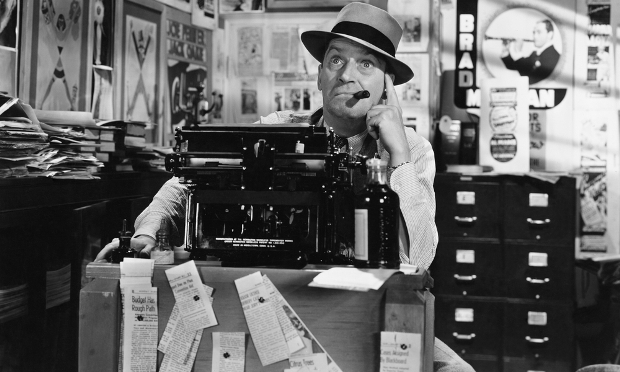
A journalist
Still not clear? Let’s move on to the questioning part.
Questioning can be difficult. Your modern terrorist will be highly committed, and trained to withstand even your steeliest glare (and whatever other tactics you might use, eh? LOL! Winky Smiley!). So it may be difficult to establish for certain whether he or she is in fact a terrorist by simply asking them. They might even say they are a journalist, when actually they are terrorists! Sneaky! But there are some ways of getting past this deviousness.
Does your suspect have strong feelings about unpaid internships and their effect on the industry? Or “paywalls” and profit models? Your journalist will pounce on these question in a way that may be quite scary to watch, and keep you there talking about it long after you’ve told her she’s free to go. Your terrorist is not as bothered by these issues, generally, though may accept that it is very difficult for kids to get on the terror ladder these days and nepotism is not an ideal way to run a global bombing campaign.
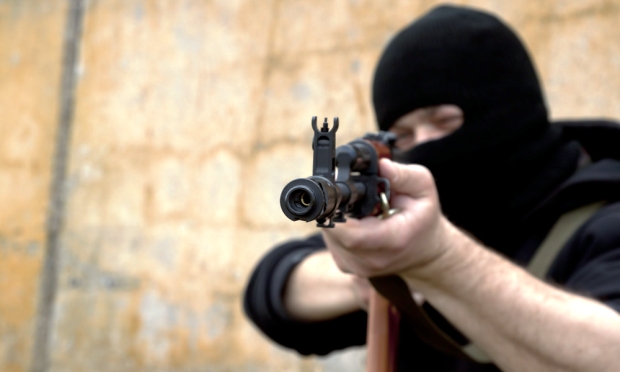
A terrorist
Ask your suspect if he spends too much time on Twitter: If he gets defensive and says something along the lines of “Yes, but the fact is it’s justified. Stories break on Twitter. It’s not just all hashtag games and…” (again, this could go on for several hours, and will most likely end up being all about hashtag games), then he’s a journalist. [Note: If your suspects seem to spend a lot of time getting into Twitter spats with the Israel Defence Force, they may be a bit terroristy].
Does your suspect look stressed? Like, really, really stressed? Probably a journalist.
Finally, just try saying the phrase “below the line”. If you get a slightly confused look, you’ve probably got a terrorist. If there is actual wailing and gnashing of teeth, journalist.
Now let’s go over why you might be making this mix up. This is where a lot of people get confused, so we’ll be as clear as possible, but do keep up.
Terrorists generally hold quite extreme views which, it’s fair to say, most of us probably do not agree with. However, this does not mean that anyone you disagree with is a terrorist. Or, importantly, that someone who’s spoke to someone who you disagree with is a terrorist.
We understand that this can be quite a difficult point to get your head around, so here’s an example: If, say, a large, international news organisation reports on things you’d rather they didn’t, in a way you don’t like, this does NOT make them a “terrorist organisation”. The people working for them are NOT terrorists “broadcasting false news that harms national security”.
Sometimes, journalists will cover the activities of terrorist organisations, like al-Qaeda. This, however, does not automatically make them their “media man”. Get this — you can even interview members of a terrorist organisation without actually being a terrorist yourself.
Similarly, if someone has something that you want back, that doesn’t mean you get to use terrorism laws to get it, even if you think that thing is very, very important. And yes, even if they intend to use that thing to write stories about you.
Keep these basic ideas in mind and we can almost guarantee you’ll never make the embarrassing mistake of calling journalists terrorists again. Any doubts? Call us. We’re here to help.
The Index team
This article was posted on 21 February 2014 at indexoncensorship.org
24 Jul 2013 | News, Politics and Society, Yemen
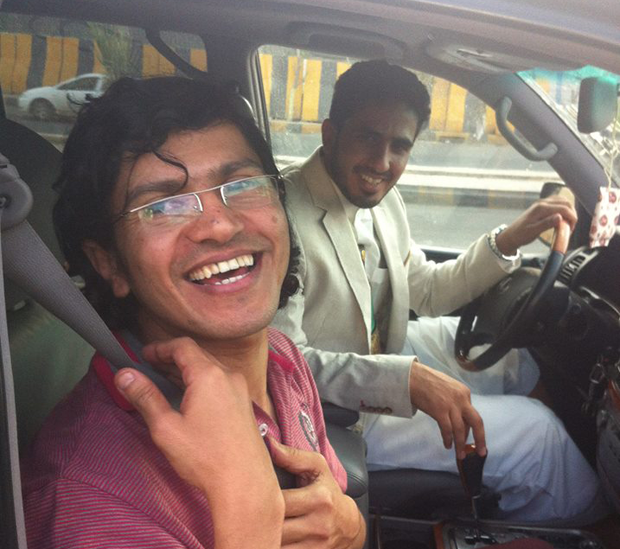
A picture of the journalist, smiling broadly as he left the capital’s Political Security Prison, quickly circulated online following his release, having served half of his five-year prison sentence handed down in January 2011.
Shaye’s reprieve was hailed late on Tuesday “as a victory for common values of media freedom, justice and human rights,” in a statement by Yemeni press freedom organisation, Freedom Foundation, which has campaigned for his release.
The first indications of a possible discharge came in May – after more than 2.5 years in solitary confinement – an order was made by President Hadi for Shaye to be released “soon”. But, it was not the first time a Yemeni president had attempted to free him. Days after being sentenced in 2011, Ali Abdullah Saleh – Yemen’s president of 33 years – issued a pardon for his release. However, due to direct intervention by Barak Obama, Shaye remained in jail. As a result his family were very sceptical that this most recent pledge would be fulfilled.
Ten days after reports of Hadi’s order, a note from Shaye was smuggled out of the prison.
“The only person responsible for kidnapping and detaining me is Obama,” read the letter. “I’m eagerly longing to see my mother and family. Still, I have not forgotten my loyal colleagues and friends. Everything you do for my sake makes my solitary confinement tolerable.”
The holy-month of Ramadan is used annually as a period of amnesty and this week local reports suggested Shaye might be released on the 17th day [July 26] of the religious month of daylight fasting. But similarly, the US has previously stepped in to prevent such pardons in Yemen. In 2004, the release of 28 prisoners during Ramadan was blocked because of ‘objections by the US government.’
Shaye’s eventual release appears to have come as the Freedom Foundation suggested “despite all the American pressures on him [President Hadi] to keep Shaye in prison.” In a recent meeting with local journalists US Ambassador to Yemen, Gerald Feierstein reinforced the US government’s position saying: “Shaye should be kept in prison.”
Shaye was arrested in August 2010 following his outspoken criticism of the Yemeni government and his reporting of a cruise missile attack on a suspected al-Qaeda training camp in al-Majala, southern Yemen, in December 2009 that left 55 dead, including 21 children. After visiting the bomb site and collecting evidence, Shaye reported that the killings were caused by cluster munitions and had been carried out by the United States, not the Yemeni government who claimed responsibility at the time.
In 2010 Shaye was found guilty of assisting al-Qaeda by the Special Criminal Court for Security Affairs, a court seen as illegal by international human rights organisations. He refused to recognise the legitimacy of proceedings, turning down legal representation he was given only a few minutes to defend himself. Shaye was later sentenced in January 2011 to five years in prison for his links to al-Qaeda – Shaye had specialised in reporting on the Yemeni off-shoot Al-Qaeda in the Arabian Peninsula. His reporting on the al-Majalah bombing was later – after the conclusion of his trial – corroborated by leaked US diplomatic cables.
The conditions of his release as part of his original sentence will be upheld, according to the state news agency [also Shaye’s former employer] Saba News: He will not be allowed to leave the capital, Sana’a for two years.

