14 Nov 2023 | Belarus, Lukashenko letters, News
It is important the international community pays close attention to the scale of politically motivated persecutions in Belarus, a panel discussion organised by the media organisation Radio Free Europe/Radio Liberty recently said.
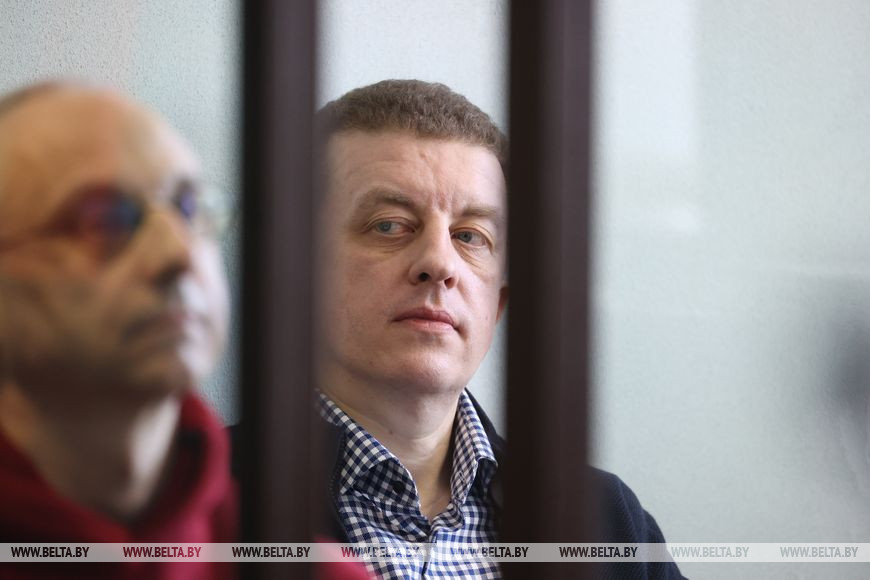
It was after Zmitser Dashkevich, a well-known Belarusian activist originally charged with extremism, had his sentence extended by a year after being charged with “blatantly disobeying penitentiary guards“. His sentenced was due to end in July. Journalist Andrei Aliaksandrau, a former employee of Index, recently spent his 1000th night behind bars after being imprisoned for 14 years in October 2022 for “extremist activities” against the state.
Anastasiia Kruope, assistant researcher for the Europe and Central Asia Division of Human Rights Watch, said there has been a large increase in human rights abuses and politically motivated persecutions in Belarus following Aleksandr Lukashenka’s heavily contested presidential election win in 2020.
“An atmosphere of fear and intimidation for journalists and human rights defenders was created,” she added.
“The way these people are treated in prisons and labelled extremist, along with the silencing of family members outside, means some of these cases may amount to crimes against humanity according to the UN.”
Aleh Hruzdzilovich was one such prisoner. A journalist for Radio Free Europe/Radio Liberty, he spent nine months in prison and was released in September 2022. After covering the protests following Lukaskenka’s re-election for his job, he was arrested and charged with actively taking part in them.
“From the very first day, people like me recorded as extremists are punished more and have a stigma in prison,” Hruzdzilovich explained.
“It means we’re put in punishment cells and solitary confinement more often. When I was tortured, I was told to sleep on the wooden floor. If I simply sat down or stopped walking around the cell in the daytime, I was reported and given more time in the punishment cell.”
Hruzdzilovich described seeing a prisoner wet himself through fear of being sent to a punishment cell.
Pavel Sapelko is a lawyer based at the Viasna Human Rights Centre in Minsk, Belarus. He said there is an absolute power of prison authorities over prisoners in Belarus, which is affecting their human rights, and seemingly makes people “disappear”.
“The prisoners are simply incommunicado. The authorities can shut down visits and calls from families, and even then can only get help from a lawyer after their sentences are passed by law.”
Speaking of the legal system in Belarus, Sapelko described the debilitating change that has occurred over the past three years.
“We’ve lost more than 300 defence lawyers, with 100 of them being disbarred. Licences have been revoked, and six defence lawyers are actually behind bars, now prison inmates themselves,” he explained.
“This massively affects a lawyer willing to take on your case, especially for those charged with being extremists.”
Ending with another reason why the international community should support those journalists and human rights defenders still in Belarus with things such as legal help and visas, Kruope had one eye on the future.
“They have the connections to document these abuses. The powerful tool we have is accountability, and it may take many years for abusers to face justice. We can focus on preserving the evidence against these abuses and document them for the future.”
Please read about Letters from Lukashenka’s Prisoners here, which is a collaborative project by Index on Censorship in partnership with Belarus Free Theatre, Human Rights House Foundation and Politzek.me.
27 Jan 2023 | Belarus, FEATURED: Mark Frary, News
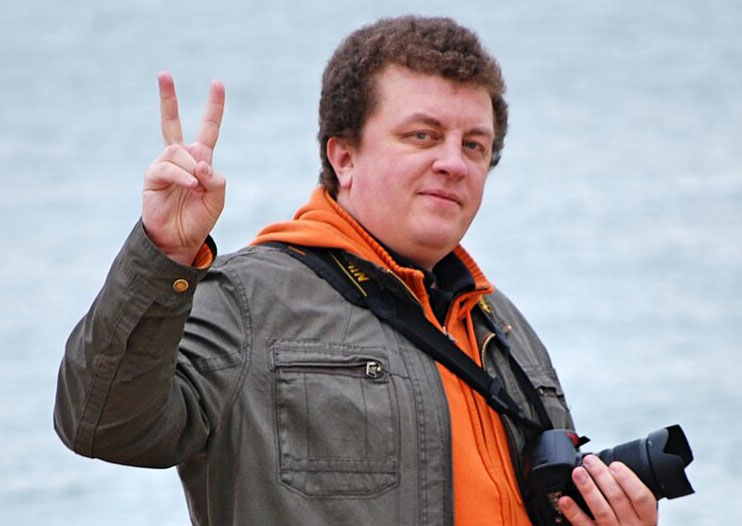
Today marks the 45th birthday of our former Index colleague Andrei Aliaksandrau. Sadly, he will not be spending it with his family, opening presents and eating cake. Instead he is in prison, serving a 14-year prison sentence handed down by the Minsk Regional Court for “grossly violating public order”, “creation of an extremist formation” and, most severely of all, “high treason”. Of course, when you are in an authoritarian regime, such charges mean nothing.
Andrei has been in the SIZO-2 pre-detention centre in Vitsebsk for just over two years now. Vitsebsk, in north-eastern Belarus is the birthplace of artist Marc Chagall. Now it is becoming better known for holding political prisoners.
A British detainee who was held in the same centre said conditions were “disastrous”. Travel agent Alan Smith was held in a cell measuring four metres by two with five other prisoners: his alleged crime - helping Iraqis illegally enter Belarus.
“Windows were closed, [there was] no ventilation, people smoke there [and] the toilet is open,” he told the independent media channel Charter 97. He added that there were informants in every cell and they were monitored with cameras and microphones and warned not to talk about “business matters” i.e. why they were in detention.
Andrei’s father visited him in Vitsebsk just over two weeks ago. He told friends, "I was met by a gaunt-looking Andrei, with very short hair, but full of energy.” Despite everything, his father said he was in “a good moral and psychological condition”.

Andrei's wife, Irina Zlobina, was previously a florist
Andrei was not even allowed to leave the detention centre to marry his fiancee Irina Zlobina last September.
Irina is a graduate of the faculty of philosophy and social sciences of the Belarusian State University and in recent years had been running her own small business of selling flowers and souvenirs. She was arrested and tried at the same time as Andrei and was sentenced to nine years in prison, again for “grossly violating public order” and “high treason”.
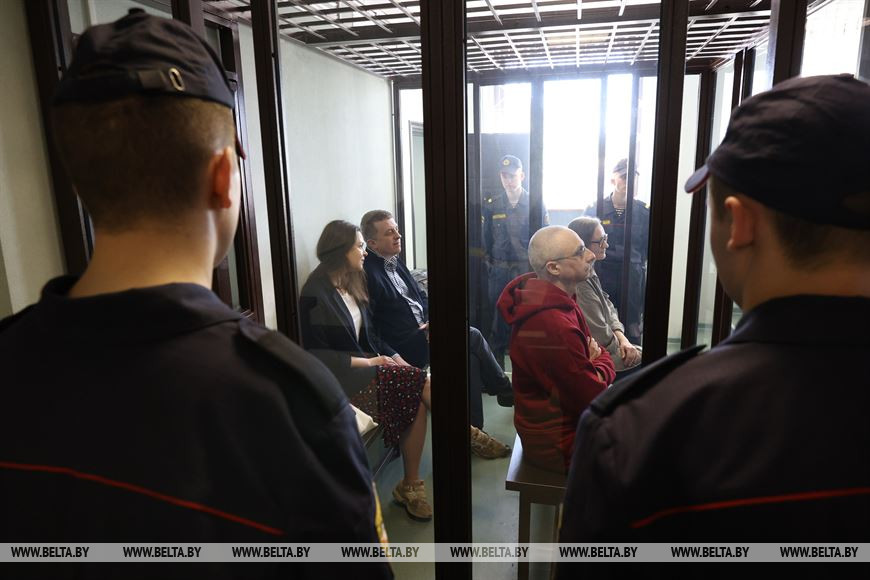
The only time the couple have seen each other since they were arrested is at their trial, in the so-called BelaPAN case, alongside the former news agency’s editor-in-chief and director Irina Levshina, who got four years in prison, and former director of the agency Dmitry Novozhilov, who got six years.
Before the trial, Irina was at a pre-detention centre in Homel in south-eastern Belarus; she has now been moved to a penal colony in the city.
Now Andrei is also on the move and he has been taken on a 115-kilometre journey to penal colony no.1 in Navapolack where he will serve out the rest of his sentence.
We asked some of Andrei’s friends for their birthday wishes for him, even though he may never see their thoughts and comments.
Joanna Szymanska, senior programme officer at ARTICLE 19, where Andrei also worked while he was in the UK, says wistfully, “It's another birthday that Andrei will spend behind bars.”
“I have lots of good memories related to Andrei, he's always been the life of the party. I especially miss our long discussions about Depeche Mode, we're both huge fans and Andrei has a great voice, I can still hear him singing his favourite songs,” she says.
“I sometimes wonder, does he still sing them? I haven't received a letter from him in a long time, many letters are not delivered to political prisoners, especially if they are sent from abroad. But I'm sure Andrei stays strong and he knows the world hasn't forgotten. Andrei, your friends are with you.”
Andrei Bastunets, chair of the Belarusian Association of Journalists (BAJ), says he met Andrei in the early 2000s: “We were united by many things: football, poetry and, of course, journalism. No, not ‘were united’, but ‘are united’. Even though he's in prison and I'm abroad. We are united despite the fact that, it seems, my letters to Andrei do not reach him. Prison censors don't let them through to political prisoners. I don't think he'll get my birthday greetings now. And not only mine, but a lot of birthday greetings. He has a lot of friends and he has been and remains a good friend - witty, charismatic, courageous.”
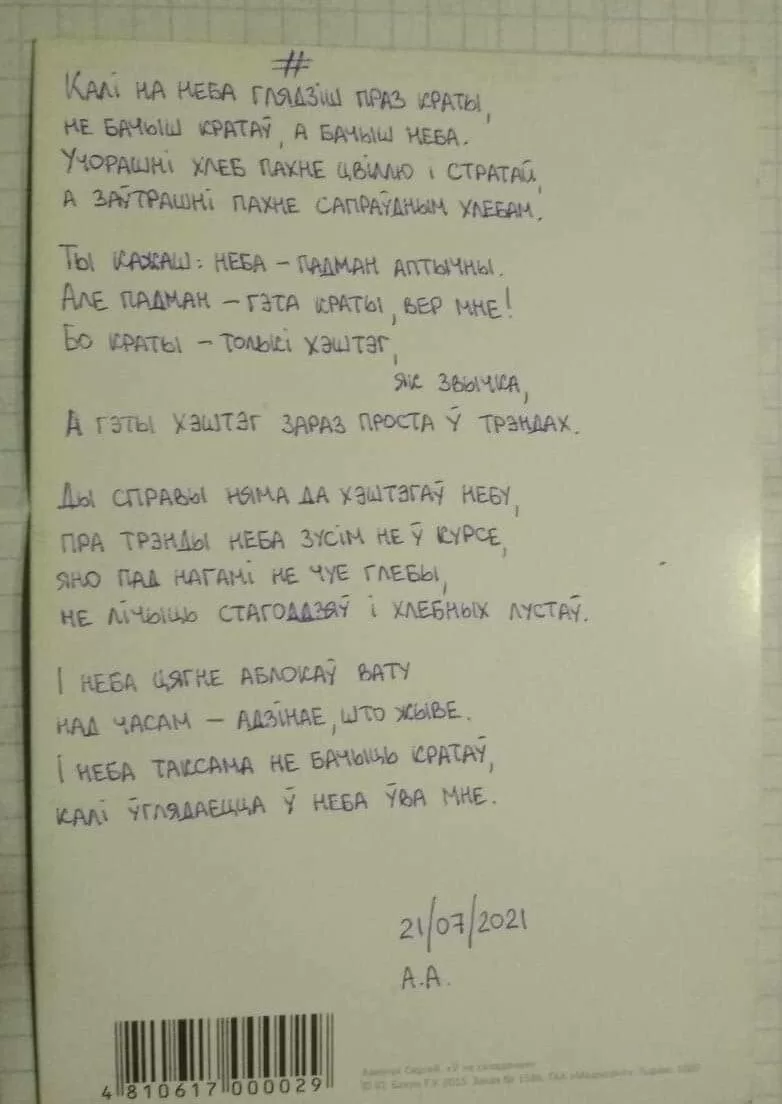
He says, “Once, back in the days when letters to political prisoners and their responses were still reaching their recipients, he wrote to me: ‘I now 'listen' to my friends' letters, guessing vibes and intonations - a personal 'radio'. My own Radio Liberty. My personal 'free speech'. Thanks for that to everyone who writes to me. We all are one big independent media outlet now. A blog of those who refuse to despair."
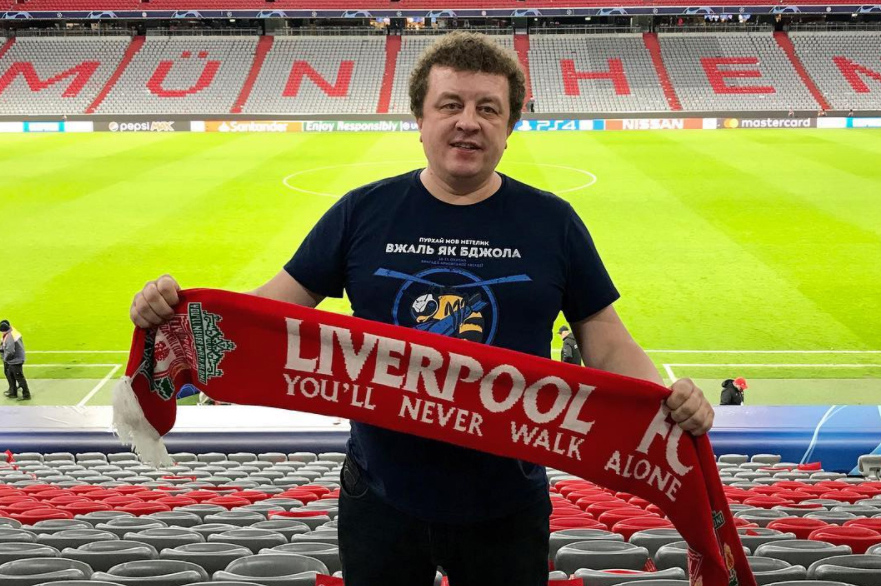
“In another letter - this time about football (although we follow different teams) – he wrote: ‘Somehow there was a reason to mumble the Liverpool’s anthem, You'll Never Walk Alone. Supportive words from the letters made me ‘sing it’, playing it on my internal radio, drowning out the external Russkoye Radio. It got to the point where I caught myself thrumming the club anthem in Belarusian. It came out a bit pathetic - but it's an anthem, just my translation (don't shoot the pianist). But somehow it seemed somehow in tune with, I don't know, with the moment, the feeling, the mood.”
Even if you may not get to read this Andrei, you'll never walk alone.
What can Index readers do? Please join our joint campaign with ARTICLE19, share the message and sign the petition. You can also befriend Andrei and Irina via our partners at Politzek.
12 Jan 2023 | Belarus, News, Statements
On 12 January 2021, our former colleague Andrei Aliaksandrau and his wife, Irina Zlobina were unlawfully detained and imprisoned. After spending over 620 days behind bars for their human rights work they were unjustly sentenced in October 2022. Today, two years on from their unlawful detention and imprisonment, Index on Censorship and ARTICLE 19 renew our call for the baseless charges against two human rights defenders to be dropped. Andrei, Irina and all political prisoners currently in jail for calling for democracy in Belarus must be released unconditionally and without further delay.
Andrei and Irina were detained on 12 January 2021 for allegedly paying fines and covering detention costs for those apprehended during a democracy protest in Minsk. They were initially charged with the ‘organisation and preparation of actions, grossly violating public order, or active participation in them’, as well as ‘funding and other material support for such activities’. Subsequently, Andrei was also charged with ‘high treason’. On 6 October 2022, the Minsk Regional Court sentenced Andrei to 14 years in prison and Irina to 9 years.
Index on Censorship and ARTICLE 19 have argued that bogus charges against Andrei and Irina are retaliatory and politically motivated. This case represents an escalation in Belarus’ sweeping crackdown on press freedom and human rights activism. On 12 January 2022, to mark the grim one-year anniversary of their detention, Index on Censorship and ARTICLE 19 launched a solidarity campaign for Andrei and Irina calling for their release. That campaign continues today.
"Andrei and Irina were detained two years ago for challenging a repressive government in Belarus. The ludicrous sentences handed down to them late last year demonstrate both the fragility of Lukashenka’s regime and the power of Andrei and Irina as human rights defenders. That they are still in prison is a damning indictment of the regime that has targeted democracy and free expression and we will continue to demand their release. Only when Belarus’s prisons are empty of all political prisoners can we hope for a better future for human rights in Belarus," said Ruth Anderson, CEO, Index on Censorship.
"Andrei has dedicated his life to human rights and journalistic work, which, in particular, included bringing to international attention Belarusians’ plight for freedom. He loves Belarus and always believed its place is among free democratic countries. Now, he is set to spend 14 years in a penal colony as a reprisal for his vital work. This severe sentence demonstrates that Lukashenko will not stop at anything in his pursuit to completely dismantle civil society and crush freedom of expression. As an international community, we have a duty to stand in solidarity with Belarusians and strongly demand their fundamental rights to be respected," said Joanna Szymanska, senior programme officer at ARTICLE 19.
Judicial harassment against journalists and activists has become one of the most notorious weapons in a vast arsenal deployed by the Lukashenka regime to further stifle dissent and strengthen his autocratic ruling. Belarus’ courts are entirely without independence and under the control of Lukashenka. They hold sham trials to justify his unrelenting attack on any remaining opposition. According to the human rights centre Viasna, as of 12 January 2023, there are 1440 political prisoners in Belarus.
We call for the end of the judicial harassment against Andrei, Irina, and all other courageous Belarusians who are viciously persecuted for their human rights work in the country and for the release of all political prisoners. The Belarusian regime must cease bringing trumped-up charges against its critics – a blatant violation of human rights law and international conventions, to which Belarus is a party. Index on Censorship and ARTICLE 19 will continue to extend unwavering support to the Belarusian community and its fight for freedom and democracy.