23 Jun 2014 | Belarus, News
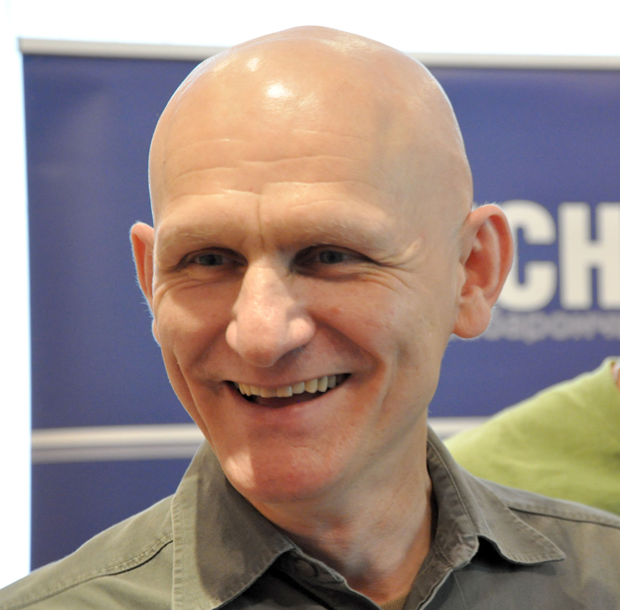
Ales Bialiatski was released from detention. (Photo: Andrei Aliaksandrau for Index on Censorship)
Ales Bialiatski, a Belarusian human rights defender, was released from prison on Saturday after almost three years behind bars on politically motivated charges.
“My release came as a surprise. I was not expecting anything like that. There was a usual routine check in the morning and they took me to work with other prisoners. But around 9 a.m. I was summoned to the prison director’s office, where they told me I am being released due to an amnesty,” Bialiatski said during the press conference in Minsk today.
Bialiatski, the chair of the Human Rights Centre Viasna and a vice president of the International Federation for Human Rights (FIDH), was arrested on 11 August 2011 in Minsk and later sentenced to 4.5 years in prison for alleged tax evasion. He did not admit guilt and stated the funds in his bank accounts abroad were in fact spent for activities of Viasna and supporting victims of human rights abuses in Belarus.
“I am not sorry for those three years I spent in prison. This is the price you pay for making Belarus a free and democratic country. If we want to improve our life and drag Belarus out of the swamp it has been in for 20 years already, we need to be active and not to be afraid of repressions civil society faces. I knew what I was in prison for, that is why it was easy for me emotionally,” Bialiatski said.
In fact, it was not always easy. “Political prisoners in Belarusian jails are kept in different conditions than other prisoners. For instance, no one was allowed to talk to me, even if it was a friendly chat about weather or football, a person who approached me could be punished by the prison authorities. That was just one of many examples of physiological pressure political prisoners face in jail,” he said, describing his time behind bars.
He symbolically crossed his name out of the list of Belarusian political prisoners on a campaigning T-shirt his colleagues wore while he was in jail.
“So, Bialiatski is out, but seven more are still there. Belarus has to become a country without political prisoners. I demand from the authorities to release all political prisoners and stop prosecuting people for their political views,” Bialiatski said.
Bialiatski expressed his gratitude to “tens of thousands of people” from Belarus and around the world who supported him during his time in prison and campaigned for his release. Bialiatski also said he is not going to leave the country and he is determined to continue his human rights work.
There will certainly be ground for that as Belarus continues to have a poor human rights record. Most commentators inside the country do not see Bialiatski’s release as a sign of any genuine improvement of the human rights situation, but merely a step of “good will” that can ensure possible renewal of a dialogue with the European Union.
“The EU is clearly looking for ways and platforms for a dialogue with Belarus. Europe certainly wants to decrease tensions in the region and stabilize the situation that was created because of Ukraine and its conflict with Russia. And it can be strategically important for the EU not to allow Belarus turn completely pro-Russian. The problem is the authorities of the country refuse to talk to the Belarusian civil society, and what we have started seeing is the West is ready to give in to the government of Belarus and ‘sacrifice’ participation of active NGOs in a possible dialogue. This will be a huge mistake. Lukashenko is going to deceive Europe once again, and we can see another clampdown on civil society of the country after the presidential elections of 2015,” Uladzimir Matskevich, a Belarusian methodologist and analyst, says.
“I am really happy Ales is out of prison – but I can hardly say he is ‘free’. We are all not free here. Bialiatski’s release is certainly great, but it does not signal any change. The authorities keep tight control over society. Dictators act this way; they need to show they are capable of strict punishment and mercy; they need to show acts of both time to time to manifest they are in charge. This is perhaps what we see with Ales’ release. The opposition is still too weak and disengaged to break through this vicious circle,” Matskevich said.
This article was published on June 23, 2014 at indexoncensorship.org
27 May 2014 | News, Politics and Society, Ukraine
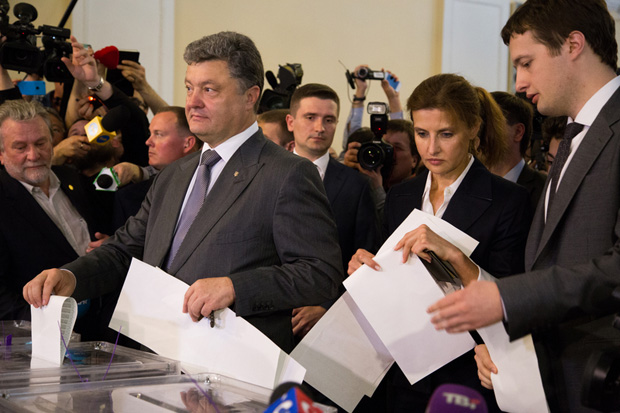
Petro Poroshenko at a polling station (Photo: Oleksandr Ratushniak/Demotix)
Petro Poroshenko has won the Ukrainian presidential election in the first round, as preliminary results and exit polls show he received over 50% of votes. A billionaire, sometimes dubbed “the Chocolate Oligarch” (his main asset is Roshen, the largest confectionery manufacturer in Ukraine) gained his popularity during the Euromaidan protests in November 2013 – February 2014. Many in Ukraine consider Poroshenko to be a controversial figure as the head of the country; he represents a revolutionary, pro-European, but still old, oligarch-driven elite, and a system the Euromaidan protests were aimed against. Yet, the huge support he received shows Ukrainians are tired of the period of uncertainty, and united to give their country a new legitimate leader who can deal with unrest in the south-east regions, where pro-Russian militants continue their attempts to destabilise the situation.
Poroshenko’s first-round victory is a sign of national agreement, but is hardly a final remedy for all the problems Ukraine faces, both externally — like the military threat from Russia, including the occupation of Crimea — and internally. The latter applies not only to economic difficulties, but also to the necessity of extensive reforms that deal with the whole system of interrelations between the state and the society, ensuring real rule of law and putting end to corruption and human rights abuses.
Events in Ukraine over the last six months have made the country one of the most dangerous places for journalists in the world. According to the Institute of Mass Information, there have been 218 cases of physical attacks against reporters in Ukraine in 2014. Viacheslav Veremiy, a reporter for Ukrainian Vesti newspaper, was shot during events on Maidan on 19 February. Vasily Sergiyenko, a journalist and a civic activist, was tortured and then killed in Cherkassy in April. The death toll continued to rise even on the eve of the election, as Andrea Rocchelli, an Italian photo reporter, and his interpreter Andrei Mironov, a Russian human rights activist and a Soviet-era political prisoner, were killed on 24 May near Slovyansk, in the Donetsk region.
“It is still difficult to say if the free speech situation will improve after the election, especially in the east of Ukraine. It will depend on effectiveness of work of the new president and development of relations with Russia,” Tetiana Pechonchyk, the head of the Human Rights Information Centre, told Index on Censorship.
But it is not only the areas of military conflict that are dangerous for journalists. Sergiyenko’s murder and the case of Evgen Polozhiy, the editor of Panirama newspaper from Sumy, who was severely beaten, show reporters’ work is becoming increasingly risky business in Ukraine.
“There were quite a number of journalistic investigations before the Euromaidan, but they led to no official reaction or criminal cases about corruption revealed. Now that the society has changed, corrupt officials and criminals are especially afraid of critical reporting as they can lose their positions or even go to prison; they choose different methods to silence investigative journalists,” Pechonchyk says.
Another important aspect of a media reality around events in Ukraine is the massive information war, launched by Russia. The aim is to show a distorted picture of a modern Ukraine as a state where right-wing extremists and “fascists” seized power, in spite of the fact that the leader of the notorious “Right Sector” organisation got less than 1% of votes during the presidential election. They also aim at perplexing the foreign audience by mixing the terms “Russian-speaking” and “Russian”, for instance to justify invasion of Crimea or actions of pro-Russian militants in Donetsk region.
“That’s what you expect Russia to do — blow the country over with lots of stereotypes, lies and myths. Unfortunately, the Ukrainian government lost this information war. But what is great is that civil society, bloggers, ordinary young people on Facebook confronted Putin’s lies with their activity and creativity, with websites that disprove Russian TV channels’ propaganda or fake news,” says Michael Andersen, a journalist who made a documentary for Al Jazeera about typical stereotypes around Ukraine and Ukrainians.
The latter still have a long way to go to ensure the Maidan changes a lot more than just the name of the president and the faces of the governmental officials. Civil society and the media have a vital role to play on this path to future reforms.
This article was published on May 27, 2014 at indexoncensorship.org
8 May 2014 | Belarus, News
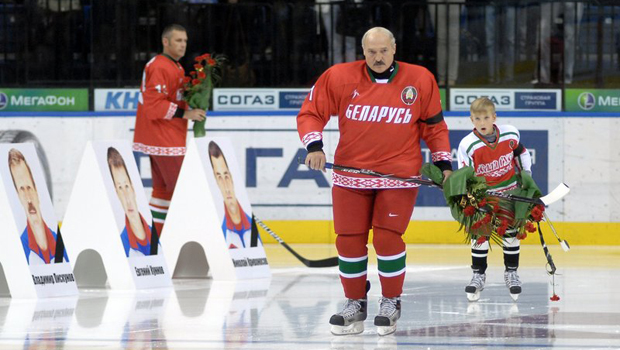
(Photo: Ivan Uralsky / Demotix)
Authorities in Belarus have been targeting human rights activists ahead of this weekend’s start of the International Ice Hockey Federation’s world championship in Minsk.
At least 17 political and civic activists were detained between 26 April and 6 May to prevent the organising of protests during the championship, which begins on 9 May. Another five are either in detention or being sought for questioning by police. All have been accused of minor hooliganism and sentenced to administrative detention of up to 25 days.
Such “preventive arrests” are common in Belarus. One of the activists, Pavel Vinahradau, who is known for his numerous detentions, opted to leave Minsk until the end of the championship. He had previously been summoned by the police: “They made it clear that either I go to Berezino (a small town 100 km outside Minsk) till 3 June, or I go to Akrestsina (a detention centre in Minsk). I choose Berezino,” Vinahradau wrote on Facebook.
A website called Totalitizator asks its visitors make predictions about which activists will be detained next, for how many days and on what charges. For people who follow political news in Belarus it is not difficult to make a choice.
Potential foreign “troublemakers” are also being kept away from the tournament. On Wednesday, Martin Uggla, a human rights activist from Sweden, was denied entry to Belarus when he was detained at Minsk-2 National Airport. According to temporary visa-free travel requirements, hockey supporters with valid game tickets do not require visa. Despite the fact Martin had one, border guards told him he was being prohibited from entering the country.
Belarus’ president Alexander Lukashenko is known for his love for hockey – and his unfulfilled desire of a real international profile. Consistent tensions with the Western democracies and an unwillingness to ease his authoritarian grip has deprived Lukashenko’s international relations of impact. Fifty-six of the president’s last 100 international visits were to Russia and Kazakhstan, though he has travelled to Turkmenistan, Venezuela, China and Cuba, as well.
The ice hockey championship in Minsk is set to become Lukashenko’s marquee performance on the world stage. That is why the government is rounding up activist voices. Lukashenko wants to present a calm, hospitable and prosperous country led by a wise and caring leader. The picturesque façade cannot hide the problems afflicting Belarus: An unsustainable economy hooked on huge Russian subsidies and a dismal human rights record.
Belarus remains the only country in Europe that still imposes the death penalty. On 18 April, 23-year-old Pavel Sialiun was, according to reports, executed. Sialiun’s case is still under review by the UN Human Rights Committee.
Nine political prisoners are still in jail in Belarus, including well-known human rights defender Ales Bialiatski, and former presidential candidate Mikalay Statkevich. A recent report by FIDH says they are in a critical situation. Many dissidents suffer regular restrictions to “their means of support, quality of food and medical assistance”, including being deprived of meetings with relatives and subject to limits on correspondence.
“Politically motivated persecution of civil society representatives and of the opposition is a general trend, and the limitations on political and civil rights of Belarusian citizens are pervading, both in national legislation and in practice,” says another statement by 12 human rights groups that represent the ice hockey championship participating countries.
But people who raise these issues are not welcome in Minsk these days. Even foreign journalists who are accredited for the championship are obliged to receive a separate accreditation at the Belarusian Foreign Ministry if they wish to cover issues other than hockey while in Belarus.
But many in the country fear the real issues to cover will appear after the championship is over on 25 May.
“Putin invaded the Crimea four days after the Sochi Olympics. Let’s see if Lukashenko will be that quick with another clampdown on civil society. But I am sure he will settle all accounts with us after the championship,” a leader of one Belarusian NGOs told Index in Minsk last week.
Next year, the country will vote in the presidential election. So there is more ice to come in Belarus after international hockey is gone.
An earlier version of this article specifically stated that both Ales Bialiatski and Mikalay Statkevich have been deprived of meetings with relatives and subject to limits on correspondence. While this may have been true in the past, we have not been able to confirm that this is currently happening to the pair.
This article was posted on May 8, 2014 at indexoncensorship.org
14 Feb 2014 | Belarus, News
Join Index at a presentation of a new policy paper on media freedom in Belarus on 19 February, 2014, 15.00 at the Office for Democratic Belarus in Brussels.
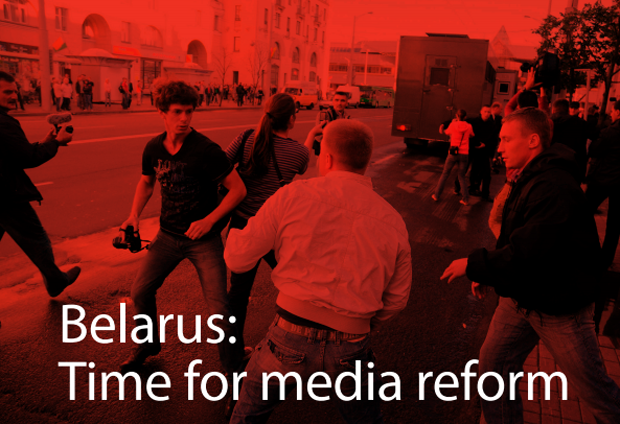
This article is the fifth and final of a series based on the Index on Censorship report Belarus: Time for media reform.
Analysis shows there have been no visible improvements of Belrusian media freedom during in recent years. The state continues to dominate the broadcast media market and preserves tight control over printed publications. State-owned media are used as a tool for government propaganda, while the independent socio-political press faces discrimination. The internet re-shapes the news media market as it provides new opportunities for free flow of information and ideas, but its full-scale development as a free speech domain is hindered by economic peculiarities and attempts of state regulation.
Despite continuous calls for reforms from Belarusin civil society and the international community, media-related legislation remains restrictive and fails to foster the development of pluralistic and independent news media in Belarus. Other laws, such as defamation articles of the Criminal Code, anti-extremist or state secrets legislation are also used to curtail media freedom, restrict access to information and prosecute journalists. Despite the recent talks between Belarus’s Foreign Ministry and the Office of the OSCE Representative on Freedom of the Media, the authorities of the country remain reluctant to discuss any possible legal reforms of the media field with civil society and professional community.
Physical safety of journalists and impunity remain serious problems that have a chilling effect of media freedom in Belarus. The most acute issue is police interference with journalistic activities and arbitrary detentions of reporters during mass street actions.
As Belarus remains one of the least free places in Europe for journalists and the media to operate, immediate reforms of the Belarus media field should be launched to end harassment and persecution of reporters, and eliminate excessive state interference in media freedom.
The European Union and other international institutions must place the issue of media freedom on the agenda of any dialogue with the Belarusian authorities to demand genuine reforms of the media for the country to live up to its international commitments in the field of freedom of expression.
Index on Censorship believes changes are needed to bring the Belarusian media-related legislation and practices of its implementation in line with the Constitution of the country and its international commitments.
Reforms of the Belarusian media field should be launched, including de-monopolising of the electronic media, introducing public service media and creating a competitive media market. The outline of these reforms should result from a dialogue with professional community and civil society of the country.
The practice of arbitrary detention of journalists, including those that cover street actions, should be immediately stopped. All cases of interference of the police and other state officials into legitimate journalistic activity should be investigated, and those responsible should be brought to account.
All forms of economic discrimination against non-state independent press should be eliminated, in particular:
• independent publications should be treated equally by the state system of press distribution and Belposhta subscription catalogues;
• the state has a pro-active duty to protect and promote freedom of expression and so should investigate anti-competitive practices including the charging of unequal prices for paper and the distribution services for publications for different types of ownership.
The Law of the Republic of Belarus “On Mass Media” must be reformed, in particular:
• to allow for independent self-regulation of journalism allowing reporters of both online and offline news media, including freelance journalists, to operate freely;
• registration procedures for new media outlets should be simplified to lift all the artificial restrictions for entering the media market;
• a possibility of extrajudicial closing down of media should be eliminated; the Ministry of Information should not have the authority to impose sanctions on media, including initiating of cases of closure of media outlets.
Six articles of the Criminal Code providing for criminal liability for defamation should be abolished:
• Article 188 “Libel”
• Article 189 “Insult”
• Article 367 “Libel in relation to the President of the Republic of Belarus”
• Article 368 “Insulting the President of the Republic of Belarus”
• Article 369 “Insulting the representative of the authorities”
• Article 369–1 “Discrediting the Republic of Belarus”
Equal and full access to information should be ensured for all journalists of both online and offline media. The institute of accreditation should not be used to restrict the right to access information. In particular, the existing ban for cooperation with foreign media without an accreditation should be lifted as it contradicts the Constitution of Belarus and its international commitments in the field of freedom of expression.
Several provisions of the Presidential Decree No 60 of 1 February 2010 on regulating the internet should be dropped in line with the recommendations in ‘Belarus: Pulling the Plug’ policy paper, along with various other edicts related to the implementation of the decree. In particular, owners of websites should be free to register them at any domain and host them in any country. News websites should not be black-listed and blocked.
Part 1 Belarus: Europe’s most hostile media environment | Part 2 Belarus: A distorted media market strangles independent voices | Part 3 Belarus: Legal frameworks and regulations stifle new competitors | Part 4 Belarus: Violence and intimidation of journalists unchecked | Part 5 Belarus must reform its approach to media freedom
A full report in PDF is available here
This article was published on 14 February 2014 at indexoncensorship.org