12 May 2015 | Campaigns, mobile, Statements
Index on Censorship condemns the brutal murder of Bangladeshi blogger Ananta Bijoy Das — the third such attack since February. AFP reported that attackers wearing masks hacked atheist blogger Das to death with machetes. The murder follows that of fellow atheist Avijit Roy, a blogger who advocated secularism, and who was hacked to death by a knife-wielding mob in Dhaka as he walked back from a book fair in February. Weeks later atheist writer Washiqur Rahman was stabbed to death in the capital.
Index CEO Jodie Ginsberg said: “Our sympathies are with the family of Ananta Bijoy Das. Like Avijit Roy and Washiqur Rahman, he was targeted simply for expressing his own beliefs. We are appalled by these deaths and call on Bangladesh and the international community to do more to protect such writers.”
16 Apr 2015 | Asia and Pacific, Bangladesh, mobile, News
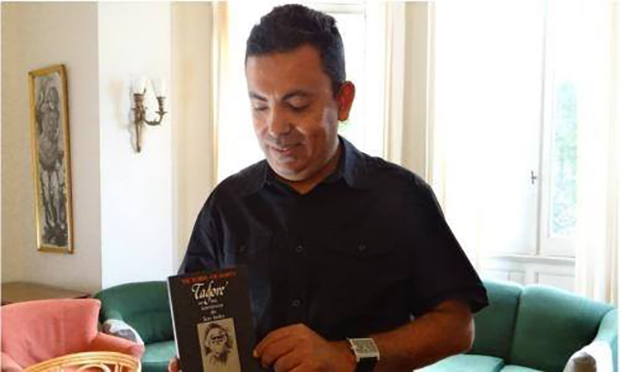
Blogger Avijit Roy was murdered in February. (Photo: Avijit Roy/Facebook)
Washiqur Rahman was murdered because he didn’t believe in God.
On the morning of 30 March 2015, the 27-year-old was set upon by three machete-wielding attackers and hacked to death because he did not believe in God.
The previous month, 42-year-old Avijit Roy was murdered because he didn’t believe in God.
One of the accusations most often levelled at self-proclaimed atheists is that they go on about it too much. What is there even to talk about? Why join, say the British Humanist Association or a university atheist group? What do you do? Go to meetings and drone on about not believing in God? And someone should just get that Richard Dawkins off Twitter, right?
Rahman and Roy were the kind of vocal atheist that tends to prompt eye-rolling in liberal secular countries.
Roy was a frontrunner, a star. He was the creator of Mukto-Mona, which claimed to be the first secular humanist web portal in South Asia. He described Mukto-Mona’s mission as “to build a society which will not be bound by the dictates of arbitrary authority, comfortable superstition, stifling tradition, or suffocating orthodoxy but would rather be based on reason, compassion, humanity, equality and science.”
Based in the US, Roy had returned to Bangladesh to visit his sick mother, despite warnings that the country was no longer safe for him. He was well-known enough to be stopped in the street for autographs. An appearance at a book fair in Dhaka had alerted Islamist extremists to his presence in the country.
Rahman was an up and coming blogger with a big Facebook following. He wrote under the name Kutshit Hasher Chhana (The Ugly Duckling), satirising religion and believers. Like many online activists, he had been horrified by the murder of Roy, and had lent support to a campaign calling for the prosecution of his killers, posting to the #IAmAvijit hashtag.
This, it seems, was enough to get him killed. Suspicion for the killings of both bloggers lies with the Ansarullah Bangla Team, an extremist organisation said to take inspiration from Anwar al-Awlaki, the American preacher killed by a US drone attack in 2011. The group, which was formed in 2013, has been implicated in the murder of atheist blogger Ahmed Rajib Haider in February of that year. The organisation recently hit the headlines in Bangladesh after it called for a jailbreak to free prisoners tied to Jamaat-e-Islami, who are on trial for war crimes that took place during Bangladesh’s war for independence from Pakistan.
The International Crimes Tribunal has been the backdrop for a fraught few years in Bangladesh. The tribunal has been criticised for lacking impartiality, particularly after leaked Skype conversations between the presiding judge, Mohammed Nizamul Huq, and a war crimes activist were published by The Economist, via Oliullah Noman, a journalist for opposition newspaper Amardesh in December 2012.
Increasing divisions were exacerbated by the governing Awami League’s decision to abandon the usual protocol of making way for an interim government to oversee the January 2014 election. The main opposition, the Bangladesh Nationalist Party, boycotted the election in protest, and the Commonwealth, the EU and the US declined to send monitors, calling the legitimacy of the result into question. The political division in Bangladesh operates roughly on a secular/religious line, with the Awami League seen as more secular and the BNP representing a more religious viewpoint.
Amidst all this upheaval, online atheists are under pressure. The two murders this year followed the attacks in 2013. Meanwhile, in spring 2013 four secularist bloggers were arrested for “offending religious sentiment” by denigrating the Prophet Mohammed, a colonial era law which is the closest Bangladesh comes to an official blasphemy statute.
Bangladesh is not Pakistan. It retains a secular identity that is fast slipping (it’s hard now to imagine a Pakistani atheist blogger operating for 13 years, as Roy did). But it cannot be entirely immune to the cross-border influences of extremist Islamism and jihadism unless it protects the free expression of non believers.
That is why the reaction to the murder of Washiqur Rahman from the deputy commissioner of the Dhaka Metropolitan police made depressing reading:
“Those who killed him differed on his ideologies about religion. He was not an atheist. He was a believer. But the way he followed religion was different from the way radical groups insist,” Biplob Kumar Sarkar told the Guardian.
Though Sarkar may have been attempting to calm the situation, the statement is a gross display of disrespect to the murder victim and his views.
Moreover, it’s a refusal to confront the prime motivation for his killing, and that of Ajivit Roy. They were killed because they were atheists who refused to keep quiet about their beliefs.
Washiqur Rahman was murdered because he didn’t believe in God.
Avijit Roy was murdered because he didn’t believe in God.
This column was posted on 16 April 2015 at indexoncensorship.org
27 Feb 2015 | Bangladesh, Campaigns, Statements
Index on Censorship condemns the brutal murder of US-Bangladeshi blogger Avijit Roy. Roy, an atheist who advocated secularism, was hacked to death by a knife-wielding mob in Dhaka as he walked back from a book fair.
Index CEO Jodie Ginsberg said: “Our sympathies are with the family of Avijit Roy. Roy was targeted simply for expressing his own beliefs and we are appalled by his death and condemn all such killings.”
10 Apr 2014 | Bangladesh, Digital Freedom, Digital Freedom Reports, News
(Photo illustration: Shutterstock)
Bangladesh witnessed the internet take on an increasing role in its socio-political sphere in 2013. Usage trends swung more toward heart-warming positives, in contrast to the country’s regulatory precedents, which despite policymakers facilitating net use via cheaper connections and better infrastructure, have been mostly negative. Common people felt empowered using the internet.
Last February, tens of thousands of people were gathered, inspired by blog posts and social media to protest for the first time in the country’s history. At the same time, religious zealots started attacking online activists, and policymakers initiated the use of a draconian ICT (information and communication technology) act to clamp down on opposition, thus threatening digital freedom of expression overall.
Internet usage, mobile telephony penetration, and other ICT-enabled applications have been enjoying steady growth in both Bangladesh’s private and public sectors for over a decade. The present political leadership came to power with a mandate to “digitise” the country by implementing its Digital Bangladesh by 2021 vision. This policy rolled out net enabled ICT centers to ensure easier access of information for its citizens all over Bangladesh. At present, the national teledensity is at over 70%. Around 20% of the population use the internet, of which 90% go online using mobile phone services. There are around 200,000 local bloggers based in Bangladesh, who alongside millions of Bangladeshi Facebook users were until recently enjoying near-uninhibited freedom to express their thoughts online.
The true power of social media to mobilise massive groups of people on a political issue was first observed in Bangladesh during the Shahbag movement in February 2013. Like the 2011 uprising in Egypt’s Tahrir Square, protesters gathered for several weeks in the Shahbag intersection of Dhaka University campus, demanding justice against known war criminals of its liberation war in 1971. This movement was initiated by local bloggers and social network users, and flourished with their help. People were using online media freely to organise in the real world and to create spaces for net based dialogue on critical issues. However, along with such freedom came confrontation. Shahbag made public the conflict between the ultra religious, anti-establishment elements and the moderate, mainstream and secular netizens. One pro-Shahbag blogger was killed, many other online activists were threatened with physically harm by the zealots. Suddenly an online inspired mass protest, which was enjoying complete freedom of expression in the digital space, turned out to be the root cause of a messy and prolonged offline affair.
The Shahbag movement exposed the major weaknesses of the local legal system, responsible for guaranteeing its citizens’ freedom of expression. The government turned out to be confused in their decision making process and tried to appease both sides. It first banned several ultra-religious sites. Then the law enforcement agency arrested four secular Shahbag bloggers and organisers, charging them with “harming religious sentiments”. Such actions sent out confusing signals to the general population and posed serious questions on the existence of any tangible legal safety net for online communication in Bangladesh.
In fact, the government’s performance in the digital space has been consistently disappointing between 2012 and 2013. In addition to its self-conflicting stance on Shahbag, it applied a heavy-handed approach in dealing with other web services throughout the year. YouTube was banned for months (September 2012 to May 2013) due to The Innocence of Muslims, which ignited major protests in Bangladesh. Additionally, Facebook was blocked on several occasions, from periods of a few hours to days at a stretch. Freedom House included Bangladesh for the first time in its yearly Freedom On the Net report in 2013. Based on its performance in 2012 and first half of 2013, the internet in Bangladesh was found to be partially free, enjoying a relatively better online environment in comparison with its South Asian peers, Pakistan and Sri Lanka. Nevertheless the situation is getting worse. Indiscriminate applications of the ICT Act 2006, a rise of online hate speech and related crimes have left net users in Bangladesh insecure.
In 2013, the government started using the ICT Act of 2006 more frequently, mainly to address issues related to online space and freedom of expression. This act was formulated in early 2000 and according to many legal experts, it was due to be amended to become more user-friendly and inclusive. The Bangladeshi government did amend it in August 2013, but unfortunately made it more repressive and inflexible. The newly amended act provisions a maximum 10 years in prison and fines up to £74,555 for any offensive religious, social, or political expression made online. It moreover made arrests under this act non-bailable and the police were given the power to arrest people without a warrant. Instead of strengthening the legal system to protect peoples’ right to communicate freely online, this act tightened its grip on peoples’ freedom of communication. A series of arrests took place and several court cases were filed under the act in 2013. Besides the bloggers, editors and journalists of two newspapers, two NGO officials, and several other people were arrested, some of whom are close to opposition party politics. One university teacher was sentenced to seven years in prison under the act for threatening to kill the prime minister through a Facebook status.
Overall, the present state of affair of net freedom in Bangladesh is very uncertain. There has been no independent regulatory or legal body put in place to protect the rights of the people online. Civil society needs to be more active to thwart any digital policing that compromises public freedom. As the challenges related to ICT access in Bangladesh are being solved fast, it is now high time to make sure that its citizens enjoy true freedom while using such digital infrastructure.
This article was posted on 10 April 2014 at indexoncensorship.org
