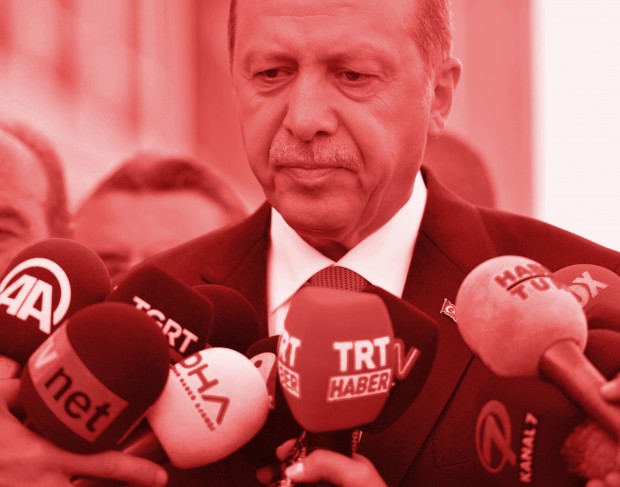
First as prime minister and now as president, Recep Tayyip Erdogan has been waging a methodical crackdown on the media in Turkey for years. Erdogan is persecuting journalists of all colours in an increasingly ferocious manner in the name of combatting terrorism and defending state security. The Erdogan regime’s arrests, threats and intimidation are unworthy of a democracy.
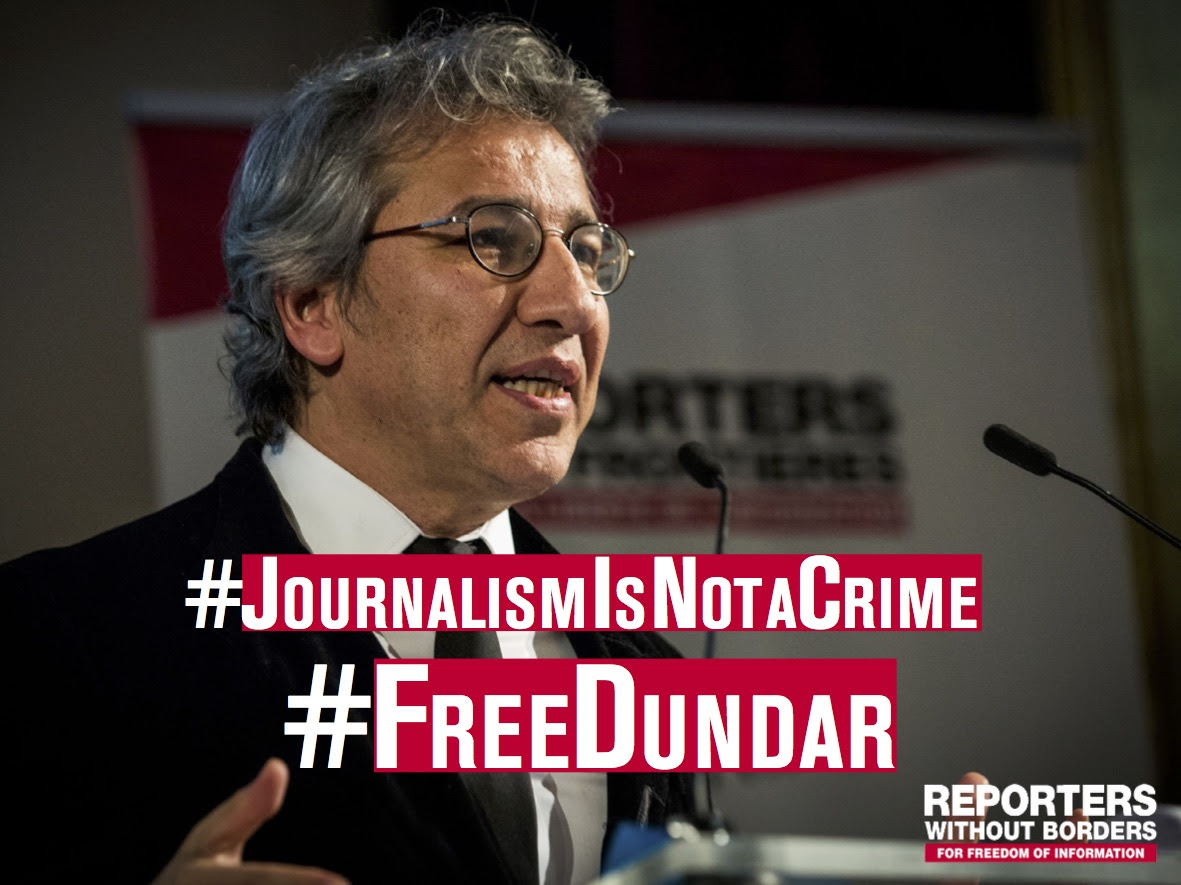
Can Dündar, the editor-in-chief of the Turkish daily Cumhuriyet, and his Ankara bureau chief, Erdem Gül, have been held since the evening of 26 November. They are charged with spying and terrorism because last May they published evidence of arms deliveries by the Turkish intelligence services to Islamist groups in Syria. Both are exemplars of journalism, the search for truth and the defence of freedoms. President Erdogan publicly said that Dündar “will pay for this.” But Cumhuriyet’s journalists just did their job, publishing information that was in the public interest.
At a time when international terrorism is at the centre of everyone’s concerns, it is unacceptable that political prosecutions are used to suppress investigative reporting and exposés. The arrest of these two journalists is the latest extreme to which political use of the Turkish judicial system has been taken. Many journalists have been detained on spurious charges of terrorist propaganda and insulting President Erdogan. The regime has also been using economic levers to put growing pressure on the media, while draconian laws have been passed.
We, public figures, media freedom NGOs and unions, reject the blatant erosion of media freedom in Turkey. The country is ranked 149th out of 180 countries in the Reporters Without Borders press freedom index. Index’s Mapping Media Freedom project has recorded 178 verified reports of media violations since May 2014.
We appeal to the Turkish authorities to free Can Dündar and Erdem Gül without delay, to drop all charges against them, and to free all other journalists who are currently detained in connection with their journalism or the opinions they have expressed.
We also urge the institutions and governments of democratic countries to face up to their responsibilities to respond to President Erdogan’s increasingly authoritarian excesses.
SIGNATORIES
Public figures
Günter Wallraff, journalist, Germany
Noam Chomsky, linguist, USA
Edgar Morin, sociologist, France
Carl Bernstein, journalist, USA
Zülfü Livaneli, writer, Turkey
Ali Dilem, cartoonist, Algeria
Thomas Piketty, economist, France
Claudia Roth, politician, Germany
Paul Steiger, journalist, United States
Kamel Labidi, journalist, Tunisia
John R McArthur, media executive, USA
Fazil Say, pianist, Turkey
Peter Price, media executive, USA
Edwy Plenel, media executive, France
Jim Hoagland, journalist, USA
Ahmet İnsel, political analyst, Turkey
Eric Chol, newspaper editor, France
Nedim Gürsel, writer, Turkey
Cem Özdemir, Green Party copresident, Germany
Hakan Günday, writer, Turkey
Mikis Theodorakis, composer, Greece
Per Westberg, writer, Sweden
Louise Belfrage, journalist, Sweden
Ali Anouzla, journalist, Morocco
Omar Bellouchet, journalist, Algeria
Jack Lang, former government minister, France
Omar Brouksy, journalist, Morocco
Pierre Haski, journalist, France
Jay Weissberg, cinema critic, USA
NGOs
Reporters Without Borders (RSF)
Committee to Project Journalists, (CPJ)
PEN International
International Press Institute (IPI)
World Association of Newspapers and News Publishers (WANIFRA)
Index on Censorship
World Press Freedom Committee (WPFC)
International Federation of Journalists (IFJ)
European Federation of Journalists (EFJ)
Ethical Journalism Network (EJN)
Global Editors Network (GEN)
Turkish Association of Journalists (TGC)
Turkish Union of Journalists (TGS)
DISK Basinİş
Media freedom has declined considerably during President Recep Tayyip Erdogan’s tenure, and it hasn’t gone unnoticed.
A recent report by the EU criticises Erdogan for the country’s “significant backsliding” on freedom of expression. “Ongoing and new criminal cases against journalists, writers or social media users, intimidation of journalists and media outlets as well as the authorities’ actions curtailing freedom of media are of considerable concern,” the report states.
Index on Censorship is deeply concerned with the situation in Turkey and participated in an emergency press freedom mission organised by the International Press Institute with a broad coalition of international free expression and media freedom groups before the Turkish elections on 1 November.
Our Mapping Media Freedom project, which identifies threats, violations and limitations faced by members of the press throughout the European Union, candidate states and neighbouring countries, has recorded 164 verified incidents in Turkey since May 2014. The country has consistently come top of our list for media violations.
The days leading up to and following the election were marred by further crackdowns on press freedoms. Here are just five examples from the last two weeks.
1. Magazine editors arrested over front cover
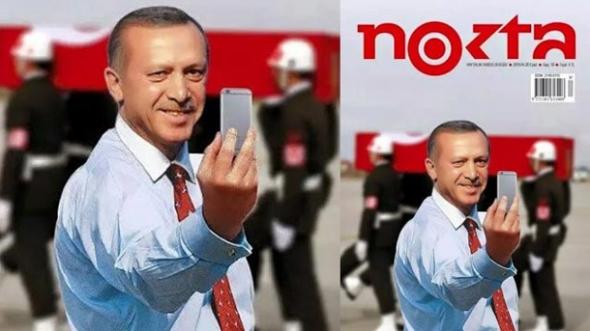
The Turkish government arrested two journalists on 3 November over claims they promoted an uprising against the state. Editor-in-chief Cevher Guven and news editor Murat Capan of the left-leaning political weekly Nokta, known for its criticism of the government, face charges after the magazine’s latest issue suggested that the aftermath of the election would spell the beginning of unrest in Turkey.
Nokta’s cover featured a doctored selfie of a smiling Erdogan, with the coffin of a soldier – a reference to comments by the president that families of soldiers killed by Kurdish rebels could be happy that their loved ones died as martyrs. The cover hints that the post-election period would signal “the start of Turkey’s civil war”. Nokta has been removed from the shelves and access to its website blocked. Many see the move as further proof of Erdogan’s determination to root out opposition media.
Journalists in Turkey don’t just face threats from the authorities, but from Islamist extremists operating the country as well. On 30 October, Mapping Media Freedom reported that Syrian citizen-journalist Ibrahim Abd al-Qader had been murdered in the city of Sanliurfa at the home of fellow Syrian Fares Hammadi. Both were activists in Raqqa Is Being Slaughtered Silently (RBSS), a group of activists using social media to document atrocities committed by Islamic State in Raqqa, Syria, which, since January 2014, has been the capital of the militant group.
Both men had been shot in the head and beheaded. ISIS took to social media to boast about the murder, posting a picture of the friends with the caption: “A selfie before being slaughtered silently.” Several suspects were arrested, but are the Turkish authorities really doing enough to protect the rights of journalists?
3. Police storm offices of independent media group
Just a few days ahead of the election, at around 4.45am on 28 October, police with chainsaws smashed through the front doors of Koza İpek Holding and took broadcasters Bugün and Kanaltürk off the air. The incident was captured on live television. After interrupting the broadcasts, riot police arrived and issued a public service announcement on air. Bügun and Kanaltürk then continued to broadcast for several hours, going against the police order.
Police then evacuated the editorial offices and attacked journalists. Bugün reporter Kamil Maman was assaulted, taken to a hospital for examination and then arrested.
Koza İpek is linked to Fethullah Gulen, a Turkish preacher living in exile in the US. Tensions between Gulen and Erdogan, a former ally, have worsened over recent years.
4. 71 journalists lose their jobs
Seized Bugün’s reporter carries his belongings in shoeboxes after he was fired, alluding to 17-25 Dec. graft ops. pic.twitter.com/5S4olzePPG
Since the police raid, 71 journalists have been dismissed from İpek Media by a new group of trustees. The media group was unlawfully seized in a government-led police operation in late October which assigned new trustees to the board. Two of the media workers dismissed — Bugün daily news desk editor Bülent Ceyhan and reporter Kamil Maman — say they were forced to go on compulsory leave for several days and are now denied access to the building.
According to the Today’s Zaman, an English-language daily based in Turkey: “Despite the fact that the trustees had no authority to fire any worker, the editors-in-chief and general managers of the TV channels were told they were sacked. […] Some of the decisions to fire staff were made on a public holiday, an act which is against the law.”
5. Police attempt to arrest journalist during protest
On 6 November, a reporter for the independent Turkish press agency Bianet, Beyza Kural, was covering a public protest when police attempted to detain and handcuff her in Beyazit, Istanbul. Students had gathered in front of Istanbul University to protest Erdogan’s control over education.
Police officers tried to seize the memory card from Kural’s camera and shouted, “from now on nothing will be like before, we will teach you” — allegedly referring to the election results and Erdogan’s renewed authority. Police officers also assaulted students while firing rubber bullets and teargas to disperse the demonstration. Kural only escaped arrest due to the intervention of fellow journalists and protesters.
Mapping Media Freedom
Click on the bubbles to view reports or double-click to zoom in on specific regions. The full site can be accessed at https://mappingmediafreedom.org/
Concern over the deteriorating state of press freedom in Turkey and its impact on upcoming Nov. 1 parliamentary elections have prompted a coalition of international free expression groups to undertake an emergency press freedom mission to the country, the International Press Institute (IPI) announced.
From Oct. 19 to 21, mission participants will meet in Istanbul and Ankara with journalists, political representatives and foreign diplomats to demonstrate solidarity with their colleagues in the news media and to focus attention in Turkey and abroad on the impact the growing pressure on independent media is likely to have on the election.
The unprecedented mission will bring together representatives from eight leading international press freedom and free expression groups, including IPI, the Committee to Protect Journalists (CPJ), Reporters Without Borders (RSF), the International Federation of Journalists (IFJ), the European Federation of Journalists, Article 19, Index on Censorship and the Ethical Journalism Network.
The mission will conclude with a press conference at 13:00 on Oct. 21 at the offices of the Journalists Association of Turkey (TGC), at Türkocağı Cad. No: 1, Cağaloğlu, Istanbul.
Since late August, when President Recep Tayyip Erdoğan called a repeat of June elections after lawmakers were unable to form a government, Turkey has witnessed a series of increasingly troubling incidents targeting journalists and media. Among others, they include physical attacks on journalists and media outlets; raids on media outlets and seizures of publications; threatening rhetoric directed at journalists; and the increasing use of criminal insult and anti-terrorism laws to chill independent reporting.
Next week’s mission will focus on these incidents, as well as the ongoing imprisonment of numerous journalists in Turkey and the deportations of foreign journalists, particularly those
attempting to cover deadly clashes with the outlawed Kurdistan’s Workers Party (PKK) and Turkey’s participation in the international fight against the Islamic State group.
The mission comes as satellite and online television providers have accepted prosecutors’ demands to stop carrying the signals of broadcasters critical of the government.
“The upcoming election is likely to decide Turkey’s direction for the coming decade and its outcome will have far-reaching implications for Turkey, its neighbours, the West and the wider world,” IPI Executive Director Barbara Trionfi said. “IPI and its partners are undertaking this emergency press freedom mission to Turkey to stand in solidarity with our colleagues under pressure, and to demand that voters be allowed to make an informed decision about their future and that the media be allowed to report freely to give voters the information they need to do so.”
The deterioration of press freedom in Turkey represents the culmination of a years-long trend documented earlier this year in an IPI Special Report on the country, “Democracy at Risk” (also available in Turkish).
For more information about the Oct. 21 Press Conference at 13:00, please contact the Journalists Association of Turkey (TGC) by telephone at +90 (0 212) 513 83 00 or via email at [email protected].
Prosecutors filed a case against Today’s Zaman columnist Yavuz Baydar on Saturday for “insulting” the president in two recent columns.
“This is the latest in a number of cases of journalists being targeted and charged for insulting the president, which in turn forms part of a wider crackdown on a free and independent media in Turkey,” said Index chief executive Jodie Ginsberg.
“The international community needs to do more to halt this rapidly deteriorating situation.”
“We, those trying to perform their jobs in the media, are using our rights to provide information and criticise the government based on rights granted to us by the Constitution, the laws and international treaties we are a party of,” Baydar said in an interview, published on BGNNews.com. “Being critical, questioning and warning is our professional responsibility. We shall continue to criticise. Just like many other colleagues who are investigated [on the same charge], there is no intention to insult in these columns but the right to criticise was used. I am saddened. I am concerned for our country and the media.”
In July it was announced that Baydar was being awarded Italy’s prestigious Caravella Meditterraneo/Mare Nostrum prize for his work on press freedom and media independence in Turkey.