20 Feb 2017 | News, Youth Board
[vc_row][vc_column][vc_column_text]Index on Censorship has recruited a new youth board to sit until June 2017. The group is made up of young students, journalists and legal professionals from countries including India, Hungary and the Republic of Ireland.
Each month, board members meet online to discuss freedom of expression issues around the world and complete an assignment that grows from that discussion. For their first task the board were asked to write a short bio and take a photo of themselves holding a quote that reflects their belief in free speech.
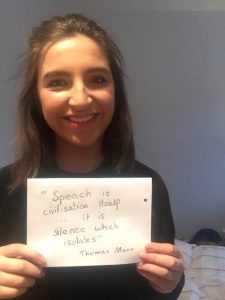 Fionnuala McRedmond – Dublin
I graduated last June from the University of Cambridge with a degree in classics. I am now studying for a MSc in political theory at the London School of Economics. I was an active student journalist during my time at Cambridge, and it was there that I first developed an interest in the struggles of censorship and speech across the globe. The propensity for governments to censor speech and ideas is not a modern phenomenon. In ancient Rome book burning was not unheard of, and Cicero once expressed the all too familiar idea: “it is not permitted to say what one thinks… it is obviously permitted to keep silent.” Then, as much as now, free speech was the cornerstone of a healthy society. And then, as much as now, speech was censored by tyrannical power. I am particularly interested in the relationship between censorship and identity. In the past, and even more so now, people have been denied the right to share their words and ideas on the basis of ethnic, religious and political identity. Work by groups like Index on Censorship is crucial in protecting people’s right to speak, no matter who they are. I hope to better understand and develop these ideas with the Index on Censorship youth board.
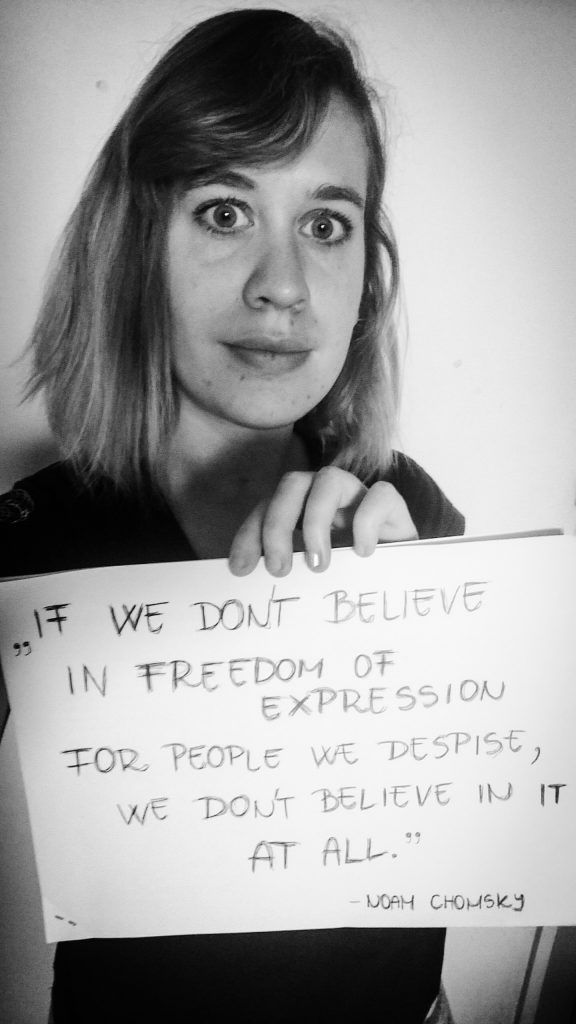 Júlia Bakó – Budapest
I am a Hungarian journalist, student and activist currently living in Budapest. After finishing my first degree in journalism, I have started studying international relations.
As a journalist and as someone who is deeply committed to human rights I am naturally drawn to freedom of expression and freedom of press issues. During the last couple of years I have worked with several NGOs and other organisations like Transparency International, Amnesty International, OSCE and Atlatszo.hu. I have dealt with corruption cases as an investigative journalist, I have studied human rights monitoring and – partly because of my studies, but mostly because of my personal interest and commitment – I have tried to explore freedom of expression and other issues not just in my own country, but all over the world, to find patterns, similarities and possible measures that could be taken either on a national or international level.
The quote I chose about freedom of expression says something what we sometimes tend to forget about. Being able to express our own opinions, however right they may seem to us, should never stop us from fighting for the rights of others to be able to act the same way, even though their opinions seem fundamentally different sometimes. Granting the chance to express opinions we do not agree with is what is able to create the diversity of thought, the debate about social issues and with that democracy itself.
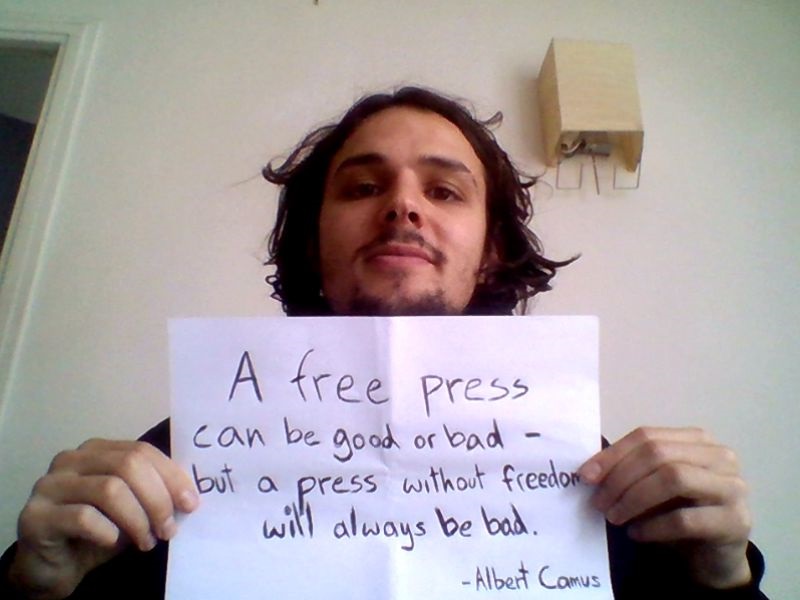 Samuel Earle – Paris
I currently live in Paris, where I am a freelance writer and English teacher.
I became interested in freedom of expression while studying politics at university – first at undergraduate and then at MSc level – and that continues today through my interest in journalism. What’s clear to me is that although freedom of expression is always valuable, the challenges it faces globally are never the same.
In the west, I think there is a complacency concerning freedom of expression: that stopping censorship is assumed to be enough. But I believe that in societies as unequal as our own, and where market forces reign, the value of freedom of expression can be diminished – as shown, for example, by the fake-news phenomenon.
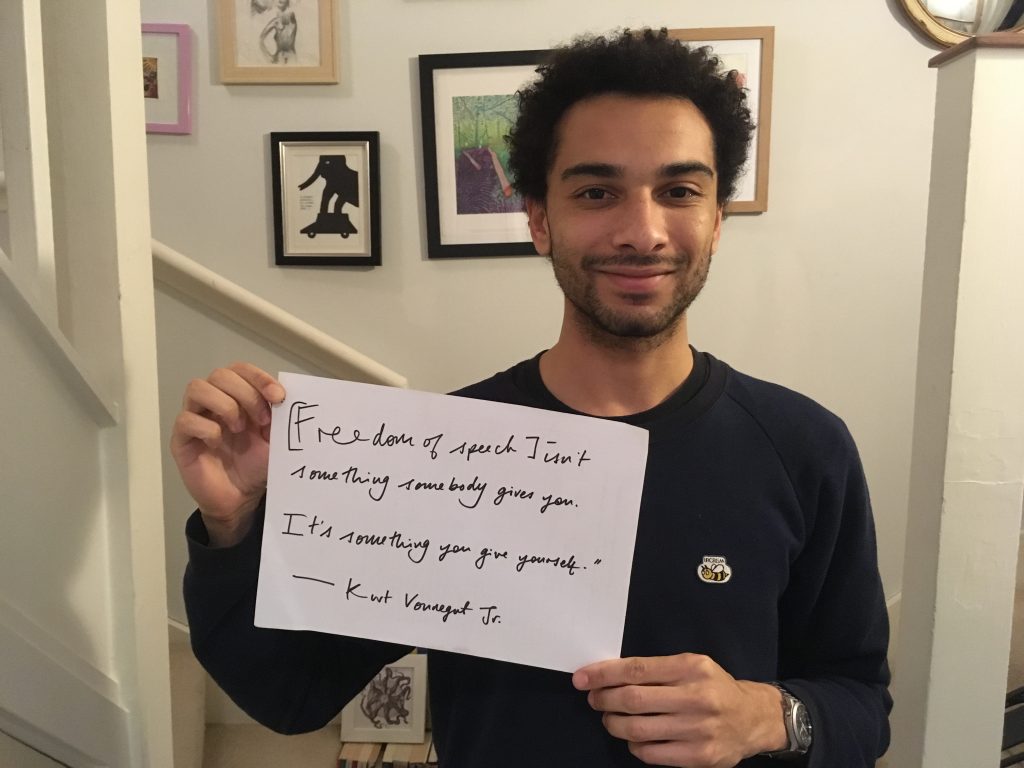 Samuel Rowe – London
I am currently a postgraduate law student, having studied literature as an undergraduate in the UK and the USA. I hope to become a public law barrister, specialising in media and information law and human rights. Like the character in Kurt Vonnegut’s Hocus Pocus, I believe that the right to freedom of speech is innate. It is not a commodity; it is not something to be bargained with. My interest in issues surrounding freedom of speech directed my undergraduate dissertation, which focused on the western surveillance state. This sort of covert action can have the effect of creating an environment of self-censorship, and often has a disproportionate impact on marginalised communities. I looked at methods of resistance (of which there are many) to see how groups maintained freedom of speech under the gaze of the state. The suppression of freedom of speech is hardly a novel phenomenon and mass surveillance is just one way in which it is currently under threat. From White House officials calling disagreeable information “fake news” to irresponsible no platforming in universities, this is an era in which the limits and value of freedom of speech are being questioned. I believe that without freedom of speech, there can be no full interrogation of the evils which face us. And without interrogation, we risk losing sight of the full scope those evils might pose.
 Tarun Krishnakumar – New Delhi
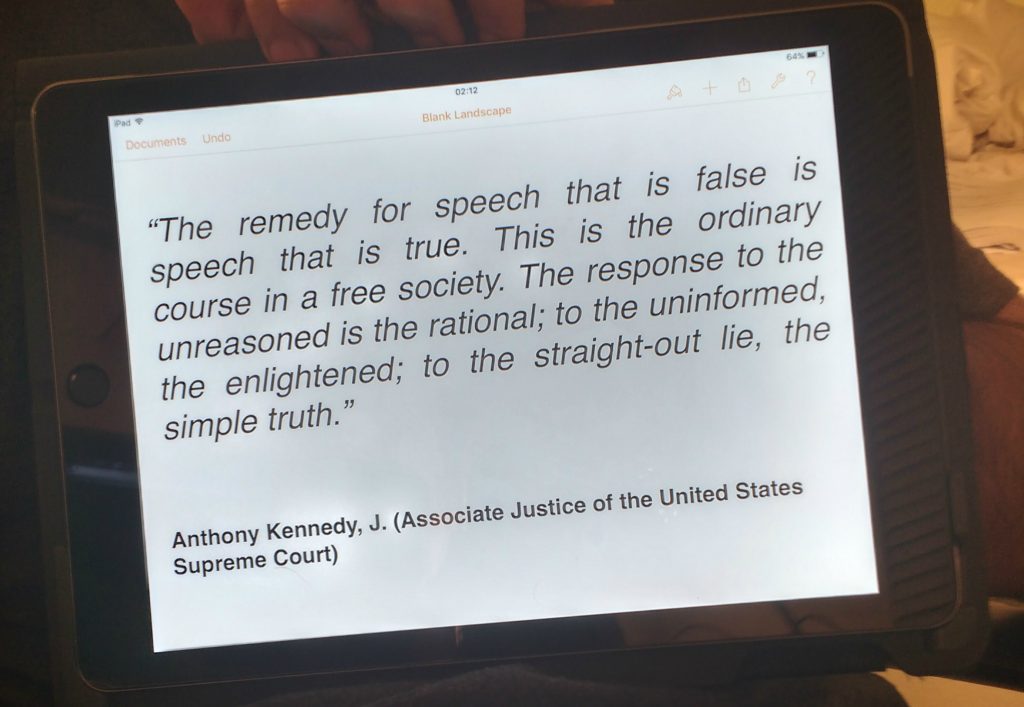
In recent times, there has been much concern expressed about the proliferation of “fake” news online and the impact it can have on democratic processes, politics and the public at large. These concerns have stirred various stakeholders – including governments, news media and internet intermediaries – into action. For instance, the German government recently declared fake news from Russia to be a significant threat to its upcoming elections. In a similar vein, internet giants like Google and Facebook – likely in the wake of unfavourable political outcomes – have been clamouring to show that they are willing to clamp down on content that is false or misleading.
In response to these developments, the quote I’ve selected manifests what, I feel, should be the appropriate response to fake speech: more “non-fake” speech – and not more regulation. While many justifications to clamp down on fake news may be well-intentioned, the history of regulating speech has shown us that inserting an intermediary into a conversation creates unintended and harmful consequences for free speech. Often this manifests as overt censorship while, in other cases, it is the creation of private arbiters of what may or may not be said on a platform – a more covert and creeping harm. Given the subjectivity in judging what news is “fake”, the debate also presents an excuse for regimes to tighten existing censorship controls or establish new ones.
The internet has given everyone an opportunity to have an equal say. This must be preserved at all costs. Fake news must be countered not through bans, blocking or regulation but by targeting the societal information asymmetries that allow it to flourish and creating conditions that facilitate society to produce more speech that is not “fake”. Policy efforts should focus on educating readers and providing them the tools to judge content for themselves – thereby minimising the effect of false or misleading content. For this, what is necessary is a culture of being exposed to a balanced diet of diverse content. When governments peddle nationalistic, religious, or political rhetoric in educational curricula and skew facts, little do they realise that they are creating the very conditions that allow “fake” news to flourish and have the harmful impacts that they complain of.
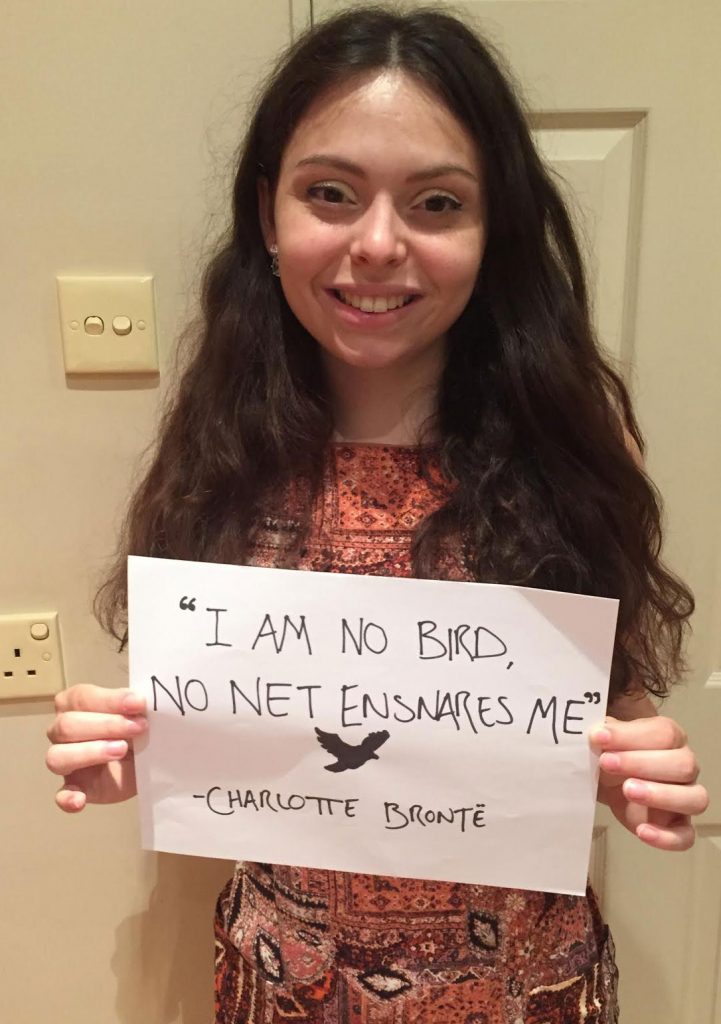 Sophia Smith-Galer – London
I’m a MA student studying broadcast journalism at City University in London. I studied Spanish and Arabic previously at Durham University and I’m particularly interested in how artists and writers overcome challenges to their freedom of expression in Latin America and the Middle East. As a singer I have always been intrigued by the imagery of a caged bird that sings despite its entrapment; Charlotte Bronte instead uses this metaphor to show how independent Jane Eyre has become by the end of the eponymous novel. Humans have always connected birds with freedom, or lack of – just look at Twitter’s logo – and so the quote really resonated with me.
Freedom of expression is particularly important to me as several countries that speak both of the languages I have dedicated years of study to continue to be plagued by tyrants and censors. I’m particularly interested addressing censorship in Latin America and the Middle East, especially with regard to the arts, as I’m also a classical singer and keen art historian.
 Constantin Eckner – St Andrews
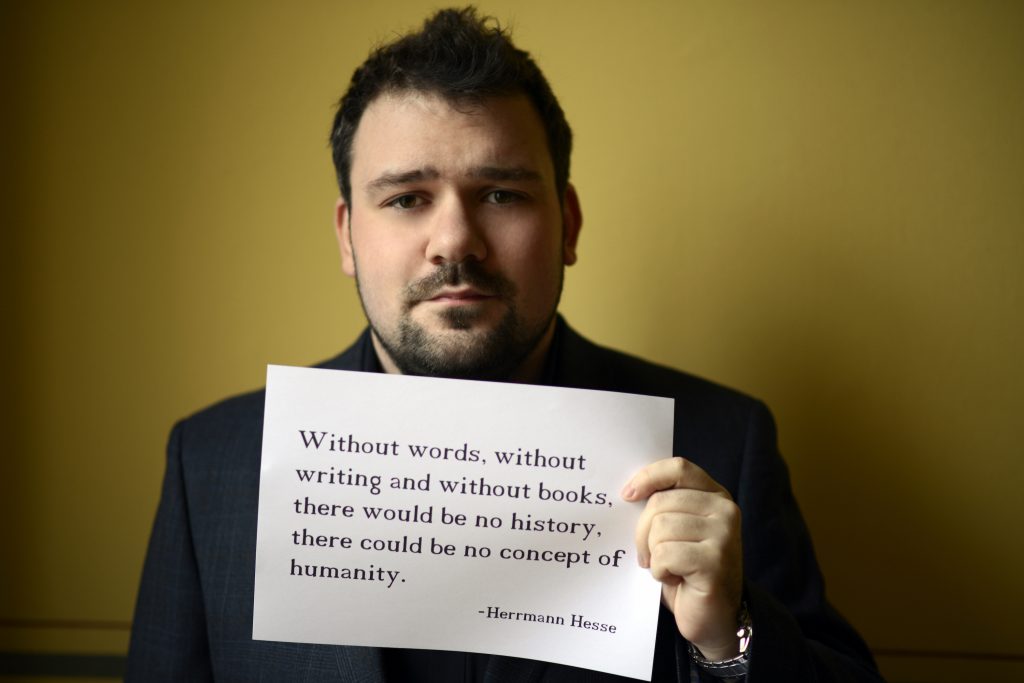
I am originally from Germany. I graduated from University of St Andrews with an MA degree in modern history. Currently, I am a PhD candidate specialising in human rights, asylum policy and the history of migration. Moreover, I have worked as a writer and journalist since I was 17 years old, covering a variety of topics over the years. Longer stays in cities like Budapest and Istanbul have raised my awareness for pressures exerted upon freedom of expression.
I chose this particular quote, because Hermann Hesse emphasised the importance of the written word and how it had an impact on the concept of humanity. In his time, Hesse was conscious that without writing it was not possible to express thoughts and spread ideas. Therefore, all those who fought the existence of the written word threatened humanity which was a frightening thought for a humanist like Hesse.
In a perfect world, every human being would live without fear of state censorship and potentially facing repercussions for the words they write—or for the pictures they draw, for the photos they shoot, for music they play.
 Isabela Vrba Neves – Stockholm
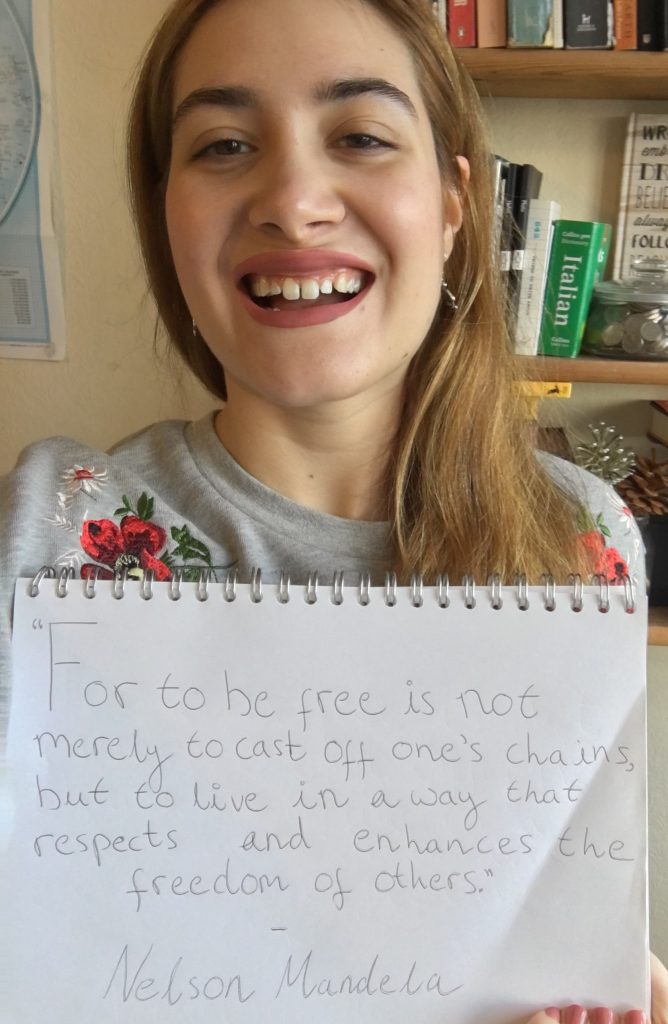
I’m half Brazilian and half Czech, raised in Sweden, but currently living in London where I work in communications for a mental health charity. I‘m also a Latin America correspondent for the International Press Foundation (IPF), a platform where young journalists get to write about stories that matter the most to them. It was during my time at Kingston University, studying journalism and French, when my interest in censorship and freedom of expression first emerged.
During my undergraduate studies I learned how important a free press is for a working democracy. It is a platform bringing together multiple voices, by sharing news, ideas and holding those in power to account. However, many journalists around the world suffer repression for simply doing their job and for using their right to free speech.
For me, Nelson Mandela‘s quote represents the importance of respecting and listening to each other, even with different views, but also highlighting the voices of those who are forced into silence.
Interviewing journalists from Venezuela and Pakistan, who face these types of constraints, has made me more engaged in sharing stories concerning freedom of expression, not only by journalists, but also by artists and activists. In the future, as a journalist, I want to focus on freedom of expression and by being part of the youth advisory board, I will be able to expand my knowledge and have great conversations with other young people who are passionate for justice and social change.[/vc_column_text][/vc_column][/vc_row][vc_row full_width=”stretch_row_content”][vc_column][three_column_post title=”More from the youth advisory board” category_id=”6514″][/vc_column][/vc_row]
14 Feb 2017 | News, Press Releases
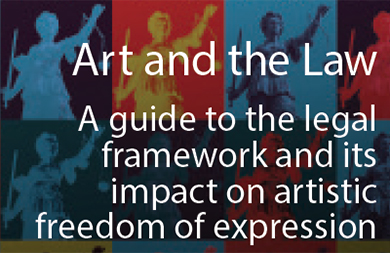
Art and the Law gives artists and arts organisations guidance about the legal implications of controversial work across five areas: Child Protection, Counter Terrorism, Obscene Publications, Public Order, and Race and Religion
Arts Council England has awarded Index on Censorship funding for the organisation’s work tackling censorship and self-censorship in the arts.
The £100,000 grant will be used to provide workshops for boards and senior management of arts organisations in England and Wales on issues of censorship and other ethical challenges as they affect programming, fundraising and managing controversy. The workshops, delivered with partners Cause4 and the What Next? movement will roll out practical ways to support freedom of expression, so that practitioners feel confident they can create great work — not just safe work.
The programme develops the long-standing work by Index on censorship and self-censorship in the arts, including its ‘Taking the Offensive’ conference in the South Bank, which identified widespread self-censorship in the sector. In 2015, Index — in collaboration with a number of legal advisers and with the support of the Arts Council and Clifford Chance — produced a series of guidance booklets entitled ‘Art and Offence’ that examined various aspects of the law and freedom of expression in England and Wales. The guidelines on public order are being distributed nationwide by the police service to help officers better understand the issues faced by arts venues in hosting potentially controversial work, and police commanders will be invited to training workshops.
The award also builds on research and guidance produced by What Next? on meeting ethical and reputational challenges. With additional funds from Theatre Development Trust, they will develop a nationwide network of local groups who will support colleagues facing ethical challenges. In parallel, and drawing on cases that surface through this nationwide programme, Index will research examples of censorship faced by arts groups in England and Wales to form the basis of a report into the state of free expression in the arts to be published at the end of the programme.
“We are delighted that the Arts Council values this work. A risk-averse culture is putting artistic expression under severe pressure,” said Jodie Ginsberg, CEO of Index on Censorship. “In the recent past, we have seen plays, performances and exhibitions being cancelled when faced with a hostile public reaction, or where police have advised closure. A disturbing pattern is emerging, which diminishes the arts.”
Simon Mellor, Deputy Chief Executive, Arts Council England, said: “Some of our greatest art has, over our history, been created by artists taking on the important issues of their day. And they have often done it in a way that audiences have found difficult and uncomfortable. But by provoking a strong response, public understanding of those issues has often deepened. We need to do all we can to create the conditions in which today’s artists can continue to provoke and challenge. The Arts Council is pleased to be supporting this important project by Index on Censorship which will support arts and cultural organisations to help artists take risks, be provocative and, hopefully, create great art.”
Notes to editors
Index on Censorship is a UK-based freedom of expression charity that campaigns against censorship and promotes free expression worldwide. Founded in 1972, Index has published some of the world’s leading writers and artists in its award-winning quarterly magazine, including Nadine Gordimer, Mario Vargas Llosa, Samuel Beckett and Kurt Vonnegut. It also has published some of the greatest campaigning writers from Vaclav Havel to Aung San Suu Kyi.
What Next? is a national movement of arts and cultural organisations, artists, funders, policy makers, institutions, and individuals who come together regularly to articulate and strengthen the role of culture in society. It is an open network of self-forming chapters, building relationships with local and national government, forming alliances outside of the cultural sector, and engaging the public in new and different conversations about the arts. It is chaired by Artistic Director of the Young Vic, David Lan. Over the last four years the What Next? movement has grown organically to encompass 34 chapters around the UK, they bring together individuals, organisations and institutions to work on locally significant issues, and to consider how to contribute to wider action.
Arts Council England champions, develops and invests in artistic and cultural experiences that enrich people’s lives. We support a range of activities across the arts, museums and libraries – from theatre to digital art, reading to dance, music to literature, and crafts to collections. Great art and culture inspires us, brings us together and teaches us about ourselves and the world around us. In short, it makes life better. Between 2015 and 2018, we plan to invest £1.1 billion of public money from government and an estimated £700 million from the National Lottery to help create these experiences for as many people as possible across the country. www.artscouncil.org.uk
20 Jan 2017 | Statements
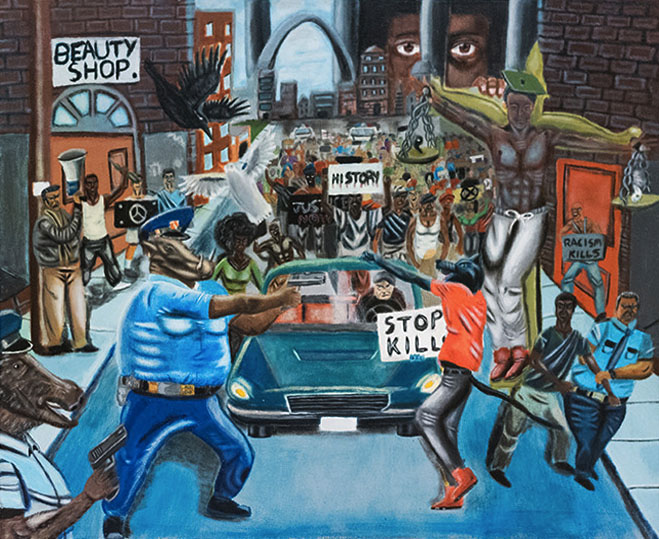
Untitled #1, by David Pulphus
As organisations devoted to promoting the arts and freedom of expression, we condemn the recent removal of a student painting from a public passageway on Capitol Hill. The removal shows a deep disregard of a young person’s constitutional right to free expression and is a flagrant violation of the principles underlying the nation’s commitment to the protection of free speech. It is a sad day when elected representatives of the people of the United States send a message to young people in this country that they should stifle passionate expression concerning important issues of public policy.
The painting, by St. Louis High School Senior David Pulphus, is among the winners of the annual Congressional Art Competition. It depicts, in an allegorical manner, a young artist’s vision of one of the facts of our recent past: a protest against police violence. Pulphus’ painting was selected through a process set by the Competition, which included a review by the office of the Architect of the Capitol. It was approved and remained on display for six months until conservative news outlets built up a controversy around it in late December.
The media-generated controversy was followed by multiple attempts on the part of several Republican Representatives to take down the work with their own hands (each time, Representative Clay (D-Mo) put it back up). On Friday, January 13th, Stephen Ayers, the Architect of the Capitol, ordered the painting’s removal on the basis that it violated competition guidelines stipulating that “subjects of contemporary political controversy or a sensationalistic or gruesome nature are not allowed.”
The retroactive use of the very guidelines by which the painting was selected in the first place to remove the work only serves to draw attention to the how vague these guidelines are. Worse, the fact that the decision to censor the work was made under strong political pressure coming from one side of the aisle proves how easy it is to use the vague guidelines to suppress political viewpoints.
What is “controversial” is entirely subjective and thus open to abuse and the enforcement of political bias: Indeed, many other artworks in the exhibition may be deemed controversial, including a depiction of white police officers harassing an African American playing checkers, a portrait of Bernie Sanders and another of President Obama. And, of course, portraits and statuary on permanent display in Congressional buildings represent many political figures that are controversial. That Pulphus’ painting of police protests was singled out among all these for a hasty removal, after partisan political pressure by representatives who claimed the work was offensive to law enforcement, only deepens our concerns about the elected representatives enforcing political bias and stifling speech.
Political artistic expression is protected speech, no matter how controversial or offensive some may find it. Criticism of government actors such as law enforcement officials is one of the foremost reasons why we have the First Amendment. Citizens’ freedom to speak out against perceived governmental abuses and injustices is necessary to the health of our democracy: were government able to silence such criticisms, meaningful political discourse would be rendered impossible.
Removing the work sends a message to young people – and everybody else – that they should not depict the world around them for fear of offending our political representatives. At a time when we have a new administration and nationwide concerns about free speech, the censoring of an artwork because of its viewpoint is a deeply disturbing and divisive act in an already polarised nation.
We urge the Architect of the Capitol to take the time to consider arguments from both sides of the aisle and make a decision that upholds one of the nation’s most cherished values, a value that should not be subject to partisan strife: the value of free speech. We hope that rather than exacerbating partisan conflict, the controversy around this young person’s painting becomes a unifying educational opportunity to reinforce free speech principles across both sides of the aisle.
National Coalition Against Censorship
American Civil Liberties Union
American Civil Liberties Union of the District of Columbia
American Society of Journalists and Authors
Authors Guild
College Art Association
Comic Book Legal Defense Fund
Free Speech Coalition
Index on Censorship
PEN America
Vera List Center for Art and Politics
Washington Area Lawyers for the Arts
20 Dec 2016 | Awards, Press Releases
 Index on Censorship is delighted to announce CNN as its media partner for the 2017 Freedom of Expression Awards.
The awards, now in their 17th year, honour those at the forefront of tackling censorship in the field of arts, campaigning, digital advocacy and journalism. Many of the winners face regular persecution for their work, including jail, death threats or harassment.
Award winners are honoured at a gala ceremony in London in April and receive training, promotion and year-long assistance from Index as part of their prize.
Judges for this year’s awards include Harry Potter actor Noma Dumezweni, former Vanity Fair editor Tina Brown and award-winning lawyer Caoilfhionn Gallagher, who represented the families of the victims of the Hillsborough football disaster.
“The media is under threat throughout the world – and not just from ‘traditional’ enemies,” said Jodie Ginsberg, Index on Censorship chief executive. “In Europe, journalists and journalism organisations are under severe pressure. Governments are widening surveillance powers and national security laws in a way that makes investigating corruption and malpractice ever more difficult. In the United States, the language coming from those at the top is painting the media as the enemy.”
“Given the pressures facing the media, it’s great to be working with an organisation that understands and recognises these threats through its work internationally,” she added.
“CNN is proud to support journalism through our extensive affiliate network of over 1,100 broadcast and digital publishers worldwide,” said Greg Beitchman, Vice President, Content Sales and Partnerships, CNN International Commercial. “We admire the work done by the Freedom of Expression Awards and look forward to being part of this important initiative to recognise vital journalism done all over the world.”
In addition to CNN, VICE News has also renewed its sponsorship of the Index awards. In 2016, VICE News journalists Philip Pendlebury and Jake Hanrahan presented the Freedom of Expression Award for Journalism to Zaina Erhaim, a Syrian-based journalist training female reporters. Index had campaigned for Phil and Jake’s release and that of their colleague Mohammed Rasool after they were arrested and imprisoned by Turkish authorities on charges of assisting a terrorist organisation.
Neil Breakwell, London Bureau Chief, VICE News said: “VICE News is proud to support the Index on Censorship awards and the courageous work of journalists, many of whom risk their lives daily to bring us the news.”
He added: “2016 has seen an alarming increase in the arbitrary arrests of reporters, the silencing of dissenting news outlets and threats of violence to media workers around the world. Impartial, fact-based journalism has never been more important and neither has the work of those, like Index, who strive to protect it.”
Previous winners of the Freedom of Expression awards include Nobel Peace Prize winner Malala Yousafzai, Israeli conductor Daniel Barenboim and Russian journalist Anna Politkovskaya. Hundreds of public nominations are made for the awards each year. Many of those nominated are regularly targeted by authorities or by criminal and extremist groups for their work.
The shortlist for the 2017 awards will be announced in early 2017 and the winners will be announced on 19 April at the Unicorn Theatre, London.
For more information, please contact: Sean Gallagher – [email protected].
Notes for editors
Index on Censorship, founded in 1972 by poet Stephen Spender, campaigns for freedom of expression worldwide. Its award-winning quarterly magazine has featured writers such as Vaclav Havel, Nadine Gordimer, Arthur Miller, Philip Pullman, Salman Rushdie, Aung San Suu Kyi and Amartya Sen.
Award winners become Index on Censorship Freedom of Expression Award Fellows and receive training and support for a year after the awards to help them maximise the impact of their work.
