2 Aug 2017 | Mapping Media Freedom, Media Freedom, media freedom featured, News
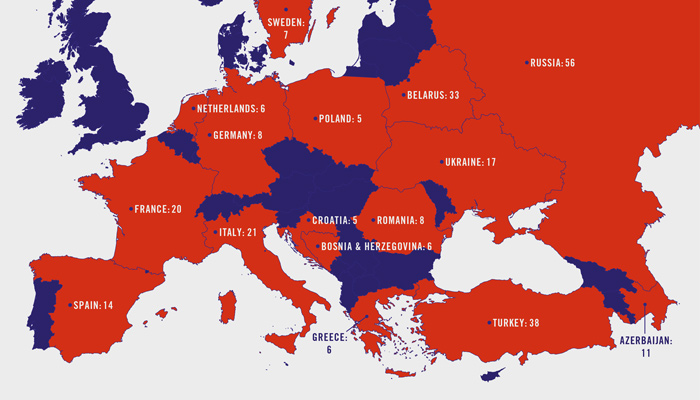
Journalists continue to face unprecedented pressure in Europe as reports submitted to Index on Censorship’s Mapping Media Freedom platform in the first quarter of 2017 demonstrate. Media professionals—primarily in Turkey, Russia, Belarus and Ukraine—were arrested at an alarming rate, more than a fourfold increase over the fourth quarter of 2016.
“During the first quarter of 2017, the MMF database registered several trends that we find to be acute challenges to media freedom. Some European governments have clearly interfered with media pluralism. Others have harassed, detained and intimidated journalists. All of these actions debase and devalue the work of the press and undermine a basic foundation of democracy,” Hannah Machlin, project manager at Mapping Media Freedom, said.
During Q1, authorities in multiple countries shut down critical and independent media outlets and intimidated reporters who asked challenging questions. Turkey continues to be the largest jailer of journalists in the world with a total of 148 journalists in prison by the end of March according to the Platform for Independent Journalists P24, a Turkey-based MMF partner, which monitors the number of arrests in the country.
Even reporters in countries often thought to respect freedom of the press, such as Sweden, France and Germany, faced obstacles to performing their professional duties. They were abused by the leaders of extreme populist movements and their supporters, who encouraged a distrust of “mainstream media”; and blocked by nervous politicians who were seeing, particularly in France, the old political certainties swept away.
Between 1 January and 31 March 2017, Mapping Media Freedom’s network of correspondents and other journalists submitted a total of 299 violations of press freedom to the database.
The full report can be found online at Mapping Media Freedom or in PDF format.
27 Jun 2017 | Mapping Media Freedom, News, Turkey
[vc_row][vc_column][vc_column_text]

Brothers Ahmet Altan and Mehmet Altan. Credit: CEFTUS
Throughout June, Index on Censorship’s Mapping Media Freedom project has recorded a number of violations in Turkey, which is now the biggest jailer of journalists in the world.
Turkish journalists charged with sending “subliminal messages”
The first hearing of the ongoing trial of Turkish journalists for involvement in last year’s coup took place on Monday 19 June. Political commentators and brothers Ahmet Altan and Mehmet Altan are accused of offences against Turkish President Recep Tayyip Erdogan and the Turkish government including “attempting to overthrow the Government of Turkey” and using “subliminal messaging” to encourage the coup.
The Altan brothers have been in pretrial detention for 11 months. Ahmet is a well-known journalist in Turkey and has worked as a reporter and editor at several newspapers. He has previously been charged with “denigrating Turkishness” after writing about the Armenian genocide. Mehmet is a professor at Istanbul University who has called on Turkey to improve its human rights record.
The hearing was delayed, and the judge spent several hours reading a long summary of the indictment, according to Index’s head of advocacy Melody Patry, who formed part of an international delegation of observers to the trial.
In his defence statement, Ahmet called the indictment against him “untruthful and nonsensical”. He described the charges and refuted them, explaining his lack of connection to instigating the coup. “I take you through all these things in such detail because I want everyone to see the recklessness with which this prosecutor and his like have darkened people’s lives, how they have abused their power,” he said. “I want all this to be documented for the day the law wakes up.”
Ahmet quoted portions of the indictment against him, including an excerpt in which he questioned the case of Can Dundar, another Turkish journalist who was convicted of espionage for publishing evidence of Turkey sending arms to Syria. Ahmet maintains that Turkish people had a right to know about these events. “Perhaps the prosecutor is giving a not at all ‘subliminal’ message to Turkey that whoever defends the rule of law will be thrown in jail,” he said.
According to Patry, this case is significant because of the potential three life sentences the journalists face as the first instance of journalists prosecuted for being complicit in the coup.
On 1 June, Turkish police detained eight people for using the chat software ByLock, the software the authorities in Turkey suspect was used by the group that plotted the 15 July coup attempt.
Former regional bureau chief of the Cihan news agency, referred to only as KA in news reports, was among those arrested.
İlker Yücel, the editor-in-chief of Aydınlık newspaper, was taken into custody and arrested on 2 June. The arrest was related to a 2014 story in Aydınlık which was found insulting to Berat Albayrak, Turkey’s Energy Minister and the son-in-law of President Recep Tayyip Erdoğan. The newspaper failed to print a correction or pay a TL 100,000 fine,
He was released on 4 June.
A court received an indictment for two consecutive life sentences without the possibility of parole for 13 journalists on 6 June. The charge from Istanbul’s Chief Prosecutor lists Gökçe Fırat Çulhaoğlu, Yakup Çetin, Bünyamin Köseli, Cihan Acar, Abdullah Kılıç, Oğuz Usluer, Atilla Taş, Hüseyin Aydın, Murat Aksoy, Mustafa Erkan, Seyit Kılıç, Yetkin Yıldız and Ali Akkuş as suspects.
The 13 journalists are charged with “attempting to overthrow the constitutional order” and “attempting to overthrow the government of the Republic of Turkey,” in connection with the 15 July coup attempt. They previously stood trial for “membership of a terrorist organisation” but were released 31 March. All but one of them were rearrested on the new charges.
The managing editor of the newspaper Evrensel, Çağrı Sarı, and former copyrights owner of the newspaper Arif Koşar each received five-month prison sentences on 6 June. They were convicted of “Denigrating the Turkish Nation, the State of the Republic of Turkey, the Agencies and Institutions of the State.” The charges were regarding a story published in Evrensel on Nusaybin.[/vc_column_text][/vc_column][/vc_row][vc_row][vc_column][vc_column_text]
Mapping Media Freedom
Click on the bubbles to view reports or double-click to zoom in on specific regions. The full site can be accessed at https://mappingmediafreedom.org/[/vc_column_text][/vc_column][/vc_row][vc_row][vc_column][vc_single_image image=”91878″][/vc_column][/vc_row]
12 May 2017 | Events
[vc_row][vc_column][vc_column_text]
Hosted with Open Democracy, the discussion will revolve around how to stay independent in an era of big budget cuts, PR, advertorials, sponsored content and self-censorship. An opening address will be given by Martin Bell OBE. The panel discussion, chaired by Mary Fitzgerald, will include:
Jodie Ginsberg, CEO, Index on Censorship
Abi Wilkinson, journalist and commentator
Jim Cusick, Open Media, formerly Independent political correspondent.
Ivor Gaber, professor of journalism, University of Sussex[/vc_column_text][/vc_column][/vc_row][vc_row][vc_column][vc_column_text]
When: Saturday 3 June 2017, 10:30am
Where: Byline festival
Tickets: More information here
[/vc_column_text][/vc_column][/vc_row]
18 Apr 2017 | Awards, Awards Update, Digital Freedom, News, Youth Board
[vc_row][vc_column][vc_column_text]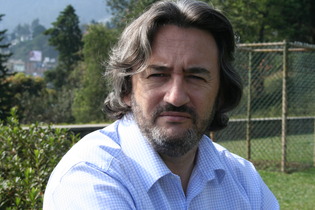
Fergal Keane is a journalist who made his name as a war reporter at the end of millennium, covering conflicts from Congo and Rwanda to Kosovo. In 2003, the Index on Censorship recognised his efforts with their award for Outstanding Commitment to Journalism Integrity. It wasn’t Keane’s first award, and it wasn’t his last either. On top of his Orwell Prize (1996) and Amnesty International Press Award (1993) and Television Prize (1994), his OBE and his BAFTA (both from 1997), Keane has since added a Sony Gold award in 2009, for his inspiring Radio 4 series ‘Taking a Stand’, and the Ireland Funds Literary Award in 2015.
In 2004, following decades in the profession, Keane made the decision to stop entering active war zones. “I couldn’t justify potentially robbing my children of a father,” he told the Daily Telegraph in 2010. “I couldn’t do it anymore.” But despite a slight career shift, Keene continues his commitment to journalism and justice just as fervently. He is now a special correspondent for the BBC, still writing and broadcasting on topics like the refugee crisis, the Yemen conflict and the South Sudan civil war – though sometimes from afar – as well as often being dispatched to the latest scenes of terrorism in Europe, whether France, Belgium or Germany. Wherever he is, he retains an insight and awareness of historical context that few can match.
Beyond the BBC, he is also the author of several well-received books and in 2011 he received an honorary degree from the University of Liverpool, where he is now three years into a Professorial Fellowship. He is part of the university’s Institute of Irish Studies, teaching students on the Understanding Conflict masters programme.
Speaking to the university’s website in 2015, Fergal criticised the “endlessly reductive” mainstream press and urged his students to “always challenge your opinions with facts, every day of your life. You will only know what your opinions are worth if they are taken out of the box and subjected to the most severe tests. Facts, facts, facts.”
Not all Keane’s work is confined to journalism, however. In 2005, he founded Msaada, an NGO dedicated to assisting Rwandans – and Rwandan society – to recover from the 1994 genocide, through meaningful, income-generating projects. It continues to support such projects today.
Samuel Earle is a member of Index on Censorship’s Youth Advisory Board. He is a freelance writer and recent masters graduate from the London School of Economics and Political Science, where he studied Political Theory. He lives in Paris.[/vc_column_text][/vc_column][/vc_row][vc_row][vc_column width=”1/2″][vc_single_image image=”85476″ img_size=”full” alignment=”center” onclick=”custom_link” link=”https://www.indexoncensorship.org/2016/11/awards-2017/”][/vc_column][vc_column width=”1/2″][vc_column_text]
Index on Censorship Freedom of Expression Awards
Seventeen years of celebrating the courage and creativity of some of the world’s greatest journalists, artists, campaigners and digital activists
2001 | 2002 | 2003 | 2004 | 2005 | 2006 | 2007 | 2008 | 2009 | 2010 | 2011 | 2012 | 2013 | 2014 | 2015 | 2016 | 2017[/vc_column_text][/vc_column][/vc_row][vc_row][vc_column][vc_basic_grid post_type=”post” max_items=”12″ style=”load-more” items_per_page=”4″ element_width=”6″ grid_id=”vc_gid:1492505799978-a5ad6490-9f12-5″ taxonomies=”4881, 8935″][/vc_column][/vc_row]
