16 Dec 2020 | Iran, Iraq, Media Freedom, Middle East and North Africa, News
[vc_row][vc_column][vc_single_image image=”115898″ img_size=”full” add_caption=”yes”][/vc_column][/vc_row][vc_row][vc_column][vc_column_text]
On Saturday 12 December, the founder of the Telegram news channel Amadnews, Ruhollah Zam, was hanged in Tehran’s notorious Evin prison.
Zam was born in Shahr-e-Rey, just outside Tehran, in 1978. He first came to prominence in 2009 after the re-election of President Mahmoud Ahmadinejad when he was jailed for voicing his opposition.
In 2011, after his release from prison, Zam, together with his wife and young daughter Niaz fled the country and were granted asylum in France, living initially in Paris before moving to a small town near Toulouse after he received threats.
Two and a half years ago, Zam co-founded the Amadnews channel on Telegram, which is hugely popular in Iran – it has 50 million users there and was reported at one point to account for 60% of the country’s entire internet usage.
Amadnews became popular for its criticism of Iran’s leaders and informed descriptions on the 2017 protests, which started as a protest against the economic policies of the government before developing into wider protests against Iran’s leaders. Twenty-five people died during the nationwide protests.
The channel grew quickly to have a million subscribers but at the end of 2017 Telegram shut it down saying the channel had called for armed uprisings. The channel reappeared under a new same, Sedaiemardom (voice of the people), just a few months later.
The story of how he even came to be in Iran again is mysterious.
In 2019, it is believed that he was lured to Iraq from his exile in France to meet the grand Ayatollah Sistani, the spiritual leader of the Iraqi Shia Muslims. While there, he was captured by agents of the Islamic Revolution Guards Corps which issued a statement saying he had been detained “in a complicated operation”.
The statement said: “Despite being under the guidance of the French intelligence service and the support of the US and Zionist intelligence services…, and being guarded round the clock by various means and covers, he fell into a trap laid by… the IRGC’s Intelligence Organization.”
He was thrown into Evin prison and tortured for months and forced to make televised confessions of his ‘crimes’.
In June this year, Zam was tried in front of the Islamic Revolutionary Court in Tehran, presided over by Judge Abolqasem Salav and convicted on 13 counts of “spreading corruption on earth”. He was sentenced to death.
Despite going to appeal, on 8 December, the supreme court announced it had upheld the death sentence.
Zam’s father, the moderate cleric Mohammad Ali Zam, has revealed on Instagram what happened after the sentence was confirmed.
Last Friday, he was telephoned by an Iranian intelligence agent who said he could come and visit his son in the notorious Evin prison but not to tell him that the sentence for execution had been confirmed. His father reports that during the visit the family started to cry and the agent was afraid that Ruhollah might find out why and told him.
“Don’t worry Ruhollah. These are happy tears from visiting you. Even if the execution is confirmed, the process would take a while to be carried out and we will inform you of the whole process.”
On Saturday 12 December at 8am French time, his eldest daughter Niaz received a WhatsApp call from a number she didn’t recognise. It was her father.
They talked about her studies and getting her diploma but after five minutes the call had to end and her father said goodbye. There was a finality in his tone and Niaz knew this would be the last time they would speak.
Just a few hours later, Zam was paraded in front of television cameras and hanged.
There has been widespread condemnation of his execution.
United States Secretary of State Mike Pompeo said in a statement, “The international community must continue to hold the regime accountable for its unconscionable actions…The Iranian people deserve a free and diverse media, not censorship, arrests, and the execution of journalists.”
The European Union said it “condemns this act in the strongest terms and recalls once again its irrevocable opposition to the use of capital punishment under any circumstances. It is also imperative for the Iranian authorities to uphold the due process rights of accused individuals and to cease the practice of using televised confessions to establish and promote their guilt.”
Masih Alinejad, author of The Wind in My Hair: My Fight for Freedom in Modern Iran and who had campaigned to prevent the execution of young Iranian wrestler Navid Afkari, told Index, “By killing Zam, the Islamic Republic has shown that it is not interested in diplomacy. It is ironic that Zam was named after Rohallah Khomeini, the founder of the Islamic Republic, an evil system that is not willing to tolerate dissent from journalists. Zam was a media pioneer who created the most influential news channel in recent memory.”
Javaid Rehman, UN Special Rapporteur on the situation of human rights in the Islamic Republic of Iran and Agnes Callamard, UN Special Rapporteur on extrajudicial, summary or arbitrary executions, said: “The conviction and execution of Mr Zam are unconscionable. The reports of his arrest, his treatment in detention, and the process of his trial, as well as the reasons for his targeting by the Iranian authorities, are a serious violation of Iran’s obligations under the International Covenant on Civil and Political Rights, including the right to freedom of opinion and expression and the right to life.
“It is clear that Ruhollah Zam was executed for expressing opinions and providing information on AmadNews that dissented from the official views of the Iranian Government.”
Index on Censorship’s CEO Ruth Smeeth has written a letter to the UN Secretary General condemning Zam’s murder.
She wrote: “Press freedom is a pillar of democracy. When journalists are targeted, all of society pays the price. Article 19 of the Universal Declaration of Human Rights guarantees the right to freedom of opinion and expression to all…As a journalist, as a human rights activist, as a global citizen Ruhollah Zam should have been protected by the state of his birth, not murdered by them.”
Ruhollah Zam is survived by his wife Mahsa Razani and their two daughters.
[/vc_column_text][/vc_column][/vc_row]
15 Dec 2020 | News
[vc_row][vc_column][vc_column_text]
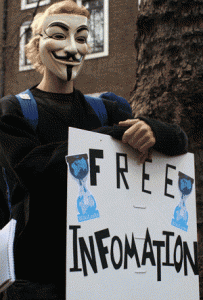
Justice for Assange campaign protester outside a court hearing in 2010. Photograph: Nadia Cosentino
Assange’s partner, Stella Moris, is remaining resolute despite his extradition hearing decision being less than a month away and him being held in a prison that has recently had a Covid-19 outbreak.
Speaking over the phone to Index, Moris discusses the hearing’s details and what it could mean for the future of freedom of expression. And she talks about the deep implications it has had for her and her young family.
“Obviously it is very difficult. I speak to Julian on a daily basis unless there is a problem. [But] he is in prison. Soon to be for two years. He has been there for longer than many violent prisoners who are serving sentences. All in all, he has been deprived of his liberty for ten years now,” she told Index. She adds:
“The kids speak to their father every day; we try to normalise it as much as we can for them. But of course, this is not a normal situation and our lives are on hold. It is inhumane and shouldn’t be happening in the UK.”
The current hearing – which will decide whether there are grounds for Assange to stand trial in the USA – should reach a conclusion on 4 January. A trial in the USA (should the decision go against Assange) will have major ramifications for free speech and whistleblower journalism.
The WikiLeaks founder is charged with conspiring with US intelligence analyst Chelsea Manning and hackers from groups such as Anonymous and LulzSec to obtain and publish classified information. Each of the 18 charges laid by US authorities, if Assange is extradited and convicted, carry a maximum penalty of 10 years. The allegations brought forward under the 1917 Espionage Act, alongside one other under the Computer Fraud and Abuse Act, mean Assange could face up to 175 years in prison – effectively a life sentence. Manning was initially sentenced to 35 years, but under the Obama administration her sentence was commuted to less than seven years.
It is easy to get sidetracked about the current extradition hearing and get into arguments about whether Assange is a journalist, whether he is guilty of other crimes or whether the publication of the documents brought harm to anyone involved. Instead people’s attentions should focus on the precedent that will be set should the case go to trial in the USA.
As it stands the case is unprecedented. No publisher has ever been tried under the Espionage Act, which itself was essentially created for spies imparting official secrets either for profit or otherwise. This is perhaps a direct contradiction of rulings of the courts in the UK. In December 2017, the UK’s information tribunal recognised WikiLeaks as a media organisation, in direct contradiction to the view of the US State Department. Australia’s media union, the Media, Arts and Entertainment Alliance, also presented an honorary member card to Assange’s Melbourne-based lawyer.
Amidst the noise of the separate matters around the case, Moris insists people need to “forget what they think they know” and assess the issues involved.
“There are a lot of assumptions being made over what this case is really about. There are all these sideshows. It is not about people being harmed because the US has admitted it has no evidence to make this argument. It comes down to the fact that the material published was classified. People who care about free speech and press freedom need to forget what they think they know about this case and look at it afresh and understand Julian is in prison for publishing. This is not something that democracies do.”
“Are they saying what he published was not in the public interest? They say that is irrelevant. They can’t deny [what he published] wasn’t in the public interest because he was publishing information and evidence of state crimes, of state abuse, torture, of rendition, blacksites and of illegal killings. What they are arguing is that Julian published information that was secret and therefore he can be prosecuted over it.”
Journalists publishing secret information is not new (nor is pressure for them not to publish) and can often be key to upholding democracy and ensuring states act properly. The Watergate revelations relied heavily on news organisations pressing on with publication despite attempts by the USA to stop them, including the threat of jail time. It proved a significant victory for free speech.
If Assange is extradited and tried the case will impact journalists and the media “for years to come”, says Rebecca Vincent, director of international campaigns at Reporters Without Borders (RSF).
“It feels like many in the media do not see the implications of this case as something that will possibly affect them,” she told Index. “This case will have ramifications on the climates for journalism and press freedom internationally for years to come.”
“This is the first time we have seen the US government prosecute anybody for publishing leaked information. If they are successful, they will not stop with Assange and WikiLeaks. This could be applied, in theory, to any media outlet.”
It’s common for journalists and publishers to cite a public interest defence for disputed documents. It is a centrepiece of a defence case against libel, for instance.
“The information published was certainly in the public interest; it served to inform extensive public interest reporting that exposed war crimes and other illegal actions by states,” said Vincent.
“The Espionage Act lacks a public interest defence. He cannot use it if he is sent to the United States and tried.”
Essentially, what this means is that Assange is being treated as a spy not a publisher. If Assange is extradited and loses his case against the US government, any time classified information is published by a journalist there will be a precedent set that they can be charged and tried as a spy in the same way.
“These sorts of cases are really highlighting the need for more robust legislation that cannot be manipulated to be used against journalists, whistleblowers and other sources. Ultimately, it is the public’s right to access information that is being impacted,” Vincent added.
“You can see this for what it is; this very much feels like a political prosecution by states that are not meant to engage in this behaviour. The reason our states can get away with this is because of a lack of public pressure. A lack of public sympathy has resulted in a lack of widespread public pressure to hold our governments to account.”[/vc_column_text][/vc_column][/vc_row]
8 Dec 2020 | Media Freedom, News, Slapps, Sweden
[vc_row][vc_column][vc_single_image image=”115804″ img_size=”full”][vc_column_text]Index on Censorship has joined with other press freedom organisations to strongly condemn the legal action that has been filed at the London High Court against the Swedish business and finance publication, Realtid, in connection with their investigation on the financing of energy projects involving a Swedish businessman.
We, along with Reporters Without Borders, Article 19, Media Defence and European Centre for Press and Media Freedom (ECPMF), are concerned about the use of litigation tactics to intimidate journalists into silence. The organisations consider the case, which was filed in November, to be a strategic lawsuit against public Participation (Slapp), which is aimed at intimidating publications, and the journalists who write for them, into silence.
Realtid is being sued by Svante Kumlin, a Swedish businessman, domiciled in Monaco. Realtid had been investigating Kumlin’s group of companies, Eco Energy World (EEW), ahead of an impending stock market launch in Norway, a matter of clear public interest. The investigation began in September when Realtid’s reporters wrote about another stock market launch and discovered off-market sales of shares in EEW. Prior to publishing, the journalists contacted the company for an interview and for reply but did not receive a response.
In October, after publishing the report, the journalists once more tried to contact the people behind the company, including Kumlin to exercise their right of reply. After Kumlin declined to be interviewed, the journalists sent 14 questions that Kumlin could answer in writing, but Kumlin answered that his legal counsel “will respond to you directly”.
This was followed by several emails and attached letters from both a law firm in the United Kingdom, TLT Solicitors, and from Monaco, Gardetto. The firms threatened legal action in both countries if Realtid continued to investigate and to publish its investigations into the company and its owners.
On 20 November, Kumlin and TLT Solicitors filed a defamation lawsuit at the High Court in London against Realtid, its editor-in-chief and the two reporters behind the story.
In their letters the lawyers accuse the editor-in-chief, Camilla Jonsson, and the reporters, Per Agerman and Annelie Östlund, of defamation for publishing false information, and breaching a non-disclosure agreement by sharing, what the lawyers claim to be, confidential information. They also claim that Realtid violated Swedish press ethics and laws. If the latter claim is accurate, there are existing procedures to handle the case through the Swedish Media Ombudsman.
It is our assessment that it is inappropriate to threaten the magazine and the journalists with legal action in two jurisdictions, including by citing large fines and prison sentences.
“The fact that investigative journalists in Sweden, publishing in Swedish, for a Swedish readership could be inundated with threatening legal letters from other jurisdictions is outrageous,” said Jessica Ní Mhainín, senior policy and advocacy officer at Index on Censorship. “Realtid’s courage in the face of these threats has been incredible, but whether or not a newsworthy investigation is published shouldn’t come down to individual courage. We need to put an end to Slapps with legislation.”
“The email conversations between the lawyers and Realtid are unpleasant reading”, says Erik Halkjaer, president of Reporters Without Borders Sweden (RSF Sweden). “It is obvious that these types of legal threats, or Slapps can be used as a threatening tool, as sharp as any weapon, to silence journalists. I strongly condemn the actions of Kumlin, who should know better. The people at Realtid should know that they have our and several other Swedish organisations strong support in this.”
Despite the continuous threats, Realtid has continued its solid journalistic investigations. Between 29 September and 13 November, the newspaper published ten articles on this investigation. Kumlin repeatedly declined to answer questions, despite the reporters having digital recordings and public documents proving the content of their articles.
“We know that over half of the cross-border Slapp suits facing journalists from Europe emanate from London. As anti-Slapp measures are being introduced in Brussels, there is an urgent need for the UK to reform its plaintiff-friendly system in line with its stated commitments to uphold and promote media freedom globally,” said Sarah Clarke, head of Europe for Article 19.
After taking an interest in the coverage of Realtid, the Norwegian financial paper Dagens Naeringsliv started its own investigation on the same story. Shortly after doing so, they too were contacted by TLT Solicitors, who used their legal action against Realtid to issue similar threats.
“Investigative journalism is essential to holding people in positions of power and responsibility to account. Journalists who do this work should not be subject to aggressive legal claims in plaintiff-friendly jurisdictions designed to intimidate and oppress. Any dispute between the parties should be resolved before the appropriate forum, in Sweden,” said Padraig Hughes, legal director of Media Defence.
Norway and Sweden are ranked 1st and 4th out of 180 countries in RSF´s 2020 Press Freedom Index. The United Kingdom is ranked 35th out of 180.
For press inquiries contact:
Jessica Ní Mhainín, [email protected];
Erik Halkjaer, [email protected];
Sarah Clarke, [email protected] [/vc_column_text][/vc_column][/vc_row]
1 Dec 2020 | India, Iran, Media Freedom, News, Pakistan, Russia, Saudi Arabia, Turkey, United Arab Emirates
[vc_row][vc_column][vc_row_inner][vc_column_inner width=”1/2″][vc_hoverbox image=”115781″ primary_title=”Aasif Sultan” hover_title=”Aasif Sultan” hover_background_color=”black” el_class=”text_white”]Aasif covers human rights for the Kashmir Narrator and was jailed for two years in August for alleged involvement in “harbouring known terrorists”[/vc_hoverbox][/vc_column_inner][vc_column_inner width=”1/2″][vc_hoverbox image=”115782″ primary_title=”Golrokh Emrahimi Iraee” hover_title=”Golrokh Emrahimi Iraee” hover_background_color=”black” el_class=”text_white”]Jailed for six years in 2016 for writing about the practice of stoning in Iran and “insulting Islamic sanctities”[/vc_hoverbox][/vc_column_inner][/vc_row_inner][vc_empty_space][vc_row_inner][vc_column_inner width=”1/2″][vc_hoverbox image=”115743″ primary_title=”Hatice Duman” hover_title=”Hatice Duman” hover_background_color=”black” el_class=”text_white”]Hatice Duman is the former editor of the banned socialist newspaper Atılım, who has been in jail in Turkey since 2002[/vc_hoverbox][/vc_column_inner][vc_column_inner width=”1/2″][vc_hoverbox image=”115783″ primary_title=”Khaled Drareni” hover_title=”Khaled Drareni” hover_background_color=”black” el_class=”text_white”]Khaled was jailed for three years in Algeria in August for covering the Hirak protest movement[/vc_hoverbox][/vc_column_inner][/vc_row_inner][vc_empty_space][vc_row_inner][vc_column_inner width=”1/2″][vc_hoverbox image=”115780″ primary_title=”Loujain al-Hathloul” hover_title=”Loujain al-Hathloul” hover_background_color=”black” el_class=”text_white”]Loujain is a women’s rights activist known for her attempts to raise awareness of the ban on women driving in Saudi Arabia, where she remains in jail[/vc_hoverbox][/vc_column_inner][vc_column_inner width=”1/2″][vc_hoverbox image=”115741″ primary_title=”Yuri Dmitriev” hover_title=”Yuri Dmitriev” hover_background_color=”black” el_class=”text_white”]Yuri has been targeted for his work in identifying the graves of victims of Stalinist terror and has been jailed on baseless charges of sexual assault by the authorities[/vc_hoverbox][/vc_column_inner][/vc_row_inner][vc_empty_space][vc_column_text]2020 has been a terrible year for the world.
Unfortunately, for some human rights activists, free speech supporters and journalists, 2020 is just yet another year they have spent in prison, incarcerated on trumped-up charges for speaking out against the actions of authoritarian regimes.
As 2020 comes to a close, we want them to know that no matter how long they have been in jail, they have not been forgotten.
We have chosen six people whose plights must not be forgotten as part of our new #JailedNotForgotten campaign.
Early in 2021, we will send cards containing messages of support from the Index team but we are also asking for you to stand in solidarity with them. Please use the form below to personalise your message to the chosen six:
- Aasif Sultan, who was arrested in Kashmir after writing about the death of Buhran Wani and has been under illegal detention without charge for more than 800 days;
- Golrokh Emrahimi Iraee, jailed for writing about the practice of stoning in Iran;
- Hatice Duman, the former editor of the banned socialist newspaper Atılım, who has been in jail in Turkey since 2002;
- Khaled Drareni, jailed in Algeria for ‘incitement to unarmed gathering’ simply for covering the weekly Hirak protests that are calling for political reform in the country;
- Loujain al-Hathloul, a women’s rights activist known for her attempts to raise awareness of the ban on women driving in Saudi Arabia;
- Yuri Dmitriev, a historian being silenced by Putin in Russia for creating a memorial to the victims of Stalinist terror and facing fabricated sexual assault charges.
Add your message of support using the form below.
You can also sign up to receive our weekly newsletter, which features news relating to freedom of expression issues around the world. You do not need to sign up to this to send a message. [/vc_column_text][gravityform id=”50″ title=”false” description=”true” ajax=”false”][/vc_column][/vc_row][vc_row][vc_column][vc_single_image image=”115746″ img_size=”full” onclick=”custom_link” link=”http://www.indexoncensorship.org/donate”][/vc_column][/vc_row]
